Aeneas
The Dardanian prince who survives the fall of Troy.
Aeneas does not occupy the same place as Hector in the Iliad: he is neither the city’s principal defender nor Achilles’ final opponent. But the poem insists on something decisive: the gods do not allow him to die. His survival is tied to the future of his line; later traditions developed that promise into the story of the Trojan who leaves the ruined city.
Who was Aeneas?
Sección titulada «Who was Aeneas?»In Homer, Aeneas is the son of Anchises and Aphrodite and leads the Dardanians, allies of the Trojans (Iliad 2.819–823). The Iliad places him within the lineage of Dardanus: from Tros, Priam’s line runs through Ilus and Laomedon, while Aeneas’ line runs through Assaracus, Capys and Anchises (Iliad 20.215–241).
He is therefore not an outsider who arrived at the last moment, but a prince from a different branch of the same Dardanian royal line. The poem also reveals a tension: Aeneas resents the fact that Priam does not grant him the honour he believes he deserves (Iliad 13.455–468). He fights for Troy, but his position is not entirely defined by Priam.
What was his relationship with Priam and Hector?
Sección titulada «What was his relationship with Priam and Hector?»Aeneas and Priam belong to different branches of the lineage descending from Dardanus and Tros. Hector, as Priam’s son, is therefore Aeneas’ kinsman, but neither his brother nor his direct rival in the Iliad.
The difference matters. Hector embodies the immediate defence of the city; Aeneas belongs to another line, that of Anchises, which the poem marks out for survival. As an editorial interpretation, one might put it this way: Hector remains to defend Troy; Aeneas survives it. Homer does not formulate that opposition, but his narrative assigns them very different destinies.
Why do the gods save him?
Sección titulada «Why do the gods save him?»In Book 5, Diomedes wounds Aeneas. Aphrodite tries to remove him from the fighting and is wounded herself; Apollo then takes the Trojan under his protection and carries him out of danger (Iliad 5.166–318, 330–446). Aeneas is not saved by a single intervention, nor simply because he is Aphrodite’s son: the poem makes his repeated divine protection unmistakable.
The issue arises again in Book 20, when Achilles and Aeneas confront one another. Poseidon, although fighting on the Achaean side, decides to save him because the line of Dardanus must not disappear (Iliad 20.291–339). Aeneas survives not because he is stronger than Achilles, but because the divine order does not permit his death.
Was he destined to survive?
Sección titulada «Was he destined to survive?»Yes, with an important qualification. Poseidon says that Aeneas is destined to escape and rule the Trojans, and that his descendants will reign after him (Iliad 20.302–308). It is one of the clearest statements of a dynastic future in the Iliad.
The poem does not tell us how that promise will be fulfilled after the fall of Troy. It guarantees only that the line of Dardanus will not end with Priam. Later narratives filled that gap in different ways: some have Aeneas withdraw before the sack; others show him fleeing after the city has already fallen.
Did he accompany Paris to Sparta?
Sección titulada «Did he accompany Paris to Sparta?»The ancient summary of the Cypria, transmitted under the name of Proclus, says that Aphrodite orders Aeneas to sail with Paris and that the two reach Sparta. This is evidence for a lost poem, not an episode preserved in the Iliad.
This allows us to say that Aeneas accompanied Paris, but not to make him a protagonist in the abduction of Helen or to attribute to him a role that the summary does not describe. The epic tradition known to us places him alongside Paris; it does not elaborate on his conduct at that point.
How did he survive the fall of Troy?
Sección titulada «How did he survive the fall of Troy?»There is no single answer. The summary of the Cypria recalls that Achilles had earlier attacked Aeneas’ cattle; the summary of the Aethiopis and other material from the Epic Cycle broaden the horizon of the war, but the surviving accounts of Aeneas’ departure come chiefly from later sources.
The summary of the Iliou Persis (Sack of Ilium), attributed to Proclus, says that after the prodigies connected with Laocoon, Aeneas and his followers withdraw to Mount Ida. Dionysius of Halicarnassus summarises the version of Sophocles’ lost Laocoon: Anchises, alarmed by the prodigies surrounding Laocoon, understands that the city is doomed and orders them to leave Troy. Dionysius also preserves verses from the tragedy in which Aeneas appears carrying Anchises on his shoulders, followed by members of his household and by a crowd wishing to accompany him.
Pseudo-Apollodorus, Epitome 5.21 offers another version: Aeneas takes his father and flees; the Achaeans allow him to leave out of respect for his piety. These are later accounts and should not be fused into a single Homeric sequence.
Is the image of Aeneas carrying Anchises ancient?
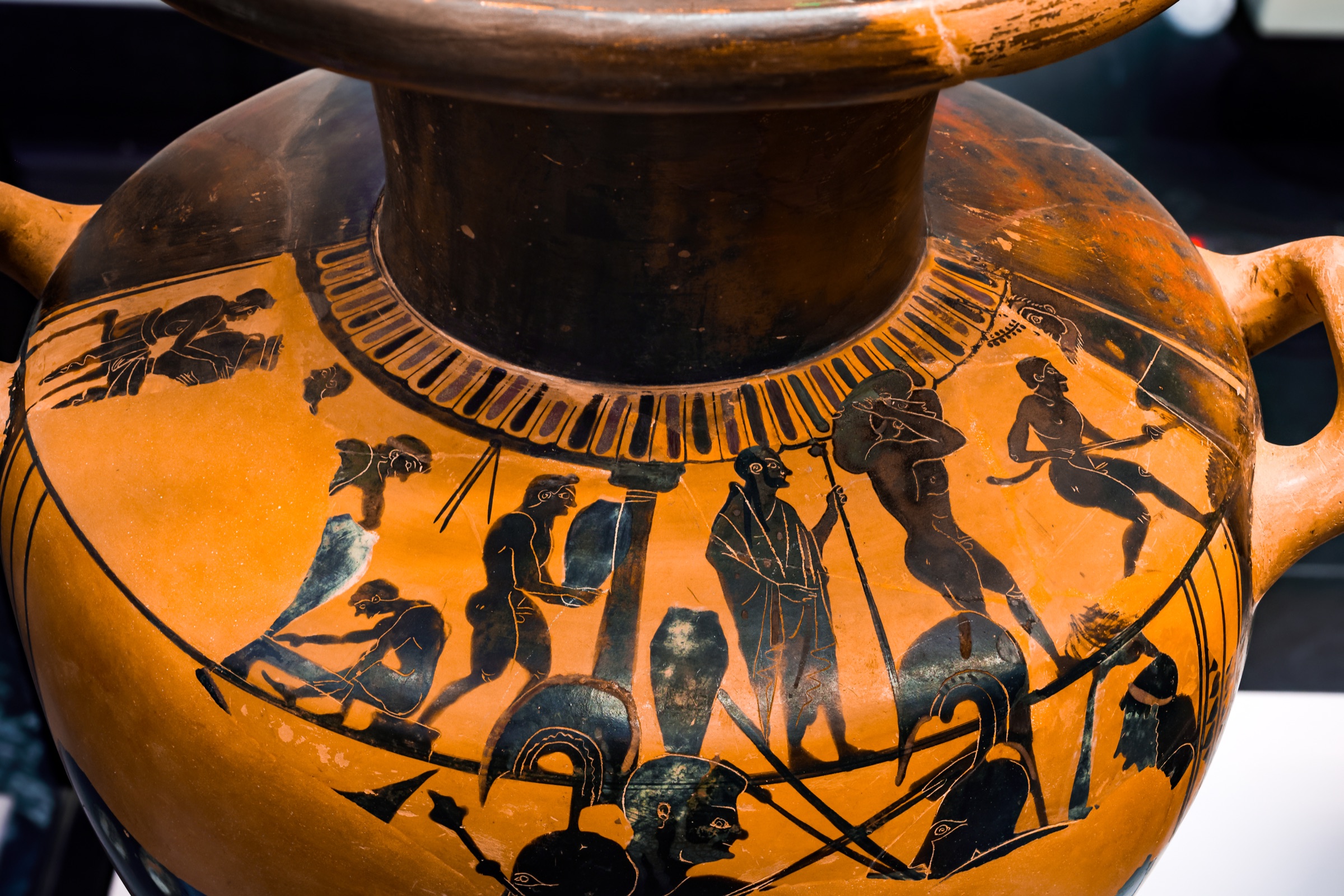
Sección titulada «Is the image of Aeneas carrying Anchises ancient?»Yes. Although no such scene is narrated in the Iliad, the image was already circulating in Attic pottery by the end of the sixth century BC. It predates Virgil and shows that the motif of Aeneas saving Anchises did not originate in Roman literature.
What remained of Troy after the fall?
Sección titulada «What remained of Troy after the fall?»The sources do not agree on a single form of continuity. The Iliad announces that Aeneas and his descendants will rule the Trojans, but it describes neither a rebuilt city nor a new kingdom. The Epic Cycle and later authors imagine the future of the region in different ways, through survivors, captives and new foundations.
A late tradition transmitted by Servius even says that Astyanax survived and that Aeneas restored him to Troy. That version directly contradicts the Iliou Persis, in which Astyanax dies, and the two cannot be combined. Aeneas’ survival is ancient; the specific forms taken by Trojan continuity are multiple.
What was Aeneas’ relationship with the Palladium?
Sección titulada «What was Aeneas’ relationship with the Palladium?»The Iliad gives Aeneas no connection with the Palladium. In later tradition, the theft of the sacred image by Odysseus and Diomedes became one of the conditions for Troy’s fall, but the versions disagree about the image itself and about its copies.
Later traditions offered different accounts of which image the Achaeans had stolen and what happened to the Palladium afterwards. Some connect Aeneas with an image that was preserved; others place the object on different routes. The subject deserves a page of its own: here it is enough not to turn a variable tradition into a Homeric fact.
Why does Aeneas matter?
Sección titulada «Why does Aeneas matter?»Aeneas matters because he allows us to see the limits of the Iliad. The poem does not narrate the fall of Troy, but it marks out one of its warriors as someone who must survive it. Later sources narrate the withdrawal, the rescue of his father and the companions who follow Aeneas; none of those expansions erases the Homeric promise that the line of Dardanus will continue.
He does not save Troy; he survives Troy.