When Nobody Signed Anything
Speech, memory, writing and social life before signed documents.
How can a complex society function when almost none of its everyday relationships depends on a signed document? The answer is not that it lacks rules, memory or institutions. It preserves them in other ways: in spoken words, those who remember, witnesses, procedures and objects that pass from one hand to another.
Before the Page, the Voice explains how a voice, a poem or a record can come to be fixed; this page looks at how relationships can exist and impose obligations when they do not normally depend on signed documents.
Nobody signs anything, but obligations exist
Sección titulada «Nobody signs anything, but obligations exist»In the society portrayed in the Homeric poems, there is property, inheritance, marriage, hospitality, compensation, oaths, rules, assemblies, alliances and genealogy. Yet these relationships are not normally supported by contracts, receipts, title deeds, civil registers or signatures. Nobody signs anything, but obligations exist.
This does not mean that Homer necessarily knew nothing of writing. The Iliad mentions the much-discussed sḗmata lugrá—the “baneful signs” carried by Bellerophon (Iliad 6.168–170).
The scene is unusual. Bellerophon is at the court of Proetus, king of Argos. Proetus’ wife, Anteia, tries to seduce him; Bellerophon rejects her, and she falsely accuses him before her husband. Proetus wants to get rid of him, but does not wish to kill him with his own hands. He therefore sends him to Lycia, to the house of his father-in-law, carrying a folded tablet on which he has traced the famous sḗmata lugrá: a message intended to bring about his death. Homer does not say whether Bellerophon knows its contents. The tablet is folded, so he could carry it without seeing the signs; nothing in the scene allows us to infer whether he could interpret them. We know only that the king of Lycia receives the message and understands what it communicates. He then assigns Bellerophon tasks from which he expects him not to return.
We cannot know what kind of signs they were. A comparison with the writing systems of the Bronze Age inevitably suggests itself: Linear B used syllabic signs, logograms and numerals. But nothing allows us to identify Bellerophon’s sḗmata with Linear B or with any specific writing system.
The scene is exceptional. It is the only unambiguous reference in the Iliad and the Odyssey to a message fixed by means of signs and intended to be interpreted by another person. Elsewhere there are recognisable marks or signs, but they do not require us to think of writing in the strict sense.
What matters is precisely its rarity: in a world where almost everything is spoken, remembered and transmitted by word of mouth, a communication fixed in signs appears only once, as something strange and exceptional.
There is another equally striking detail: Homer does not reveal the contents of the message. Proetus knows what he has inscribed; the king of Lycia understands the signs; Bellerophon carries them; but neither Homer’s audience nor we know exactly what they say. The clearest graphic communication in the Homeric poems is, paradoxically, a communication that travels folded and whose contents remain hidden, in contrast with a world in which almost everything important is said in front of others.
The scene may be an anachronism introduced by the poet or by the tradition that shaped the poem; it may also preserve a faint memory of older forms of graphic communication. We cannot go much further.
Oral did not mean informal
Sección titulada «Oral did not mean informal»Our habits tend to equate writing with what is formal and secure, and oral communication with what is provisional. Rosalind Thomas warns that this opposition works poorly for Greece: even in the Classical period, transactions and procedures could depend on witnesses and oaths, and a document was not always sufficient proof on its own. A personal signature was not the usual means of authentication either; seals and witnesses could matter.
We should not simply project those Classical institutions back onto the Homeric world. They do, however, suggest a useful caution: writing and formality are not automatic equivalents. A word spoken before the right people could carry a social force that we now associate with a signed document.
Marrying without a certificate
Sección titulada «Marrying without a certificate»Marriage makes this visible. In the Homeric world it is not presented as the private union of two individuals backed by a certificate, but as a relationship between households involving agreements, gifts, recognition and consequences for the oîkos. We should not invent a single rite or a fixed set of legal rules; but the absence of a certificate does not mean the absence of an institution.
Penelope and the Weaving of the Odyssey explains how marriage can create kinship and new obligations between households.
Nor was a certificate required for a marriage to be dissolved. In historical Greece we know of different ways of dissolving one; the Great Inscription of Gortyn, from the fifth century BC, even regulates some of the property consequences of separation.
But we should not project those later rules onto the world of the Odyssey: there marriage appears above all as a recognised relationship between households, with obligations, property and kinship that exist without depending on a civil register.
When the rule exists, but no one can enforce it
Sección titulada «When the rule exists, but no one can enforce it»The assembly on Ithaca (Odyssey 2.229–241) reveals another important difference. Telemachus can publicly denounce the suitors’ abuse, but the existence of a claim does not guarantee its enforcement. Mentor reproaches the people of Ithaca for sitting by and failing to intervene. There is a recognisable rule and a community that hears it, but no authority able to enforce it as a matter of course.
The scene does not turn the assembly into a modern court. On the contrary, it shows that the force of a rule also depends on the support, memory and willingness of those who ought to make it effective.
Before written law there was law
Sección titulada «Before written law there was law»A community can have binding rules, expectations of redress, procedures and claims without possessing a written code.
Before written law there was law.
But this does not require us to call every unwritten rule an “oral law”. Thémis is not simply “law”: depending on context it may refer to a legitimate custom, a proper procedure, an acknowledged order or even divine will. Social life did not begin when someone wrote down its rules.
Rosalind Thomas and Michael Gagarin help us specify what changes when some rules begin to be fixed in writing. Writing need not merely copy an earlier custom: it can clarify it, modify it, organise a procedure, limit the action of an authority, or make public a formulation whose stability is particularly important to the community.
Dreros: not an isolated law, but a landscape of laws
Sección titulada «Dreros: not an isolated law, but a landscape of laws»Dreros, in Crete, offers some of the earliest evidence for this process. Between about 650 and 600 BC, several legal provisions concerning civic offices were inscribed there. One of them regulated the office of kosmos, a civic magistracy: it prohibited anyone who had held the office from holding it again before ten years had passed. Its lines are written boustrophedon: one line is read from left to right and the next from right to left, like the path of an ox as it ploughs and turns back along the furrow.
These inscriptions do not belong to the same writing system as the Mycenaean tablets. Linear B was a syllabic script with logograms and numerals, derived from a Minoan graphic tradition and used chiefly for palatial administration. Centuries later, Dreros used the archaic Greek alphabet, capable of representing the sounds of the language in a different way. The Mycenaean tablets also preserve names, places and divinities from before Homer, as explored in Names and Places Before Homer.
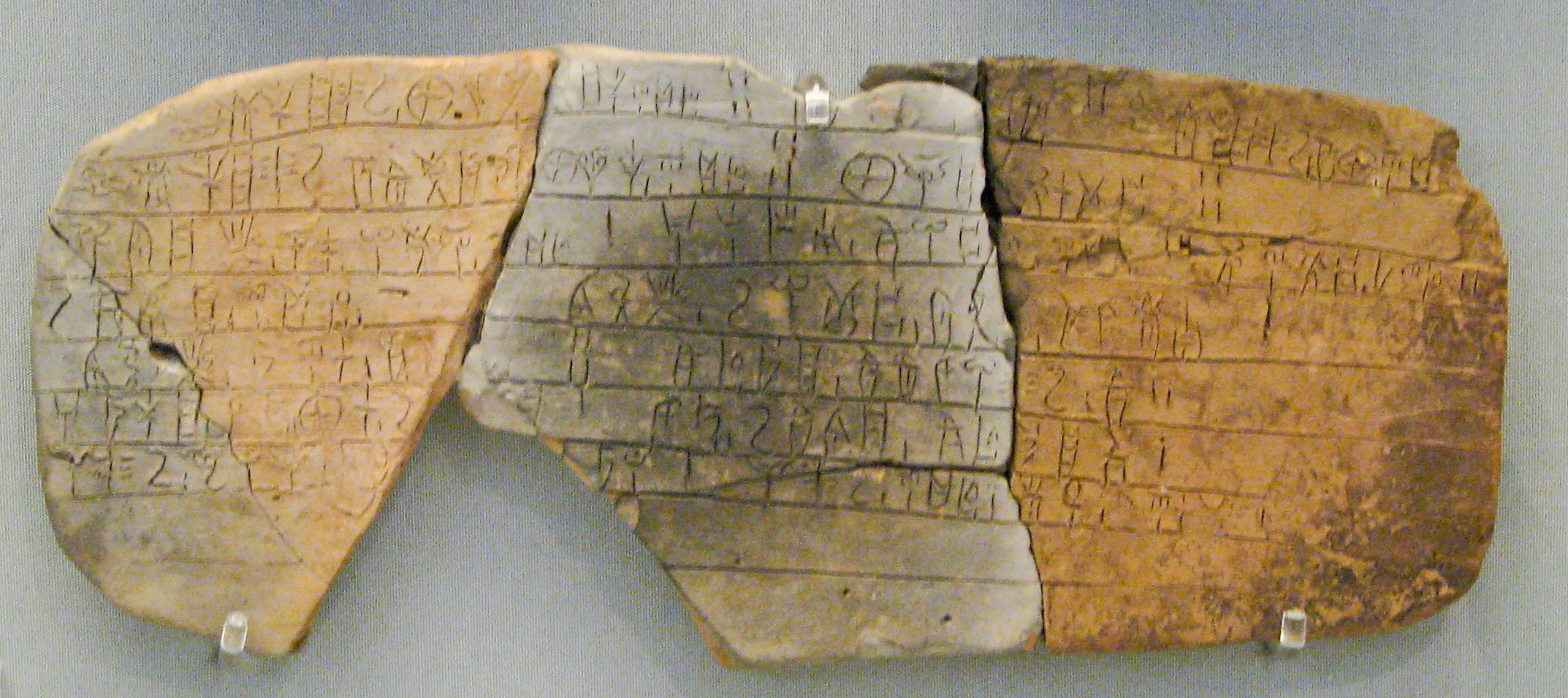
The inscription did not stand alone. James Whitley notes that at least seven roughly contemporary archaic legal inscriptions are known from Dreros, carved on local stone. They were probably displayed in public spaces within the city, near the agora and the temple of Apollo Pythios; it has even been proposed that some formed part of the walls of the sanctuary itself.
This changes the picture considerably. We do not have a community without law that suddenly decides to invent it in writing. We have a community that already possesses offices, procedures and rules, and that begins to decide which parts of that order should be materially fixed and made visible to everyone.
The law of the kosmos itself presupposes much that it does not say. To understand it, the community already had to know what the office was, who could hold it, what its functions were and what consequences followed from a decision made by its holder. The stone does not contain the whole system; it contains a particular provision within a system that already existed.
The stone was not meant to contain everything a community knew or did. It made permanent and visible what the community had decided to put into writing.
What everyone knows is not necessarily what gets written down; what may be written is what needs to remain fixed.
An oral rule could also change through a new oral decision. The problem arose when different versions of what ought to be done could later coexist. Writing then offered a new possibility: to make a formulation public and give it material stability. An inscription could preserve a rule, but it could also clarify it, modify an earlier practice or restrict the interpretation of the person exercising power.
Writing also meant occupying a place
Sección titulada «Writing also meant occupying a place»Whitley stresses another point that is particularly useful here: an inscription is not only a text. It is also a thing. It is made of a material, placed somewhere and seen by particular people. At Dreros, the proximity of the laws, the agora and the sanctuary physically linked rules, religion and political life.
This means that a law could communicate even to someone unable to read it in full. Its presence made visible that the rule belonged to the public order of the city.
Dreros continued to use writing centuries later. From the late third century BC we know, among other evidence, an inscribed oath of 180 Drerians belonging to an agélē, a youth group commonly connected with civic training. The archaeological study by V. Zographaki, A. Farnoux, N. Thanos and K. Moniaki also emphasises how strongly the inhabitants continued to connect their identity with their past, their ancient temples and their sacred objects.
Writing could do more than fix a rule. It could become part of a community’s public memory.
Other Cretan cities, other ways of writing the rule
Sección titulada «Other Cretan cities, other ways of writing the rule»Dreros was not an isolated case. At Praisos, around 500 BC, an inscription survives, probably legal in character, written in Greek letters but in an Eteocretan language that we still do not understand. Interpreting it as a public document is a cautious inference: it depends not only on the words — which we cannot reliably translate — but also on where it was found and on its relationship with other inscriptions and with the city’s sanctuary.
The case is revealing: an inscription can continue to speak to us even when we no longer understand its language, because its material, location and relationship to other objects also transmit information.
Two centuries after Dreros, Gortyn displays the same process on a much larger scale. Its great legal inscription, from the fifth century BC, occupied a monumental structure about nine metres long and around 1.7 metres high, with twelve columns written in boustrophedon. Measurements vary depending on whether one measures the surviving ensemble or a reconstruction of the monument; in any case, the figure describes a monumental written surface, not a complete modern code.
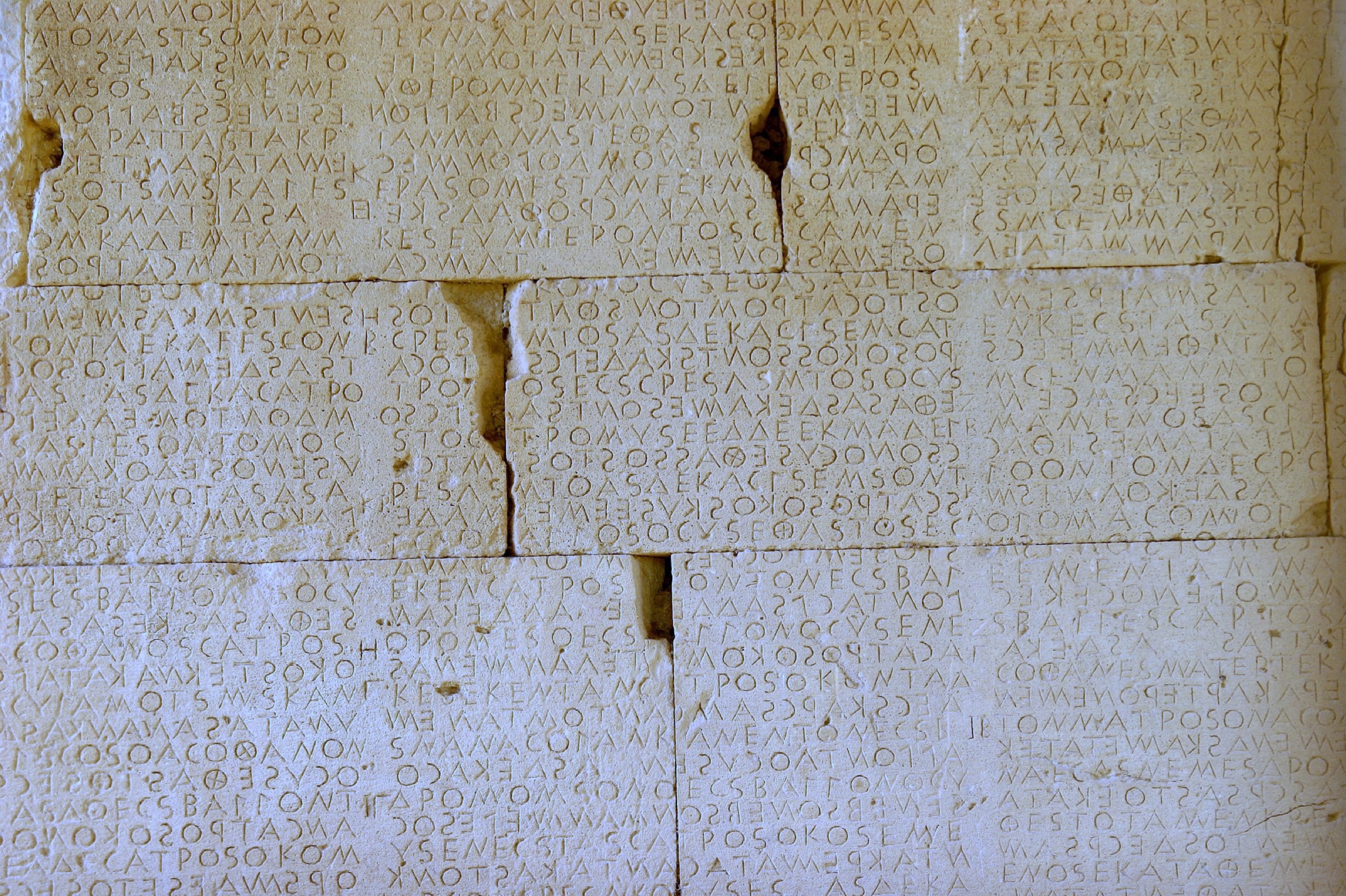
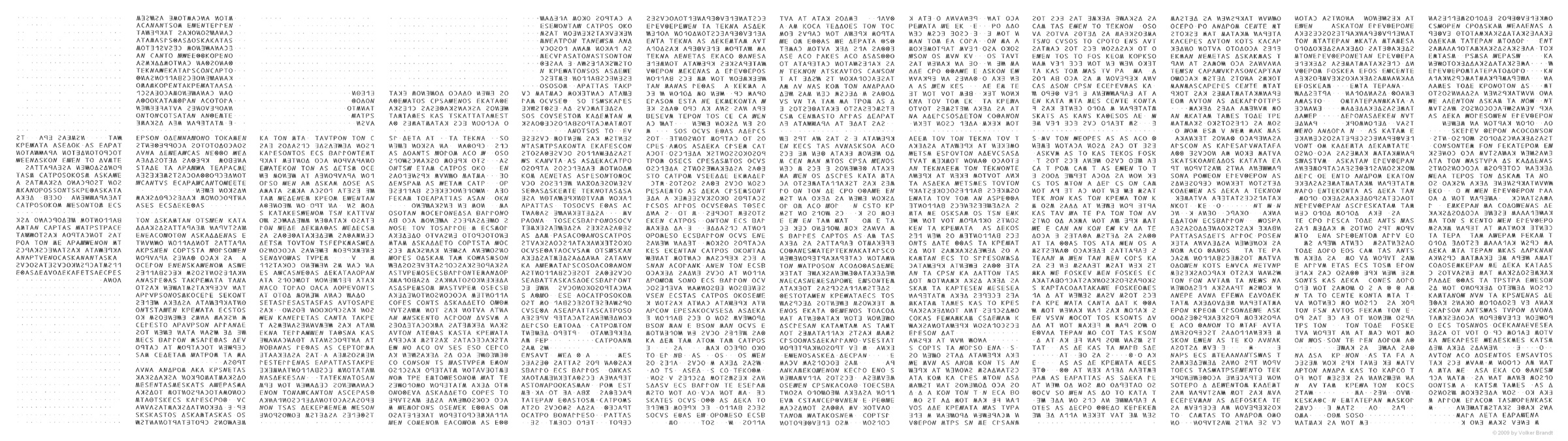
Ten provisions from the Great Inscription, with commentary
Sección titulada «Ten provisions from the Great Inscription, with commentary»This is not a complete translation of the monument, but our own explanatory selection of ten provisions. Each section offers an abbreviated rendering and a brief commentary. The translations and commentary have been checked against the historical editions and translations of Rodolphe Dareste and H. J. Roby, together with modern scholarship. Scholars debate the segmentation of the text and the scope of several technical terms; here the purpose is to see how an inscription could fix specific rules about status, compensation, family, property, witnesses and judicial decision.
Free or enslaved? (IC IV 72, I 15–24)
Sección titulada «Free or enslaved? (IC IV 72, I 15–24)»“If one party claims that a person is free and another that the person is enslaved, the testimony affirming freedom shall prevail. […] If two parties claim the same enslaved person, the judge shall decide according to the testimony presented; if there is testimony for both sides or for neither, he shall decide under oath.”
This passage brings together two disputes from the same section and omits their technical details. The first concerns a disagreement over whether someone is free or enslaved: the inscription gives precedence to testimony affirming freedom. The second concerns competing claims over an enslaved person. It shows that the judge must follow the relevant testimony when it resolves the dispute, but must decide under oath when the testimony supports both parties or neither.
The inscription thus distinguishes between cases in which testimony determines the judgement and cases requiring a sworn decision by the judge. It is a useful warning against any simple picture of servile status, although these rules from Gortyn cannot be transferred directly to the Homeric world.
Sexual offence, compensation and proof (IC IV 72, II 2–45)
Sección titulada «Sexual offence, compensation and proof (IC IV 72, II 2–45)»“If someone uses force against a free man or woman, he shall pay one hundred staters; if an enslaved person commits the same offence against a free person, he shall pay double that amount. […] Whoever is caught in moicheia with a free woman in the house of her father, brother or husband shall pay one hundred staters; elsewhere, fifty.”
The quotation omits other cases and amounts, which also vary according to social status. We leave moicheia untranslated because it is not simply equivalent to our “adultery”. Nor is this merely a matter of placing a “price” on an offence.
The full passage links graded compensation with a procedure: in certain cases, relatives or masters must be notified in the presence of witnesses. If the person detained alleges that he was deceived, the inscription prescribes an oath to resolve that particular dispute. The witnesses make the notification publicly verifiable; they are not all required to swear an oath.
This provides a useful counterpoint for thinking about how an offence can create an obligation to provide redress, without reducing redress to private revenge or projecting these rules from Gortyn onto the Homeric world.
An enslaved woman and her oath (IC IV 72, II 11–16)
Sección titulada «An enslaved woman and her oath (IC IV 72, II 11–16)»“If someone uses force against a female household slave, he shall pay two staters. If she has previously had sexual intercourse, he shall pay one obol if the offence occurs during the day and two if it occurs at night.”
The inscription then adds a clause concerning the enslaved woman’s oath. Its meaning is debated: it has been understood either as giving precedence to her oath or as requiring her to swear. The provision does not place her on the same footing as a free person: the disparity in the compensation itself shows a marked hierarchy of status. Yet it does not mean that her word had no value. Her oath has a specific procedural role, without implying an equality of testimony.
A free woman and an enslaved man (IC IV 72, VI 56–VII 10)
Sección titulada «A free woman and an enslaved man (IC IV 72, VI 56–VII 10)»“[…] if [an enslaved man] goes to live with a free woman and marries her, the children shall be free. But if a free woman goes to live with an enslaved man, the children shall be enslaved. If the same mother bears both free and enslaved children and dies leaving property, the free children shall receive it; if there are none, [it shall pass to] those entitled to inherit.”
The beginning of the provision is damaged; the brackets therefore mark a reconstruction. The asymmetry is striking: the status of the children is linked to the household in which the couple establishes their life together. The text distinguishes between an enslaved man joining a free woman in her household and a free woman joining an enslaved man in his.
The verb used in the inscription is often translated as “marry”, and such unions were recognised in law. That does not mean their legal consequences were equivalent to those of marriages between free persons. Nor should residence be understood simply as a matter of physical location: the distinction appears to concern the household within which the union is established. The inscription recognises real social relationships and their consequences for children and inheritance without erasing the dependence that structures them.
Gifts, debts and encumbered property (IC IV 72, X 20–25)
Sección titulada «Gifts, debts and encumbered property (IC IV 72, X 20–25)»“If someone makes a gift while owing money, having been ordered to pay compensation, or while a lawsuit is pending, and the property he retains is insufficient to meet the outstanding obligation, the gift shall have no effect.”
The provision prevents someone from emptying his estate by means of a gift while leaving a debt or compensation unpaid. It does not describe a modern market or turn every gift into an economic transaction. Rather, it shows that a gift can conflict with another relationship already in force: before disposing freely of property, one must answer for an earlier obligation. The exact scope of the rule, including its relationship to nearby provisions on family gifts, is debated. In that sense it speaks to The Economy of Debt, although the Gortyn inscription is not a direct reflection of the Homeric world.
When the debtor dies (IC IV 72, XI 32–42)
Sección titulada «When the debtor dies (IC IV 72, XI 32–42)»“If someone dies owing money or after a judgement has been given against him, those entitled to his property may take it over if they agree to pay the compensation and debts he left behind. If they do not wish to do so, the property shall go to those who won the lawsuit or to the creditors; no additional penalty shall be imposed on the prospective heirs who decline it.”
The rule links inherited property with outstanding obligations, but it does not make the entire kin group automatically responsible. In the circumstances described, those entitled to inherit may take the property together with its burdens or let it pass to those with outstanding claims against the deceased. The debt does not disappear when the inheritance is declined: the property remains available to satisfy those claims. The extent to which different classes of heirs could refuse their inheritance is, however, debated.
Separation and property (IC IV 72, II 45–III 16)
Sección titulada «Separation and property (IC IV 72, II 45–III 16)»“If a man and a woman separate, she shall retain the property she brought with her when she joined her husband, half the produce derived from her own property, and half of what she has woven. She shall also receive five staters if the husband is responsible for the separation. If he denies under oath that he was responsible, the judge shall also decide under oath.”
The provision recognises that a woman retains property of her own and is entitled to certain assets following separation. If the husband is found responsible, he must also pay her five staters. The judge’s intervention allows the dispute to be resolved when that responsibility is contested.
The rule does not describe a modern matrimonial property regime, nor does it exhaust everything that could happen when a marriage was dissolved. It does show that separation had specific property consequences and that procedures existed for resolving disagreements.
A child born after separation (IC IV 72, III 44–55; IV 1–16)
Sección titulada «A child born after separation (IC IV 72, III 44–55; IV 1–16)»“If a separated woman gives birth, the child shall be presented at the former husband’s house in the presence of three witnesses. If he does not receive it, the mother shall decide whether to rear or expose it. […] If the woman is a woikea, the child shall be presented to the master of the man with whom she had been joined, in the presence of two witnesses.”
The precise meaning of the terms describing dependency requires caution; for that reason we retain woikea rather than reduce it to a single modern category. But the sequence is clear: the consequences of a birth after separation are not left to a purely private decision. The child must be presented before witnesses, and the consequences differ according to the status of the persons involved and their relationship with a household. In the case of a woikea, the child’s fate also depends on relations of ownership and dependence. The provision also provides for oaths to establish that the presentation was made. The rule organises kinship, recognition and dependence at the same time. No certificate was needed for the act to leave evidence: what was needed was a specified place, a recognisable action and people who could later testify that it had occurred.
Widowhood, remarriage and witnesses (IC IV 72, III 17–31)
Sección titulada «Widowhood, remarriage and witnesses (IC IV 72, III 17–31)»“If a man dies leaving children, the woman, if she wishes, may marry [again], taking with her her own property and what the husband had given her according to what is written, in the presence of three free witnesses described as dromeis. If she takes anything belonging to the children, a claim may be brought [against her].”
The witnesses are not a certificate in the modern sense: their presence gives public form to an act affecting property, kinship and inheritance. The term dromeis belongs to Cretan civic terminology and is connected with age categories and civic training. It is often interpreted as referring to men who had attained a recognised adult status, but whether it necessarily implied full citizenship is disputed. The inscription also expressly requires these witnesses to be free. Neither condition should therefore be reduced to an overly precise modern social category.
Writing and judgement (IC IV 72, XI 26–31)
Sección titulada «Writing and judgement (IC IV 72, XI 26–31)»“The judge, when it is written that he must judge according to testimony or an oath of denial, shall judge as it is written; in other matters he shall decide under oath according to the matter in dispute.”
The inscription itself thus distinguishes between cases for which it formulates a rule and others in which it leaves room for the judge’s sworn decision. Writing did not replace the whole procedure: it intervened within it.
Nor should Gortyn be imagined as a modern code containing all the law of the city. The text is not organised as a systematic modern code, deals with related matters in different places and belongs to a much broader tradition of inscribed public legislation.
Its monumentality also had a function of its own. Even someone unable to read every provision could see that vast surface covered with writing. The law could not only be consulted: it could be made visible.
Between Dreros, Praisos and Gortyn we do not simply see a linear passage from “oral law” to “written law”. We see communities experimenting with different ways of fixing, publishing, proclaiming, displaying and preserving some of their rules.
When the community disappears
Sección titulada «When the community disappears»The material history of these inscriptions adds another dimension. When Dreros was conquered by Lyttos in the late third or early second century BC, it ceased to exist as an independent political community. The inscribed laws were removed and eventually deposited in a cistern; Whitley interprets this treatment as part of the symbolic destruction of the city’s political order.
Something comparable happened at Praisos when the city was destroyed by Hierapytna in the second century BC: the sanctuary and its inscriptions were also attacked.
Gortyn had a different fate. Its Great Inscription survived because it was eventually incorporated into a Roman building, the odeon. The stone remained; the community and the inscription’s original social meaning changed. The stone could outlive the institution that had given it meaning.
This returns the argument to an idea that appears elsewhere on the site: things can accumulate memory. A written law was not only an abstract formulation. It was also a stone tied to a place, an institution and a community.
Writing does not replace living law
Sección titulada «Writing does not replace living law»Memory does not preserve a story and a rule in the same way. A story can be recreated; a rule needs enough stability to continue to be recognised and applied as the same rule.
Before a rule could be stored in stone, it had to be stored in people.
But even after it was written, people were still necessary. An inscription cannot interpret itself, settle a claim, deliver a judgement or impose a sanction. Magistrates, witnesses, litigants, memory, authority and a community that recognises the formulation are still required.
Writing a rule does not automatically make it just or guarantee that it will be obeyed. Above all, it changes where it can be preserved, how it can be made public and which version can be invoked when a dispute arises.
This helps us understand more clearly the compensations, oaths and claims examined in The Economy of Debt. They are not rudimentary forms of a law that does not yet exist. They are other ways of sustaining obligations in a world where a rule depends to a great extent on speech, memory, support and recognition by others.
Where is information stored?
Sección titulada «Where is information stored?»When relationships are not normally written down, memory needs people, words, witnesses and things.
The spoken word: Promises are made, oaths sworn, claims voiced and stories told.
Human memory: Preserves genealogies, grievances, gifts and earlier ties.
Witnesses: Important acts take place before others because they must later be remembered and recognised.
Rituals and procedures: Repeating a familiar form makes a rule visible or renews a bond.
Things: Gifts, weapons, géras, keimḗlia and tokens of recognition preserve origins and relationships.
Xenía, for example, can survive for generations; a genealogy places someone within a network of kinship; and an oath turns the spoken word into a commitment placed under human and divine witnesses. Oral did not mean informal.
Things also preserve history
Sección titulada «Things also preserve history»Objects do not remember as people do, but they can accumulate stories.
The krater that Menelaus wants to give Telemachus also matters because of its history: its story tells us that Hephaestus made it and that Phaedimus, king of the Sidonians, gave it to Menelaus when he hosted him on his return from Troy (Odyssey 4.615–619; the gift reappears at 15.113–119).
In Sophocles’ later reworking, the exchange of gifts between Ajax and Hector becomes tragic: Ajax kills himself with the sword he received from Hector, while the belt he had given Hector becomes associated with the dragging of the Trojan’s corpse (Iliad 7.303–305; Ajax 661–665 and 1028–1039).
Odysseus’ bed preserves its past as an olive tree and becomes a test of recognition when Penelope pretends to order it moved from the room: only her husband can know that it was built around a rooted olive tree (Odyssey 23.183–204).
A valuable object does not carry its past written on it, but it can carry a history with it. Speech preserves the history of the object; matter preserves the traces of its history.
Sources and method
Sección titulada «Sources and method»See also
Sección titulada «See also»- Bards and Rhapsodes: How Was Homeric Poetry Made?
- How Did Homer Reach Us?
- The Bronze Past
- The Economy of Debt
- Penelope and the Weaving of the Odyssey