A Song for Penelope: Weaving the Odyssey
Neither the Iliad nor the Odyssey tells us how Odysseus chose Penelope, or how their marriage was arranged or celebrated.
According to Pseudo-Apollodorus, Odysseus was one of Helen’s suitors, among the kings who came to Sparta hoping to marry her. Faced with so many rivals and the prospect of conflict when her husband was chosen, he offered Tyndareus, Helen’s father, a way to prevent a quarrel. In return for his advice, Odysseus asked Tyndareus to help him win the hand of Penelope, the daughter of Icarius. Following Odysseus’ proposal, the suitors swore to defend the man chosen as Helen’s husband against any wrong connected with the marriage. In the end, Tyndareus chose Menelaus and, keeping his promise, intervened with Icarius to favour the marriage of Odysseus and Penelope (Library 3.10.9).
We know almost nothing about how the relationship between Odysseus and Penelope began, but this story tells us at least that Penelope was already on Odysseus’ mind while the others competed for Helen.
Pausanias records a different tradition: Icarius organises a race among Penelope’s suitors, and Odysseus wins. He does not marry her by chance: he competes for her and wins her hand (Description of Greece 3.12.2).
Pausanias also tells us that, once they are married, Icarius tries to persuade Odysseus to remain in Lacedaemon. When Odysseus refuses, Icarius asks his daughter to stay instead. Odysseus then offers Penelope a choice: accompany him to Ithaca or remain with her father. Penelope answers not with words but by covering her face with her veil. Icarius understands her gesture and lets her go. To commemorate the moment, he dedicates a statue to Modesty (Aidṓs), the personification of modesty and reserve, at the very spot where Penelope covered her face (Description of Greece 3.20.10–11).
Ithaca becomes her home: there she lives as Odysseus’ wife, there she keeps his household together throughout the long years of his absence, and there 108 suitors seek to take the absent king’s place (Odyssey 16.245–253).
Again and again, the poem emphasises Penelope’s personal qualities. The epithets and formulae associated with her highlight her prudence, thoughtfulness and sound judgement. Homer calls her períphrōn, ‘prudent’; ekhéphrōn, ‘judicious’; and amýmōn, ‘blameless’. These are related but not identical terms, which together create the image of an intelligent, sensible woman capable of devising plans of her own.
At several points, the poem also draws attention to her beauty.
In Book 17, when Penelope leaves her chamber to greet Telemachus, who has just returned, Homer compares her to Artemis and golden Aphrodite (Odyssey 17.36–39). The pairing of the two goddesses evokes a beauty combining dignity, reserve and allure. The comparison returns in Book 19, when Penelope comes down to speak to Odysseus, who is still in disguise (Odyssey 19.53–55).
In Book 18, Athena decides to enhance Penelope’s beauty still further before she appears before the suitors. Penelope has just told Eurynome, the elderly woman who oversees the household, that she believes she has lost her beauty since Odysseus’ departure. Then, while Penelope sleeps, the goddess anoints her face with an ambrosial balm, makes her taller and more stately, and renders her skin whiter than newly sawn ivory. The poem explains that Athena wishes to inflame the suitors’ desire and increase the esteem in which Odysseus and Telemachus hold her (Odyssey 18.158–196).
When Penelope appears before the suitors, they are all dazzled. Eurymachus assures her that, if the Achaeans could see her, she would have still more suitors by the following day, for she surpasses other women in beauty, stature and good judgement (Odyssey 18.243–249).
Penelope replies that the immortals robbed her of her beauty and figure when Odysseus departed for Troy (Odyssey 18.250–255). Curiously, she still believes her beauty has faded just when the poem has shown us the suitors captivated by her presence.
Women Who Weave Stories
Sección titulada «Women Who Weave Stories»Textile production was a familiar, time-consuming and technically demanding activity in the Greek world, closely associated with women’s work within the household. Preparing the wool, spinning it, setting up the warp and weaving at a large loom required time, skill and, sometimes, several people working together.
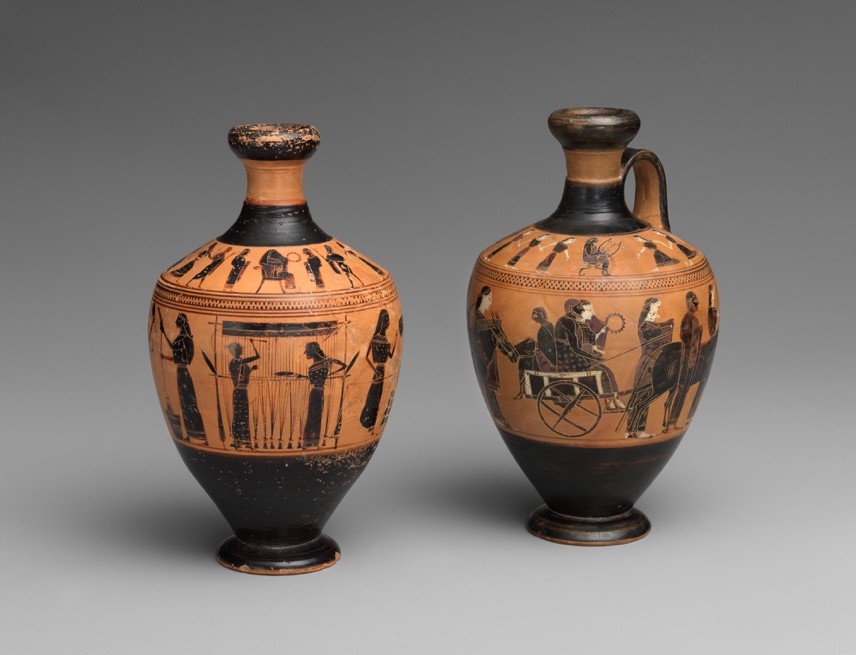
The lekythos on the left shows women engaged in different stages of textile production. Some prepare and spin the wool; others work at an upright loom, while still others fold the finished cloth. The warp threads hang down from the top of the loom, kept taut by weights.

On the shoulder of the lekythos, above the loom scene, a seated woman also holds out her veil.
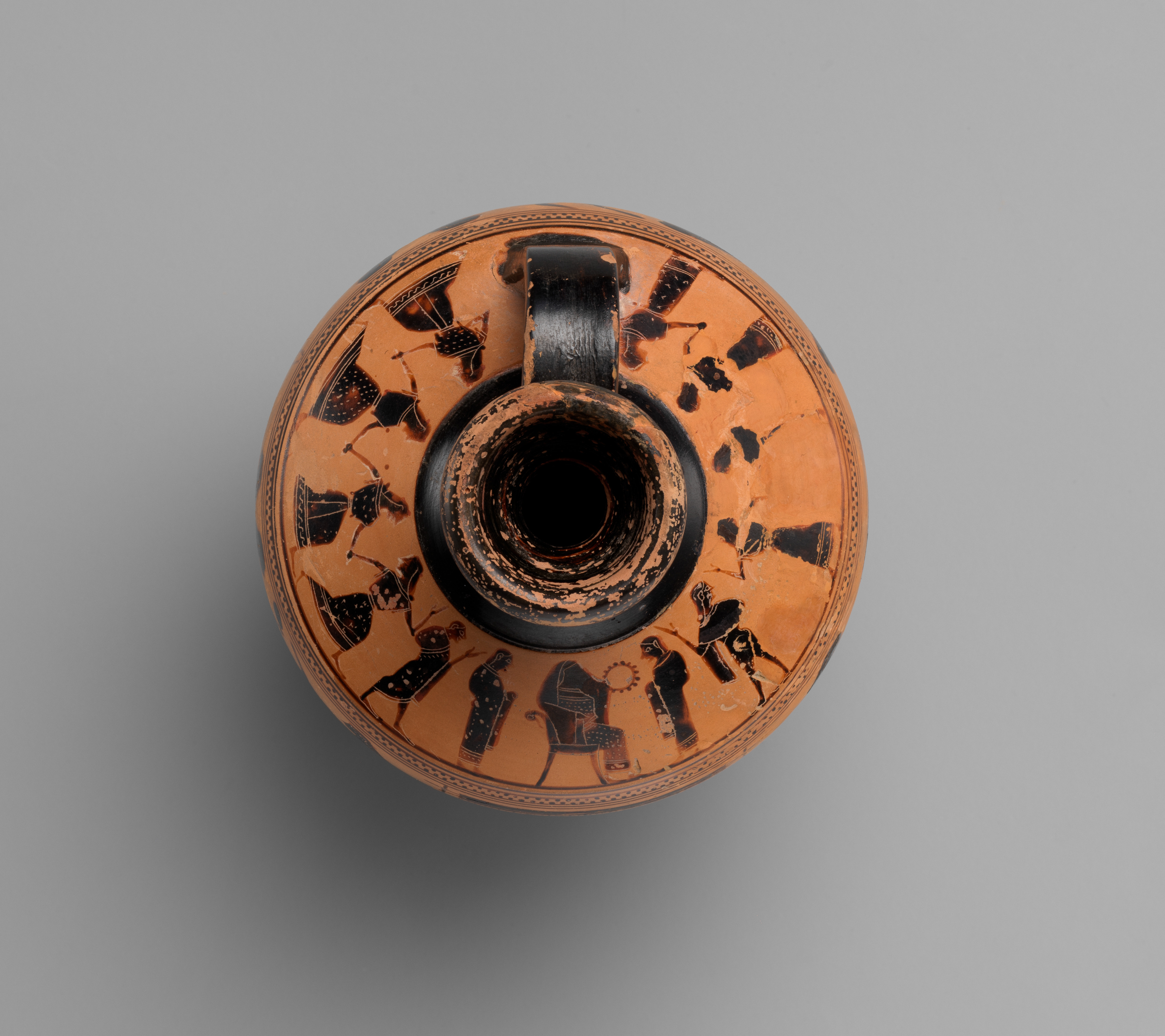
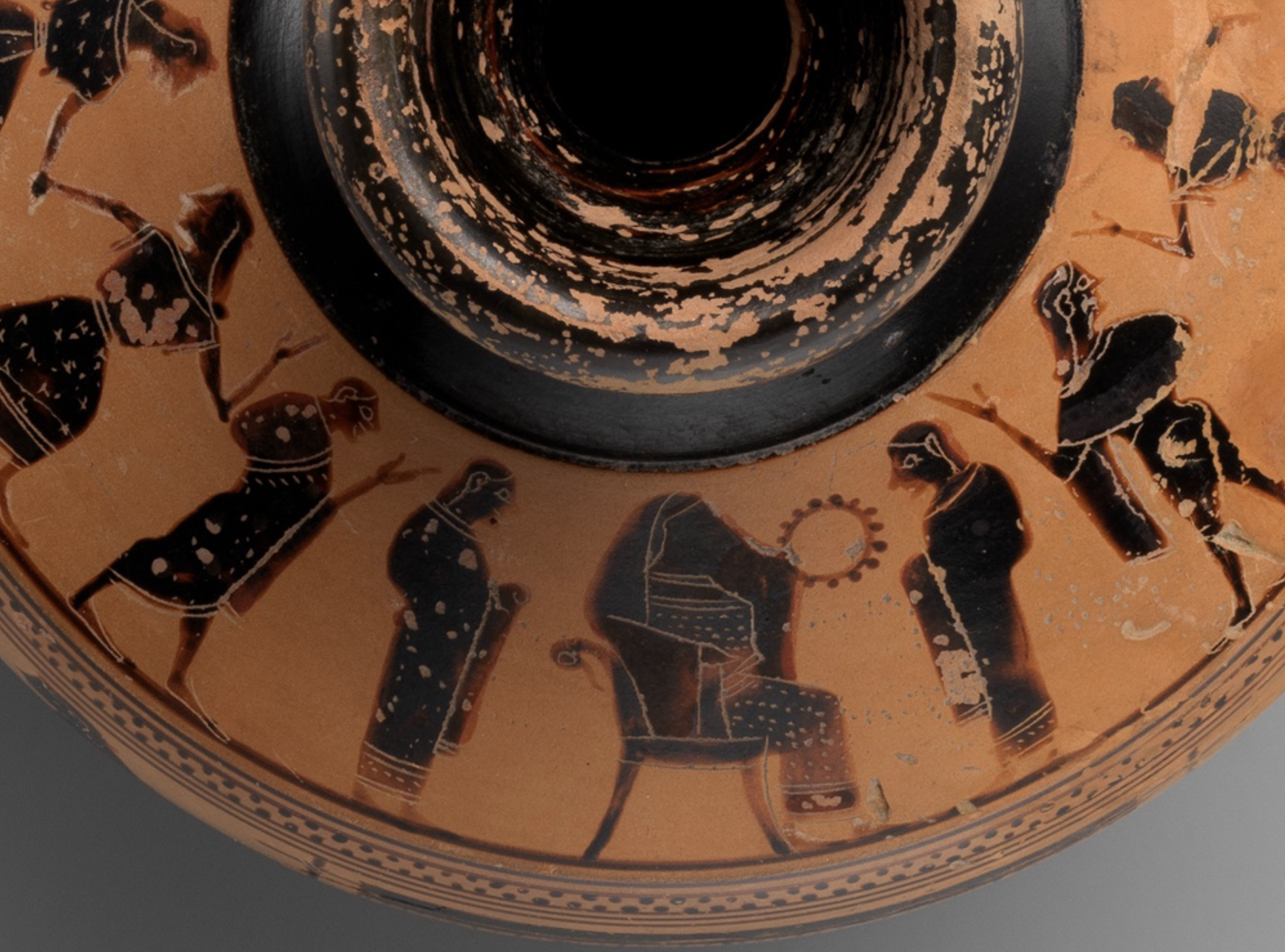
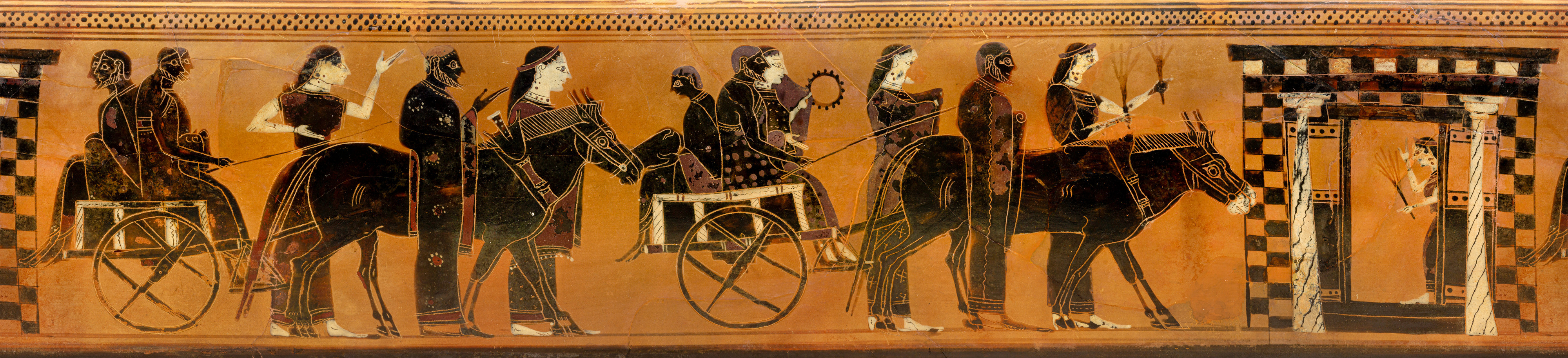
The two lekythoi depict women making a similar gesture with their veils. The resemblance recalls the episode described by Pausanias in which Penelope covered her face with her veil to express her decision to accompany Odysseus to Ithaca.
The vases have just shown us how women worked at the loom and some of the gestures associated with marriage. Ancient literature reveals something more: the different things women wove into their textiles. Some depicted recognisable stories; others displayed ornamental motifs; and sometimes a woven image acquired a meaning its maker could not have foreseen.
In the Iliad, the cloth Helen is weaving becomes a chronicle of the war. She is working on a large purple cloth, folded double, depicting the many battles the Trojans and Achaeans have fought on her account. Iris, the messenger of the gods, comes to summon her to the walls to watch the impending duel between Paris and Menelaus (Iliad 3.121–145).
Also in the Iliad, Andromache, Hector’s wife, is working on a purple cloth, folded double, weaving flowers of different colours into it, unaware that her husband has just been killed by Achilles. She is in her room and has instructed her serving women to prepare a hot bath for Hector’s return, while his body is being dragged behind Achilles’ chariot before the walls of Troy. Unlike Helen, Andromache is not weaving a recognisable story, but ornamental patterns. She knows nothing of what is happening outside and goes on waiting for the return of a man who is already dead (Iliad 22.437–446).
When Andromache hears the cries and runs to the walls, she sees Hector’s body being dragged away and faints. Her headdress and ornaments fall away, together with the veil Aphrodite had given her on the day of her marriage (Iliad 22.460–472).
Philomela weaves what she can no longer say, and the cloth becomes her testimony. Tereus, the husband of her sister Procne, rapes her and cuts out her tongue to prevent her from revealing what happened. Philomela finds another way to communicate: she weaves signs recounting what happened and manages to send the cloth to her sister. Pseudo-Apollodorus speaks of letters woven into a garment (Library 3.14.8); Ovid, in a fuller account, describes purple marks woven among white threads (Metamorphoses 6.576–583). Procne unfolds the cloth and understands what her sister cannot tell her in words.
Euripides tells us that Iphigenia had woven the memory of her lineage. In Iphigenia among the Taurians, Orestes, seeking to prove that he is her brother, reminds her of a cloth she had woven while she still lived in Argos: the quarrel between Atreus and Thyestes over a golden ram, and the image of the sun reversing its course. Iphigenia remembers both scenes. They are not events she herself experienced, but stories from her family’s distant past that she had turned into images. Many years later, that piece of weaving becomes one of the memories that help Iphigenia recognise her brother (Iphigenia among the Taurians 811–826).
In Euripides, too, a piece of weaving becomes evidence of identity. In Ion, Creusa remembers a cloth she had woven when she was still a girl, an unfinished piece of work with a Gorgon in the centre and serpents decorating its borders, like Athena’s aegis. Years earlier, she had left the cloth among the objects placed with her newborn son, whom she had abandoned. When she meets him again many years later, she describes the fabric before seeing it. Ion confirms that her description is accurate, and the cloth, together with other objects kept since his birth, enables mother and son to recognise each other (Ion 1412–1438).
As in Iphigenia’s case, a piece of weaving made many years earlier preserves a memory of the past and makes it possible to restore a bond that had seemed lost.
Arachne weaves an accusation against the gods. In the contest narrated by Ovid, Minerva depicts at the centre of her fabric her victory over Neptune in the contest for Attica, before the solemn assembly of the gods. In the four corners she adds examples of mortals punished for daring to challenge the divinities. Her weaving presents divine power as legitimate and warns that to confront it leads to ruin (Metamorphoses 6.70–102).
Arachne responds by showing the other side of that power. Her fabric presents a succession of deceptions, transformations, abductions and sexual assaults committed by Jupiter, Neptune, Apollo, Bacchus and Saturn. Where Minerva shows just gods punishing the insolence of mortals, Arachne shows those same gods using their power to deceive, subdue and satisfy their own desires. Her work is so perfect that even Minerva can find no artistic fault in it. But Arachne’s success is intolerable to the goddess, who tears apart the fabric depicting the crimes of the immortals and strikes her rival with the shuttle. Humiliated, Arachne tries to hang herself. Minerva prevents her death, but transforms her into a spider, condemned to hang from a thread and continue weaving (Metamorphoses 6.103–145).
Proserpina weaves the order of the universe. Claudian, a Latin poet of Late Antiquity, portrays her making a cloth as a gift for her mother, Ceres. On it she represents Nature separating the elements from primordial chaos, the sky, the earth, the sea, the stars, the coasts and the five climatic zones: one torrid zone at the centre, two temperate zones on either side and two frozen zones at the extremes. The materials imitate what they represent: the stars are made of gold, the sea of purple, the shores of precious stones, and the threads stand out in relief to reproduce the movement of the waves. The fabric does not merely depict the universe: it attempts to reproduce the very substance of what it depicts (The Rape of Proserpina 1.246–265).
Proserpina then depicts the realm of her uncle Pluto and the spirits of the underworld, not knowing that she will soon become its queen. The image seems to anticipate her fate and, as if seized by a dark foreboding, she suddenly bursts into tears. She begins to trace Oceanus around the edges of the cloth, but the arrival of Venus, Minerva and Diana interrupts her work (The Rape of Proserpina 1.266–272).
When Ceres later finds the abandoned loom, she discovers the warp in disarray, the work unfinished, and even a spider spreading its own web across the space Proserpina had left empty. The mother kisses the loom and embraces the implements her daughter’s hands had touched. The fabric is left unfinished just as the world of the woman who was weaving it is shattered (The Rape of Proserpina 3.146–163).
What the Textiles Leave Untold
Sección titulada «What the Textiles Leave Untold»In many other stories, women weave without any description of what their fabrics depict. In the Odyssey, Calypso sings as she works at the loom with a golden shuttle; Circe also sings as she weaves a great cloth, fine, beautiful and splendid as the work of goddesses. In Alcinous’ palace, fifty enslaved women are at work: some grind grain, while others spin or weave. Homer praises the exceptional skill of the Phaeacian women at the loom. Yet in none of these cases does he tell us what images, if any, their fabrics contained (Odyssey 5.61–62; Odyssey 10.220–223; Odyssey 7.103–111).
Hesiod tells us that Zeus instructs Athena to teach Pandora the art of weaving; Euripides portrays Electra making her own clothes out of necessity, because of her poverty; and Ovid shows the daughters of Minyas spinning and weaving while telling one another stories to pass the time. These passages mention weaving, but tell us nothing about the images, if any, that appeared in the finished fabrics (Works and Days 63–64; Electra 305–309; Metamorphoses 4.31–54).
Herodotus mentions the splendid, many-coloured cloak that Amestris weaves for Xerxes, while Pausanias records that sixteen women of Elis wove a peplos for Hera at Olympia every four years. Here too, we are not told what figures, if any, decorated the fabrics (Histories 9.109; Description of Greece 5.16.2).
Weaving the Odyssey
Sección titulada «Weaving the Odyssey»The story of Laertes’ shroud is told three times in the Odyssey. First Antinous tells it when he accuses Penelope before Telemachus at the assembly on Ithaca; then Penelope herself tells it to Odysseus, unaware that she is speaking to her husband; and finally Amphimedon, one of the dead suitors, recalls it when he explains to Agamemnon in Hades what happened in Odysseus’ household. The same story thus reappears at different points in the poem, told by three characters and from different perspectives (Odyssey 2.85–110; Odyssey 19.137–156; Odyssey 24.125–148).
Penelope weaves the shroud during the day and secretly unweaves it at night. Her loom controls the pace of events on Ithaca: for three years she manages to postpone the choice of a new husband and keep open the possibility of Odysseus’ return. In the fourth year, one of her serving women betrays the deception, and the suitors catch her unweaving the cloth. Penelope is then forced to finish it against her will (Odyssey 2.104–110; Odyssey 19.148–156).
Laertes’ shroud was a large and finely woven cloth. Yet Homer mentions neither its colour nor the material from which it was made, nor does he describe any figure upon its surface. Unlike the fabrics of Helen, Iphigenia or Creusa, we do not know what images, if any, it contained. Only in the final account, that of Amphimedon, are we told that Penelope displayed it once it had been finished and washed, shining like the sun or the moon (Odyssey 24.147–148).
We know for whom Penelope weaves. We know why she weaves. We know why she unweaves. We know how much time she manages to gain by doing so. But there is something Homer does not tell us: what she had woven upon that cloth. And perhaps we do not need to know: we need only look away from the loom and contemplate all that happens around her.
A Song for Penelope
Sección titulada «A Song for Penelope»In the final book of the Odyssey, Amphimedon tells the story of the shroud in Hades. Agamemnon listens to his account and, when he replies, he speaks no longer of the shroud, but of the woman who wove it:
“The fame of her virtue will never perish; the immortals will compose a beautiful song in praise of wise Penelope for people on earth.”