Hector
The foremost defender of Troy.
Hector is neither invulnerable nor always victorious. In the Iliad, he is the most prominent leader of the Trojans, capable of carrying the war all the way to the Achaean ships; he is also Andromache’s husband, Astyanax’s father, and a man who knows that Troy may fall. He makes mistakes, feels fear before Achilles, and realises that the gods have abandoned him. The greatness the poem gives him arises precisely from this combination of duty, lucidity and vulnerability.
Hector, prince and leader of Troy
Sección titulada «Hector, prince and leader of Troy»Who was Hector?
Sección titulada «Who was Hector?»In Homer, Hector is the son of Priam and Hecuba, prince of Troy and the city’s foremost warrior. In Book 3 he rebukes Paris for having caused the war and then refusing to face Menelaus (Iliad 3.38–57); throughout the poem, he organises the Trojan resistance and is recognised by the Achaeans as their most formidable opponent.
He is not a king who remains safely inside the city. He fights, gives orders, rallies the Trojans and assumes a responsibility that is both military and familial. The Iliad does not call him a “tragic hero”: that is a modern interpretation. But it does present a defender who cannot save what he defends and who eventually comes to understand that.
Was he Priam’s son, or were there other genealogies?
Sección titulada «Was he Priam’s son, or were there other genealogies?»The genealogy that makes Hector the son of Priam and Hecuba is the one found in the Homeric poem and in the most stable tradition. Pseudo-Apollodorus, Library, likewise presents Hector as the first son of Priam and Hecuba (3.12.5).
There is, however, a variant preserved in a later source: Tzetzes, in his commentary on Lycophron, attributes to Stesichorus the claim that Apollo was Hector’s father. We do not possess the passage of Stesichorus in a surviving poem, and this variant should not replace the parentage given in the Iliad. It is an alternative genealogy, not a correction of Homer.
Was he the leader of the Trojans?
Sección titulada «Was he the leader of the Trojans?»Yes, although the Trojan war effort is not directed by a single voice. Priam retains royal authority; Polydamas offers military advice; Helenus interprets divine signs. Hector leads the men in battle and makes decisions whose consequences affect the whole city.
His relationship with Helenus shows this division of functions particularly well. In Iliad 6.73–101, Helenus recognises that Achaean pressure requires a religious response and advises Hector to return to Troy and ask Hecuba to make an offering to Athena. Hector carries out the plan.
It can be summarised like this: Hector leads the men; Helenus provides the ritual response through his counsel. The irony emerges only in later traditions: the same Helenus will eventually be associated with knowledge crucial to the capture of Troy, although the sources do not all tell that story in the same way.
What was his relationship with Andromache and Astyanax?
Sección titulada «What was his relationship with Andromache and Astyanax?»The meeting in Iliad 6 is not merely a domestic farewell. Andromache fears Hector’s death, foresees that she and her son will be left without protection, and already imagines her own enslavement if the city falls. She also gives Hector very specific military advice: to reinforce the sector of the wall near the fig tree, where the Achaeans have repeatedly tried to break through (Iliad 6.431–439).
Hector recognises the force of what she says, but he cannot promise to remain inside the city. He knows that his death would leave Andromache and Astyanax exposed; he also fears the shame of abandoning the fighting. When the child is frightened by his helmet, Hector removes it and places it on the ground; he then takes Astyanax in his arms and prays that he may grow to be a better man than his father (Iliad 6.466–481). The scene does not resolve the conflict between family and defence: it makes it visible.
Did he know that Troy was doomed?
Sección titulada «Did he know that Troy was doomed?»Hector does not know when or exactly how Troy will fall, but in the same conversation he voices a grim certainty: he knows that the day will come when Ilium, Priam and Priam’s people will perish (Iliad 6.447–465). What pains him most is not simply his own death, but the thought of Andromache as a captive, forced to work for others.
The Iliad does not present this awareness as passive resignation. Hector continues to defend Troy. The tension between knowing that the city may fall and acting as though it could still be saved is one of the central features of his character.
The Trojan advance and Achilles’ return
Sección titulada «The Trojan advance and Achilles’ return»What military successes does he achieve?
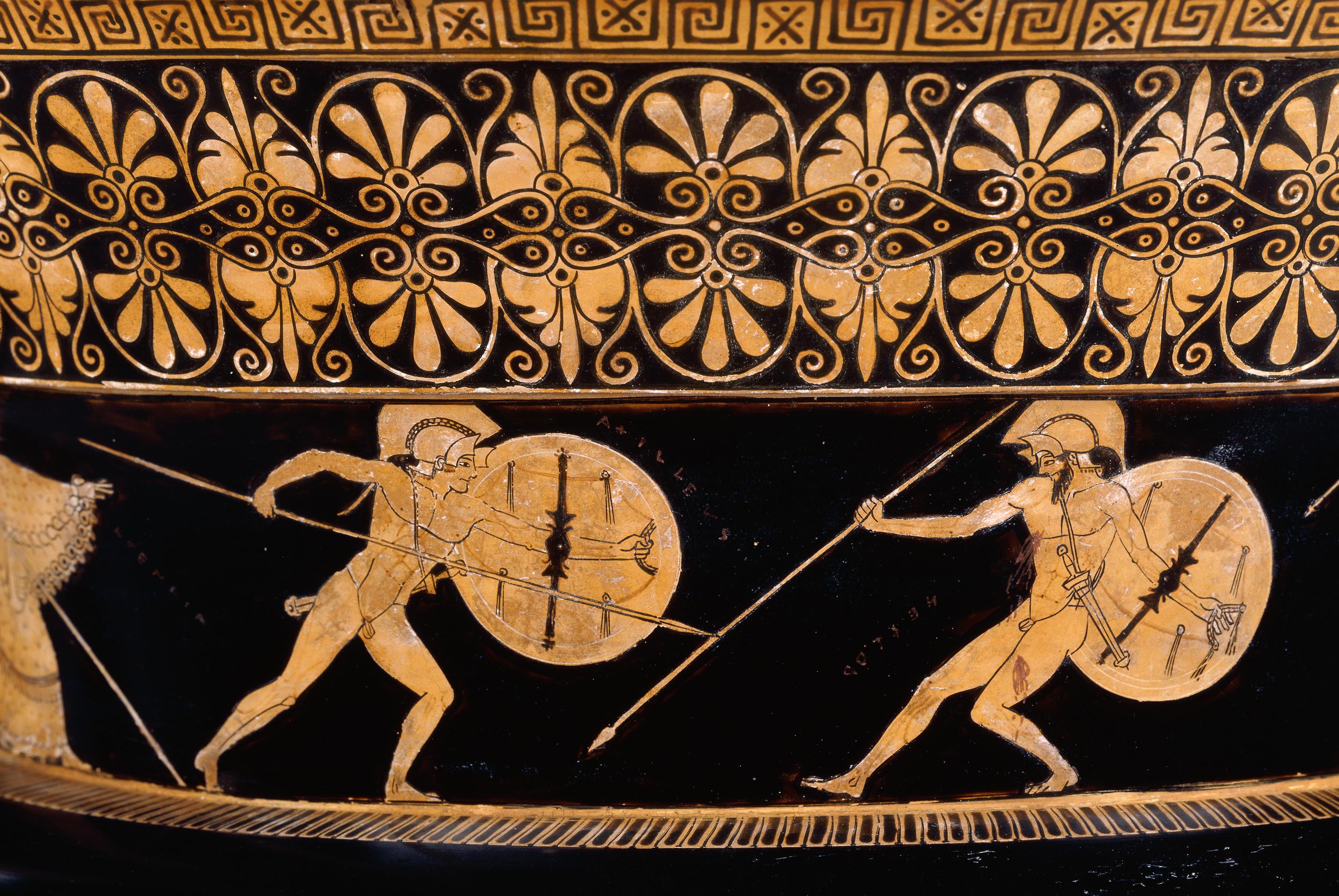
Sección titulada «What military successes does he achieve?»Hector challenges the best of the Achaeans to face him and eventually fights Ajax, son of Telamon, in Book 7. Neither wins: night brings the combat to an end, and the two exchange gifts (Iliad 7.206–312). The episode does not diminish Hector; it places him among the few warriors capable of standing against Ajax in single combat.
His greatest success comes when Achilles’ absence allows the Trojans to drive the Achaeans back to their wall and ships. In Books 11–15, Hector leads that advance and succeeds in setting fire to one of Protesilaus’ ships (Iliad 15.704–746). It is the moment of greatest danger for the Achaeans: if the fleet were destroyed, the possibility of return itself would be lost.
How did Patroclus die, and what role did Hector play?
Sección titulada «How did Patroclus die, and what role did Hector play?»It is not enough to say that Hector defeated Patroclus. The Iliad marks out a precise sequence: Apollo strikes and disarms Patroclus; Euphorbus wounds him with a spear; Hector then arrives and deals the mortal blow (Iliad 16.786–857). Hector is the one who finishes Patroclus and claims the victory, but he does not face an uninjured opponent.
He then takes possession of Achilles’ old armour, the armour Patroclus had worn into battle. The act gives him a visible triumph and at the same time foreshadows his end: Hector wears the armour of the man who will soon return to kill him. In Book 17, while the fighting continues over Patroclus’ body, Zeus warns that the armour will not bring Hector a happy homecoming (Iliad 17.201–208).
Why does Achilles return?
Sección titulada «Why does Achilles return?»Patroclus’ death transforms Achilles’ anger. In Books 18 and 19, Thetis obtains new armour from Hephaestus, and Achilles is reconciled with Agamemnon before returning to battle. Hector is not solely responsible for that return: Apollo and Euphorbus also take part in Patroclus’ death. But the final blow and the taking of the armour make Hector the man Achilles now seeks.
The new panoply makes the asymmetry of the final encounter even clearer. Hector wears Achilles’ old armour; Achilles returns in new, divine armour and with an anger he no longer attempts to restrain.
The fall of Hector
Sección titulada «The fall of Hector»Why did he remain outside the walls, and why did he flee?
Sección titulada «Why did he remain outside the walls, and why did he flee?»As Achilles approaches, Priam and Hecuba beg Hector to come back inside the city (Iliad 22.25–89). Hector remembers that he ignored Polydamas’ advice to withdraw after Patroclus’ death and recognises that his decision has put the Trojans in danger. He even considers offering to return Helen and the wealth taken with her, but realises that Achilles would probably not accept such terms (Iliad 22.99–130).
Hector does not remain outside because he is unaware of the danger. He stays because of a mixture of shame, responsibility and the increasingly fragile hope of repairing his mistake. When he sees Achilles, he flees. Achilles pursues him three times around Troy. Homer does not present this as cowardice: he allows us to see the fear of a man who understands the scale of his defeat.
How did Athena deceive him, and how did he die?
Sección titulada «How did Athena deceive him, and how did he die?»Athena takes the form and voice of Deiphobus and persuades Hector to stop and face Achilles with his brother at his side (Iliad 22.227–247). When Hector’s spear misses and he looks for his brother to ask for another, he discovers that Deiphobus is not there: the goddess has deceived him, and he understands that death is imminent (Iliad 22.294–305).
He does not flee again. He draws his sword and rushes at Achilles, determined not to die without a fight. Achilles finds an exposed point in the armour at the neck and wounds him mortally (Iliad 22.326–363). Hector asks Achilles to return his body to the Trojans; Achilles refuses.
What did Achilles do with his body, and how did Priam recover it?
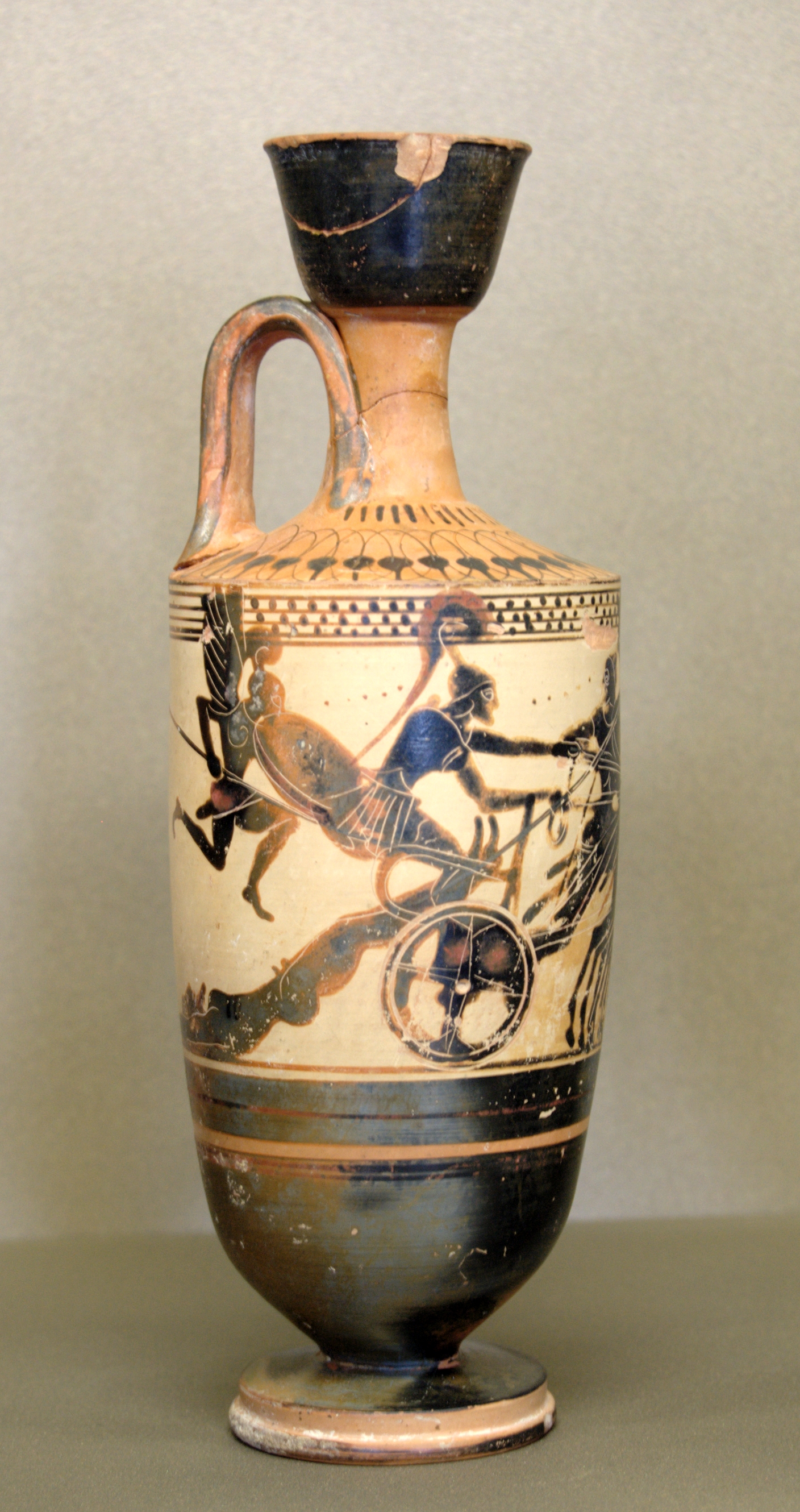
Sección titulada «What did Achilles do with his body, and how did Priam recover it?»Achilles pierces the tendons of Hector’s feet, ties the body to his chariot and drags it towards the ships (Iliad 22.395–404).
In Book 24, Apollo preserves Hector’s corpse from decay, and Priam, guided by Hermes, comes to Achilles’ shelter to ransom the body. The encounter does not erase the violence that precedes it, but it allows the father to kiss the hands of the man who killed his son and culminates in Achilles returning the body (Iliad 24.468–676).
The return of the body restores Hector to his family and makes Trojan mourning possible. Andromache, Hecuba and Helen lament him in different ways before the city celebrates his funeral rites (Iliad 24.720–776).
Why does the Iliad end with Hector’s funeral?
Sección titulada «Why does the Iliad end with Hector’s funeral?»The poem does not end with the fall of Troy, the Trojan Horse or the death of Achilles. It ends with Hector’s funeral: “So they held the funeral of Hector, tamer of horses” (Iliad 24.804). The city has not been saved, but for a few days it regains the right to mourn and bury the man who defended it.
That ending does not make Hector victorious. It makes him the human centre of a brief truce: the war will continue, Troy will fall in later traditions, and Achilles too is destined to die. But the Iliad chooses to close with the body returned and with a community able to say farewell to him.
What do later traditions add?
Sección titulada «What do later traditions add?»Later traditions expanded Hector’s story beyond the events narrated in the Iliad. Pindar connects the vulnerability of Troy’s walls with the section built by the mortal Aeacus, as opposed to the sections built by the gods (Olympian Odes 8.31–46); that story helps contextualise the sector Andromache advises Hector to defend, but Homer does not narrate it in that form.
There are also later accounts of alternative genealogies, Hector’s activity as a commander, and episodes of the war that the Iliad does not tell. Pseudo-Apollodorus and Dictys of Crete are witnesses to this expansion, not transparent continuations of the poem. The Rhesus, a tragedy transmitted under Euripides’ name but of disputed authorship, again presents Hector as a demanding commander; it does not, however, provide a new Homeric biography.
A figure of responsibility and limits
Sección titulada «A figure of responsibility and limits»Hector matters because the Iliad does not spare him error or fear. He is Troy’s foremost defender, a husband and father, a leader capable of carrying the war to the Achaean ships, and a man who understands too late the cost of some of his decisions. He knows that he may lose his city, his family and his life; even so, he remains to defend what he sees as his responsibility.