Here Stood Troy
When Homer composed the Iliad, roughly four or five hundred years had passed since the period in which the Trojan War is traditionally placed.
No one could any longer remember that war. The men who had fought in it, their children and their children’s children had been dead for centuries. Bronze Age Troy had been destroyed, rebuilt and transformed many times. Yet the war was still being sung.
We should not imagine Homer gathering fixed fragments and arranging them like an archive. Between those two ends lay a long oral tradition: stories, episodes, genealogies, formulas and songs transmitted and transformed over generations. We know that epic diction belongs to that tradition; we cannot reconstruct, step by step, what each generation preserved or when each detail entered it.
The war survived in song
Sección titulada «The war survived in song»For centuries, the Trojan War continued to be told. Its names, scenes and kinships could reappear in new performances; its formulas helped make recognisable a world of heroes, gods, journeys and battles. That continuity does not turn oral tradition into a literal record of the Late Bronze Age. Rather, it helps explain how a remote conflict — whether large or limited — could acquire an extraordinary capacity to survive in collective memory.
The scale of the Iliad does not prove that the original war had the scale of epic. A smaller event, several different conflicts, or a political memory transformed over many generations may have grown into a ten-year war involving the greatest heroes of Greece and Troy. Epic preserves memory, but it also composes, selects, enlarges and gives form.
The Iliad as an ‘archaeological remain’
Sección titulada «The Iliad as an ‘archaeological remain’»In a metaphorical sense, the poem can be read as an archaeological remain of memory: not because it is an excavation or a chronicle, but because traces of different periods may coexist within it. Archaeology finds walls, pottery, destructions and transformations; the Iliad preserves names, formulas, social images and stories that have likewise passed through centuries, mixed with later elements and with the choices of epic composition.
The metaphor has a clear limit. A layer of earth can be dated and compared with other materials; a verse cannot by itself date the event it describes. The poem does not replace archaeology, and archaeology does not prove the Homeric plot. They are different ways of approaching the same memory, with different kinds of evidence and different limits.
A Troy imagined by the Greeks
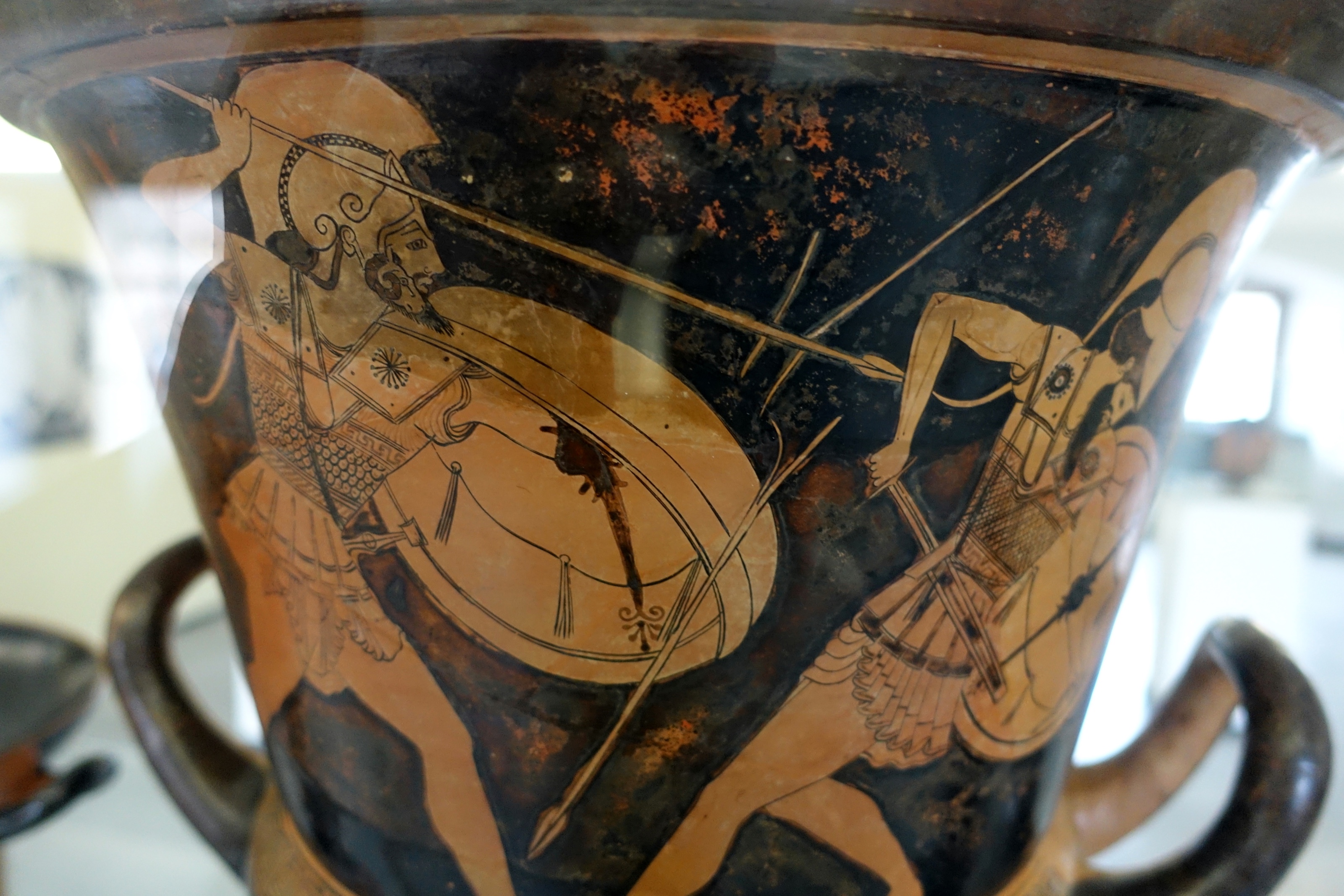
Sección titulada «A Troy imagined by the Greeks»The memory of Ilios — the Greek name of Troy — did not end with Homer. Centuries later, Greeks continued to imagine, view and represent their heroic tradition. The krater below does not reproduce the historical Troy of the Bronze Age and is not archaeological evidence for the war: it shows how an Attic painter at the beginning of the fifth century BC could depict the duel between Achilles and Hector.
What physically remained of that Troy beyond the poems?
Sección titulada «What physically remained of that Troy beyond the poems?»The Bronze Age city did not remain intact waiting for archaeologists to find it. The site underwent destructions, rebuilding and new occupations; later it became Greek and Roman Ilios. But the settlement never disappeared entirely from the geography or from ancient memory. The material question leads to a specific hill in the Troad: Hisarlık.
Where was Troy?
Sección titulada «Where was Troy?»Hisarlık is a tell — a mound formed by successive occupations — in the Troad, in north-western Anatolia, within the modern Turkish province of Çanakkale. It overlooks the plain associated with the Scamander and lies near the Dardanelles, the ancient Hellespont, about 4.8 km from their southern entrance.
It therefore occupied an important regional position in a zone of movement and contact.
The landscape of Hisarlık fits, in broad terms, the horizon of the Iliad: plain, rivers, Ida, Hellespont and coast. But this fit should not be read as an exact correspondence between poem and map. Epic geography is not an archaeological plan.
Why do we know that Hisarlık was Ilios?
Sección titulada «Why do we know that Hisarlık was Ilios?»The identification does not rest on a single find or on Homer’s authority. Several lines of evidence converge. Greek and Roman Ilios stood on the same site, with a sanctuary of Athena Ilias, public buildings and a local tradition that recognised it as the Trojan city. The geography matches the Troad of that tradition. Beneath the Classical and Roman city, archaeology has revealed a much older sequence of occupation, including a fortified settlement of the Late Bronze Age.
The Hittite texts provide an additional convergence. Most specialists connect Wilusa, a state known from those texts, with Wilios/Ilios and the Troad. This is not an inscription found at Hisarlık saying ‘Troy’: it is a highly probable historical and linguistic identification that strengthens the overall case.
The most accurate formulation is therefore: Hisarlık is the historical Ilios/Troy of ancient tradition. Not: ‘Hisarlık has been proved to be Homer’s Troy’.
The modern search: Calvert and Schliemann
Sección titulada «The modern search: Calvert and Schliemann»Hisarlık was not discovered from scratch. Ilios had been a Greek and Roman city visible in the landscape and in ancient sources. In the nineteenth century there was still debate over which of several sites in the Troad best corresponded to Homeric Troy, but Hisarlık was already known for its ruins.
Frank Calvert, a resident and consul in the region, had bought part of the tell, excavated there from 1863 and argued for its identification before Heinrich Schliemann began his campaigns. Schliemann brought resources, international publicity and excavation on an incomparable scale; he also dug with an aggressiveness that disturbed and destroyed parts of the later levels that matter most today for Troy VI and VIIa.
Schliemann made Hisarlık the great site of the modern search for Troy, but he was not the first to identify or excavate it.
And the ‘Treasure of Priam’?
Sección titulada «And the ‘Treasure of Priam’?»Schliemann called a group of gold, silver and other objects found in the phase he believed to be Homeric the ‘Treasure of Priam’. Archaeology places it in Troy II, roughly a thousand years earlier than VI and VIIa, the phases discussed in relation to the traditional horizon of the war.
It was therefore not the treasure of Homer’s Priam. The name preserves Schliemann’s historical imagination, not the identity of its owners. Schliemann said that Sophia helped him remove the jewellery from the site, concealing it in a shawl. But the accounts and correspondence raise enough doubts for that scene to be treated as a romanticised anecdote, not secure documentation.
Layers, destructions and rebuilding
Sección titulada «Layers, destructions and rebuilding»| Phase | Approximate date | Why it matters |
|---|---|---|
| I | c. 3000–2550 BC | First fortified settlement. |
| II | c. 2550–2300 BC | ‘Treasure of Priam’: far too early for the traditional war. |
| III–V | c. 2300–1750 BC | Continuity of occupation. |
| VI | c. 1750–1300 BC | Large Late Bronze Age city. |
| VIIa | c. 1300–1180 BC | Successor to VI; final destruction. |
| VIIb | c. 1180–950 BC | Later occupation. |
| VIII | c. 8th century–85 BC | Greek Ilios and sanctuary of Athena Ilias. |
| IX | 85 BC–c. AD 550 | Roman Ilios. |
These are phases of a settlement that changes over time, not nine complete cities stacked like boxes. The dates are working ranges: ‘around 1300’ and ‘around 1180’ describe what we know better than an artificially precise year.
Troy VI or Troy VIIa?
Sección titulada «Troy VI or Troy VIIa?»The question has no demonstrated winner. Both phases matter because they offer two different ways of thinking about a possible historical background.
| Troy VI | Troy VIIa | |
|---|---|---|
| Appearance | Monumental, strongly fortified citadel. | Continuation of VI, with denser occupation. |
| End | Around 1300 BC. | Around 1180 BC. |
| Main explanation | Earthquake, with caution. | Fire and evidence compatible with violence. |
| Limit | Does not prove an Achaean conquest. | Does not identify attackers or the Homeric war. |
Troy VI ended around 1300 BC; the dominant explanation is an earthquake, though this should not be turned into absolute certainty. Its monumental architecture long made it seem the best candidate for the city of tradition.
Troy VIIa directly succeeded VI. Its buildings are denser and its large storage vessels have been read as possible signs of pressure or insecurity, although other explanations are possible. It ended in destruction around 1180 BC; a violent destruction is compatible with the evidence, but we do not know who attacked and cannot identify it with Homer’s war.
Was Troy only a small citadel?
Sección titulada «Was Troy only a small citadel?»No. The visible citadel was surrounded by a larger settlement. Excavations and geophysical and geoarchaeological studies have identified occupation outside the citadel, defensive ditches or trenches, and other structures associated with the lower city.
This changes the picture of a tiny, isolated fortress. But it does not justify treating as established fact a city of exactly thirty hectares, a large population, a continuous outer wall or a major commercial centre. The full extent, density and operation of the defences remain debated.
The cautious formulation is this: the citadel was surrounded by a larger settlement; ditches and other evidence show outer defences, although their complete extent and function remain debated.
Wilusa, Ahhiyawa and the world of the Hittite texts
Sección titulada «Wilusa, Ahhiyawa and the world of the Hittite texts»The Bronze Past — The Trojan War
The Hittites were a Bronze Age power based in central Anatolia, with their capital at Hattusa, between the seventeenth and twelfth centuries BC. Their diplomatic archives allow us to glimpse, from their own perspective, the political network of western Anatolia.
Wilusa is the name of a state known from those Hittite texts. The relationship Wilusa ↔ Wilios/Ilios is strong or highly probable; Taruisa ↔ Troia is plausible but more disputed. That distinction should be preserved.
Alaksandu was a historical king of Wilusa who concluded a treaty with the Hittite king Muwatalli II in the early thirteenth century BC. His name recalls Alexandros, the other name of Paris. The resemblance is suggestive; it does not allow us to claim that Alaksandu was a historical Paris.
Ahhiyawa, also mentioned in the Hittite archives, probably designates a power of the Mycenaean world, located across the sea from Anatolia. The connection with Achaioi, ‘Achaeans’, is strong as a historical-linguistic identification. But Ahhiyawa is not automatically equivalent to Homer’s particular Achaeans: the tablets do not name Agamemnon, Achilles or Hector.
They document a political world; they do not narrate Homer’s plot.
| Hittite document | What it shows |
|---|---|
| Treaty of Alaksandu | Wilusa had a king and political ties with Hatti, the Hittite kingdom. |
| Manapa-Tarhunta Letter | Wilusa appears in a context of regional instability. |
| Tawagalawa Letter | Hatti and Ahhiyawa had a dispute connected with Wilusa. |
| Milawata Letter | Mentions the case of Walmu, king of Wilusa, within an Anatolian political network. |
Was the coastline the same as today?
Sección titulada «Was the coastline the same as today?»No. Sedimentation from the Scamander and Simoeis progressively transformed the plain. The Bronze Age coastline was not the present one: around Hisarlık there were shallow bays, wetlands and an evolving alluvial plain. The plain of Troy, so prominent in the Homeric poems, should therefore not be imagined with today’s coastal outline.
This helps explain why the modern distance between the tell and the shore does not decide the question by itself. It does not allow us to draw a precise palaeocoast without reproducing a published geomorphological reconstruction. Nor does it support the easy image of a large deep harbour immediately beneath the walls.
What archaeology can demonstrate — and what it cannot
Sección titulada «What archaeology can demonstrate — and what it cannot»Archaeology and the Hittite texts can establish a context, not recover a chronicle.
We know that there were fortified cities at Hisarlık, destructions and rebuilding, and conflicts involving western Anatolia, Hatti and Aegean powers. It is plausible that one or more Late Bronze Age conflicts contributed to the Trojan tradition. We cannot demonstrate that Agamemnon led a coalition against Hisarlık, that Achilles and Hector fought there, that the siege lasted ten years or that the epic Horse existed.
Archaeology can provide a historical context; it does not turn the Iliad into a chronicle.
From Troy to us
Sección titulada «From Troy to us»The continuity is not a straight line and is not proof that epic preserves a war report. It is a history of survivals and transformations: oral songs, Homeric composition, Greek vases, generations who inhabited and visited Ilios, the modern search of Calvert and Schliemann, archaeology, and us, still speaking today about that war.
Here stood the city that Greeks and Romans knew as Ilios, built over a place that had been occupied and fortified for many centuries before. We can point with great confidence to the location of Troy. What we cannot point to with the same confidence is a wall and say: ‘Hector fought here’.
Here Was Troy! Yes, if we are asking about the place. It is much harder to answer exactly what happened there more than three thousand years ago.
| Degree of certainty | What we can say |
|---|---|
| Very solid | Hisarlık = historical Ilios/Troy. |
| Highly probable | Wilusa = Wilios/Ilios; Ahhiyawa connected with the Mycenaean world. |
| Plausible | Late Bronze Age conflicts contributed to Trojan memory. |
| Not demonstrable | The Homeric war as we know it. |
The next question is what happened to that place after the Bronze Age cities: What Became of Troy?
For the limits and types of evidence used to reconstruct the conflict, see also How Do We Know What Happened in the Trojan War?.
Sources and method
Sección titulada «Sources and method»See Also
Sección titulada «See Also»The Trojan War: the Story and Its Sources