What Were Homer’s Ships Like?
Between Poetry and Archaeology
Sección titulada «Between Poetry and Archaeology»Homer shows us ships setting sail, reaching unfamiliar shores, carrying men and provisions and weathering storms. He gives us no plans from which to reconstruct them. To imagine what these ships were like, we must distinguish the poetic formulas of the Iliad and the Odyssey from images and documents that have survived from other periods.
What Might a Ship in Homer’s World Have Looked Like?
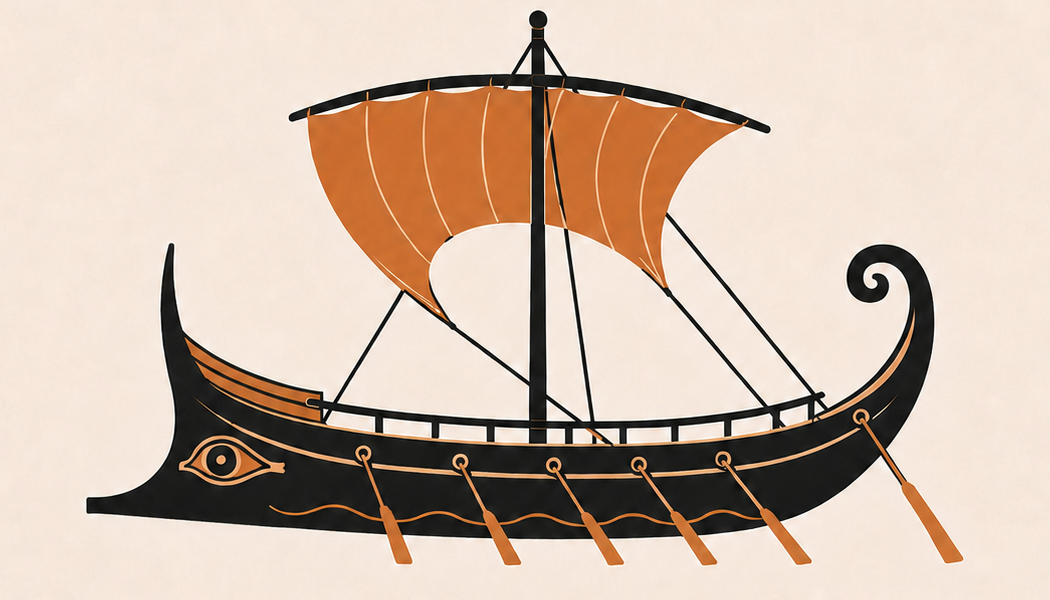
Sección titulada «What Might a Ship in Homer’s World Have Looked Like?»Homer does not describe a ship as a shipbuilder would. His ships are black and swift, deep-hulled, with curved ends, well-benched and long-oared. Some have bluish prows or red cheeks. A mast supports a sail that catches favourable winds, while oars allow the ship to advance when the wind fails or manoeuvring is necessary. In the Odyssey, a black ship is made ready with mast and sail, and a breeze carries it onwards (11.1–10). Elsewhere, red-cheeked, well-benched ships appear when Odysseus explains that the Cyclopes have neither ships nor shipbuilders (9.125–129).
No single vessel need combine all these expressions. Some emphasise shape, others colour, construction or speed. The poem allows us to imagine a ship, not to reconstruct one as though we had its plans.
Oars, Sail and Steering
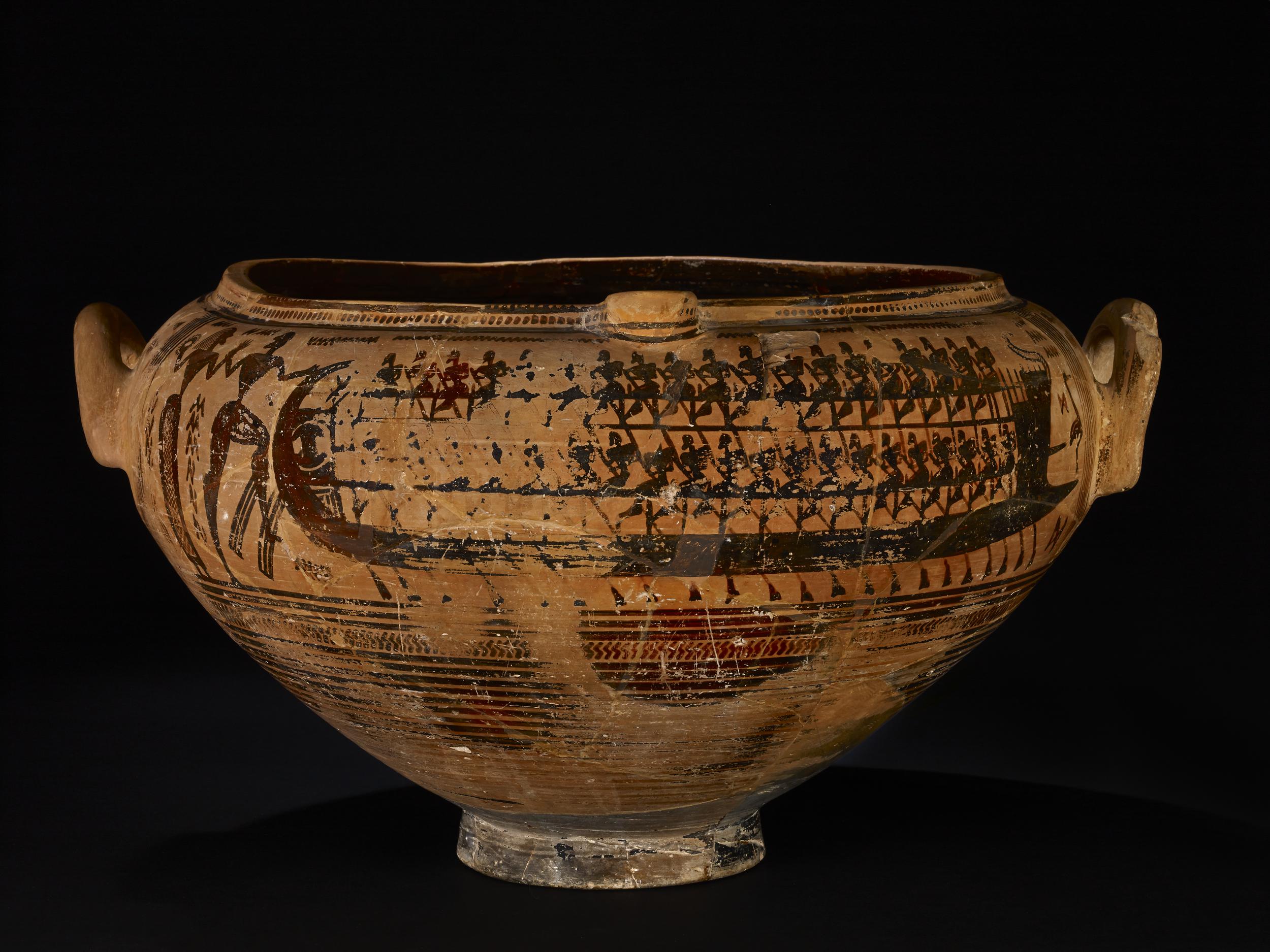
Sección titulada «Oars, Sail and Steering»Homeric descriptions, read alongside depictions of ships from periods close to the composition of the poems, suggest vessels propelled by oars and equipped with a square sail. A mast supported the yard, while the rigging allowed the sail to be raised, lowered and adjusted. At the stern, one or two steering oars helped control the vessel’s course.
The sail harnessed favourable winds; the oars provided propulsion when the wind failed and allowed the crew to manoeuvre near the coast. The two methods were not mutually exclusive. A ship could alternate between them according to the conditions of the voyage.
Homer seldom dwells on technical details. He is more interested in the moment of departure, the efforts of the crew, the arrival at a beach or the threat of a storm. Yet behind these scenes we can recognise a genuine familiarity with seafaring.
Rowers Before Homer
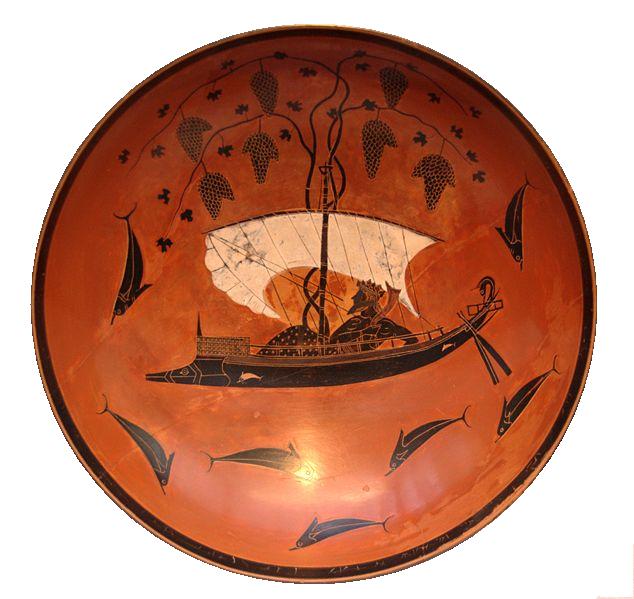
Sección titulada «Rowers Before Homer»Rowing is documented long before the Homeric poems took the form in which we know them. Several Linear B tablets from the archives of the Mycenaean palace at Pylos mention e-re-ta, “rowers”. These administrative records offer a glimpse of how rowers were organised in the thirteenth century BC.
Three Pylos Tablets Recording Mycenaean Rowers
Sección titulada «Three Pylos Tablets Recording Mycenaean Rowers»| Tablet | Transliteration | Linear B | Meaning | Notable information |
|---|---|---|---|---|
| PY An 1 + fr. + fr. | e-re-ta pe-re-u-ro-na-de / i-jo-te | 𐀁𐀩𐀲 𐀟𐀩𐀄𐀫𐀙𐀆 / 𐀂𐀍𐀳 | Rowers bound for Pleuron | Five groups: 8, 5, 4, 6 and 7 men; 30 in all. |
| PY An 610 + frr. | me-za-[wo-]ne e-re-ta | 𐀕𐀼[𐀺]𐀚 𐀁𐀩𐀲 | e-re-ta: rowers; preceding term uncertain | Contingents from several places; original estimate near 600 men. |
| PY An 724 | e-re-ta a-pe-o-te | 𐀁𐀩𐀲 𐀀𐀟𐀃𐀳 | Absent rowers | Absences connected with service obligations; cause uncertain. |
What the Documents Tell Us
Sección titulada «What the Documents Tell Us»PY An 1: thirty rowers bound for Pleuron. The tablet identifies five groups of men who were to travel to a place called pe-re-u-ro-na, generally identified with Pleuron. It does not tell us what ships they would use or the precise purpose of their journey.
Pleuron was a city in Aetolia, near present-day Messolonghi, on the northern shore of the Gulf of Patras. Homer names it among the Aetolian towns that joined the expedition against Troy (Iliad 2.639). If the Mycenaean place name refers to the same location, this would provide evidence of its name several centuries before the composition of the poems.
PY An 610: hundreds of rowers. This is a much larger register. It lists contingents of men associated with different localities and records their numbers. Missing sections prevent us from establishing the original total with certainty, although estimates approaching six hundred rowers have been proposed.
The first line contains me-za-[wo-]ne, followed by e-re-ta, “rowers”. The brackets indicate that the syllable wo has been restored by scholars from a damaged passage. The meaning of the preceding expression is not sufficiently secure for us to translate it here.
PY An 724: absent rowers. The expression e-re-ta a-pe-o-te is interpreted as “absent rowers”. John Killen proposes that the tablet chiefly records exemptions from a compulsory obligation to serve as rowers, which may in some cases have been connected with landholding. This interpretation is plausible, although the reasons for, and circumstances of, each exemption remain uncertain (The New Documents in Mycenaean Greek, vol. 2, 2024, pp. 477–479).
A comparison with PY An 1 is particularly intriguing: the eight rowers recorded for ro-o-wa in that tablet correspond in number to eight absent men from the same locality in PY An 724. It has been suggested that they were absent because they were performing naval service, but we cannot establish that the two records concern the same individuals.
The reverse of PY An 724 also bears an incised drawing that the archaeologist Shelley Wachsmann interprets as a possible ship (Seagoing Ships and Seamanship in the Bronze Age Levant, 1998, figs. 7.2–7.3). Its appearance, however, differs from more familiar Mycenaean depictions of ships, so the identification cannot be considered certain.
The epigraphic edition of The Palace of Nestor (IV.2, 2025, pp. 446–447) also considers the possibility that the incised marks represent a boat, although the identification remains uncertain.
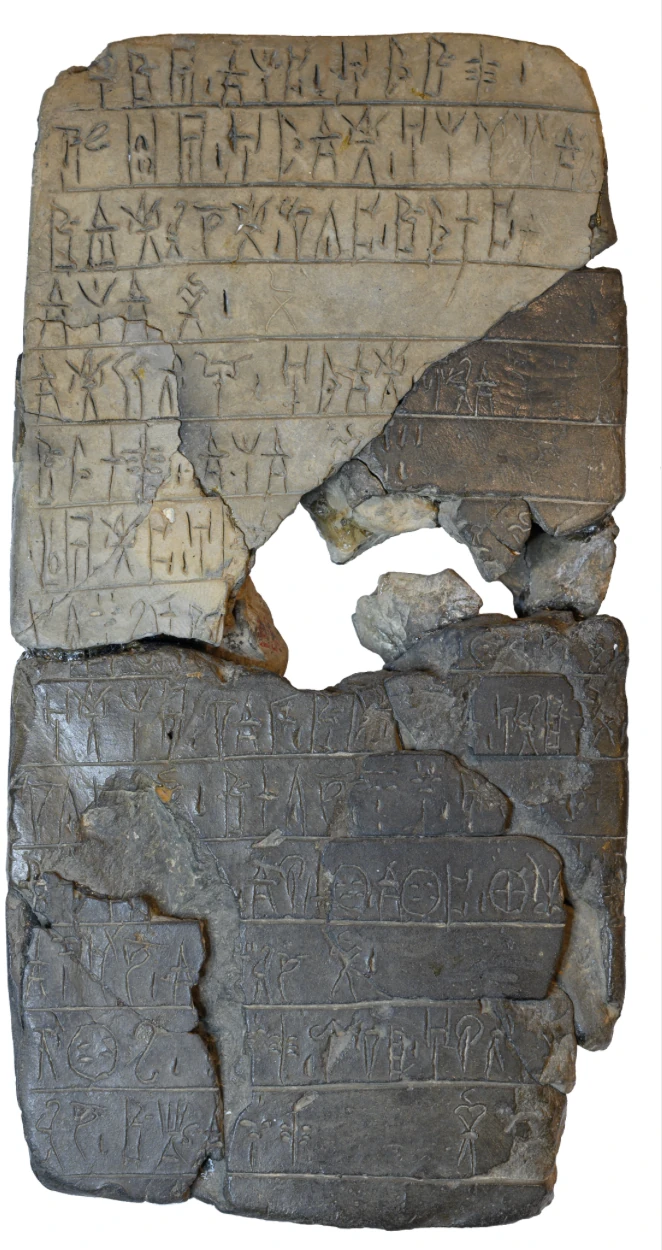
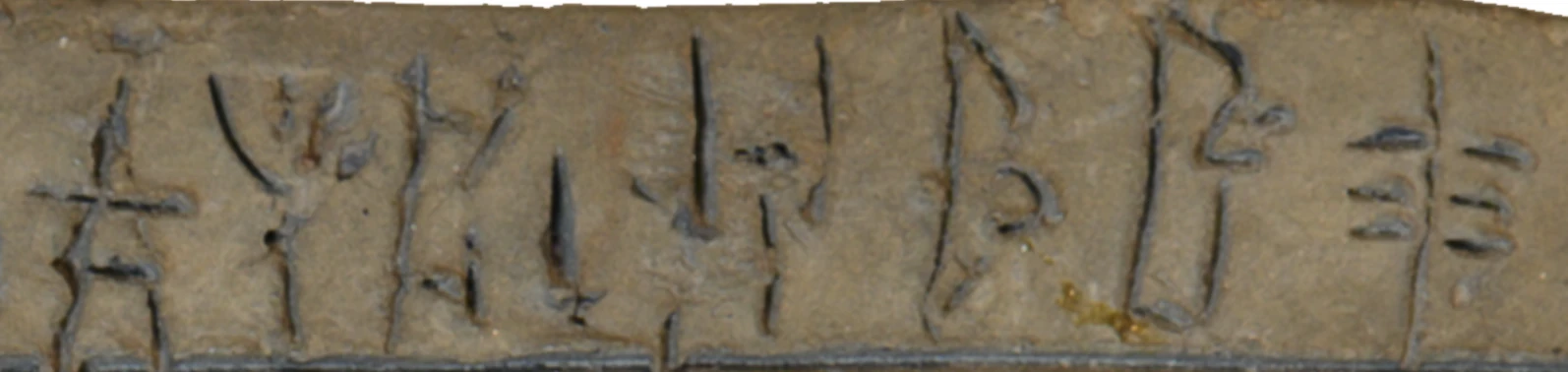
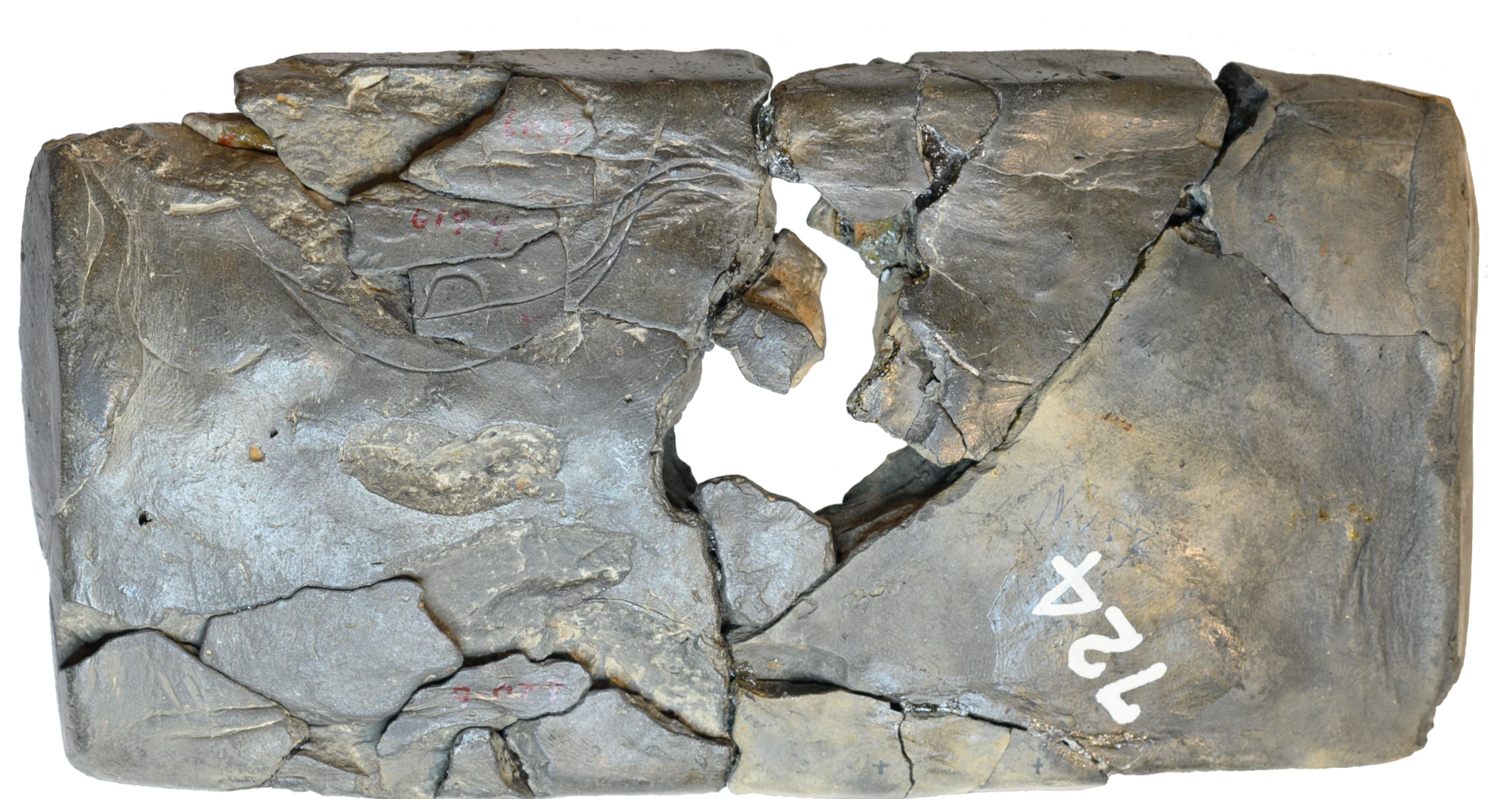
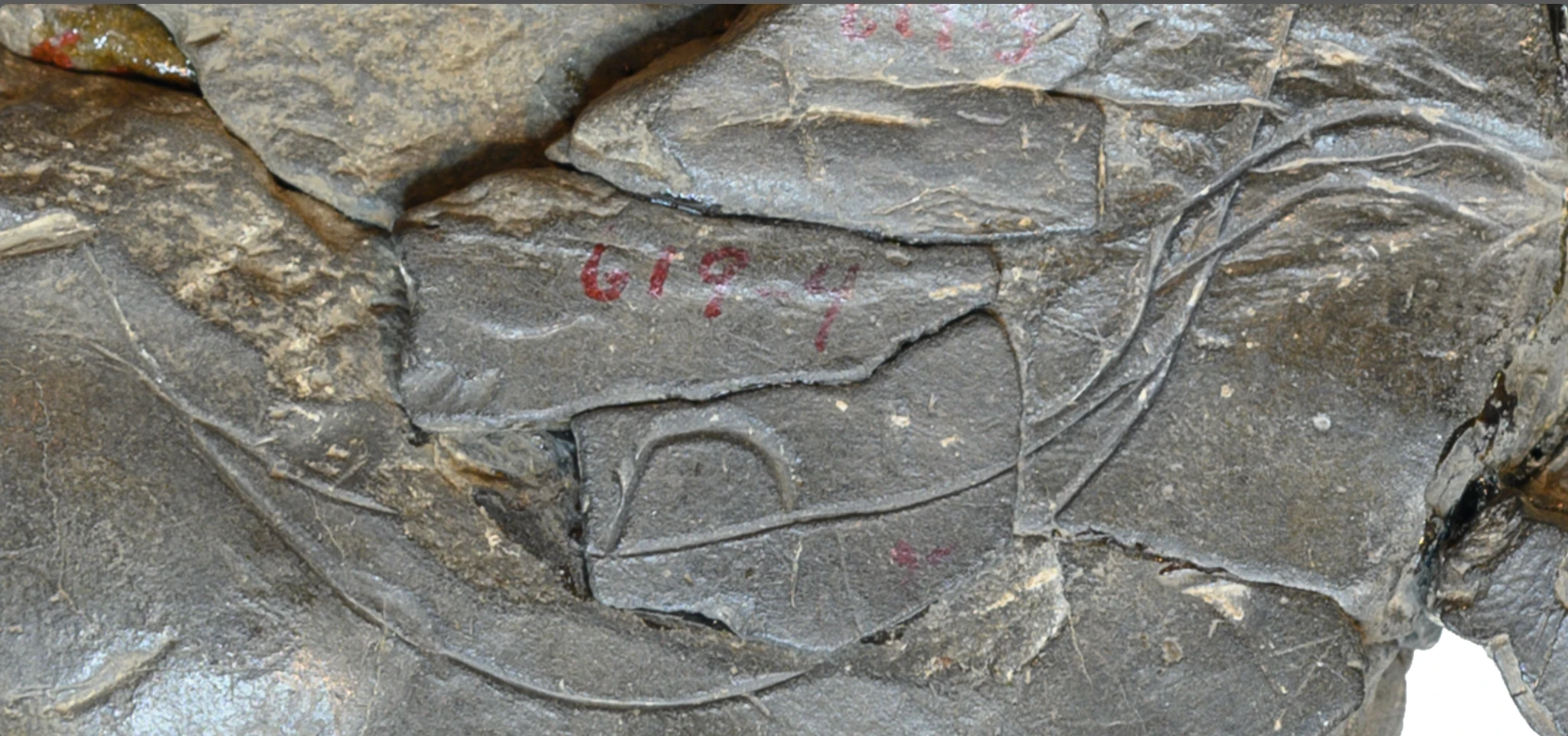
Shared credit for the four photographs: © National Archaeological Museum, Athens. Photograph by T. Manolova. Tablet: inv. Π 23769. Consulted via AncMed, catalogue A47.
Consulting the Original Tablets
Sección titulada «Consulting the Original Tablets»The photographs, Linear B signs and transliterations of these documents can be consulted in Linear B Explorer. Search for the following tablets:
| Tablet | Opening words |
|---|---|
| PY An 1 | e-re-ta pe-re-u-ro-na-de / i-jo-te |
| PY An 610 | me-za-[wo-]ne e-re-ta |
| PY An 724 | e-re-ta a-pe-o-te |
In all three documents, we can recognise the word e-re-ta, written 𐀁𐀩𐀲, meaning “rowers”. The numerical signs accompanying some of the entries indicate the numbers of men recorded.
What Do These Tablets Tell Us?
Sección titulada «What Do These Tablets Tell Us?»The three documents show that, centuries before Homer, Mycenaean palace administrators could register groups of rowers, identify their places of origin and keep track of their obligations. Seafaring required more than individual skill: men also had to be assembled and their participation organised.
Shelley Wachsmann examines these records in Seagoing Ships and Seamanship in the Bronze Age Levant (1998). His analysis calls for caution: the availability of hundreds of rowers does not, in itself, prove that a military expedition was being prepared. Ships could serve different purposes, and the documents do not allow us to reconstruct the circumstances behind these records.
Nor do these tablets describe Odysseus’ ships. They show, rather, that centuries before the Odyssey took shape, Mycenaean communities could organise rowing service and mobilise substantial numbers of men.
Bronze Age Ships and Homeric Ships
Sección titulada «Bronze Age Ships and Homeric Ships»Mycenaean representations provide a different kind of evidence. Pottery, models and drawings depict elongated vessels, oarsmen, masts and rigging, although the features shown vary from one representation to another. Wachsmann has studied these images, drawing attention to both their similarities and their differences.
Such evidence must be interpreted with caution. Ancient artists were not producing shipbuilding plans: they simplified shapes, altered proportions and emphasised particular features. Some details of how these vessels were constructed remain unknown.
From the Mycenaean World to Homer
Sección titulada «From the Mycenaean World to Homer»| Period | Approximate dates | Available evidence |
|---|---|---|
| Late Bronze Age | 1600–1200 BC | Minoan and Mycenaean ship depictions on pottery, in paintings and other media. |
| End of the Mycenaean palatial period | Around 1200 BC | Pylos tablets recording rowers; late Mycenaean depictions of ships. |
| Early Iron Age | 1050–900 BC | Scarcer and more fragmentary evidence of seafaring. |
| Geometric period | 900–700 BC | Depictions of hulls, oars and crews in Geometric art. |
| Composition of the Homeric poems | Eighth–seventh centuries BC | Poetic descriptions that may preserve elements of different traditions. |
Centuries of change separate the end of the Mycenaean palatial civilisation from the naval depictions of the Geometric period, and we cannot trace every stage of that development. Geometric pottery, especially scenes of ships associated with the Dipylon Group, provides images closer to the period in which the Homeric poems took shape.
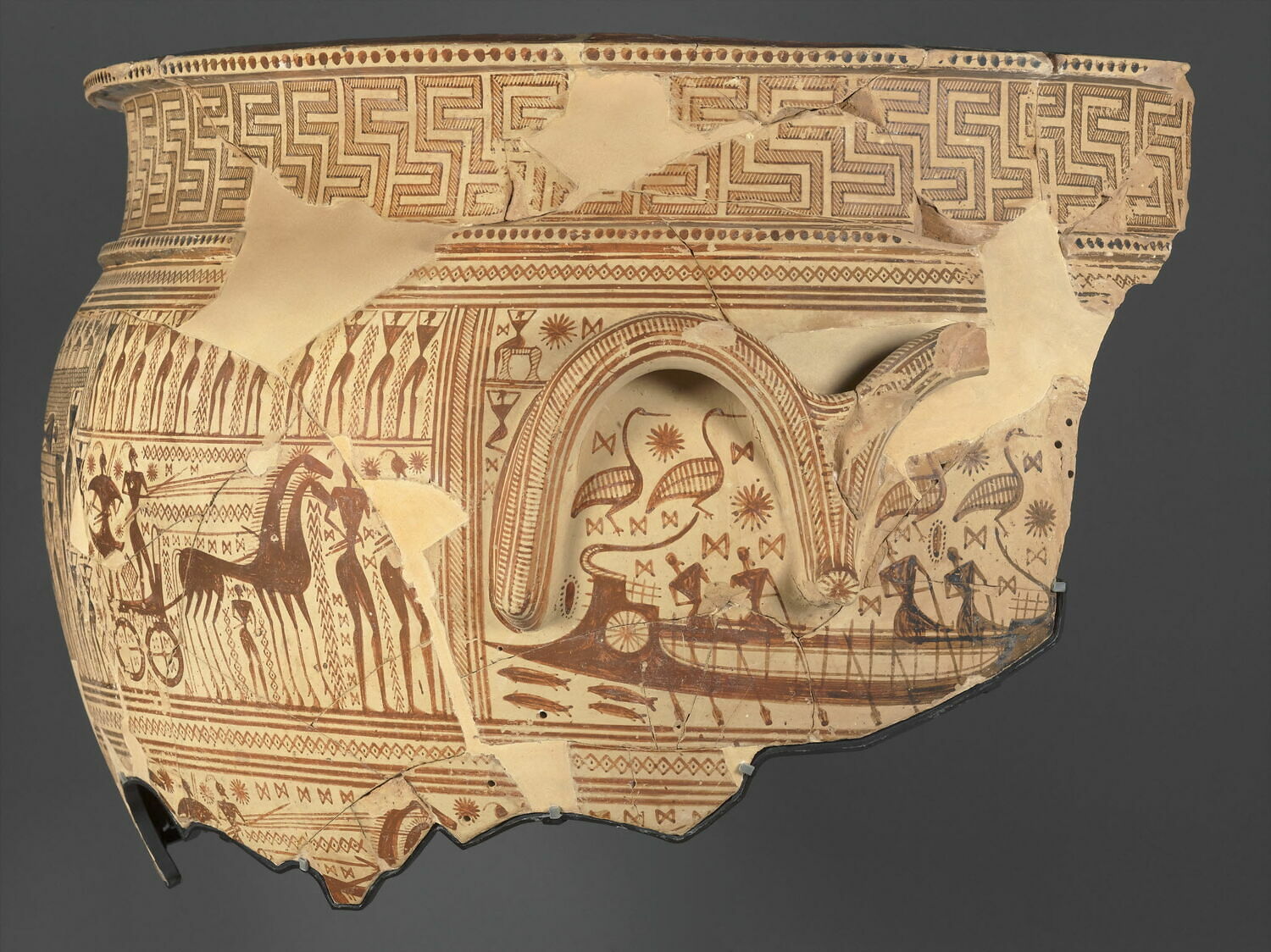
Mycenaean ships therefore provide important evidence for the earlier history of Aegean seafaring, but they cannot simply be taken as models for the ships described by Homer.
Men, Provisions and Dangers
Sección titulada «Men, Provisions and Dangers»When Homer speaks of a twenty-oared ship, he generally means twenty rowers, not necessarily twenty people in total aboard. The vessel could also carry passengers, warriors, provisions, weapons and booty. Water, wine and food were among the necessities of a voyage.
We should not imagine cabins or the comforts of a modern vessel. Men might sleep beside a ship drawn up on the beach; during his voyage home with the Phaeacians, Odysseus sleeps on the stern deck (Odyssey 13.70–80).
Nor was there necessarily a strict division between the functions we now assign to merchant ships, transports and warships. The same vessel might carry goods, transport armed men or take part in a raid. Homer’s world knows both trade and piracy, and its ships reflect that diversity.
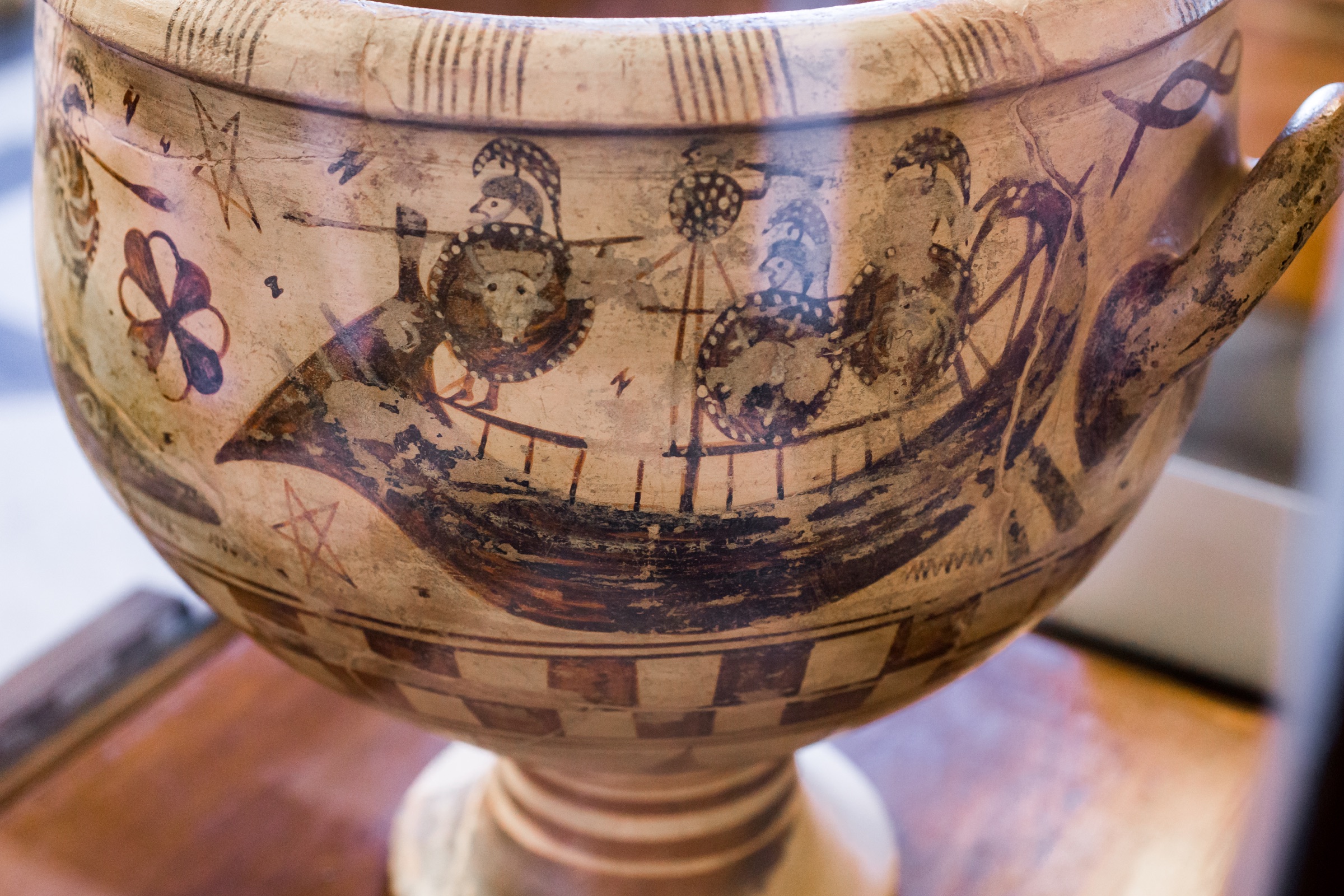
Images and archaeological evidence help us imagine the vessels known to different generations of the Aegean world. Yet the Homeric ship remains, above all, a ship made of words: a poetic creation in which memories of older techniques and experiences of seafaring survive, although we cannot always date them.
We have no single model. What we have are clues that help us understand how those people put to sea.