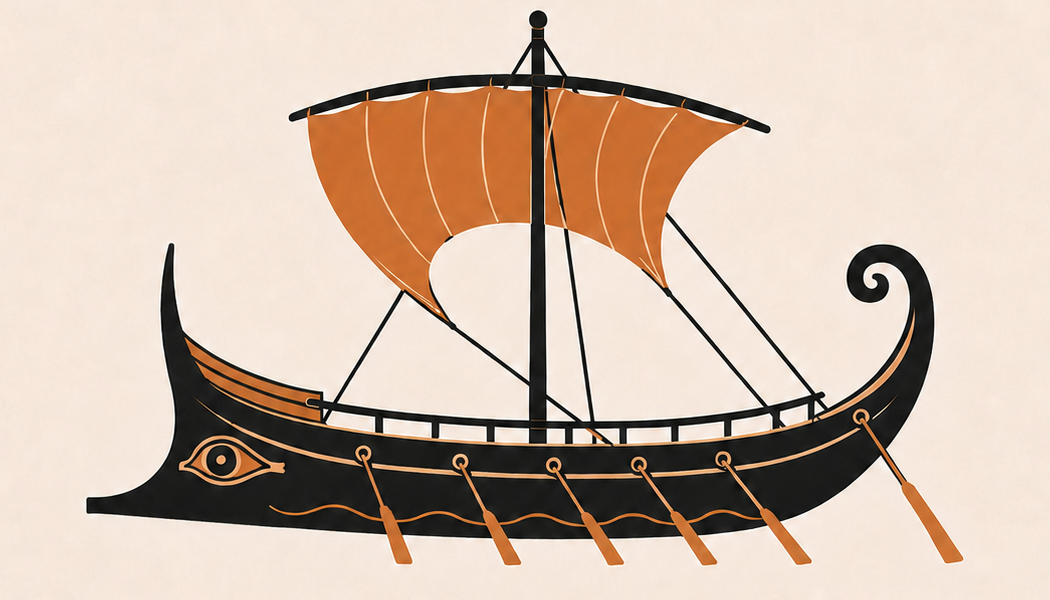
Iphigenia
The daughter whose fate changes with the telling.
In some traditions Iphigenia is sacrificed by her father Agamemnon; in others, Artemis saves her at the last moment and leaves a hind in her place. The story we call “the sacrifice of Iphigenia” is in fact a set of ancient versions that do not always agree. The decisive question, therefore, is not only whether she died, but how and why her story changed from one source to another.
The Iliad does not narrate this episode. In its list of Agamemnon’s daughters, an Iphianassa appears (Iliad 9.145–147), but identifying that name without qualification with the Iphigenia of later tradition neither resolves the problem nor adds a sacrifice that the poem does not tell.
Why was Iphigenia at Aulis?
Sección titulada «Why was Iphigenia at Aulis?»The traditions place the Achaean expedition at a standstill in Aulis before its departure for Troy. Sea and winds prevent the fleet from sailing; Calchas announces a demand from Artemis, and Agamemnon faces an extreme decision. This is the common framework, but the authors do not always explain the goddess’s anger or the king’s responsibility in the same way.
The summary of the Cypria attributed to Proclus says that, during a second gathering at Aulis, Calchas persuades Agamemnon to sacrifice his daughter in order to appease Artemis and secure the voyage. Aeschylus presents adverse winds, pressure on the ships and Agamemnon’s decision; Euripides makes the delay the centre of a conflict between the father, Menelaus, the army and the girl. These are related narratives, not a single chronicle to which each author merely added a detail.
What was Artemis’s role in the sacrifice?
Sección titulada «What was Artemis’s role in the sacrifice?»Artemis is the divinity who, in these versions, withholds or conditions the fleet’s departure. But the cause of her anger has no single formulation that can be applied to the whole tradition.
In the summary of the Cypria, Agamemnon has offended the goddess by killing a deer and boasting of his skill; in Aeschylus’ Agamemnon, Calchas, the Achaean seer, identifies Artemis as the cause of the winds without turning that background into a fully explained scene; in Iphigenia at Aulis, the prophecy attributed to Calchas demands the sacrifice, and the play explores above all the human decisions that follow.
This matters because the story does not simply present a goddess who “asks” for a victim. Each version decides how much weight to give to Agamemnon’s offence, the oracle, the pressure of the expedition or divine will.
What did the Cypria say?
Sección titulada «What did the Cypria say?»We do not possess the complete Cypria. We know this episode from an ancient summary transmitted under the name of Proclus, together with fragments and indirect testimonia; we should not present it as though we were reading the lost poem word for word.
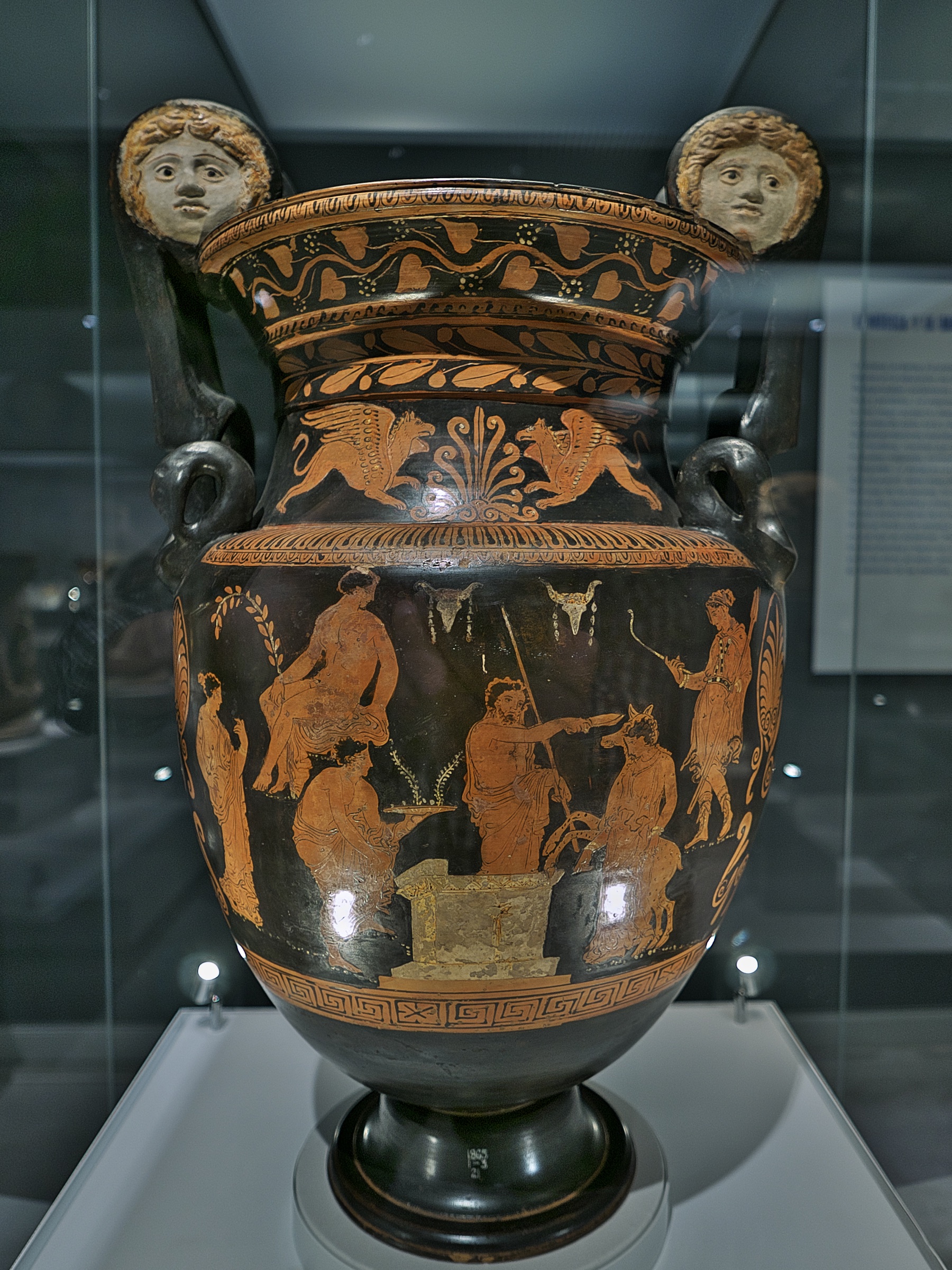
According to that summary, when the sacrifice has been prepared, Artemis snatches Iphigenia away and takes her to the land of the Taurians; in her place she leaves a hind beside the altar and makes the girl immortal. This detail is crucial: in the cyclic tradition as preserved indirectly, the outcome is not Iphigenia’s definitive death, but substitution, rescue and removal.
What changes in Aeschylus?
Sección titulada «What changes in Aeschylus?»In Agamemnon (lines 183–257), Aeschylus turns Aulis into the moral origin of the catastrophe of the house of Atreus. The chorus presents the adverse winds, the demand for a sacrifice that will calm the sea and Agamemnon’s deliberation. Finally, it shows him accepting the role of sacrificing his own daughter so that the fleet can depart.
The scene does not function as a mythographical entry. Its violence — the girl led to the altar, silenced and deprived of speech — makes Clytemnestra’s anger intelligible and hangs over Agamemnon’s return. The text does not then describe the final blow: the chorus declares that it did not see and will not tell what followed. That reserve strengthens the tragic function of the episode: the sacrifice is a guilt that organises the later destruction, not a historical fact that Aeschylus claims to document.
What happens in Iphigenia at Aulis?
Sección titulada «What happens in Iphigenia at Aulis?»Euripides makes the deception and its consequences visible. Agamemnon summons Iphigenia to Aulis on the pretext of a marriage to Achilles; Clytemnestra arrives trusting in that marriage, and Achilles discovers that his name has been used without his consent. The play sets a wavering Agamemnon against a mother pleading for her daughter and an Achilles who offers help, although he cannot overcome the pressure of the army.
Iphigenia moves from begging to be saved to declaring that she will give her life for the Achaeans. That transformation is a dramatic decision by Euripides, not a version that should automatically be transferred to the Cypria or to Aeschylus. The play thus turns the episode into a reflection on political violence, family and heroic language.
The ending requires special caution. The play has reached us through a difficult textual transmission, with additions or revisions disputed by scholars; the final messenger speech includes Iphigenia’s disappearance and the appearance of a hind. We should therefore not use that ending as indisputable proof of “what Euripides wrote” or as a secure reconciliation of all the variants. What the transmitted text does make clear is that its sacrificial ending and the possibility of Artemis’s intervention are deliberately held in tension.
What does Iphigenia among the Taurians show?
Sección titulada «What does Iphigenia among the Taurians show?»Euripides’ other tragedy presupposes a tradition in which Iphigenia survived. There she lives among the Taurians as a priestess of Artemis, far from Argos, and meets her brother Orestes again. The play develops their recognition and their escape from the land of the Taurians; it does not need to repeat the sacrifice at Aulis for the audience to understand that the girl had been saved and carried away by the goddess.
This surviving Iphigenia does not erase the sacrificed Iphigenia of Aeschylus. It shows that both possibilities could coexist within the tradition and serve different dramatic purposes.
Did Iphigenia really die in the tradition?
Sección titulada «Did Iphigenia really die in the tradition?»There is no single answer that can bring all the surviving evidence together without loss. The table allows the different layers to be compared without turning them into a single biography.
| Source / tradition | Date / layer | Iphigenia’s fate | Function of the version |
|---|---|---|---|
| Cypria, through the summary attributed to Proclus | Lost Epic Cycle; known indirectly | Artemis substitutes a hind for Iphigenia, takes her to the Taurians and makes her immortal | Explains the departure without a definitive death; the transmission is indirect. |
| Aeschylus, Agamemnon 183–257 | Fifth-century BC Athenian tragedy | The sacrifice is the decisive action and moral wound; the chorus does not narrate the material outcome | Makes Aulis the antecedent of Clytemnestra’s revenge and the ruin of the house of Atreus. |
| Euripides, Iphigenia at Aulis | Fifth-century BC tragedy; text with transmission problems | The action leads to the sacrifice; the transmitted ending introduces a hind and the girl’s disappearance | Explores deception, collective pressure and heroic resolve; the ending requires philological caution. |
| Euripides, Iphigenia among the Taurians | Fifth-century BC Athenian tragedy | Iphigenia lives as a priestess of Artemis among the Taurians | Provides unambiguous dramatic evidence for a tradition of survival. |
| Pseudo-Apollodorus, Epitome 3.21 | Later mythography | A hind is substituted for Iphigenia, who is then taken to the Taurians | Organises and transmits a variant; it is not equivalent to the lost cyclic poem. |
Why does a hind appear in Iphigenia’s place?
Sección titulada «Why does a hind appear in Iphigenia’s place?»The hind belongs to the logic of sacrificial substitution: Artemis removes the girl at the last moment and provides another victim for the altar. The motif is already present in the summary of the Cypria and reappears in later traditions; it is not a modern explanation designed to soften the story.
We do not know, however, whether all ancient versions understood that substitution in the same way or how they were related to one another. The hind does not “resolve” the contradiction: it marks the existence of an ancient strand of the myth that chose to preserve Iphigenia and move her to another setting under the power of Artemis.
What roles do Agamemnon, Clytemnestra and Achilles play?
Sección titulada «What roles do Agamemnon, Clytemnestra and Achilles play?»In tragedy, Iphigenia is not an isolated episode. Aeschylus makes the sacrifice an indispensable antecedent for understanding Clytemnestra’s murder of Agamemnon and, with it, the chain of revenge within the house of Atreus: the family descended from Atreus to which Agamemnon belongs. There is no need to develop the whole Oresteia here, Aeschylus’ trilogy about these crimes and acts of family vengeance, to see the connection: Aulis turns a decision of war into a wound within the family.
The deception involving a marriage to Achilles belongs in particular to Iphigenia at Aulis. Euripides presents Achilles as initially unaware of the plan and turns him into Iphigenia’s defender when he discovers that his name has been used as bait. This is not a detail from Homer, nor a feature common to all variants.
Why does this story change so much?
Sección titulada «Why does this story change so much?»Because the narratives do not all pursue the same question. The Epic Cycle links the departure to Artemis’s intervention and to substitution; Aeschylus explores Agamemnon’s guilt and the destruction of his house; Euripides develops deception, violence against a daughter, the pressure of war and the possibility of rescue. Mythography organises variants that tragedy has turned into conflict.
Variation is not noise that we need to eliminate. It is part of the history of the myth: different periods recognise Iphigenia, Aulis, Artemis and the expedition to Troy, but change the moral and narrative meaning of those same elements.
What can we say with the greatest confidence?
Sección titulada «What can we say with the greatest confidence?»Iphigenia belongs to an ancient tradition connected with Aulis and the departure of the Achaeans for Troy. Homer does not narrate her sacrifice. Later and cyclic sources do not agree about her fate: the sacrificial version and the version in which a hind is substituted for her coexisted; tragedy developed their familial and moral consequences with exceptional force.
For that reason, we should not choose one later variant and turn it into “what really happened”. The answer most faithful to the sources is that the story of Iphigenia was, from an early stage, a story with versions.