Helenus and Cassandra
Two children of Priam whom tradition associated with prophecy, though the poems treat them differently and their destinies diverge.
Helenus and Cassandra were children of Priam and Hecuba. This page brings them together because later tradition turned them into a pair of seers and contrasted their destinies, not because Homer constructs them as symmetrical figures. An ancient tradition attributed to Anticlides (late fourth century BC) described them as twins and explained their prophetic powers through a prodigy in childhood: while they slept in the sanctuary of Apollo Thymbraeus during a festival, sacred snakes were said to have licked their ears. From then on, both would know what was to come.
Homer, however, does not tell this story of a shared origin. In the Iliad, Helenus is already an inspired counsellor whose words are heeded; Cassandra does not yet appear as a prophetess. Later tradition turned this difference into a paradox: he was able to use his knowledge to survive; she knew disaster was coming but could persuade no one.
Cassandra: a voice tradition refused to believe
Sección titulada «Cassandra: a voice tradition refused to believe»How did Cassandra receive the gift of prophecy?
Sección titulada «How did Cassandra receive the gift of prophecy?»The story of the snakes belongs to a later tradition attributed to Anticlides, not to Homer. The best-known explanation comes from Servius (late fourth to early fifth century AD), in his commentary on Aeneid 2.247: Apollo desired Cassandra and, when she rejected him, did not take away her ability to foresee the future, but caused no one to believe her prophecies.
What does Homer say about Cassandra?
Sección titulada «What does Homer say about Cassandra?»The Iliad calls her the most beautiful of Priam’s daughters (Iliad 13.363–369) and, when she is the first to see Priam returning with Hector’s body, compares her with golden Aphrodite (Iliad 24.699–706). But Homer gives no detailed physical portrait.
Dares the Phrygian, a much later source, describes her as of medium height, with a rounded mouth, reddish hair and gleaming eyes (De excidio Troiae historia 12). The description is not Homeric. In later tradition, detailed physical portraits proliferate for Trojan characters whom the Homeric poems do not describe in such terms.
The fall of Troy and its aftermath
Sección titulada «The fall of Troy and its aftermath»Did Cassandra warn the Trojans about the Trojan Horse?
Sección titulada «Did Cassandra warn the Trojans about the Trojan Horse?»That is the famous tradition, but it is not narrated in the Iliad or the Odyssey. Later traditions have Cassandra warn that the horse left behind by the Achaeans conceals enemy warriors, and have the Trojans refuse to believe her. The story concentrates her fate into a single scene: the city receives a true warning precisely from the voice that has been rendered powerless to persuade.
What did Ajax the Lesser do to her?
Sección titulada «What did Ajax the Lesser do to her?»During the sack, Cassandra seeks refuge in the sanctuary of Athena and clings to the image of the goddess. Ancient tradition does not preserve a single version: some sources emphasise the sacrilege of dragging a suppliant from the sanctuary; others explicitly describe rape. Neither version should be reduced to a decorative detail: in all of them, Ajax the Lesser violates the protection owed to Athena and to the suppliant.
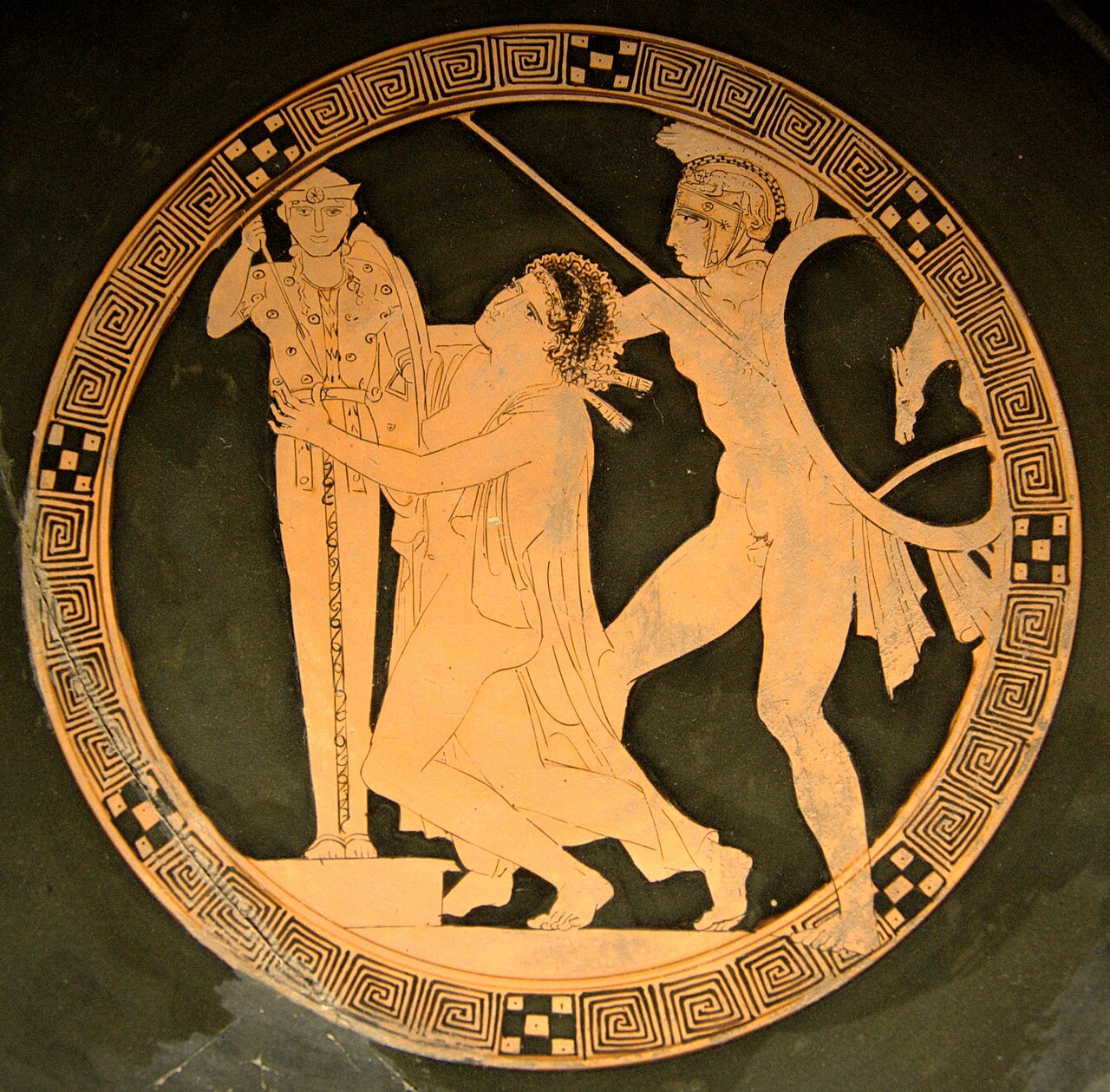
The crime provoked Athena’s anger. Later tradition connects Ajax’s death on the voyage home with this outrage; it is not a Homeric episode, but part of the later stories of the nostoi.
What was Cassandra’s relationship with Agamemnon?
Sección titulada «What was Cassandra’s relationship with Agamemnon?»After the fall, Cassandra is among the captives, and Agamemnon takes her with him to Greece. Some traditions make her more than a captive taken in war: Euripides presents decisions by Agamemnon that others interpret in the light of his regard for Cassandra. Pausanias also transmits a tradition according to which they had two sons, Teledamus and Pelops (Description of Greece 2.16.6–7). None of these details is Homeric.
How did Cassandra die?
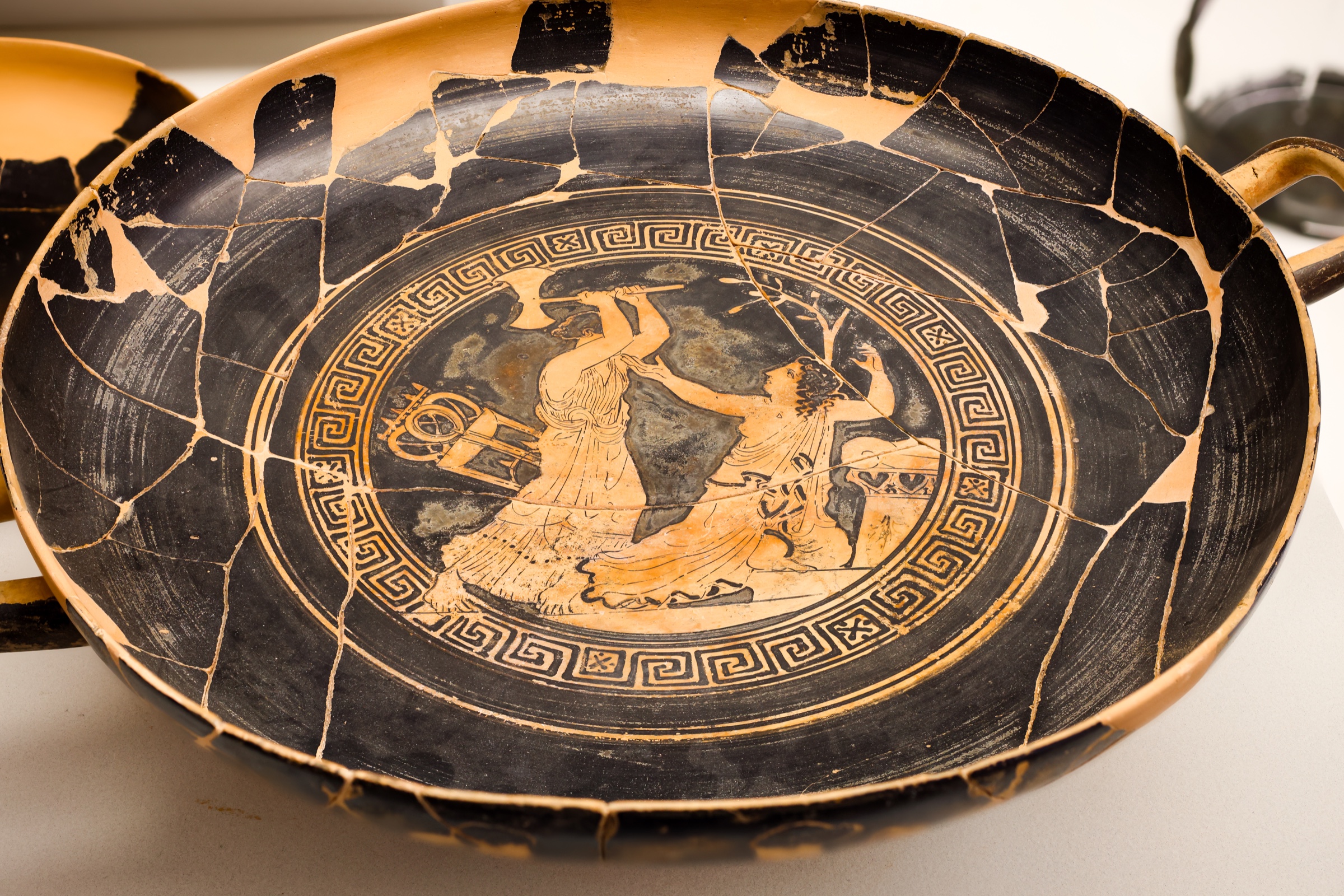
Sección titulada «How did Cassandra die?»Cassandra understands that Clytemnestra is preparing to murder Agamemnon and that she herself will die if she enters the palace. In Aeschylus’ Agamemnon, she also sees the crimes of the house of Atreus and foretells the avenging return of Orestes, but her knowledge cannot save her.
She is murdered alongside Agamemnon. The outcome is already known to the Odyssey: Agamemnon’s shade recalls that, as he died, he heard Cassandra’s voice (Odyssey 11.421–426). Pausanias adds that Teledamus and Pelops were also killed by Aegisthus.
Was Cassandra venerated after her death?
Sección titulada «Was Cassandra venerated after her death?»Yes, according to Pausanias. In Laconia he found sanctuaries of Alexandra, identified there with Cassandra, and other cities claimed to possess her tomb. The young woman whom no one believed in life came to be honoured after death and, centuries later, became an object of cult. This is later religious reception, not a Homeric fact.
Helenus: a counsellor who was heard and a changing postwar fate
Sección titulada «Helenus: a counsellor who was heard and a changing postwar fate»Was Helenus only a seer?
Sección titulada «Was Helenus only a seer?»No. In the Iliad he already appears as a recognised seer: he advises Hector and Aeneas when the Achaeans press against the walls, recommends sending Hecuba to Athena’s temple (Iliad 6.73–101) and, understanding a plan of Apollo and Athena, urges Hector to challenge the Achaeans to single combat (Iliad 7.44–53). His words lead to action.
He also fights. He kills Deipyrus and shoots at Menelaus; Menelaus drives a spear through the hand with which Helenus holds his bow (Iliad 13.576–600). A later tradition even claimed that Helenus wounded Achilles in the hand, but that should not be projected back onto the Iliad.
Why did he leave Troy?
Sección titulada «Why did he leave Troy?»There is no single explanation. Pseudo-Apollodorus says that, after Paris’ death, Helenus and Deiphobus competed for Helen; when Deiphobus was chosen, Helenus withdrew to Mount Ida. Dictys of Crete offers another version: Helenus breaks with his own people over a sacrilege against Apollo and voluntarily surrenders to the Achaeans after receiving guarantees. These are variants, not episodes that can simply be combined.
Did Helenus betray Troy?
Sección titulada «Did Helenus betray Troy?»It depends on the version. In Pseudo-Apollodorus, Odysseus captures him in an ambush and the Achaeans obtain decisive information from him; in Dictys, his cooperation is voluntary, but follows an earlier break with the Trojan leaders. To call him simply a “traitor” would erase the difference between a captive compelled to speak and a prince who decides to abandon his city.
What secrets did he reveal to the Achaeans?
Sección titulada «What secrets did he reveal to the Achaeans?»Pseudo-Apollodorus attributes to him three conditions for the capture of Troy: bringing the bones of Pelops to the camp, bringing Neoptolemus into the war and stealing the Palladium. Sophocles preserves another tradition in the Philoctetes: Helenus is already in Achaean hands before Paris’ death and announces that Philoctetes must go to Troy, where he will be healed, and that he and Neoptolemus will prove decisive. Tradition did not preserve a single stable list of secrets.
What happened to Helenus after the war?
Sección titulada «What happened to Helenus after the war?»He survives the fall of Troy and remains connected with Neoptolemus. One tradition says that he advises him to avoid the sea voyage home and head for Epirus, thus escaping the storm that strikes other leaders. The sources later place Helenus in Molossia, where he eventually settles and rules.
Whom did Helenus marry?
Sección titulada «Whom did Helenus marry?»Here too the versions differ. Pseudo-Apollodorus says that Neoptolemus gave him Deidamia, his own mother; other traditions unite Helenus with Andromache, Hector’s widow and Neoptolemus’ captive. The latter version became especially influential: Virgil has Aeneas encounter Helenus in Epirus as king, with Andromache as his wife.
Two figures brought together by tradition, not by parallel lives
Sección titulada «Two figures brought together by tradition, not by parallel lives»The Iliad presents Helenus as an inspired counsellor whose words guide action, while in Cassandra it emphasises beauty, kinship and lament, not a prophetic gift. Later tradition draws them together through prophecy and separates their destinies: she becomes a truthful voice without authority; he, a survivor able to negotiate, advise and rule. The contrast is powerful, but it belongs to a history of versions, not to a single psychology constructed by Homer.