How Do We Know What Happened in the Trojan War?
We do not possess a single ancient work that tells the whole Trojan War from beginning to end. What we now call ‘the story of the Trojan War’ is assembled from poems, fragments, summaries, tragedies, mythographical compendia, Latin works, commentators and modern reconstructions.
Each of these sources answers a different question. Some narrate; others merely allude; some summarise lost poems; others reimagine the story centuries later. Nor do they belong to a single period: many centuries separate Homer and the Epic Cycle from the Byzantine commentators. Reconstructing the Trojan War therefore does not mean reading a single chronicle; it means recognising what each witness tells us, when it was composed and how it has reached us.
Is there a single story of the Trojan War?
Sección titulada «Is there a single story of the Trojan War?»No. There is a shared body of Trojan tradition — Helen, Paris, Achilles, Hector, the fall of the city and the homecomings — but there is no single ancient version that gathers all its episodes into one fixed form.
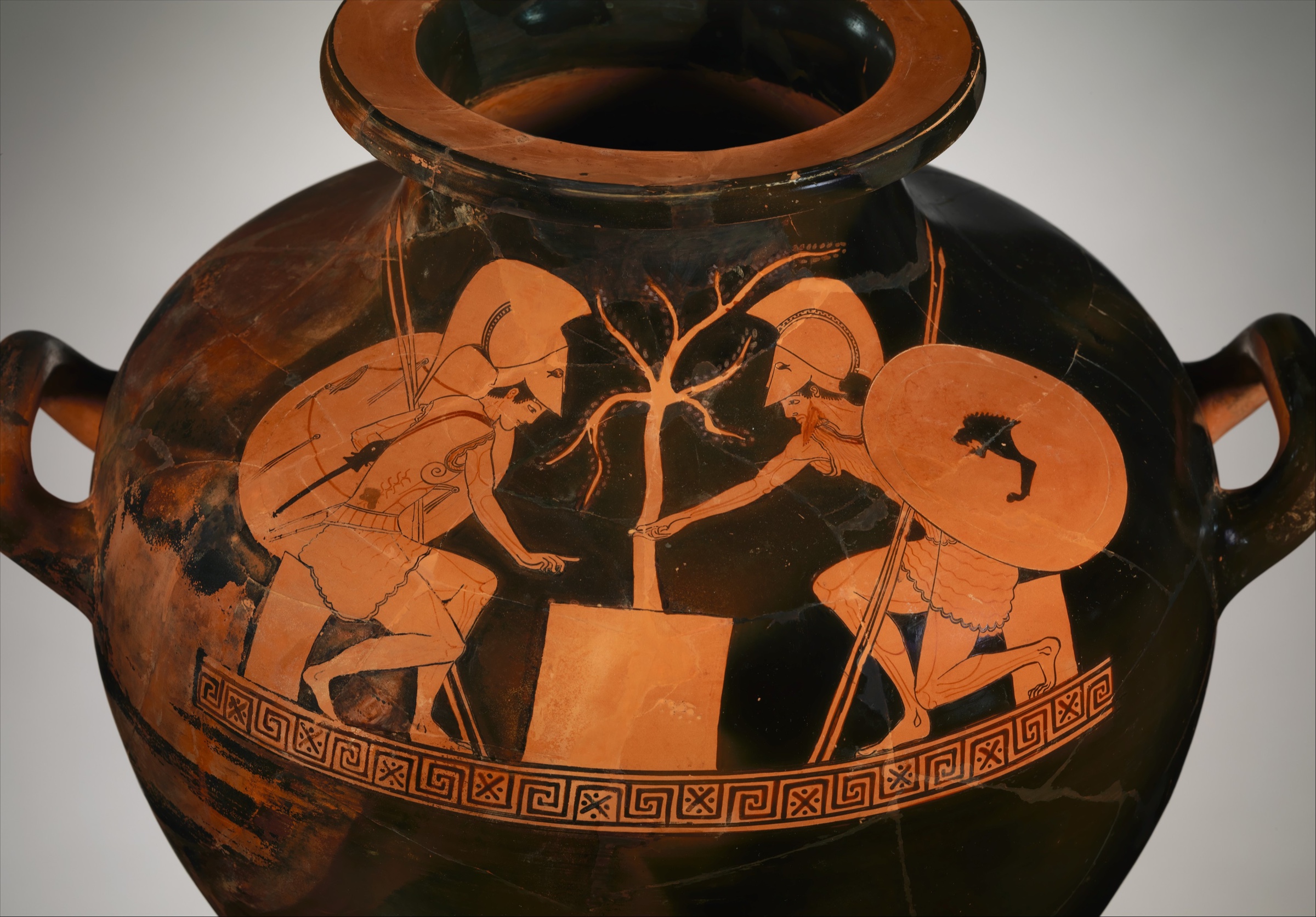
Homer stands at the centre of the literary tradition that has survived, but he does not exhaust the Trojan material. The poems of the Epic Cycle narrated other phases of the war; lyric poetry and tragedy transformed characters and conflicts; mythography organised genealogies and variants; Rome rewrote the fall of Troy according to its own concerns; and later commentators preserved notices of lost works and ancient interpretations.
The right question is not only ‘what happened?’, but also: who tells it, when, and through what kind of source?
What does Homer actually tell us?
Sección titulada «What does Homer actually tell us?»The Iliad does not begin with the abduction of Helen, does not narrate the full ten years of war, and does not tell of the death of Achilles, the Trojan Horse or the fall of Troy. Its main action occupies only a short span in the tenth year: roughly six weeks, often summarised as about forty days, although the total depends on how the intervals are counted; Irene J. F. de Jong counts fifty-one days under a different convention. Only about fourteen of those days contain narrated action. The poem begins with the wrath of Achilles and ends with the funeral of Hector.
That does not make the Iliad an incomplete version that later authors had to finish. It is a poem with a narrative design of its own: it concentrates the war into a particular crisis — the wrath of Achilles, the death of Patroclus, the duel with Hector and Troy’s final mourning.
The Odyssey does not provide a continuous history of the war either, but it preserves decisive memories. Helen and Menelaus recall the Trojan past; Demodocus sings of the Horse; Odysseus speaks with Achilles and Ajax among the dead; and several characters remember the homecomings and their consequences. The poem also knows that Memnon killed Antilochus, although it does not narrate that battle.
Hector therefore belongs above all to the core of the Iliad, whereas episodes such as the arrival of Penthesilea, the arrival of Memnon or the death of Achilles require us to turn to other traditions.
What were the poems of the Epic Cycle?
Sección titulada «What were the poems of the Epic Cycle?»The name Trojan Epic Cycle is used for a group of poems dealing with the events before the war, episodes following the Iliad, the fall of Troy and the heroes’ homecomings. Among them were:
| Poem | Main subject | Approximate date | How it should be cited |
|---|---|---|---|
| Cypria | Prehistory of the war, expedition, early years of the war and events before the Iliad. | Late 7th to 6th century BC (disputed). | Lost poem, known indirectly; traditionally attributed to Stasinus of Cyprus. |
| Aethiopis | Penthesilea, Memnon, and the death and funeral of Achilles. | 7th century BC (disputed). | Lost poem, known indirectly; traditionally attributed to Arctinus of Miletus. |
| Little Iliad | Arms of Achilles, Ajax, Philoctetes, Helenus, Neoptolemus, the Palladium and the Horse. | 7th–6th centuries BC (disputed). | Lost poem, known indirectly; traditionally attributed to Lesches of Lesbos. |
| Sack of Ilium | Capture of the city, death of Priam, the captive women and the Achaean departure. | 7th–6th centuries BC (disputed). | Lost poem, known indirectly; traditionally attributed to Arctinus of Miletus. |
| Nostoi (Returns) | Fates of several Achaeans after the fall of Troy. | 7th–6th centuries BC (disputed). | Lost poem, known indirectly; traditionally attributed to Agias of Troezen. |
The order of the events narrated by these poems does not date them. A poem dealing with events before the Iliad was not necessarily composed earlier. The forms in which several cyclic poems are known are usually placed in the 7th and 6th centuries BC, probably after the Iliad; but the dating remains disputed, and the traditions from which they drew may be older. We cannot securely arrange all the poems in chronological order of composition.
These dates are approximate and refer to the forms of the poems that scholarship attempts to place in time. They are, in any case, relatively close to the period in which Homeric composition is usually situated, but they do not allow us to establish with certainty which poem came first. Nor do they date the Trojan traditions the poems may have inherited, or make the authorial names transmitted by ancient sources secure.
We should not imagine these poems as a mechanical continuation of Homer, nor as works written simply to fill in what the Iliad does not tell. They narrated other phases of the Trojan tradition and may have developed in complex, partly parallel relationships with the Homeric poems.
Thus the Judgement of Paris and the story of Iphigenia are associated above all with the Cypria; Penthesilea and Memnon with the Aethiopis; and the capture of Helenus, the fate of Cassandra and the fall of Troy with the Little Iliad and the Sack of Ilium.
How do we know poems that have been lost?
Sección titulada «How do we know poems that have been lost?»Most of these poems do not survive complete. We know them through fragments, quotations, notices in other authors, scholia and, above all, the synopses transmitted under the name of Proclus.
Those synopses are an essential guide to the episodes attributed to each poem. They allow us to follow, for example, the arrival of Penthesilea, the death of Memnon, the contest for the arms of Achilles, the building of the Horse and the sack of the city.
But these synopses do not transmit the poems themselves: they transmit summaries. We cannot automatically reconstruct their verses, tone, scenes or every detail. The correct formulation is therefore ‘the summary transmitted under the name of Proclus attributes this to the Aethiopis’, not ‘the Aethiopis certainly tells every detail later developed by another version’.
This matters, for example, with Achilles, Palamedes or the Trojan Horse: the core of a tradition may be ancient, while the particular form we remember today may come from a later source.
Why does it matter to distinguish three dates?
Sección titulada «Why does it matter to distinguish three dates?»A Trojan tradition can have at least three different times.
ONE STORY, THREE CHRONOLOGICAL LAYERS
| 1 · NARRATIVE TIME The time in which the story is set | The heroic age in which tradition places the Trojan War, conventionally associated with the Late Bronze Age. This does not prove that the epic narrative describes a verifiable historical event. |
|---|---|
| 2 · DATE OF COMPOSITION When the story was written or reshaped | Different poets and authors retell, select or transform the Trojan tradition at different times: Homer · Epic Cycle · Lyric poetry · Tragedy · Mythography · Rome · Commentators. |
| 3 · DATE OF THE SURVIVING EVIDENCE When the evidence available to us was produced | The original work does not always survive. Sometimes we know it only through a fragment, quotation, summary, scholion or later manuscript. The surviving evidence may be centuries later than the work itself. |
| TWO EXAMPLES | |
| Penthesilea and Memnon The Aethiopis placed them after Hector’s death. The poem is lost; its plot survives mainly in a later summary. | The Trojan Horse The Odyssey already knows the Horse. Other lost poems developed the episode further. |
The time in which the story is set, the date when a work was composed, and the date of the evidence through which it survives are not the same.
An ancient tradition may survive only in much later evidence.
-
Narrative time. This is the heroic time in which tradition places the war, conventionally associated with the Late Bronze Age. That association does not demonstrate that the epic war occurred as a verifiable historical event.
-
Date of composition or circulation. This is the period in which a work recounting an episode may have been composed, performed or fixed in a more stable form. Homer and the cyclic poems belong to the Archaic world; Stesichorus is usually placed in the 7th–6th centuries BC; Aeschylus, Sophocles and Euripides in the 5th century BC; Virgil, Ovid and Seneca between the 1st century BC and the 1st century AD; later compendia and commentaries extend into Late Antiquity and Byzantium.
-
Date of the surviving evidence. This is the date of the papyrus, manuscript, quotation, scholion or summary through which we know a tradition today. A poem may be ancient and yet reach us only through a much later notice.
Penthesilea and Memnon provide a good example. The Aethiopis placed them after Hector’s funeral, but the poem does not survive complete. We know its plot mainly through a later synopsis. That does not mean the tradition originated at the date of the summary; nor does it allow us to recover the lost poem word for word.
The fact that a notice reaches us late does not prove that it is itself late; but neither does it prove, by itself, that it preserves an ancient tradition unchanged.
What did later poets and dramatists do?
Sección titulada «What did later poets and dramatists do?»Later poets are not merely repositories of information that complete Homer. More than six centuries separate Stesichorus from Seneca: these are authors who reshape Trojan material in response to problems of their own.
Stesichorus, in the 7th–6th centuries BC, offers decisive variants of Helen. In 5th-century Athens, Aeschylus turns the homecomings, Cassandra and the house of Agamemnon into a tragedy of crime and vengeance; Sophocles returns to Ajax and Philoctetes; Euripides transforms Iphigenia, Helen, Hecuba, Polyxena and the captive women of Troy into figures of political, familial and moral conflict.
Many centuries later, Roman literature recreated Troy once again. Virgil wrote in the late 1st century BC; Ovid around the turn from the 1st century BC to the 1st century AD; Seneca in the 1st century AD. Virgil made the fall of the city and Aeneas part of a foundational story for Rome; Ovid and Seneca developed new voices, gestures and forms of violence. These works may preserve older variants, but they should not be used as though they automatically revealed the archaic form of the myth.
The stories of Paris, Helen and Polyxena show particularly well how the same character changes function from one source to another.
What value do mythographers, scholia and commentators have?
Sección titulada «What value do mythographers, scholia and commentators have?»Pseudo-Apollodorus, probably dating from between the late 1st and the 2nd century AD, and Hyginus, whose date is more uncertain and is usually placed between the 1st and 2nd centuries AD, organise genealogies, connect episodes and preserve variants that appear scattered elsewhere. They are useful guides, but they are late compilers: their accounts do not become contemporary evidence for the heroic war.
The scholia to Homer, Servius — from Late Antiquity — and Eustathius and Tzetzes — Byzantine scholars of the 12th century — have a different value. They may preserve notices from ancient philologists, indirect fragments, interpretations, etymologies or alternative versions. But these are stratified materials: the date of the manuscript or commentator is not enough to date every piece of information they transmit.
A late source may therefore preserve earlier material, combine different traditions or create a new explanation. Each case requires a recognisable chain of transmission and should not enter the narrative as though it were Homeric evidence.
Why are Dictys and Dares not witnesses to the war?
Sección titulada «Why are Dictys and Dares not witnesses to the war?»The surviving texts transmitted under the names Dictys of Crete and Dares the Phrygian are works of Late Antiquity. The Latin version of Dictys that we read dates from the 4th century AD, although it depends on an earlier Greek version from the 2nd–3rd centuries AD; the account attributed to Dares is usually dated to the late 5th century AD. Both present the war with the appearance of memory, eyewitness testimony or chronicle. Their narratives pretend to come from participants in the events: an Achaean in the case of Dictys and a Trojan in the case of Dares.
That is a literary fiction, not evidence that we possess campaign diaries or contemporary documents from the war. Nor are these works substitutes for the lost poems of the Cycle.
Their interest lies elsewhere: they show how, centuries later, tradition sought to imagine Troy with an appearance of historical precision. They develop negotiations, kinship ties, physical descriptions, palace intrigues and personal motives that are not found in Homer and cannot automatically be transferred to the Epic Cycle. This is especially important on the pages devoted to Palamedes, Nauplius and Polyxena.
How, then, should we read a Trojan tradition?
Sección titulada «How, then, should we read a Trojan tradition?»For any episode of the Trojan War, five questions are useful:
Who tells it? → When? → How has it reached us? → What is its relationship to Homer? → Are there variants?
This method does not impoverish the myth. It allows us to see more clearly what each source does: Homer concentrates a crisis; the Cycle ranges across other phases; tragedy changes the point of view; mythography organises; Rome transforms; commentators transmit and reinterpret; archaeology studies a place and its successive cities.
The Trojan War survives not because a single version remained intact. It survives because for centuries it was told, debated, summarised, reinterpreted and imagined anew.