Was the Trojan Horse Really a Horse?
Homeric tradition and Archaic iconography present a horse. We do not know whether the story preserves a transformed memory of some historical event, but we have no solid reason to replace that horse with a ship. The naval interpretation is an interesting modern hypothesis, with genuine but weak and unprovable support.
What Homer says
Sección titulada «What Homer says»The Iliad ends with Hector’s funeral: it narrates neither the Horse nor the fall of Troy. The Odyssey, however, looks back on an object called ἵππος (hippos, “horse”).
In Odyssey 4.271–289, Helen walks around it and imitates the voices of the Achaeans’ wives, while the men remain hidden inside. In Odyssey 8.487–520, Demodocus sings of the ἵππος δουρατέος (hippos dourateos, “wooden horse”) that Epeius builds with Athena’s help; Odysseus fills it with warriors, brings it into the citadel, and from it emerge the men who sack Troy. In Odyssey 11.523–532, Odysseus again recalls that the Achaeans entered the horse made by Epeius.
Homer allows us to say that the object is called a horse, contains warriors and is connected with the stratagem and the sack. He gives no dimensions, wheels or extended technical description. Sinon, Laocoön and other familiar details belong to later traditions.
The adjective dourateos can refer to wooden beams or planks; in the context of the poem, the usual reading is “wooden horse”. The fact that the text does not describe its form in detail does not make the name it uses indeterminate.
How the tradition developed
Sección titulada «How the tradition developed»The motif continued to develop in other epic and literary traditions. The Iliou Persis (“Sack of Ilium”), a poem of the Epic Cycle now lost and known through the summary attributed to Proclus, presents the Trojans debating whether to throw the Horse down, burn it or dedicate it to Athena. They choose the last option, and two serpents kill Laocoön and one of his sons. It is important evidence for the tradition of the Cycle, although the complete poem has not survived.
Virgil, Aeneid 2 later develops Sinon’s deception and the fall from Aeneas’ perspective. Quintus of Smyrna, Posthomerica 12 offers an extended account of the construction of the hollow Horse. None of these later developments should simply be projected back onto Homer.
What Archaic iconography shows
Sección titulada «What Archaic iconography shows»Iconography is independent evidence: it documents how the motif was understood, not a historical event, and not necessarily an illustration of a particular passage.
| Object | Date and provenance | What it allows us to say |
|---|---|---|
| Boeotian bronze fibula | ca. 680 BC; British Museum, inv. 1898,1118.1 | Preserves part of a horse on wheels with a rectangular body. The museum cautiously identifies it as the Trojan Horse; its fragmentary state does not allow warriors to be recognised inside. |
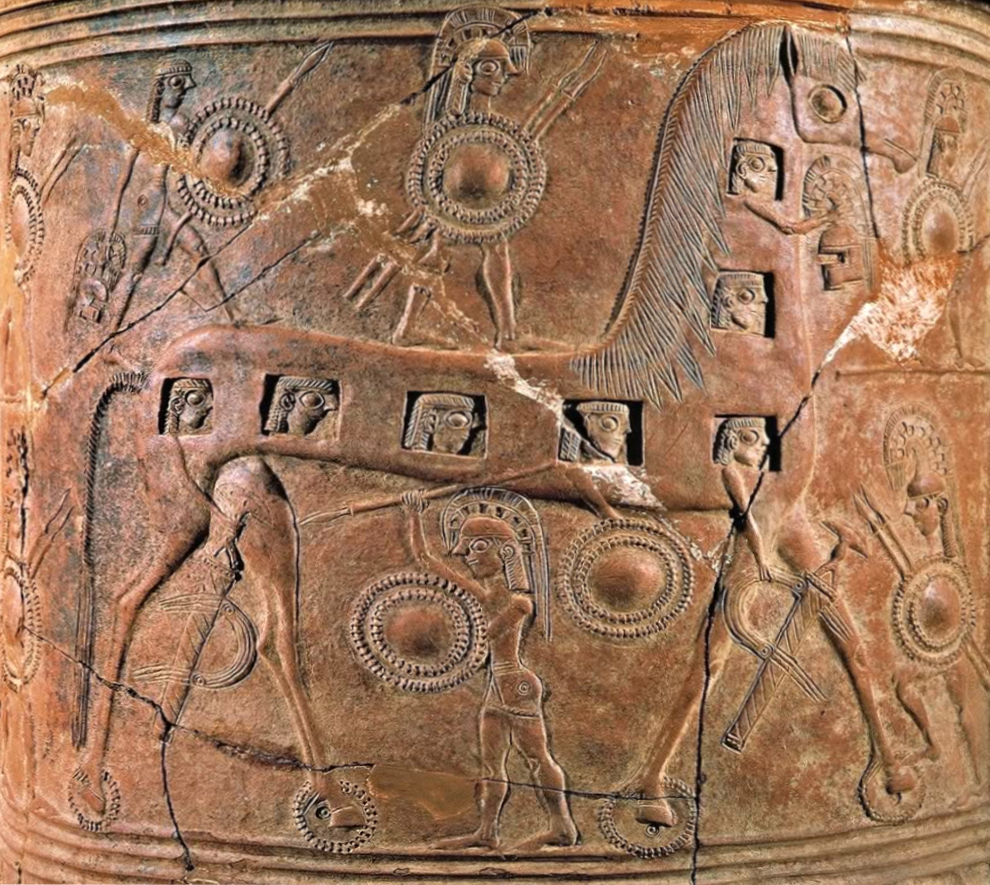
| Mykonos relief pithos | ca. 675–650 BC; Archaeological Museum of Mykonos, inv. 2240 | Shows a horse on wheels with openings, warriors’ heads and weapons inside, among scenes of the sack. It is early and explicit visual evidence for a horse containing men. |
A modern naval reinterpretation
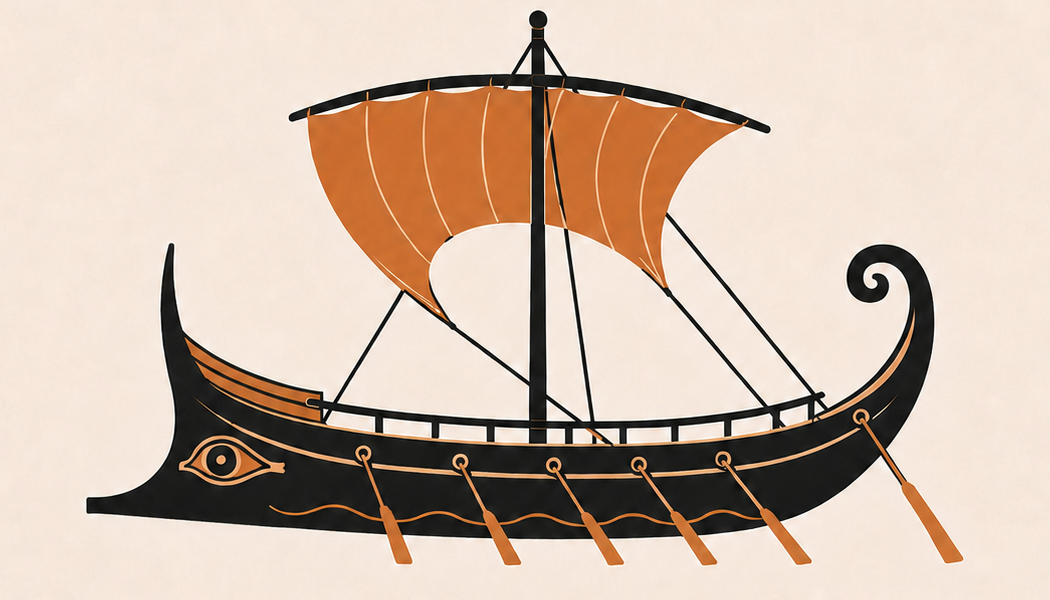
Sección titulada «A modern naval reinterpretation»Francesco Tiboni, The Hippos of Troy: Why Homer Never Talked About a Horse (2021), develops the idea that the object may have been a merchant vessel called a hippos, with a plank-built hull and an equine figurehead. There is also an indirect precedent: John the Lydian, a Byzantine author, attributes to Euphorion, a lost Hellenistic poet, the explanation that the Horse was a ship called “horse” by the Greeks.
The hypothesis starts from genuine points of support: the Odyssey compares ships to “horses of the sea” (Odyssey 4.708–709), there are later attestations of vessels called hippoi, and some terms in the episode have naval uses in other contexts. But those parallels do not establish a demonstrable connection with Homer’s Trojan Horse. The passage from Euphorion reaches us only through a much later source, and Archaic iconography already shows a literal horse with warriors inside. It is therefore a weak hypothesis, not a probable explanation of the Homeric text.
The archaeology of Troy, siege practices, ancient ships and the literary Horse are different kinds of evidence: no archaeological find directly identifies the episode.
So, was it really a horse?
Sección titulada «So, was it really a horse?»In the sense in which the ancient sources allow us to answer, yes: Homer calls it a horse and Archaic iconography represents it as one. That does not turn the story into a chronicle or determine what memory, if any, may lie behind it. The naval interpretation shows how far a myth can be reinterpreted, but it does not outweigh the earliest textual and iconographic evidence.