The Passing of Time in the Odyssey
The Odyssey tells of an absence lasting almost twenty years, yet concentrates its main action into just a few weeks. These two timescales shape the poem’s structure. We do not need to follow every day of the Trojan War and the journey home; what matters is to feel what those years have left behind in a home, a family and a man who returns when recognition can no longer be taken for granted.
Time therefore appears in three dimensions:
- The long span of events: the Trojan War and the journey home.
- Time as lived experience: those who wait or grow old.
- Narrative order: the way Homer arranges the events.
Exact chronology matters, but chiefly because it helps us understand the relationship between time lived and time narrated.
Twenty years of absence, a few weeks of action
Sección titulada «Twenty years of absence, a few weeks of action»Odysseus returns to Ithaca in the twentieth year after his departure. Epic tradition assigns ten years to the Trojan War and another ten to his long-delayed homecoming, and the poem itself places his return at the end of that span (Odyssey 2.174–176; 17.326–327). Yet it does not recount those twenty years as a continuous sequence. The story begins when Odysseus is still being held by Calypso and the pressure exerted by the suitors on his household in Ithaca has become intolerable.
The action unfolding in the poem’s present occupies a remarkably short period. In her chapter ‘Homer’, published in Time in Ancient Greek Literature (2007), Irene J. F. de Jong reconstructs the sequence from the opening council of the gods to the final reconciliation on Ithaca as spanning forty-one days. This is not a figure given by Homer, but a modern scholarly reconstruction. It helps us follow the succession of days, nights and journeys within a narrative that repeatedly returns to earlier events.
The contrast becomes clearer when we compare individual episodes. Odysseus spends a year with Circe, while Calypso holds him on her island for seven. He builds his raft in four days, then sails for seventeen days before sighting the coast of Scheria on the eighteenth (Odyssey 5.243–281). Some long periods are passed over in a few lines, while individual days are described in great detail, according to what matters to the story. Homer does not keep a uniform record of elapsed time: he compresses the years that keep Odysseus away from Ithaca and lingers over the days when his return finally comes within reach.
The past brought into the present
Sección titulada «The past brought into the present»The reader therefore learns about the past when someone remembers or recounts it. Telemachus asks about his father; Nestor, Helen and Menelaus piece together episodes of the war and the homecomings; Demodocus sings of events at Troy; and in Books 9–12 Odysseus himself tells the Phaeacians of his adventures from Troy to Calypso’s island. The past does not appear as a separate prologue: it enters the present through the voices of those who remember it.
This structure allows the same span of years to acquire different meanings. For Penelope, it is waiting and the management of a threatened household; for Telemachus, an absence he must learn to put into words; for Odysseus, a succession of losses and delays that only take shape when they are told. Tiresias’ prophecy also introduces a future beyond the homecoming: even revenge against the suitors does not bring the hero’s life entirely to a close.
The Odyssey does not erase the intervening years; it distributes them among voices, songs, memories and anticipations. How the Odyssey Tells Its Story explores this interplay of narrative voices in more detail. What matters here is its effect on time: a single night of storytelling among the Phaeacians can contain years of Odysseus’ wanderings.
Speeding up, slowing down and guiding the listener
Sección titulada «Speeding up, slowing down and guiding the listener»The poem alternates great leaps in time with almost day-by-day detail. Seven years with Calypso can pass in a few brief references; the final stretch on Ithaca, by contrast, dwells on disguises, tests, feasts, conversations and recognitions. As events approach their resolution, every gesture may matter: who has seen whom, what has been said, which object preserves a shared memory.
The recurring formulas for dawn, meals, rest and the coming of night are not merely decorative repetitions. They mark the passing days, provide listeners with points of orientation and help shape the rhythm of the narrative. A voyage can be summarised; waiting, by contrast, may feel long even when the poem devotes only a few lines to each night. Concentrating the action into a short period does not mean telling it in haste: it allows Homer to decide where the listener’s attention should linger.
Other characters’ stories also organise time in their own way. Menelaus, for example, recalls eight years of wandering before returning to Sparta (Odyssey 4.81–92). His experience is different from Odysseus’ own, but it places his homecoming within a wider pattern of difficult returns. The Odyssey measures time not only by the days that pass, but also by the distance between the person who left and the home to which he is trying to return.
Waiting leaves its marks
Sección titulada «Waiting leaves its marks»Twenty years are not an abstraction. Penelope has delayed the suitors for years by weaving Laertes’ burial shroud by day and unravelling it by night; Telemachus has grown up without knowing his father; Laertes has grown old in seclusion; and Argos dies shortly after recognising his former master. The house retains its familiar objects and habits, but it cannot simply be the same as before. Argos recognises Odysseus at once, yet for others his return requires proof: identity and shared history must be established through signs and memories that have survived the years.
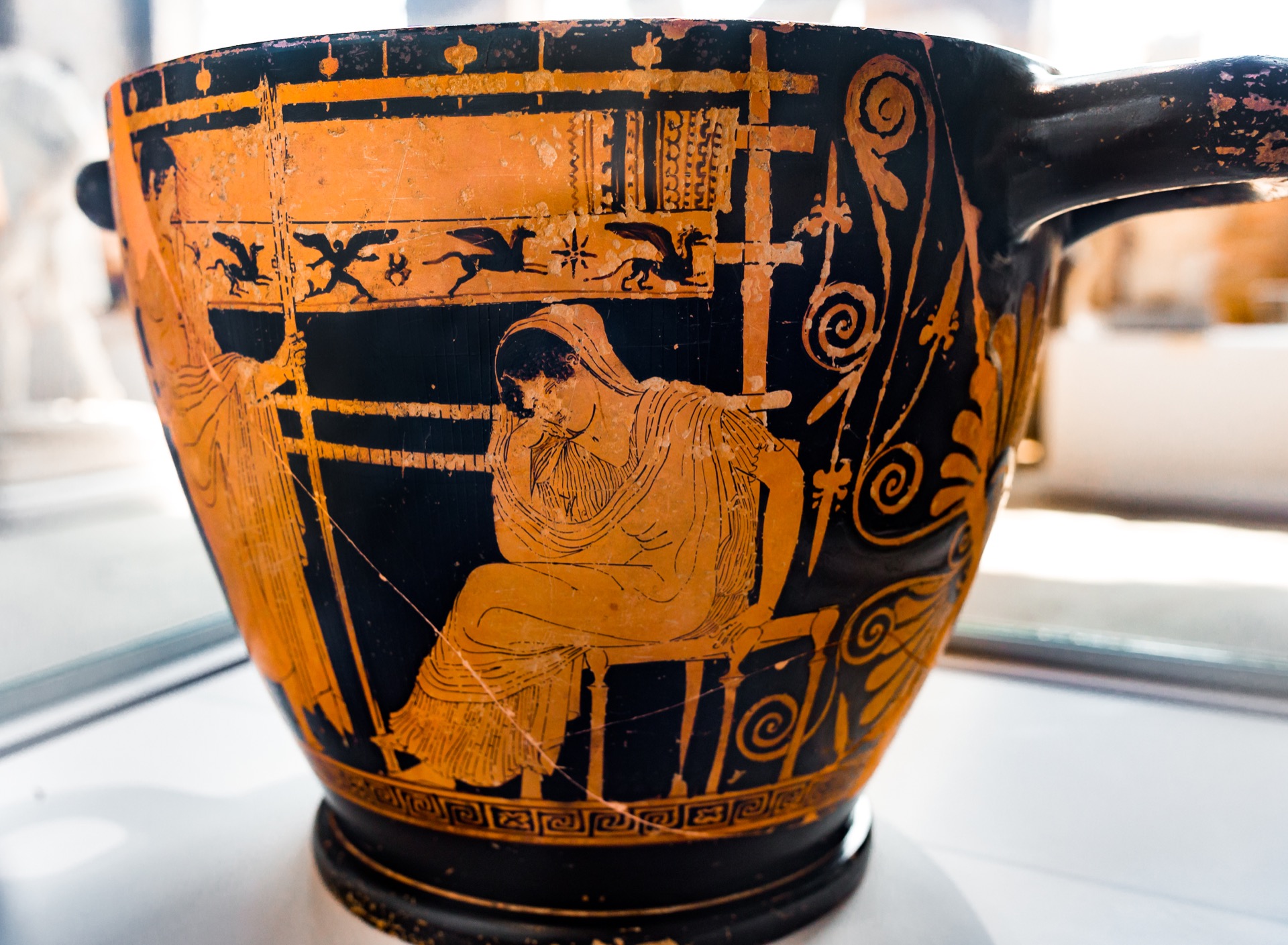
Odysseus’ scar, the secret of the bed built around an olive tree, the bow and, finally, the trees Laertes once gave his son connect past and present through tangible signs. They do not all serve the same purpose. The scar reveals Odysseus’ identity to Eurycleia; the bed recalls a secret shared with Penelope; the bow demonstrates the strength and authority of the returning master; and the trees bring back a memory shared between father and son. Together, they show how the past survives in objects, places and experiences that time has not erased.
There is a revealing contrast with the encounter with Polyphemus. After escaping the Cyclops, Odysseus endangers himself by revealing his name, driven by the desire to claim the glory of his achievement. On Ithaca, however, his name alone is no longer enough. To reclaim his place, he must be recognised through familiar signs and memories shared with those he left behind. Twenty years have passed, and identity can no longer be established simply by declaring who he is.
For Penelope, waiting is not passivity: she turns the passing years into a strategy of resistance. Her place in this long period of waiting is explored further in Women in the Odyssey.
Death marks the most radical limit to that waiting. Anticleia has died before her son returns, and in Hades Achilles declares that he would rather live as a hired labourer than rule among the dead (Odyssey 11.488–491). Against such irreversible loss, Calypso offers Odysseus immortality and eternal youth, but he chooses to return to Ithaca as a mortal man. The poem does not present endless life as a solution to the losses caused by time. To live is also to belong somewhere, to maintain bonds with others and to inhabit a span of time that, once lost, can never be fully recovered.
Being rooted in a place
Sección titulada «Being rooted in a place»In the Odyssey, a person is not simply someone: they are someone from somewhere. When Odysseus introduces himself to the Phaeacians, he gives his name and lineage, but he also names Ithaca and locates it among the neighbouring islands. Where he comes from is part of the answer to who he is (Odyssey 9.19–27). Odysseus does not merely live on Ithaca: he is rooted there.
M. I. Finley observes that exile means more than leaving a land: it is separation from the network that provides position and security — household, possessions, kinship, dependants, allies and prestige. The poem adds a dimension of memory: a place holds the tangible traces of those bonds. That is why even imagining the smoke rising from his native land is enough to awaken Odysseus’ longing to return (Odyssey 1.57–59).
The objects and encounters that mark Odysseus’ return are inseparable from the place to which he belongs. The marriage bed was built around a living olive tree; the trees Laertes once gave his son belong to a landscape remembered from childhood. Even Argos and the bow connect his identity to the household he left behind. These memories do not exist in his mind alone: they survive in the landscape, the people and the objects that have remained in Ithaca (Odyssey 17.290–327; 21.404–434; 23.177–206; 24.336–344).
Calypso can offer him security, beauty and immortality, but she cannot give him a sense of belonging. On Ogygia he can live, but he cannot reclaim the place he once occupied in the lives of those he left behind. Nóstos does not simply bring Odysseus back to a location. It returns him to the place where his name, memories, relationships and history are rooted.
Returning cannot give back the lost years
Sección titulada «Returning cannot give back the lost years»In the end, time in the Odyssey is not simply a sequence of events, but a tension between what has been lost and what can be recognised once more. Odysseus returns, but his homecoming cannot undo the war, the shipwrecks or the years Penelope and Telemachus have lived without him. What the poem concentrates into its final days is precisely the work of recognition, of recounting what has happened and of rebuilding a household after so long an absence.
This way of telling the story allows the poem to encompass decades of experience while making a single night, a scar or a conversation unforgettable. Its roughly 2,700 years of transmission add another timescale, one that lies beyond the world of the narrative itself. Each new reading brings us back to an ancient story in which time is measured not simply by the years that pass, but by what they change.
In the Odyssey, homecoming makes time visible through what it can restore — and what it cannot bring back.
Sources and method
Sección titulada «Sources and method»See also
Sección titulada «See also»-
How the Odyssey Tells Its Story
-
What Did the Greeks Believe Happened after Death?