The Dream of the Twenty Geese
Night has fallen on Ithaca. The suitors have retired for the night, and Penelope is speaking with a stranger whom she has welcomed into her home. He has spoken to her about Odysseus and assured her that he will soon return. Penelope apparently does not know that she is speaking to her own husband.
Earlier, Telemachus returned from his journey to Pylos and Sparta. He told his mother that, according to the news he had received from Menelaus, Odysseus was still alive, though held captive on Calypso’s island. Theoclymenus, the seer who accompanied the young man on his journey home, went much further: he declared that her husband was already on Ithaca, watching events unfold and planning the suitors’ downfall (Odyssey 17.124–161).
Earlier that night, while washing the stranger’s feet, Eurycleia recognised him by the scar on his leg. She tried to signal her discovery to Penelope with a glance, but Athena diverted Penelope’s attention, preventing her from noticing. Odysseus then compelled his old nurse to remain silent.
Penelope faces a difficult decision. She has just explained to the stranger that she does not know whether she should remain beside her son and preserve Odysseus’ household, or accept one of the suitors and leave. Telemachus is now an adult, and the pressure on her to marry again is becoming increasingly difficult to resist.
During their conversation, before announcing the bow contest that will take place the following day, Penelope tells the stranger a dream and asks him to interpret it.
The Dream
Sección titulada «The Dream»Penelope continued:
‘But listen to this dream of mine, and interpret it for me.
‘I have twenty geese in my house. They come out of the water and eat wheat, and I delight in watching them. Then a great eagle with a hooked beak came down from the mountain, broke their necks and killed them all. They lay heaped together in the great hall as the eagle rose into the bright sky.
‘I wept and cried aloud, even in my dream, and the Achaean women with their beautiful braided hair gathered around me as I sobbed because the eagle had killed my geese.
‘But the eagle returned and perched on a projecting beam of the roof. Speaking in a human voice, it stilled my cries and said:
“Take heart, daughter of renowned Icarius. This is no dream, but a true and favourable vision, one that will certainly come to pass. The geese are the suitors. I was once the eagle, but now I have returned as your husband, and I shall bring a shameful fate upon all the suitors.”
‘So it spoke, and sweet sleep released me. I looked around and saw the geese in the hall, pecking at wheat beside the feeding trough, where they always fed.’
Then resourceful Odysseus replied:
‘My lady, there is no other way to interpret this dream, for Odysseus himself has revealed to you how it will come to pass. The destruction of all the suitors is certain. Not one of them will escape death or his dreadful fate.’
Wise Penelope answered him:
‘Stranger, dreams are bewildering and their words hard to interpret, and not everything they foretell comes to pass among mortals.
‘There are two gates through which fleeting dreams pass: one is made of horn, the other of ivory. Those that pass through the gate of sawn ivory deceive us, bringing words that never come true. But those that emerge through the gate of polished horn fulfil what they foretell for the mortal who sees them.
‘Yet I do not believe my troubling dream came through the gate of horn. How welcome it would be to my son and me if it had!’
A Dream That Explains Itself
Sección titulada «A Dream That Explains Itself»At first glance, the dream seems to need no interpretation.
Penelope delights in watching the geese that live in her house and feed on her wheat. When the eagle kills them, she weeps inconsolably. Yet the eagle itself declares that it represents Odysseus and that the geese are the suitors. And when the stranger confirms this interpretation, Penelope acknowledges that their destruction would be welcome to her and her son.
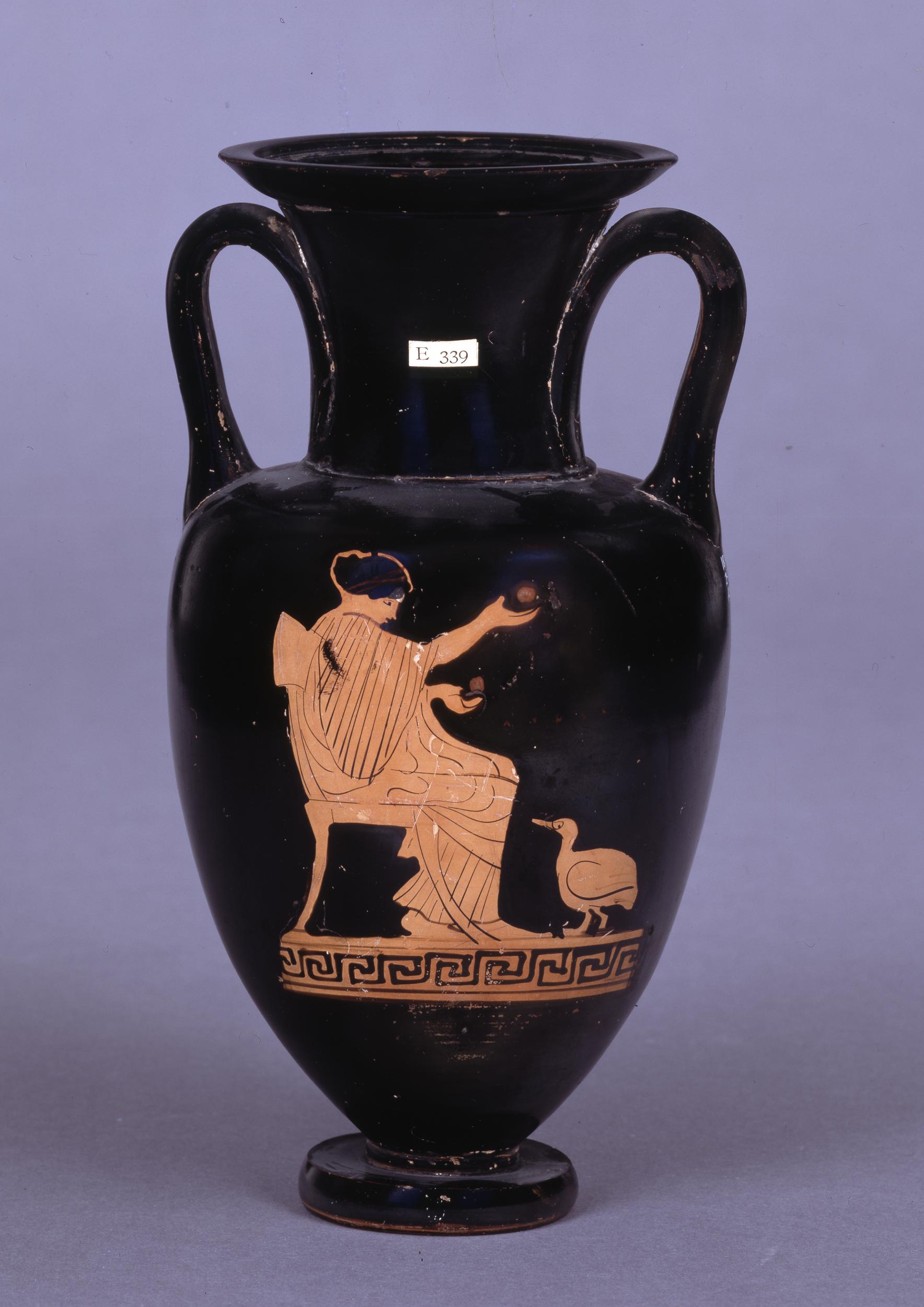
That does not mean Penelope feels affection for the suitors: the geese she watches in her dream are one thing, and the men the eagle says they represent are another. But rather than resolving the question, this distinction makes it more intriguing. If the eagle represents Odysseus and the geese represent the suitors, what role does Penelope play, as she feeds the birds, delights in watching them and weeps when her husband kills them? What do her tears mean?
There is another curious detail. The eagle declares that this is no dream, but a true vision that will come to pass. Yet this assurance is itself part of the dream. The stranger then confirms the interpretation without hesitation. The reader knows that he is Odysseus; Penelope apparently does not.
When Penelope wakes, she finds the geese once again eating wheat in their accustomed place. Their destruction has taken place only in a dream. Recalling the gates of horn and ivory, she distinguishes between dreams that reveal the truth and those that deceive. Yet she does not believe hers has passed through the gate of horn.
Penelope wants the prophecy to be true, but cannot bring herself to trust it fully. Shortly before, when the stranger assured her that Odysseus would return, she expressed the hope that his words would come true, only to voice her fear that her husband might never return. Now, after hearing the interpretation of her dream, the same uncertainty resurfaces.
The poem itself shows how difficult it is to believe that such an unequal contest could be won. When Odysseus reveals his identity to Telemachus, his son doubts that the two of them could face so many men and suggests seeking allies (Odyssey 16.240–256). At the beginning of the slaughter, the narrator observes that no one would have imagined that a single man, however strong, could bring death to Antinous in the midst of so many men at the feast (22.8–14). This incredulity helps explain why Penelope wants the dream to be true and yet finds it difficult to trust.
Eustathius of Thessalonica offers a specific explanation for her doubts: Penelope finds it hard to believe that Odysseus could defeat so many suitors single-handedly (Commentary on the Odyssey, ad 19.568; ed. Stallbaum, vol. II, p. 218).
There is, moreover, something we should not overlook. We do not know whether the dream occurred exactly as Penelope describes it. Homer does not show Penelope dreaming: we know of the episode only through the account she gives to a man who is himself keeping a secret. This does not prove that she invented the dream, but it raises a question: why does she choose to tell it in this way, at precisely this moment, and to a stranger whom she has just questioned at length about her husband?
The conversation does not end there. Immediately afterwards, Penelope announces that the following day she will set the suitors a challenge involving Odysseus’ bow. The hero used to arrange twelve axeheads in a row and shoot an arrow through them. Whoever can string his bow and repeat that feat will become her new husband, and she will leave Odysseus’ house.
The circumstances are extraordinary. Telemachus has returned with news that his father is still alive. Theoclymenus, the seer who accompanied him home, has declared that Odysseus is already on Ithaca. The dream foretells the death of all the suitors, and the stranger standing before Penelope confirms that interpretation without hesitation.
Why, in these circumstances, does Penelope choose this particular moment to announce the bow contest? Is it simply a final concession to pressure she can no longer resist, or might there be some connection between the dream, the news about Odysseus and this unexpected decision?
Thus the bow contest is announced immediately after a dream whose meaning seems clear, but whose fulfilment Penelope considers uncertain. We shall return later to the consequences of her decision.
Time Within the Dream
Sección titulada «Time Within the Dream»Alexandra Rozokoki (2001) has drawn attention to the verb tenses in Penelope’s account of the dream. The most revealing contrast comes when the eagle speaks as Odysseus.
It does not say that Odysseus will return. Instead, it uses the Greek perfect tense to declare: ‘Now I have returned as your husband’ (Odyssey 19.549). Penelope recounts these words to Odysseus himself, who listens disguised as a stranger.
The eagle then uses the future tense to announce the death of the suitors. The distinction matters: Odysseus’ return has already taken place, while his vengeance still lies ahead.
The reader knows that Odysseus has returned and that his vengeance is yet to come. Penelope, by contrast, is not certain that her husband is home. Her dream presents his return as an accomplished fact, although she still doubts it. And the man listening to her account is none other than Odysseus himself.
Helen, Too, Saw an Eagle and a Goose
Sección titulada «Helen, Too, Saw an Eagle and a Goose»Penelope’s dream has a striking parallel earlier in the Odyssey. Helen witnesses a remarkably similar scene and foretells a similar outcome: Odysseus’ return and his revenge upon the suitors.
The episode takes place in Sparta, as Telemachus prepares to return to Ithaca after visiting Menelaus and Helen in search of news of his father (Odyssey 15.154–181).
The young travellers have received their farewell gifts and are about to depart. Menelaus wishes them a safe journey, and Telemachus expresses a hope: that when he returns to Ithaca, he will find Odysseus at home and be able to tell him of the generous welcome he has received.
At that very moment, an eagle appears on their right, carrying a large white goose in its talons. It has snatched the bird from a courtyard, and men and women run after it, shouting. The eagle approaches the travellers, then veers to the right again, passing in front of the horses.
The onlookers rejoice, for the eagle’s flight to the right is regarded as a favourable omen. Its appearance is especially significant because it comes just as Telemachus has expressed his hope of finding Odysseus back on Ithaca.
Peisistratus, Nestor’s son and Telemachus’ travelling companion, asks Menelaus what the omen means. While Menelaus considers how to interpret it, Helen steps forward and speaks.
Helen’s Interpretation
Sección titulada «Helen’s Interpretation»Helen, in her long robe, was the first to reply:
‘Listen to me. I shall interpret this omen as the immortals have put it into my heart, and as I believe it will come to pass.
‘Just as this eagle came from the mountain, where it has its kin and offspring, and seized a goose raised in a house, so Odysseus, after enduring many hardships and wandering for so long, will return home and take his revenge.
‘Or perhaps he is already at home, plotting the downfall of all the suitors.’
Telemachus replies that he hopes Zeus will fulfil her words. If that happens, he says, he will offer prayers to Helen as though she were a goddess.
Two Women, the Same Image
Sección titulada «Two Women, the Same Image»In Helen’s omen, there is only one goose, and Homer tells us that the eagle seizes it and carries it away. He does not describe its death. In Penelope’s dream, by contrast, there are twenty geese, and the eagle breaks their necks, leaving them heaped together in the hall.
The interpretations differ as well. Helen directly associates what she sees with Odysseus’ return and vengeance, but she does not explicitly identify the goose with the suitors. Nor is there any conclusive reason to do so: geese were valued domestic birds, provided companionship, could be associated with the protection of the household, and appeared in scenes of children’s play.
According to Penelope’s account, however, the identification in her dream seems unequivocal: the eagle itself explains that the twenty geese represent the suitors and that it represents Odysseus.
Helen witnesses an omen and interprets it confidently. Penelope recounts a dream that foretells the destruction of the suitors, yet cannot bring herself to believe that it will come true. The similarity between the images makes the contrast between their responses all the more striking.
There is also an irony that the reader can appreciate, though the characters remain unaware of it. When Helen interprets the omen, Odysseus has already returned to Ithaca and is staying in Eumaeus’ hut. Neither Helen nor Telemachus knows this. Yet Helen’s second possibility—that Odysseus is already in his homeland, preparing the suitors’ downfall—comes remarkably close to what is actually happening.
Helen and Penelope: Two Women from the Same Family
Sección titulada «Helen and Penelope: Two Women from the Same Family»According to the traditional genealogy, Helen and Penelope were first cousins: Tyndareus, king of Sparta and Helen’s acknowledged father, was the brother of Icarius, Penelope’s father (Apollodorus, Library 3.10.3–7). Both women therefore belonged to a prestigious family, and both attracted numerous suitors. Yet the circumstances of their marriages were very different.
Helen’s Marriage and the Great Achaean Heroes
Sección titulada «Helen’s Marriage and the Great Achaean Heroes»More than twenty-five years before the final days of the Odyssey, Helen had married Menelaus. The ancient sources describe a contest for her hand that attracted suitors from across the Achaean world and involved some of its most prominent heroic families.
Apollodorus (Library 3.10.8) lists thirty-one suitors; Hyginus (Fabulae 81) names thirty-six and notes that other authors mentioned even more. The Catalogue of Women, attributed to Hesiod, contained another extensive list, but the surviving fragments do not allow us to reconstruct it in full (frr. 196–204, ed. Merkelbach and West).
Among the suitors were Odysseus, Diomedes, both Ajaxes, Patroclus, Philoctetes and other figures associated with the Trojan War. All are recognisable figures from the Greek heroic tradition. Most of Penelope’s suitors, by contrast, barely acquire an individual identity in the narrative.
Why Menelaus Was Chosen
Sección titulada «Why Menelaus Was Chosen»The ancient sources offer different accounts of how Menelaus came to be chosen. The Catalogue of Women emphasises his wealth and the value of his marriage gifts. According to this tradition, Agamemnon—his brother and the husband of Clytemnestra, Helen’s sister—supported his suit. Recognising Menelaus’ advantage in wealth, Odysseus decided not to offer gifts.
According to Apollodorus (Library 3.10.9), Odysseus offered Tyndareus a way to prevent disputes among Helen’s suitors in exchange for his help in securing Penelope’s hand. Once the king agreed, Odysseus advised him to require all the suitors to swear an oath: they would undertake to defend whoever married Helen if anyone threatened the marriage.
Euripides offers another version in Iphigenia at Aulis (49–70): after the oath had been sworn, Tyndareus allowed Helen to choose whichever suitor the ‘gentle breezes of Aphrodite’ led her towards. She chose Menelaus. Hyginus adds that she signalled her choice by placing a wreath upon his head (Fabulae 78).
The oath also appears in the Catalogue of Women, attributed to Hesiod, although the poem does not explicitly credit Odysseus with devising it. Not every version explains who proposed the oath or who chose the husband.
Years later, when Paris took Helen away, the tradition invoked the oath to explain why so many Achaean leaders came to Menelaus’ aid. The men who had once competed for Helen’s hand were now bound to defend her husband.
Odysseus and Penelope’s First Courtship
Sección titulada «Odysseus and Penelope’s First Courtship»Apollodorus’ account thus links the two marriages: Odysseus, who had once sought Helen’s hand, secured Tyndareus’ help in marrying Penelope through his advice.
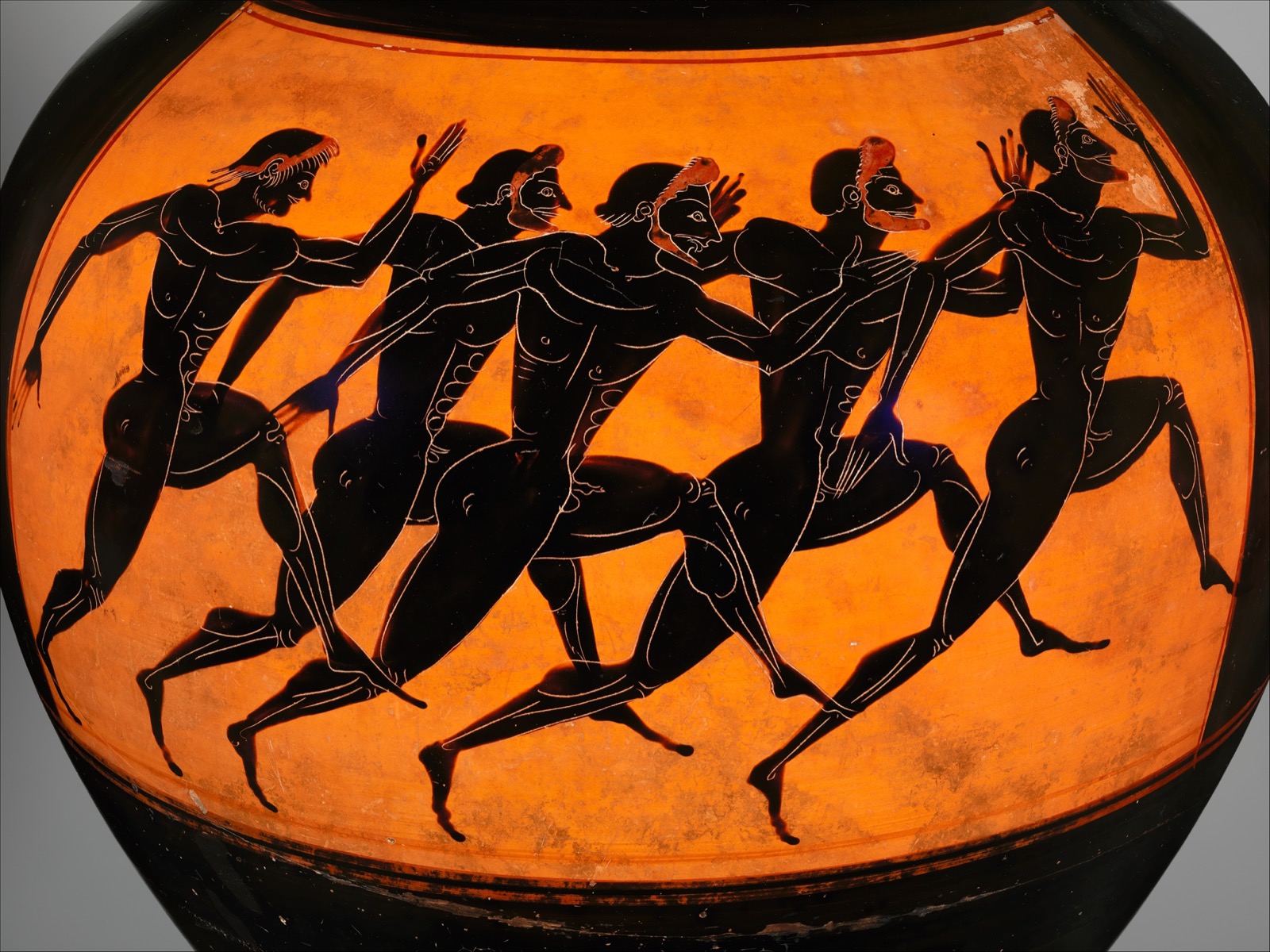
Pausanias also records a Spartan tradition according to which Icarius organised a footrace among his daughter’s suitors, and Odysseus emerged as the winner (Description of Greece 3.12.1). Pausanias adds that Odysseus erected a statue of Athena, naming her Keleuthea, ‘Athena of the Roads’, and established three sanctuaries in her honour (3.12.4). He does not say who the other competitors were or how many took part.
One Hundred and Eight Suitors in Ithaca
Sección titulada «One Hundred and Eight Suitors in Ithaca»When Odysseus, meeting Telemachus in secret and already recognised by his son, asks how many men they will have to face, Telemachus provides a precise breakdown (Odyssey 16.245–253). These are not visitors from across the Greek world, but young men from Ithaca and three other territories nearby.
| Origin | Homer | Apollodorus | P.Oxy. LIII 3702 | Dictys of Crete |
|---|---|---|---|---|
| Dulichium | 52 | 57 | 52 | ? |
| Same | 24 | 23 | 24 | ? |
| Zacynthus | 20 | 44 | ? | ? |
| Ithaca | 12 | 12 | 12 | ? |
| TOTAL | 108 | 136 | ? | 30 |
The figures in Apollodorus’ column come from the Epitome (7.26–30). They add up to 136, although the list contains only 129 names. Dictys of Crete (Diary of the Trojan War 6.6) mentions thirty suitors but provides no numerical breakdown by place of origin. His geographical account also differs from Homer’s. In the papyrus P.Oxy. LIII 3702, the figure for Zacynthus cannot be established with certainty. These discrepancies have been examined by Stefano Acerbo (2021).
The Odyssey gives a total of 108 suitors but names only fourteen of them individually. Among the most prominent are Antinous and Eurymachus. The ambitions of some suitors extend beyond marrying Penelope: Antinous proposes killing Telemachus and, after Antinous’ death, Eurymachus claims that he had intended to make himself king of Ithaca (Odyssey 16.372–405; 22.44–59). We should remember, however, that Eurymachus makes this accusation while trying to save his own life.
Two Generations, Two Ways of Courting
Sección titulada «Two Generations, Two Ways of Courting»Decades separate Helen’s marriage from the final days of Odysseus’ return. The great heroes who sought Helen’s hand belong to the generation of the Trojan War. Penelope’s suitors, by contrast, largely belong to a younger generation, one that grew up during Odysseus’ long absence. The distance between the two stories is therefore also generational.
More striking than the difference in prestige is the contrast in behaviour. Helen’s suitors compete by offering gifts and seeking alliances between families. Penelope’s suitors, on the other hand, gather in Odysseus’ house, consume his livestock and provisions, and threaten his son. In Book 16, Antinous proposes murdering Telemachus; later, Eurymachus attempts to blame him for ambitions to seize the kingship (Odyssey 22.44–59).
Penelope herself condemns the way these men are courting her. She points out that men seeking to marry a woman of noble birth normally bring gifts and entertain her family. Her suitors do precisely the opposite: they live off the resources of the household they hope to control (Odyssey 18.274–280).
Laura Slatkin has identified a significant reversal between the two stories. Helen’s suitors swear to act together in defence of the chosen husband. Penelope’s suitors, by contrast, unite against the absent husband’s household. In the first case, courtship was meant to forge alliances; in the second, the suitors violate the very rules that ought to govern it.
Could this contrast preserve a memory of two different forms of society? Helen’s suitors evoke the great heroic families associated with the imagined world of the Bronze Age; Penelope’s resemble a local aristocracy, more akin to the communities of the early Iron Age. It would be going too far, however, to treat this impression as evidence of a direct historical correspondence: both stories belong to the same mythical age, and the traditions that preserve them were composed or reworked much later. Even so, the contrast reveals the different layers of the past portrayed in Homer, where great heroic alliances coexist with local rivalries and struggles for authority within a household.
From this perspective, the slaughter of the suitors is more than Odysseus’ victory over his rivals. He reclaims a household in which the obligations of hospitality have been violated, his possessions consumed and his son threatened. He punishes behaviour that the poem presents as abusive and restores his authority. Yet the slaughter does not bring lasting peace: the families of the dead seek revenge, and only the intervention of Zeus and Athena brings the conflict to an end (Odyssey 24.472–548).
From 108 Men to Twenty Geese
Sección titulada «From 108 Men to Twenty Geese»Returning to the dream, we find a numerical contrast that should not be overlooked. There are 108 suitors but only twenty geese. The eagle says that the birds represent the suitors, but this does not mean that each goose must correspond to a different man. A dream need not provide an exact count of those whose deaths it foretells.
The number twenty also corresponds to the years of Odysseus’ absence, around which the poem is structured. This coincidence suggests a possible additional meaning, but Homer offers no explanation for it, and we should not present it as a certain interpretation.
Odysseus, a Suitor to His Own Wife
Sección titulada «Odysseus, a Suitor to His Own Wife»Odysseus had once been among Helen’s suitors and, according to the tradition recorded by Pausanias, had won a footrace against the men seeking Penelope’s hand. Now he faces another marriage contest, but under entirely different circumstances: he has returned disguised as a beggar, while other men occupy his house.
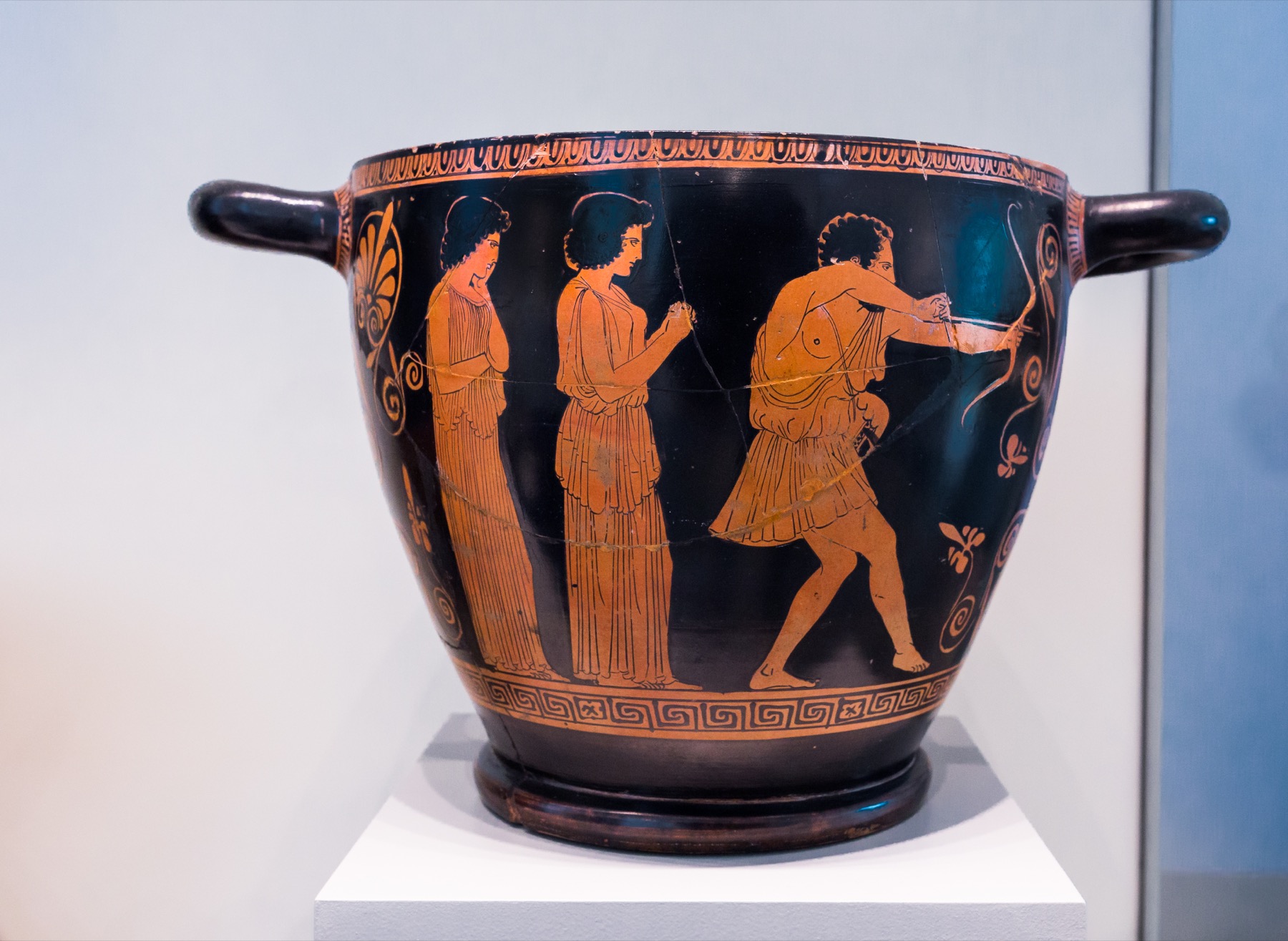
Penelope’s role has changed too. In the earlier tradition, Icarius organised the race; now Penelope herself announces the contest involving Odysseus’ bow and the twelve axeheads, immediately after recounting her dream. Odysseus, still in disguise, urges her not to postpone it (Odyssey 19.583–587). At the beginning of Book 21, the narrator explicitly attributes to Athena the impulse that leads Penelope to present the bow to the suitors (21.1–4).
Thus the man who once won Penelope’s hand prepares to compete for it again, without revealing his identity. Odysseus finds himself, paradoxically, a suitor to his own wife. The contest intended to choose a new husband will instead mark the beginning of the destruction foretold in the dream. How much Penelope knows when she announces it, and why she chooses this particular test, remain open questions.