What Did Homer Know About the World He Described? I: Objects and Techniques
The Iliad and the Odyssey tell stories set in a distant past, but the world they depict does not belong entirely to a single period. Roughly four or five centuries separated the end of Mycenaean palatial civilisation, around 1200 BC, from the formation of the Homeric poems in the eighth and seventh centuries BC. During that time, stories passed from generation to generation, preserving ancient memories while incorporating elements from later societies.
Homer thus looks back on the past through a tradition that had continued to evolve. His poems present a heterogeneous past in which memories of the Bronze Age coexist with practices from later centuries, elements that may have belonged to the poet’s own time, and conventions of epic poetry itself.
How far can we distinguish these different layers? What did the Homeric tradition really know about the world it sought to represent?
Chariots: Had Their Original Purpose Been Forgotten?
Sección titulada «Chariots: Had Their Original Purpose Been Forgotten?»In the Iliad, chariots frequently accompany the great warriors. Typically, a charioteer drives the horses while the hero rides beside him, carrying his weapons. Warriors often dismount to confront their opponents on foot, although Homer also describes fighting from chariots.
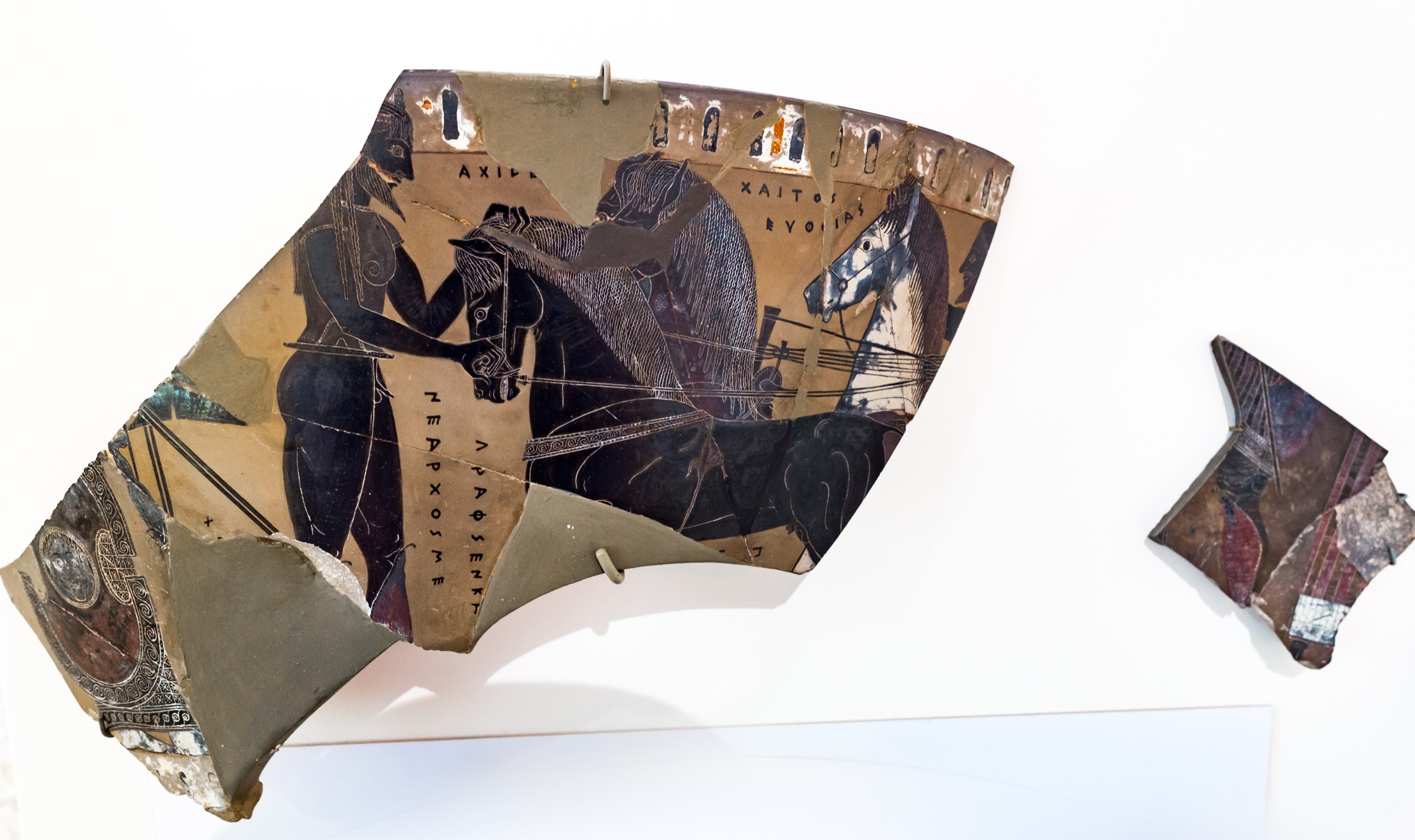
Achilles preparing the horses of his chariot. Fragments of an Attic black-figure kantharos, signed by Nearchos as both potter and painter, c. 560–550 BC; found on the Acropolis of Athens. National Archaeological Museum, Athens, inv. 15166 / 15155 / Akr. I.611. The inscriptions identify Achilles and several of the horses; only fragments of the scene survive. Photograph: ArchaiOptix / Wikimedia Commons, CC BY-SA 4.0. Cropped from the original.
Homer depicts several different uses of chariots:
| Passage | Use of the chariot |
|---|---|
| Iliad 4.297–309 | Nestor positions the chariots in front of the infantry and instructs his warriors to attack from them with their spears. |
| Iliad 5.9–20 | Phegeus attacks Diomedes from his chariot, while Diomedes fights on foot. |
| Iliad 8.112–125 | Nestor drives the chariot while Diomedes hurls his spear at Hector, killing his charioteer. |
| Iliad 22.395–404; 24.14–18 | Achilles ties Hector’s body to his chariot and drags it before the walls of Troy and later around Patroclus’ tomb, dishonouring his fallen enemy. |
| Iliad 16.426–430 | Sarpedon and Patroclus dismount from their chariots to fight on foot. |
| Iliad 23.262–650 | Chariots take centre stage in a race held during the funeral games for Patroclus. |
Nestor and the Warriors of Earlier Times
Sección titulada «Nestor and the Warriors of Earlier Times»Nestor never tires of recalling his youth. In Book 1 of the Iliad, he remembers the heroes alongside whom he once fought, men whose strength and courage he considers superior to those of his own generation (Iliad 1.260–272).
In Book 4, his recollections take on particular significance. As he organises his troops, he positions the chariots ahead of the infantry and orders the men to maintain their formation, neither advancing too far nor falling behind. When they encounter an enemy chariot, they are to attack with their spears from their own vehicles. Nestor recalls that this was how warriors of earlier times fought, conquering cities and strongholds (Iliad 4.297–309).
The detail is striking: in a poem already set in a heroic past, Nestor recalls a method of warfare that he attributes to still earlier generations.
Yet this way of fighting is not unfamiliar to the warriors of the Iliad. Phegeus attacks Diomedes from his chariot, and Diomedes himself fights from another while Nestor drives the horses. Homer thus describes both combat from chariots and their use to transport warriors who then fight on foot.
Chariots in the Bronze Age
Sección titulada «Chariots in the Bronze Age»Chariots are well documented in the Mycenaean world. Linear B tablets record vehicles, wheels and other components, while artistic depictions associate them with warriors and the elite. The palaces devoted considerable resources to their maintenance, although the surviving documents do not explain how they were used in battle.
In Egypt and the kingdoms of the Near East, particularly among the Hittites and other peoples of Syria and Mesopotamia, chariots played an important military role during the Bronze Age. They could serve as mobile fighting platforms, allowing one warrior to shoot arrows while another drove the horses, and could also be deployed in organised formations.
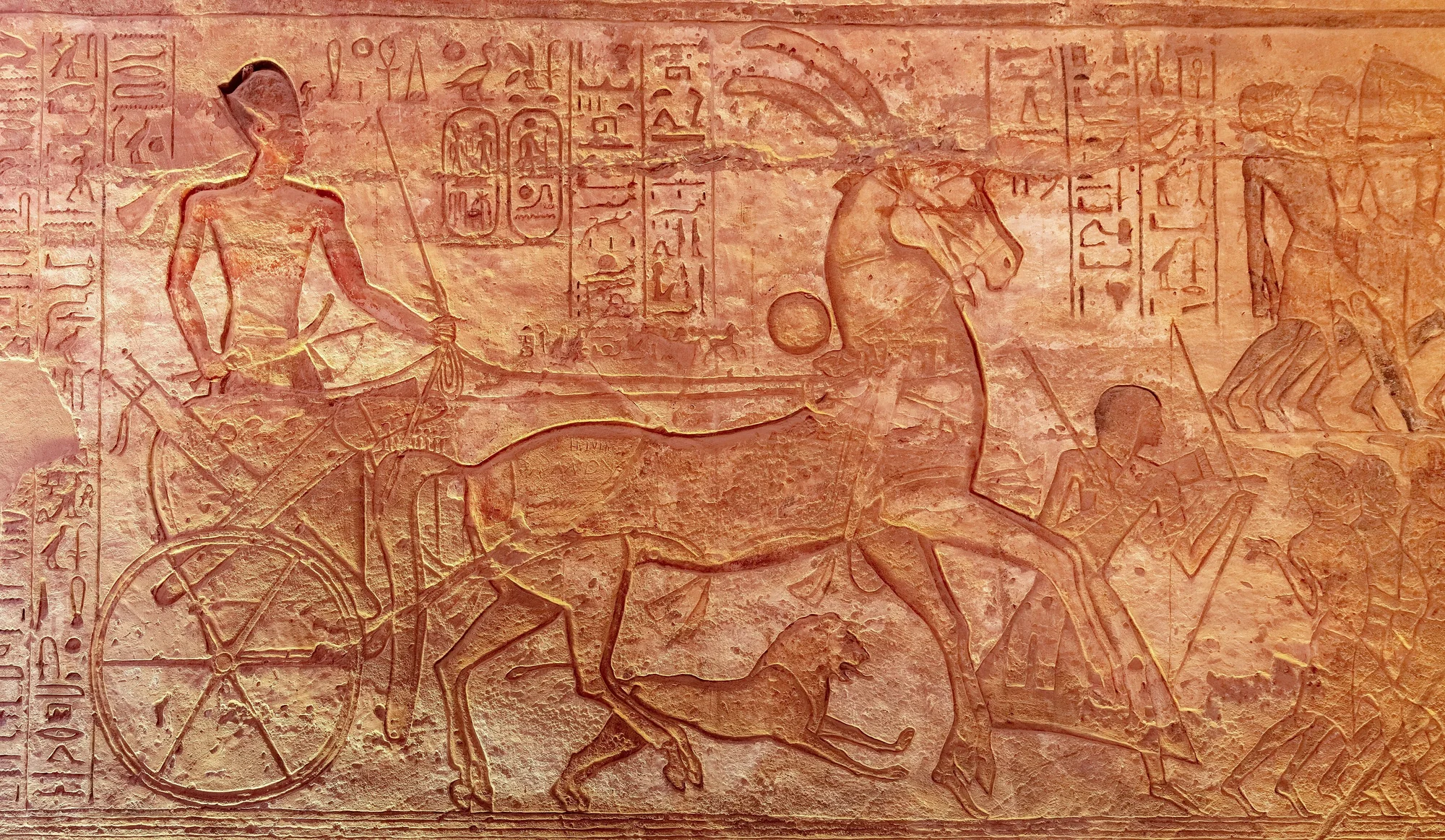
Ramesses II fighting from his chariot. Relief from the Great Temple at Abu Simbel, Egypt, thirteenth century BC, depicting the Battle of Kadesh against the Hittites. The pharaoh is shown shooting arrows from his chariot, illustrating its use as a mobile fighting platform during the Bronze Age. Photograph: Diego Delso / Wikimedia Commons, CC BY-SA 4.0.
Was this also the case in Greece? Mycenaean evidence confirms the importance of chariots, but does not allow us to determine with certainty how they were used in battle.
Had Homer Forgotten How Chariots Were Used in Battle?
Sección titulada «Had Homer Forgotten How Chariots Were Used in Battle?»M. I. Finley argued that the epic tradition had preserved the memory of Bronze Age war chariots but had lost almost all knowledge of how they were originally used in battle. In his view, Homeric heroes used them primarily to reach the fighting or move about the battlefield, combining an ancient means of transport with later methods of combat. For Finley, this was not an accurate portrayal of Mycenaean warfare, but a poetic reconstruction of a practice whose original purpose had been forgotten.
J. K. Anderson took a more cautious view. He noted that Greece’s mountainous terrain would have made it difficult to deploy large chariot formations like those known from Egypt and the Near East. He described chariots in Homer primarily as a means of carrying warriors into battle, while acknowledging the episodes in which men fight from the vehicles themselves. He nevertheless left a fundamental question open: we do not know whether this way of fighting was already practised in the Bronze Age.
Robert Drews offered a different interpretation. He argued that Mycenaean chariots formed an organised military force and were probably used chiefly as mobile platforms for archers, much as they were in other armies of the eastern Mediterranean. On this interpretation, the Homeric tradition had preserved the chariots themselves but profoundly transformed the memory of their military use. Drews acknowledged, however, that the Mycenaean tablets do not explain how these vehicles were used in battle.
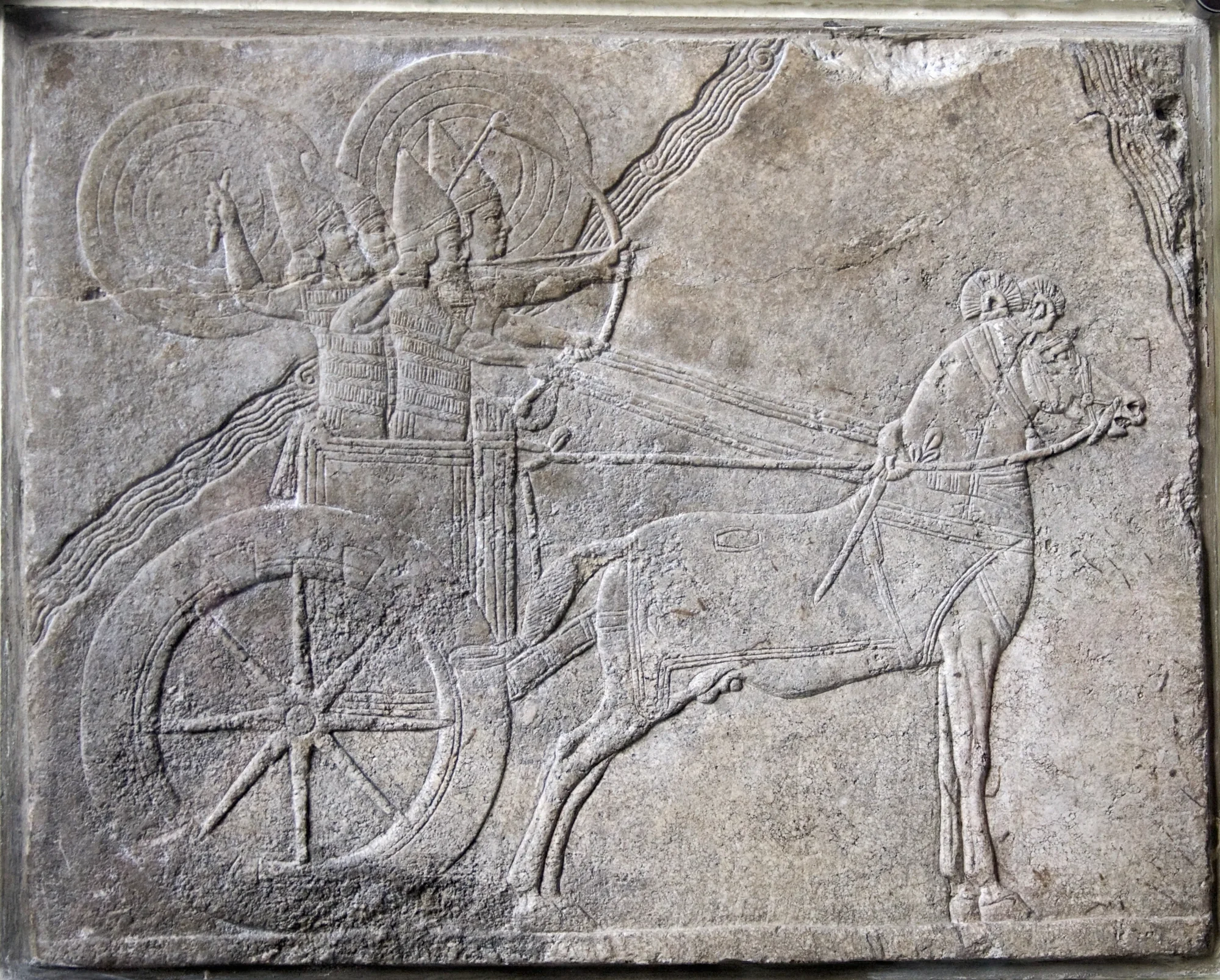
Assyrian war chariot with archer and charioteer. Alabaster relief from Nineveh, c. 650 BC, possibly associated with a campaign by Ashurbanipal against the Elamites. The scene shows a charioteer and an archer protected by shield-bearers, illustrating the use of the chariot as a mobile fighting platform, in contrast to its more common role as a means of transport in the Homeric poems. Pergamon Museum, Berlin. Photograph: Ealdgyth / Wikimedia Commons, CC BY-SA 3.0.
The differences between these scholars show how difficult it is to reconstruct the relationship between the Mycenaean world and its Homeric representation. We know that Mycenaean palaces maintained chariots and that other Bronze Age societies used them in warfare. We also know that Homer depicts warriors dismounting to fight on foot, but also describes attacks from chariots, sometimes in considerable detail.
Nestor’s recollection adds a revealing detail: he attributes to earlier generations a way of organising and using chariots that he presents as worthy of imitation. This does not prove that these were the tactics employed by Mycenaean warriors, but it does suggest that the poem preserves a memory of military practices inherited from the past.
Perhaps the tradition preserved the memory of chariots better than that of their original use, as Finley believed. Yet some of the practices Homer describes may be much older than the surviving evidence allows us to establish.
Chariots thus illustrate a problem that runs throughout this article: Homer preserves elements of a distant past, but we cannot always determine how much of his description belongs to that earlier world and how much reflects the centuries during which the epic tradition continued to evolve.
Ships and Seafaring
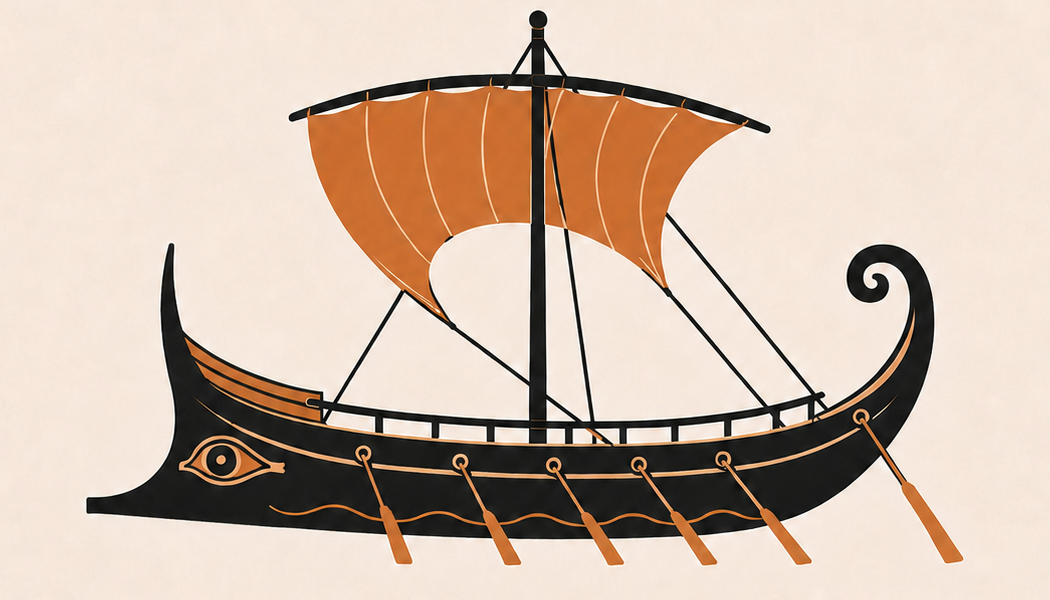
Sección titulada «Ships and Seafaring»Ships occupy a central place in the Iliad and the Odyssey. The Achaeans reach Troy by sea, and their vessels, drawn up along the shore, are both their means of returning home and an essential part of the setting of the war. In the Odyssey, voyages shape much of the narrative: characters embark, hoist sails, row, seek shelter along the coast, and face winds and storms.
For further discussion, see “A Word to Seafarers” and “What Were Homer’s Ships Like?”.
Homer describes these activities with a familiarity that contrasts with some of the difficulties we encounter when examining his war chariots. Nautical manoeuvres are not merely evocations of a heroic past. Ships are prepared and handled through recognisable procedures.
When Telemachus sets out for Pylos, the sailors raise the pine mast, set it in its socket, secure it with ropes and hoist the sail. Athena sends them a favourable wind, and the ship sails through the night (Odyssey 2.414–434). The description does not simply tell us that the ship departed: it shows the operations needed to get it under way.
Elsewhere, men row when the wind fails, take in the sails as they approach land, lower the mast and haul their vessels onto the beach. Homer shows familiarity, at least in narrative terms, with the combined use of sail and oar, the manoeuvres involved in departure and arrival, and the difficulties of seafaring.
But what period did these ships belong to? Was the poet describing vessels he knew, or was he preserving, as with other aspects of the heroic world, memories of much older seafaring?
Bronze Age Ships
Sección titulada «Bronze Age Ships»Seafaring was firmly established in the Aegean many centuries before Homer. One of the most remarkable pieces of evidence is the Flotilla Fresco, discovered in the West House at Akrotiri, on the island of Thera (modern-day Santorini), and generally dated to the seventeenth century BC.
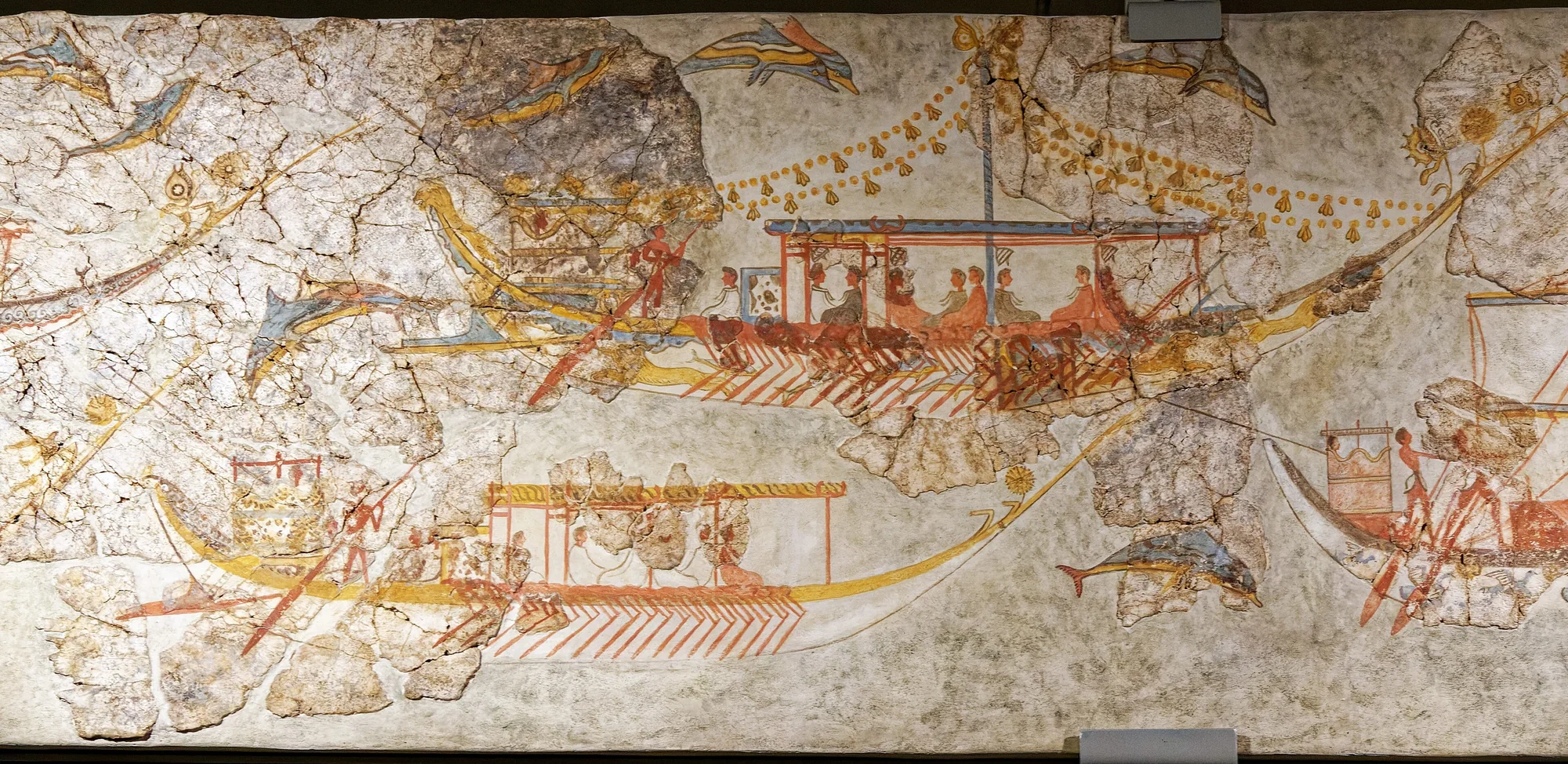
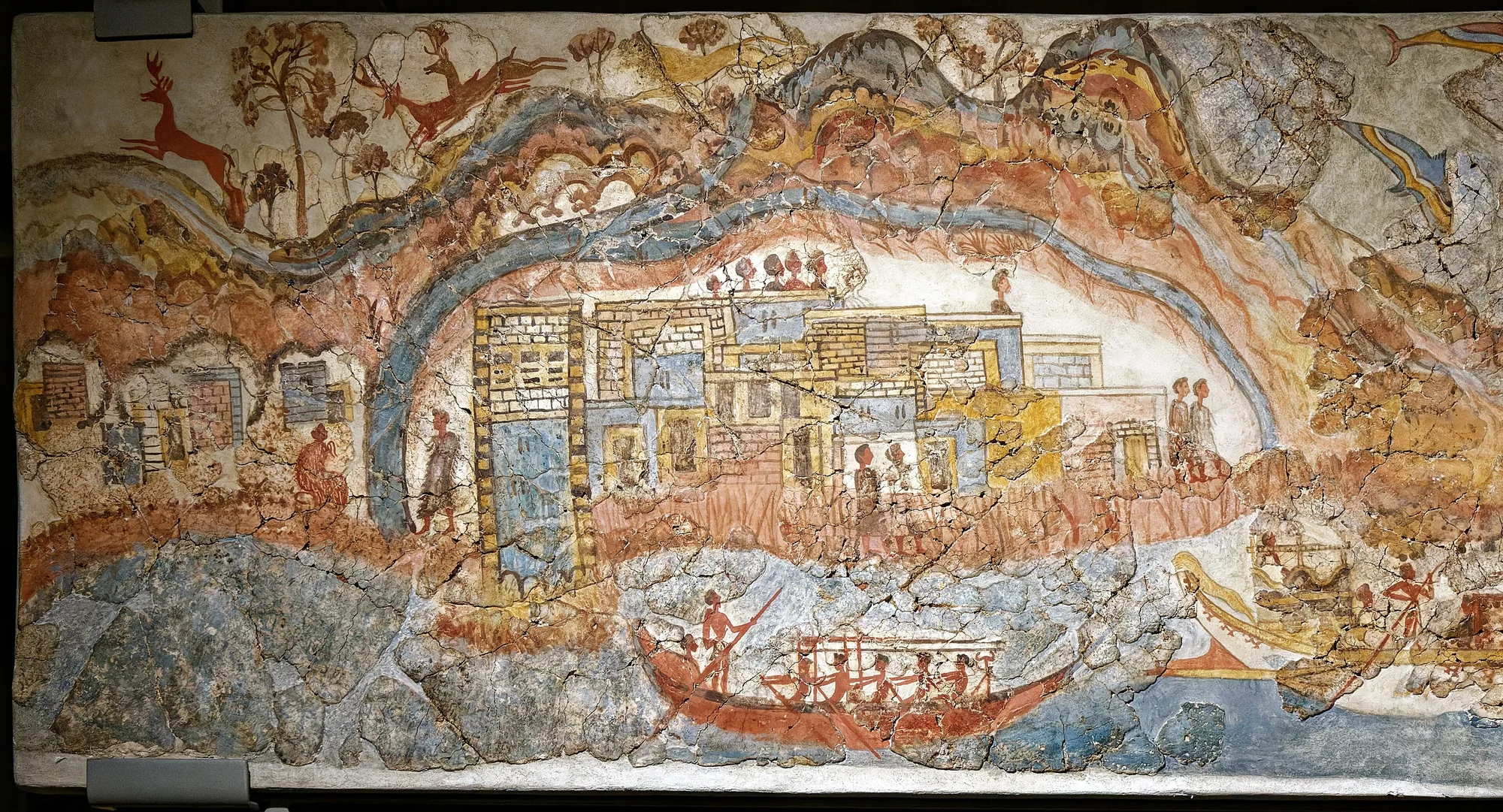
The Akrotiri flotilla. Two scenes from the Flotilla Fresco in the West House at Akrotiri (Thera, Santorini), seventeenth century BC. On the left, vessels carrying numerous crew members and displaying elaborate decorative structures; on the right, a coastal settlement with other vessels nearby. Together, the scenes provide some of the most important evidence for seafaring in the Bronze Age Aegean. Photographs: Holger Uwe Schmitt / Wikimedia Commons, scene 1 and scene 2, CC BY-SA 4.0.
The fresco depicts several vessels amid coastal landscapes, settlements and groups of people. Some are long and narrow, with large crews; others are elaborately decorated and carry figures who appear to occupy prominent positions. Some vessels seem to be propelled by paddles, while another appears to use oars. A sailing vessel is also depicted.
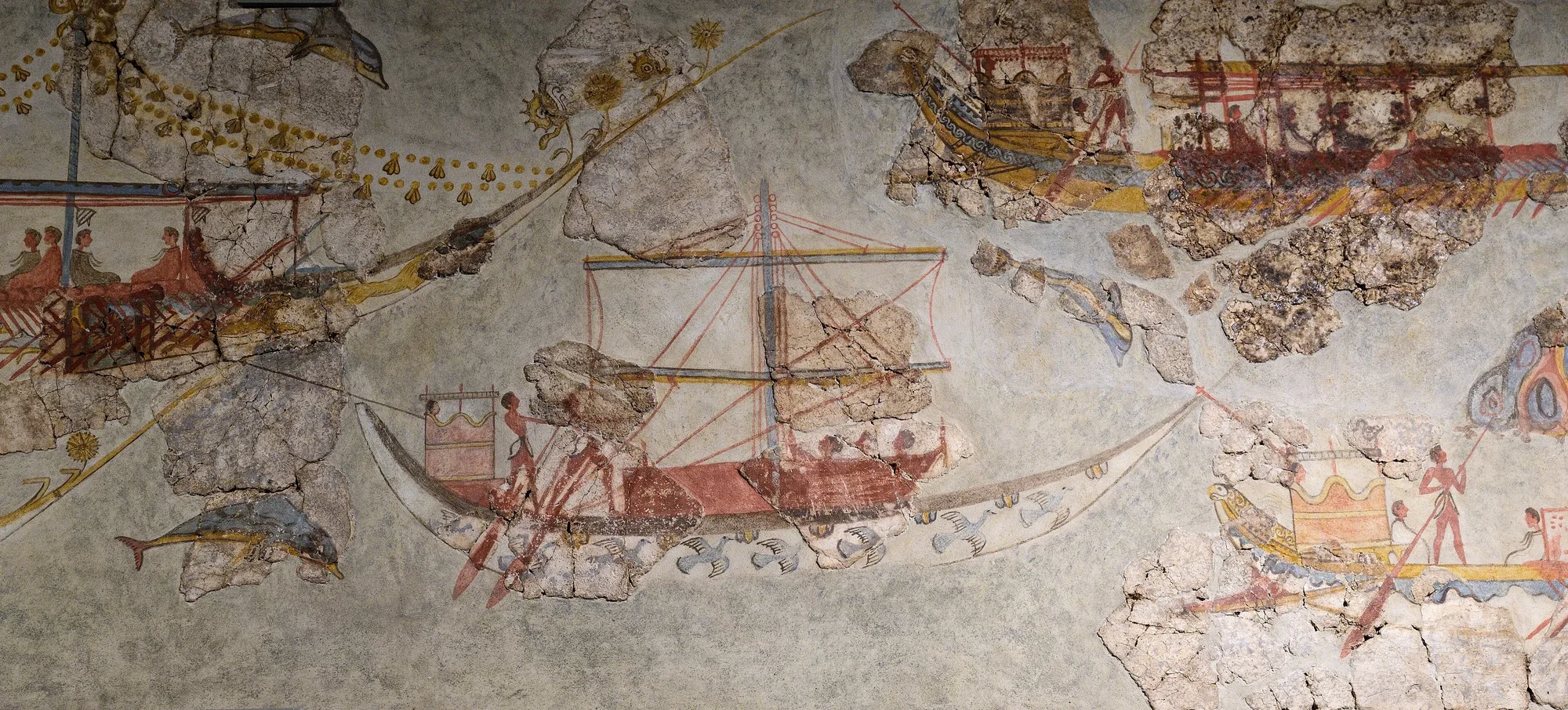
Sailing vessel depicted in the Flotilla Fresco at Akrotiri (Santorini), seventeenth century BC. The image provides evidence of sailing in the Bronze Age Aegean, many centuries before the composition of the Homeric poems. West House, Room 5; Museum of Prehistoric Thera. Photograph: Zde / Wikimedia Commons, CC BY-SA 4.0. Cropped from the original.
The scene is generally interpreted as a maritime procession or celebration, although its precise meaning remains debated. The fresco is fragmentary, and some of the rigging visible in modern reconstructions is based on conjecture.
With these reservations, Akrotiri shows that, centuries before the late Mycenaean period, Aegean communities were familiar with different types of vessels and methods of propulsion. Seafaring was neither rudimentary nor occasional: it was sufficiently developed to occupy a prominent place in their art.
In 1982, archaeologists discovered the remains of a merchant ship that sank around 1300 BC near Uluburun, off the southern coast of Anatolia. Dendrochronological analysis of one of the recovered timbers indicates a date after 1305 BC.
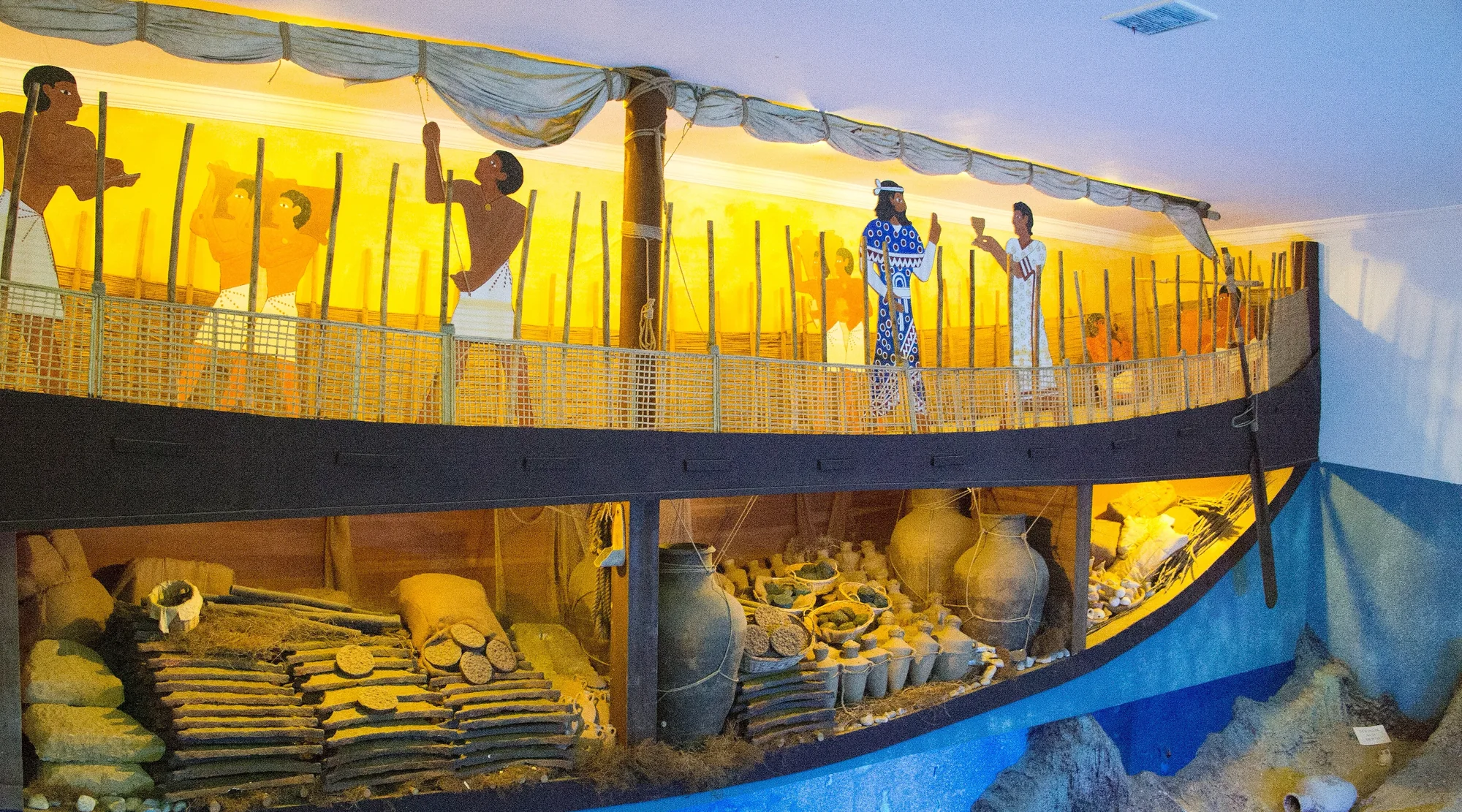
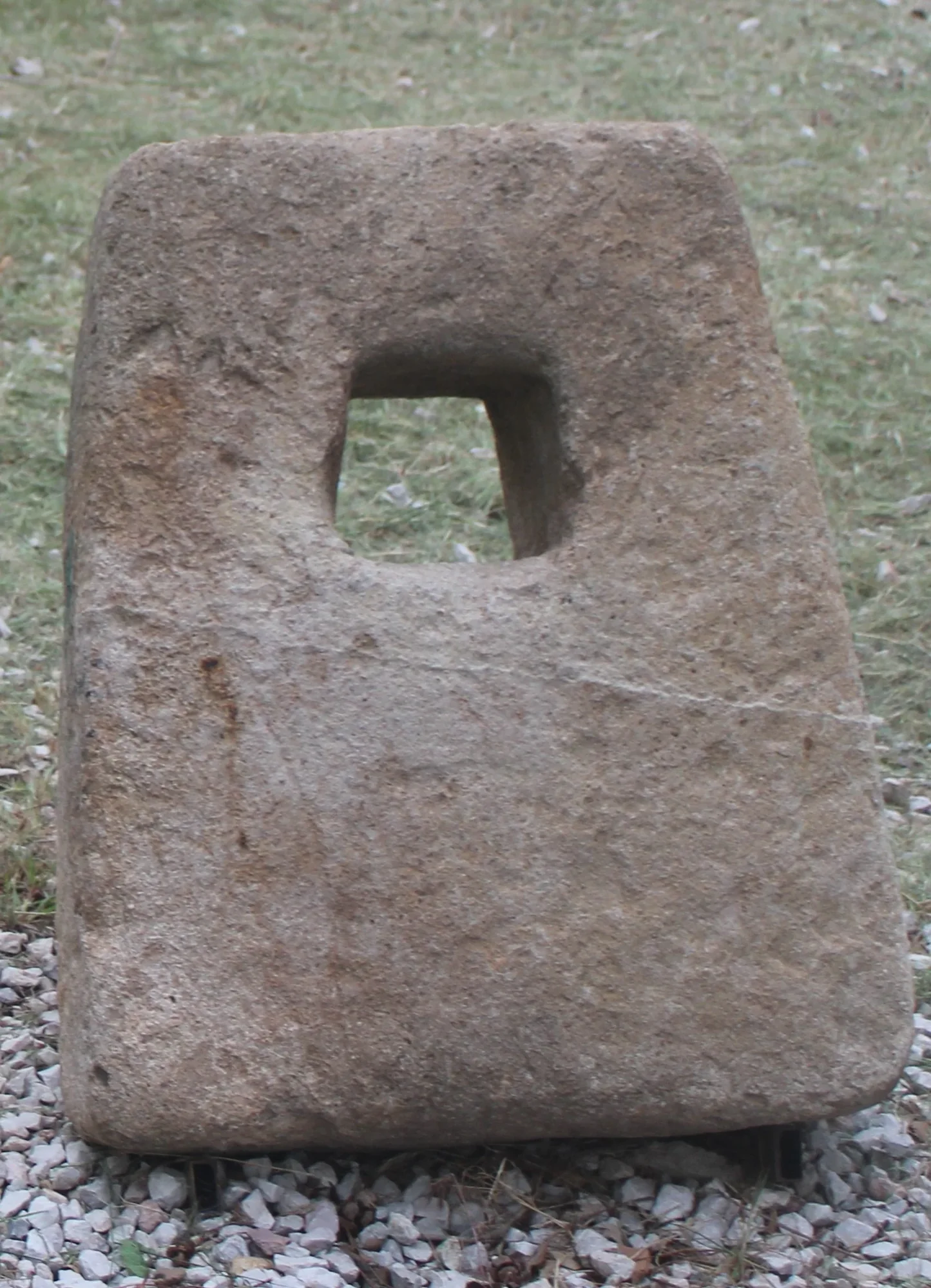
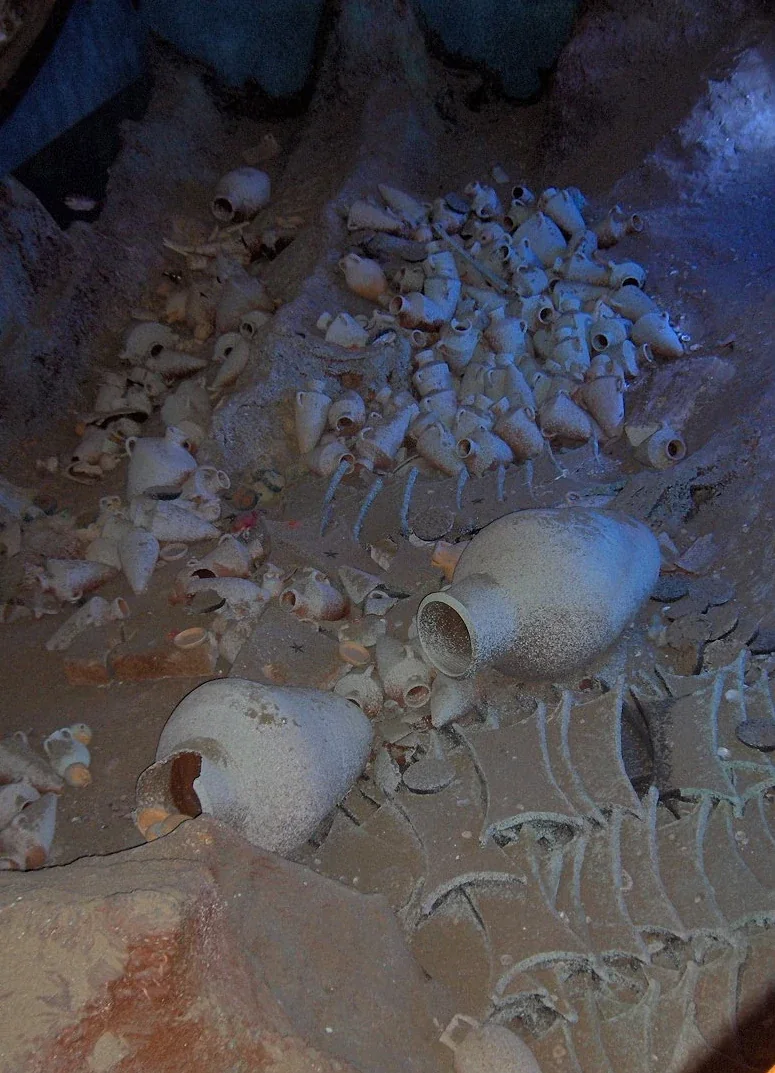
The Uluburun shipwreck, c. 1300 BC. Above: a museum reconstruction of the vessel and its cargo. Below, from left to right: a stone anchor weighing 148.3 kg, recovered from the wreck, and a reconstruction showing how the cargo lay on the seabed. Bodrum Museum of Underwater Archaeology, Turkey. Photographs: Dick Osseman (Dosseman), CC BY-SA 4.0; Zunkir, CC BY-SA 4.0; Georges Jansoone, CC BY-SA 3.0. Images cropped from the originals.
Maritime trade in metals also appears in the Odyssey. In Book 1, Athena visits Telemachus disguised as Mentes, king of the Taphians, and explains her presence in Ithaca as a stop on a trading voyage:
“I shall tell you everything truthfully. My name is Mentes, son of the wise Anchialus, and I rule the Taphians, a seafaring people fond of the oar. I have come here with my ship and crew, crossing the wine-dark sea towards people of another language, bound for Temesa with a cargo of gleaming iron which we intend to exchange for copper.”
Odyssey 1.179–184.
The scene is significant because Athena is inventing both an identity and a reason for her voyage. Yet her explanation must sound credible to Telemachus: there is nothing extraordinary about a ship carrying iron to exchange for copper.
The comparison with Uluburun is suggestive, but does not demonstrate continuity between the two periods. The wreck provides evidence of copper and tin being transported across the eastern Mediterranean around 1300 BC. Homer, by contrast, describes iron being exchanged for copper, a detail more consistent with a world in which iron had already become important. Both illustrate the role of the sea in the movement of metals, but belong to different historical contexts.
The Uluburun ship was an estimated fifteen metres long and could carry at least twenty tonnes. Its cargo included copper and tin—metals fundamental to the Mycenaean world—alongside numerous objects from widely differing regions, evidence of the extensive maritime connections of the eastern Mediterranean during the Bronze Age.
For our purposes, however, the wreck is particularly important because of the surviving remains of its hull. Archaeologist Cemal Pulak studied cedar planking joined by wooden tenons fitted into mortises and secured with dowels. This technique allowed the planking itself to form a strong structure, without first assembling a complete framework of ribs.
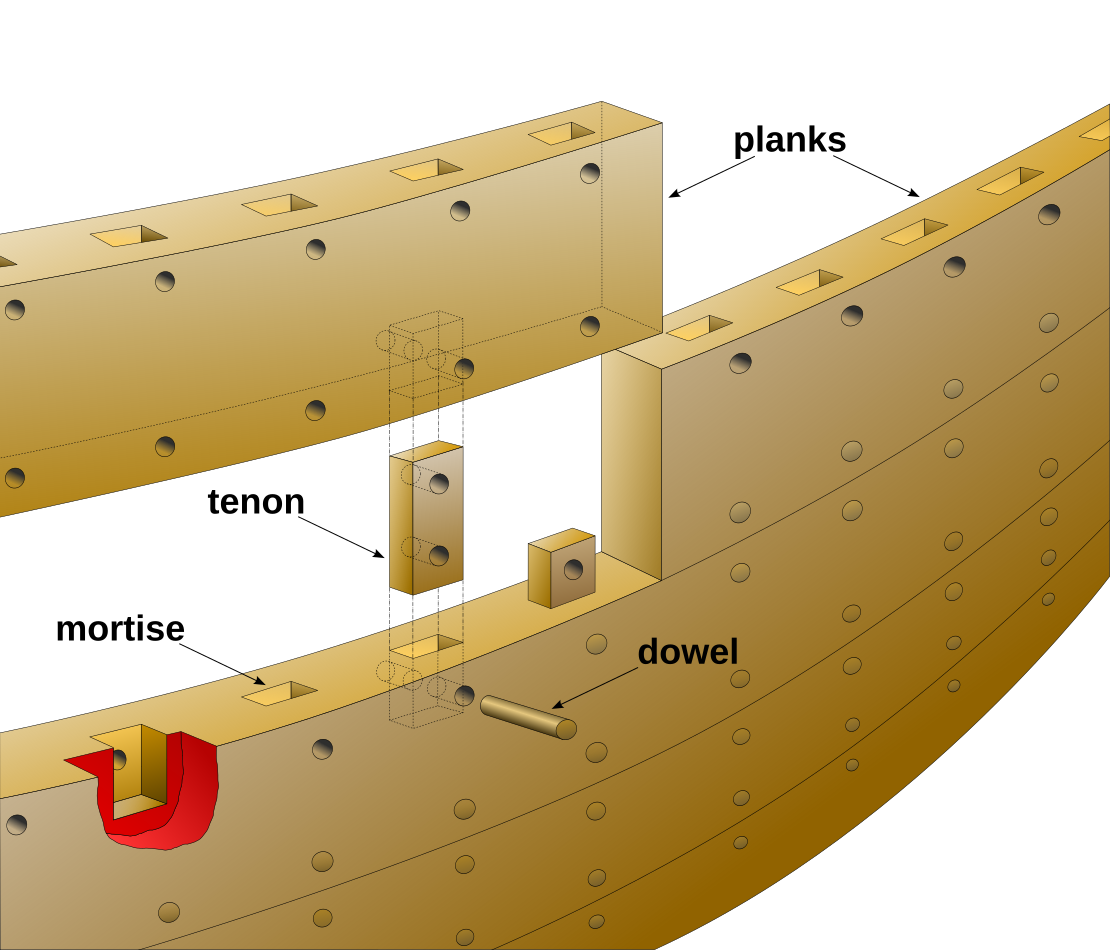
Mortise-and-tenon construction secured with wooden dowels. Diagram illustrating a shipbuilding technique documented at Uluburun around 1300 BC; it does not depict that particular vessel. Illustration: Eric Gaba (Sting) / Wikimedia Commons, CC BY-SA 2.5.
The vessel also had a keel that projected only slightly below the hull, helping to strengthen the structure and possibly protecting the bottom when the ship was hauled ashore. These remains show that shipbuilders in the eastern Mediterranean had mastered relatively sophisticated construction techniques by the Late Bronze Age, before the traditional date of the Trojan War.
Uluburun, however, was a merchant ship rather than a warship, and only a small part of its hull survived. We have no direct evidence of the arrangement of its mast, sails or steering gear. Nor can it serve as a general model for all Bronze Age vessels.
The Vessel Odysseus Built
Sección titulada «The Vessel Odysseus Built»One of Homer’s most remarkable nautical descriptions appears in Book 5 of the Odyssey, when Calypso finally allows Odysseus to leave her island.
The hero must build the vessel that will carry him out to sea. Calypso gives him a bronze axe and an adze and leads him to a place where alders, poplars and firs grow—tall trees whose timber had long since dried and would float easily. Odysseus fells twenty trees, trims, smooths and straightens the timbers, then bores holes to join them together.
He then prepares the side structures, makes a mast and yard, fashions a steering oar and protects the sides with woven wickerwork to keep the waves out. Finally, Calypso provides cloth for the sail, and Odysseus completes the rigging (Odyssey 5.234–261).
Although the craft is usually described as a “raft”, its construction is considerably more elaborate than that of a simple platform of lashed logs. Homer describes a vessel with structural elements, a sail and a means of steering.
The passage has prompted different interpretations. In “Odysseus’ Boat” (1964), Lionel Casson suggested that the references to fastenings and joints might indicate mortise-and-tenon construction. Samuel E. Mark, in “Odyssey 5.234–53 and Homeric Ship Construction: A Reappraisal” (1991), questioned this interpretation and argued that the passage might instead describe timbers joined by lashings. The Greek text does not allow us to settle the dispute with certainty.
There is, however, a particularly interesting parallel with Uluburun. Among the remains of the wreck were pieces of woven plant material which Pulak tentatively interpreted as part of a possible barrier against the waves. He explicitly compared this structure with the wickerwork described in Homer’s account of Odysseus’ vessel.
The resemblance is suggestive, but it does not prove that Homer was describing a technique preserved unchanged from the Bronze Age.
Ships in Homer’s Time
Sección titulada «Ships in Homer’s Time»To assess what the poet might have known from his own world, we have another body of evidence: depictions of ships from the Geometric period, particularly those found on Attic pottery from the second half of the eighth century BC.
The large funerary vases from the Dipylon depict long ships with raised bows and sterns and numerous rowers. Some images appear to show two rows of oars, although the conventions of artistic representation do not always allow us to determine how the rowers were actually arranged within the hull.
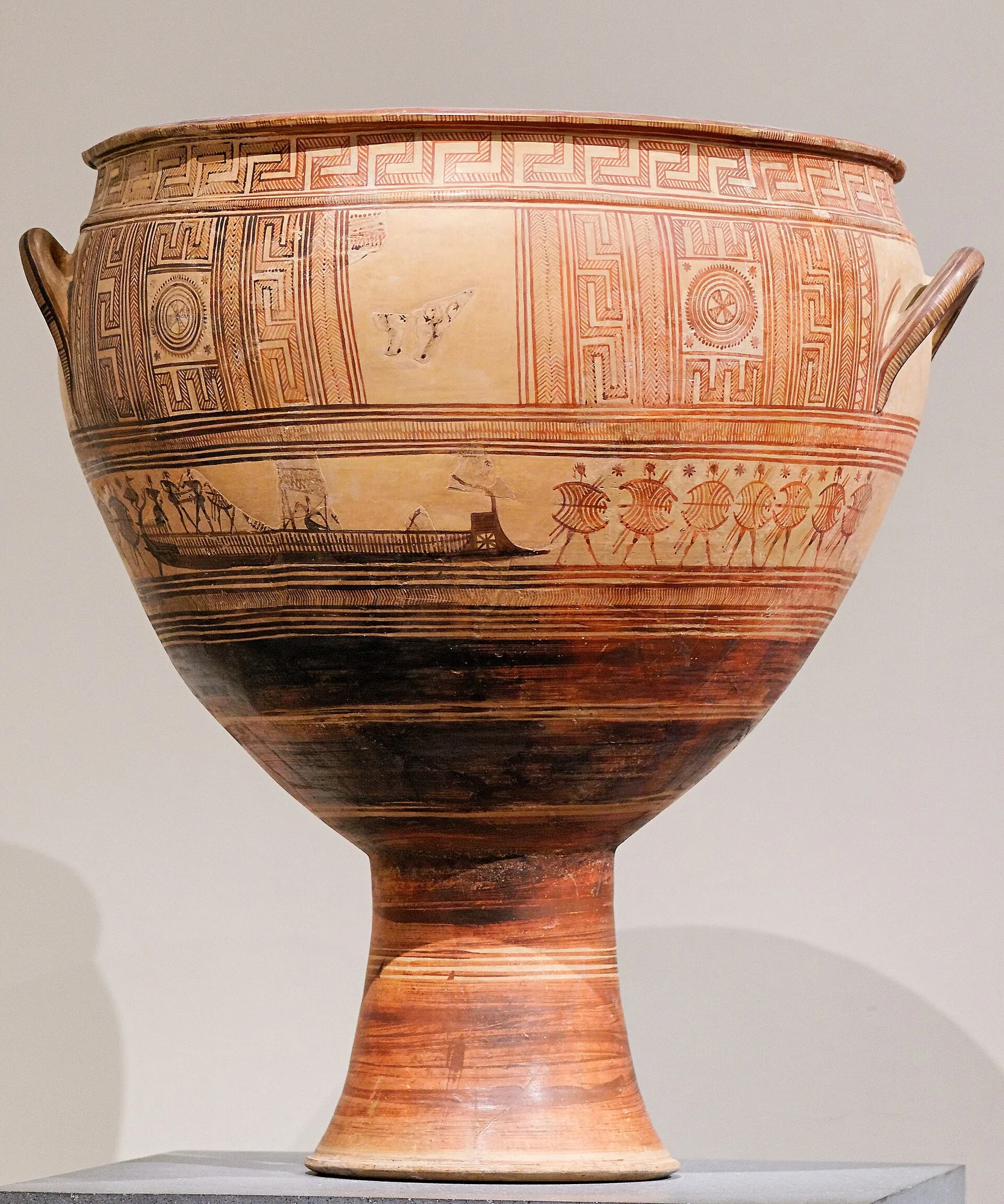
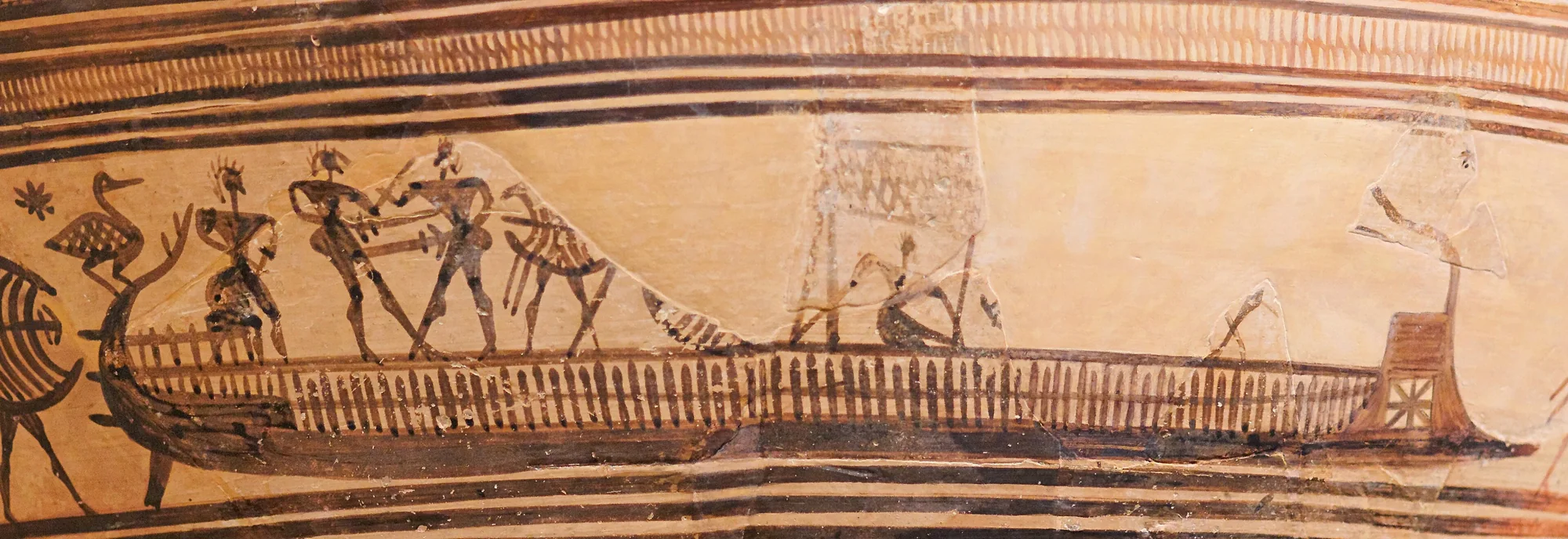
Curved ornaments also appear, sometimes resembling birds’ heads, along with projections at the bow whose function remains uncertain. These may have been decorative or structural features, but we should not automatically interpret them as rams designed to strike other ships.
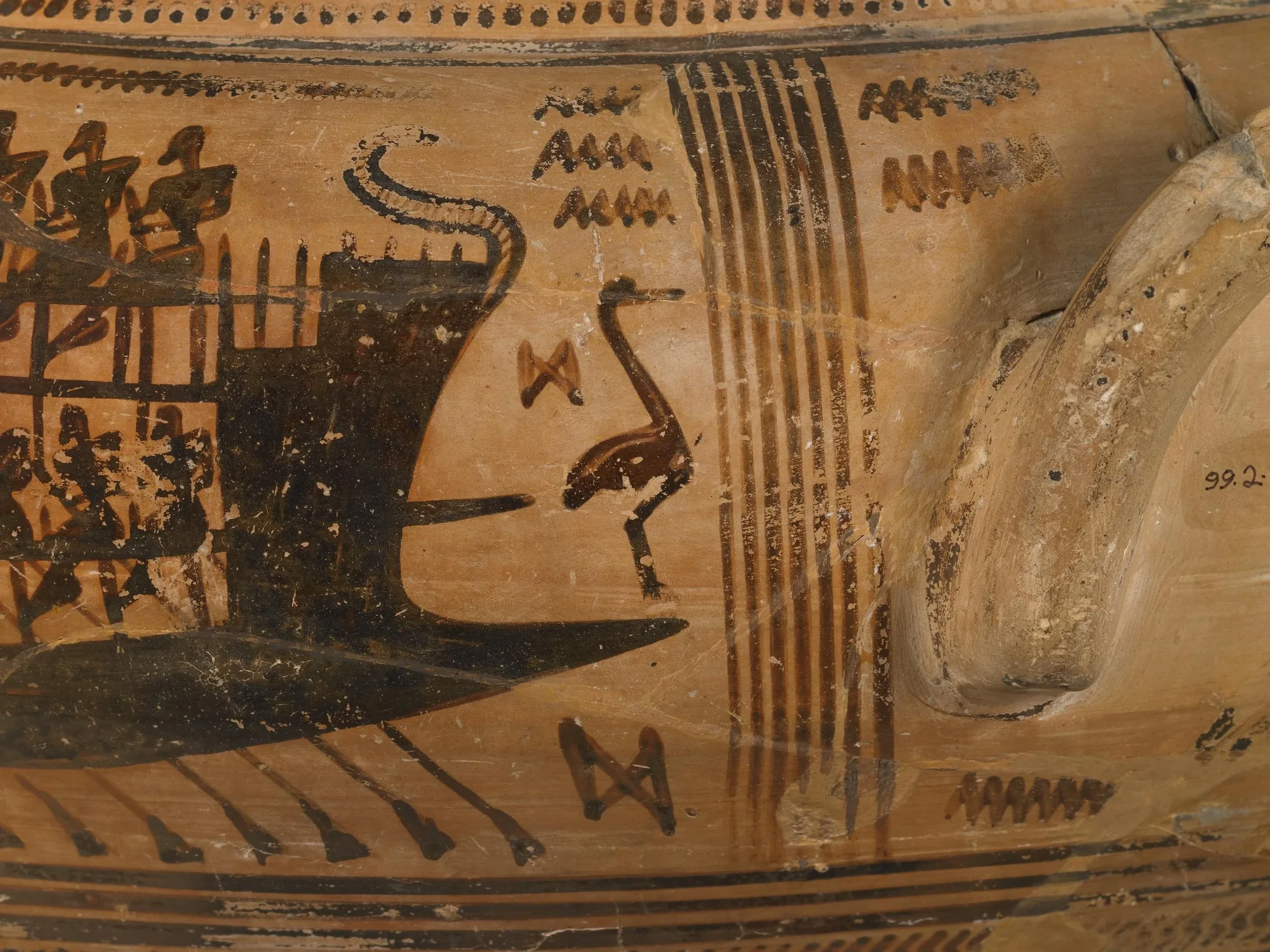
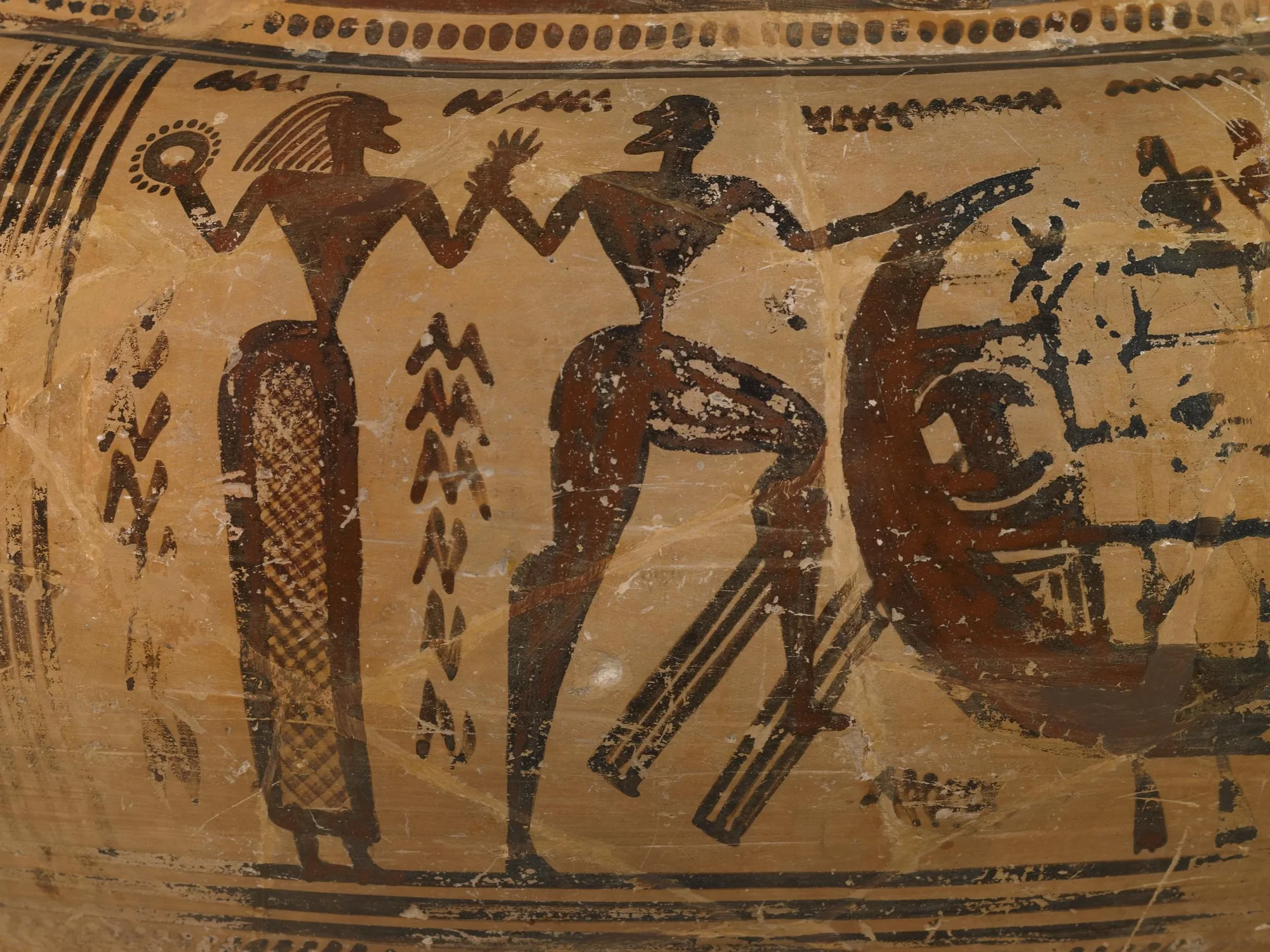
These paintings are much closer to the period in which the poems took shape than the evidence from Akrotiri and Uluburun. They show that long, oared ships were part of the visual culture of eighth-century Greece. The surviving evidence, however, comes from a limited number of workshops and cannot necessarily be taken as representative of the entire Greek world.
Homeric ships, capable of carrying warriors, travellers, provisions and spoils, are broadly consistent with this picture. The images do not, however, reveal how such vessels were built or establish that every feature matches Homer’s descriptions.
Comparing the poems with the archaeological evidence suggests a different picture from the one presented by war chariots. Homer seems more at home in the world of ships than in certain military practices of the distant past. While his descriptions of chariot warfare raise questions about how much of Bronze Age military practice the tradition preserved, the nautical manoeuvres he describes are coherent and recognisable. The poet may have been more familiar with the ships of his own time than with the methods of warfare of a much earlier age.
The Heroes’ Weapons
Sección titulada «The Heroes’ Weapons»In the Iliad, weapons are inseparable from the identity of the heroes. Swords, spears, shields and cuirasses are not merely instruments of combat: some have such distinctive features that their owners can be recognised by them. Some pass from one warrior to another as gifts or spoils of war; others remain with their owners until death.
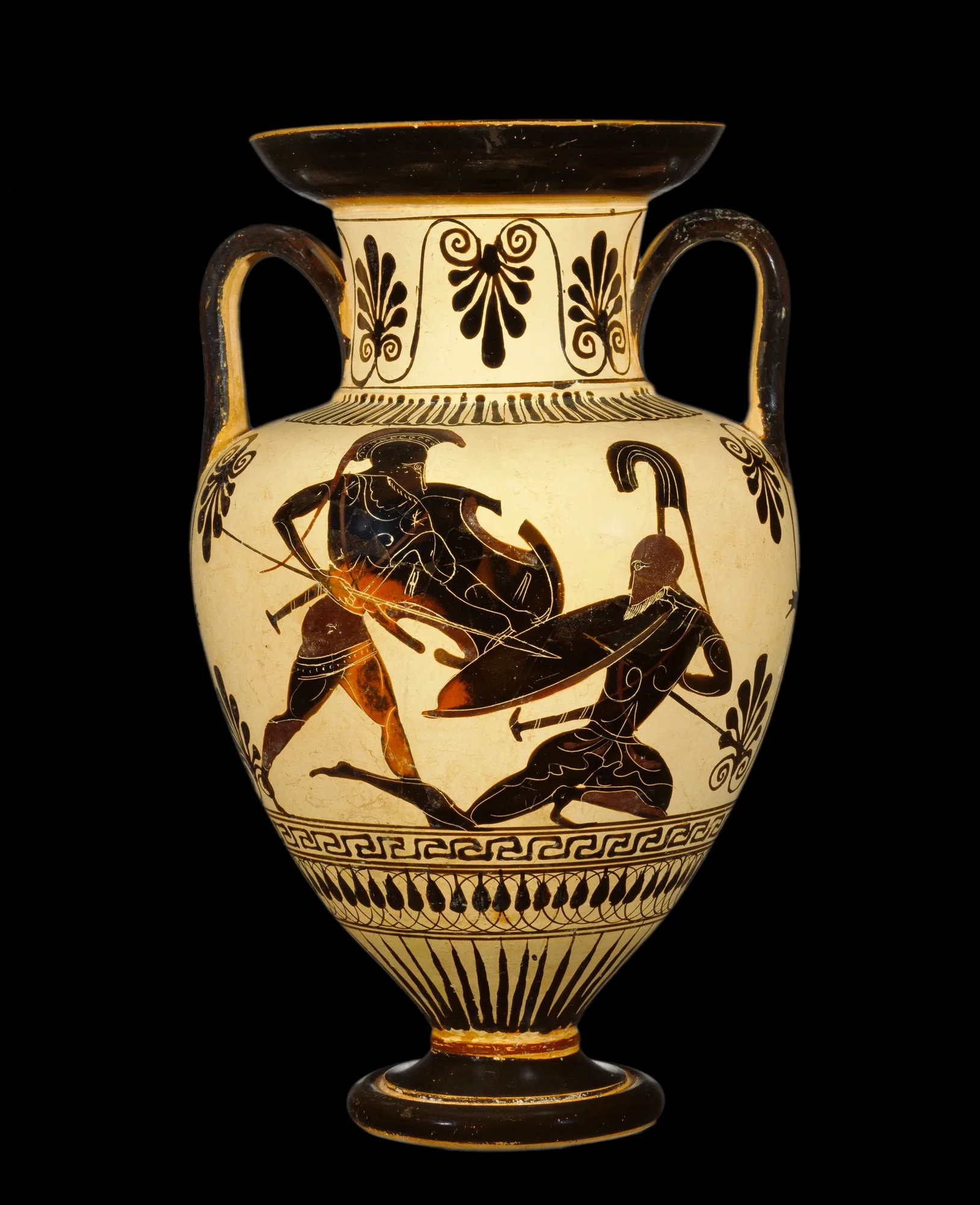
Homer frequently describes how warriors arm themselves before entering battle. They put on their greaves, fasten their cuirasses, strap on their swords, place helmets on their heads and finally take up their shields and spears. Weapons also feature in the fighting itself: a spearhead pierces a piece of armour, a sword breaks, a shield stops a blow, or a cuirass fails to save its wearer.
These descriptions, however, do not necessarily reflect a uniform set of equipment. Archaeology shows that weapons, materials and methods of warfare changed between the Mycenaean period and the time when the poems took shape. Some of the weapons Homer describes have parallels dating back many centuries; others may also have been familiar in the poet’s own time.
The Boar’s-Tusk Helmet
Sección titulada «The Boar’s-Tusk Helmet»One of the most remarkable passages appears in Book 10 of the Iliad. Before setting out on a night raid against the Trojans, Odysseus receives a helmet from Meriones, which Homer describes in unusual detail:
Meriones gave Odysseus a bow, a quiver and a sword, and placed a leather helmet upon his head. Inside, it was firmly reinforced with numerous straps; outside, gleaming white boar’s tusks covered both sides, carefully arranged. A layer of felt lined the interior.
The poet then explains how the helmet had passed through the hands of several owners before reaching Meriones.
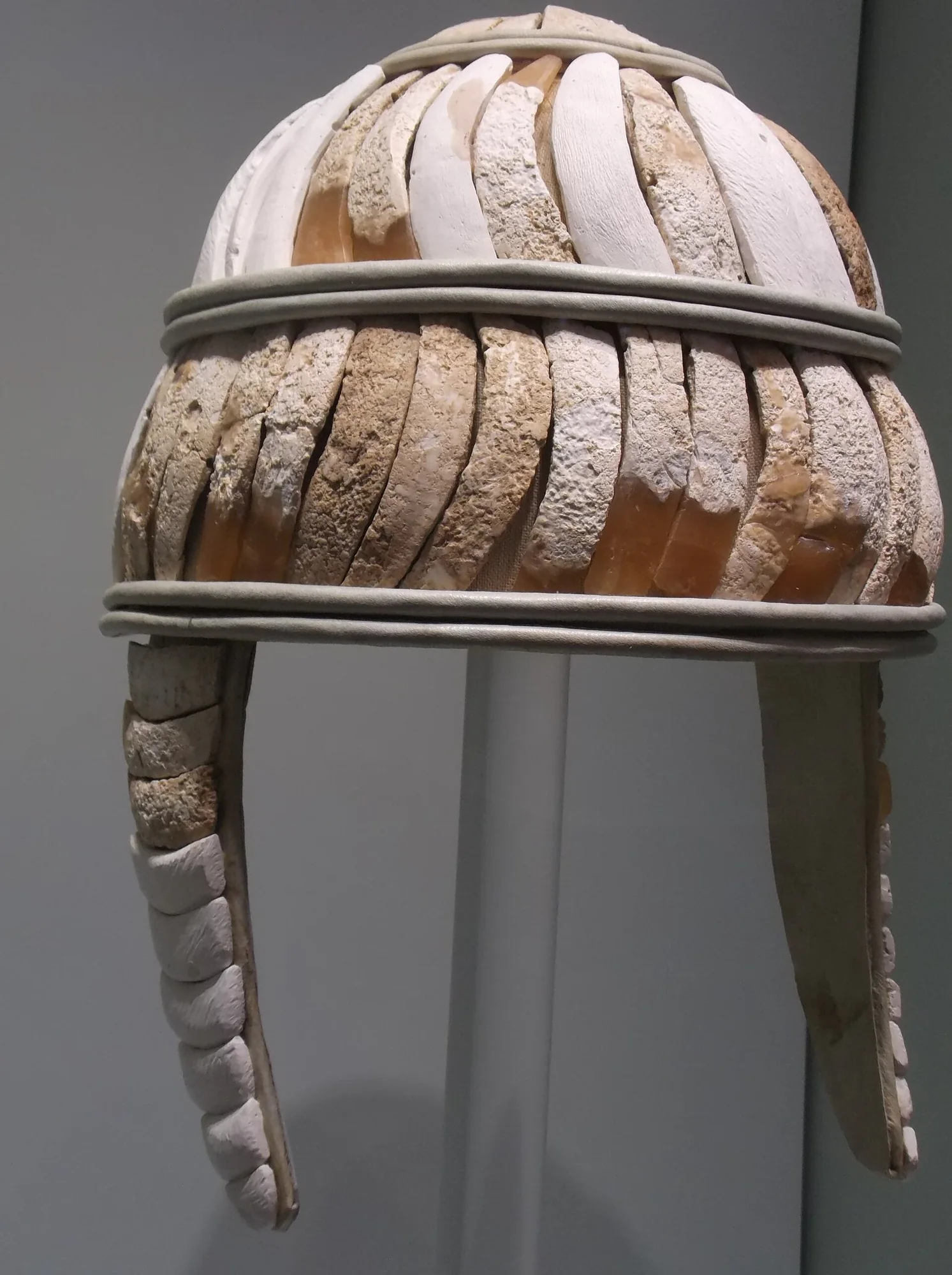
Mycenaean boar’s-tusk helmet from Knossos (Crete), 1450–1300 BC. The tusks, cut and perforated, were attached to a leather framework. This type of helmet provides a particularly close parallel to Homer’s description of the one Meriones gives to Odysseus (Iliad 10.260–271). Heraklion Archaeological Museum. Restored helmet. Photograph: Eunostos / Wikimedia Commons, CC BY-SA 4.0.
These were no imaginary helmets. Worked and perforated boar’s tusks, used to make such protective headgear, have been found at several Mycenaean sites. This type of helmet also appears in Bronze Age art. The resemblance is striking because Homer does not merely mention a helmet decorated with tusks: he describes their arrangement over a leather framework, a detail consistent with the archaeological reconstruction of these objects.
Boar’s-tusk helmets are particularly well attested in the Mycenaean world of the second millennium BC and seem to have disappeared from common use long before the Iliad was composed.
It is curious that Odysseus should be the one to receive this helmet. In the Odyssey, a scar left by a boar’s tusk during a hunt in his youth allows Eurycleia to recognise him after twenty years away (Odyssey 19.392–466). Homer does not explicitly connect the two episodes, but the coincidence creates an intriguing link between the poems.
How could such a precise description have survived?
One detail is particularly suggestive: Homer recounts how the helmet passed from one owner to another before reaching Meriones, who eventually gives it to Odysseus (Iliad 10.266–271). The poem itself thus illustrates how an object might be preserved and handed down long after its manufacture. We cannot know whether Homer was familiar with these helmets through poetic tradition, ancient representations or perhaps even a surviving example. What is clear is that his description corresponds to a material reality much older than his own time.
Warriors’ Shields
Sección titulada «Warriors’ Shields»Shields present a more complex problem. During the Bronze Age, warriors in the Aegean used shields of different shapes and sizes. Mycenaean depictions show large shields capable of protecting much of the body. Some are roughly rectangular, resembling towers; others narrow at the centre, giving them the characteristic figure-of-eight shape.
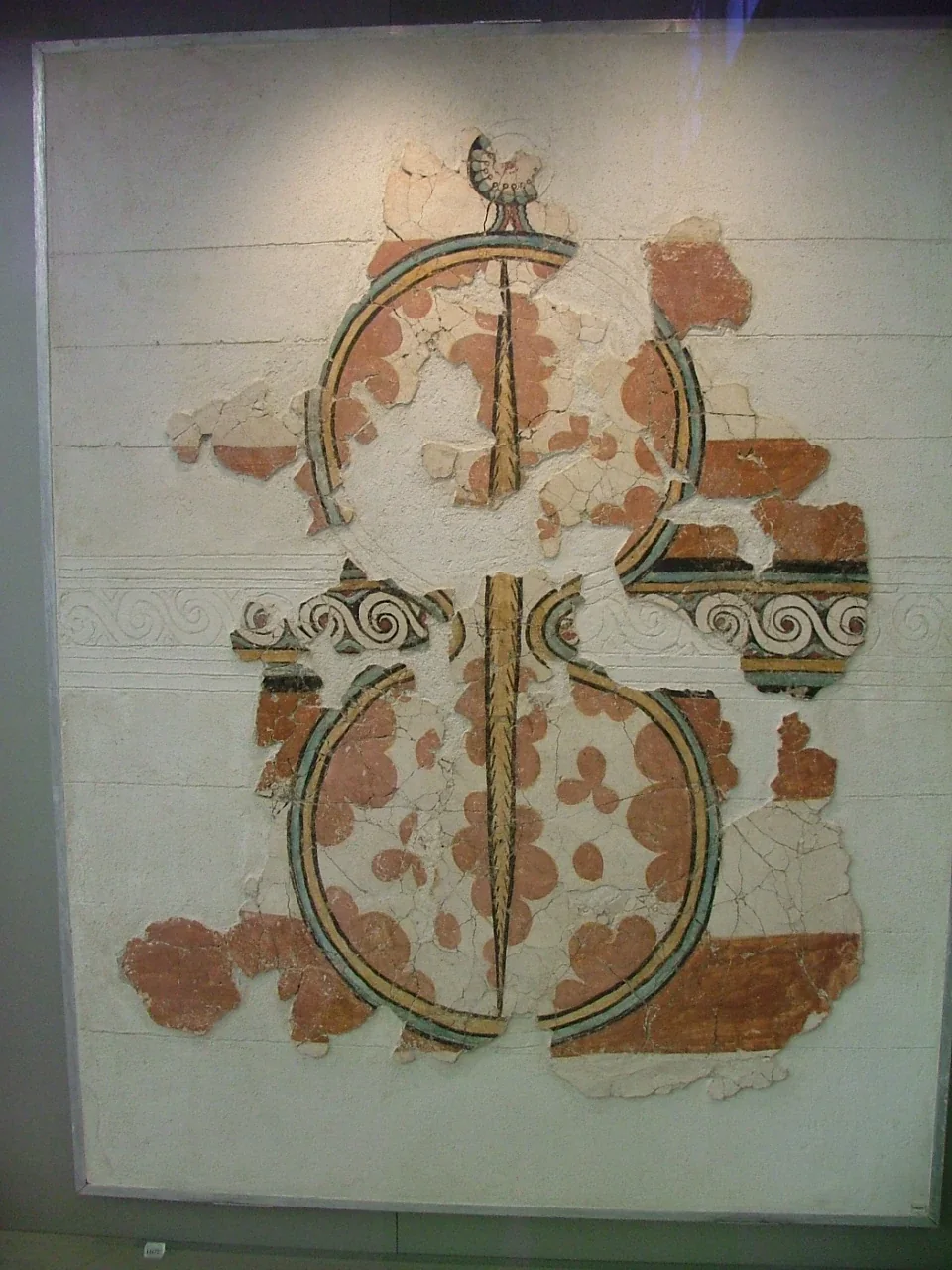
Mycenaean figure-of-eight shields. Wall painting from Mycenae, Late Bronze Age. The painting depicts large shields narrowed at the centre, with suspension straps and decorated surfaces resembling cowhide. This type of shield is characteristic of Mycenaean military iconography. National Archaeological Museum, Athens. Photograph: Dorieo / Wikimedia Commons, CC BY-SA 3.0.
Homer describes Ajax’s shield as enormous, resembling a tower. It consisted of seven layers of oxhide covered by an outer layer of bronze (Iliad 7.219–223). Its size and defensive function invite comparison with the great shields depicted in Mycenaean art.
Yet the resemblance is not enough to identify it with a particular archaeological type. Homer does not describe its shape precisely, and its construction from oxhide and bronze comes from the poetic account, not from the examination of a surviving artefact.
Other shields described by Homer are harder to associate with the large Mycenaean types. They appear to be smaller and more manageable, compatible with later forms of combat. The poet may therefore have brought together, within the same heroic world, memories of ancient shields and features of those used in periods closer to his own.
Achilles’ shield is a different case. Hephaestus makes it at Thetis’ request and decorates it with an extraordinary series of scenes: cities, fields, harvests, herds, dances and representations of the heavens (Iliad 18.478–608). The shield recreates a civilised world within a world at war.
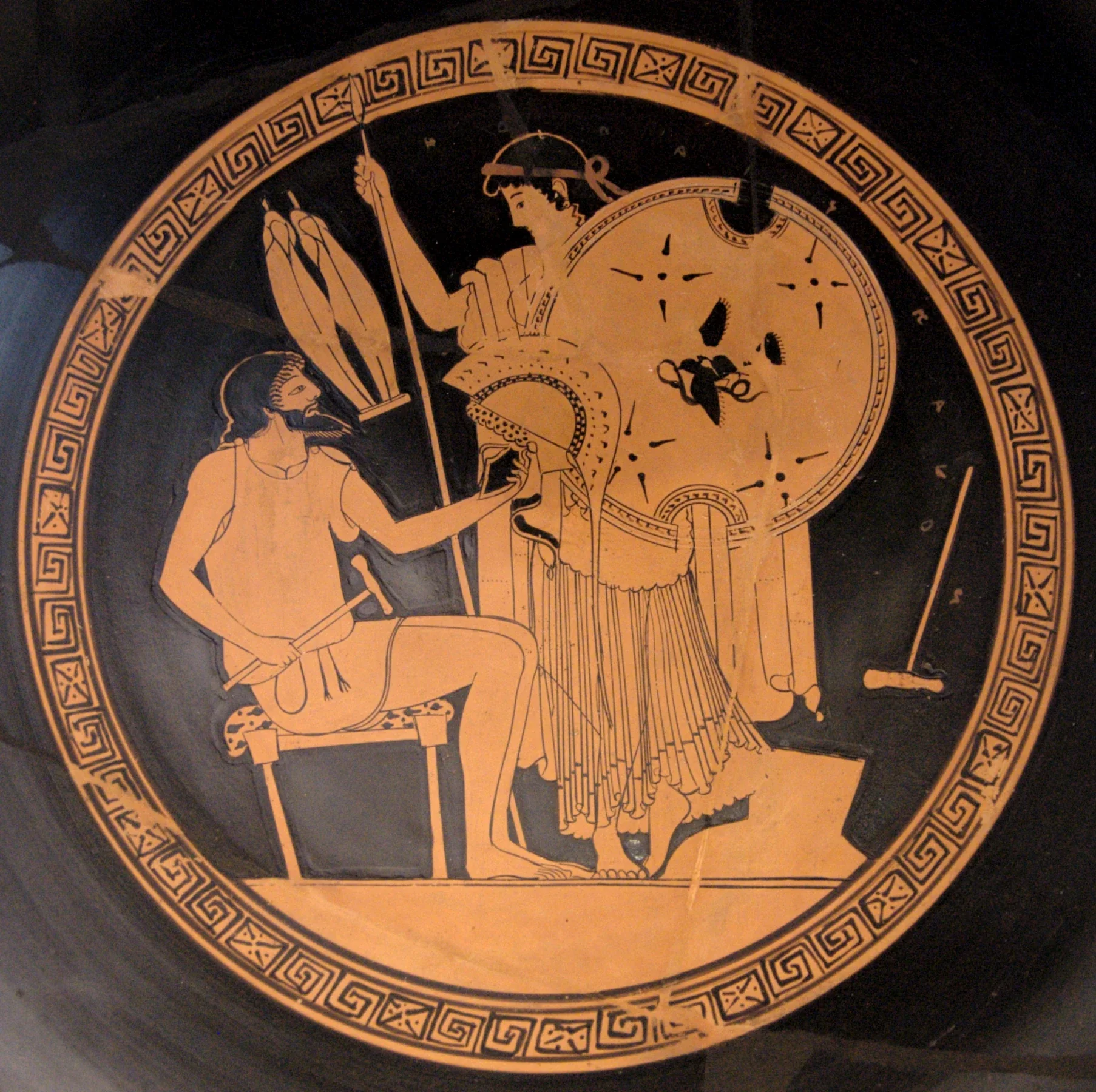
Hephaestus presenting Achilles’ armour to Thetis. Attic red-figure kylix attributed to the Foundry Painter, c. 490–480 BC. The scene depicts Hephaestus handing Thetis the new armour he has made for Achilles, including his extraordinary shield (Iliad 18.468–617). Altes Museum, Berlin, inv. F 2294. Photograph: Bibi Saint-Pol / Wikimedia Commons, public domain.
Here, Homer’s description goes beyond any attempt at archaeological identification. The shield becomes a representation of the world, a poetic creation in which the images matter as much as the object that bears them. To seek an exact archaeological counterpart would be to confuse the shield’s literary purpose with a technical description.
Body Armour
Sección titulada «Body Armour»Archaeology has provided equally remarkable evidence of Bronze Age armour. At Dendra, near Mycenae, archaeologists discovered a remarkable suit of armour made from large bronze plates, dating to the fifteenth century BC. The armour protected the torso and other parts of the body through articulated sections, forming a much more elaborate structure than a simple cuirass.
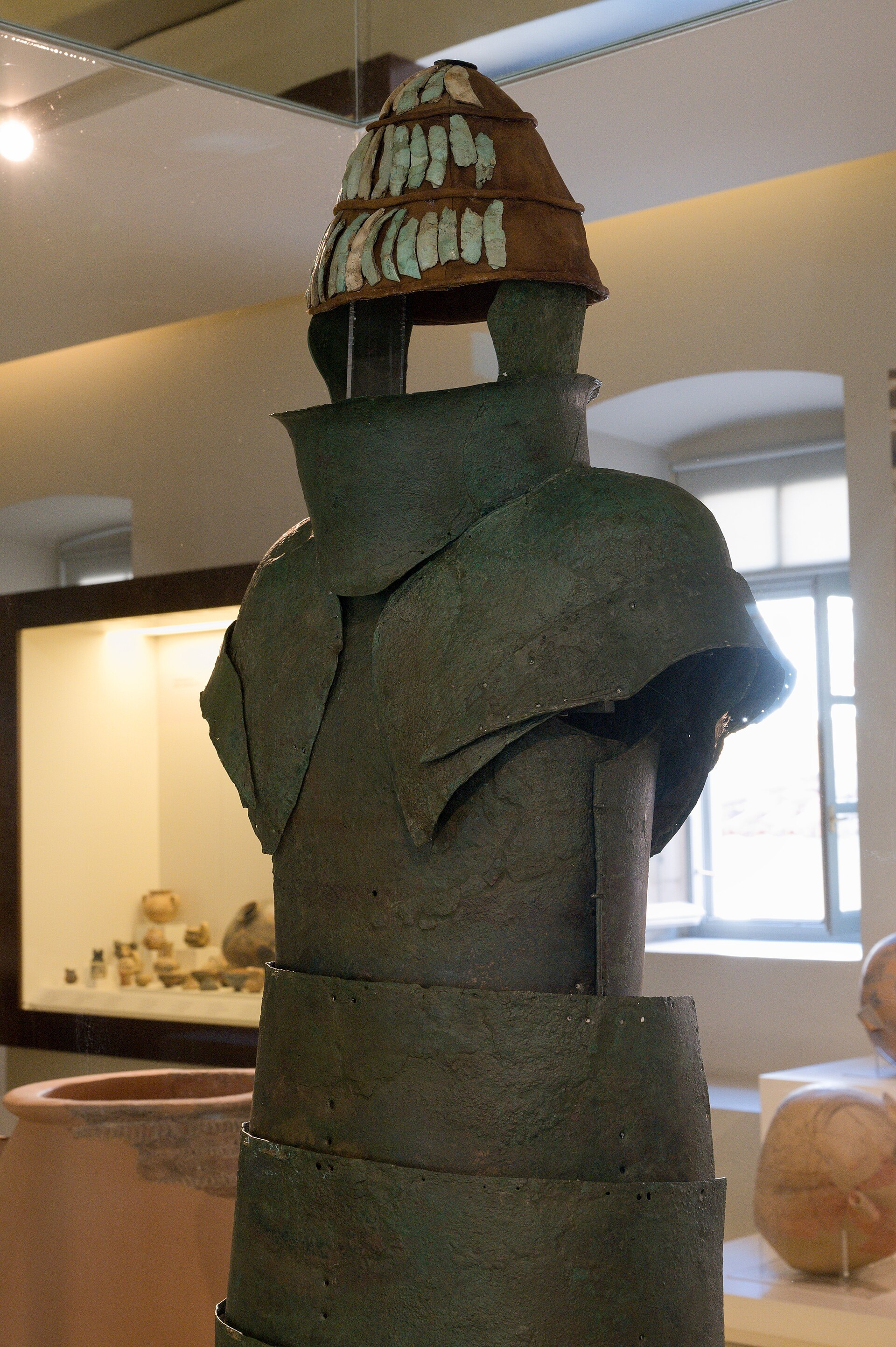
Mycenaean panoply from Dendra, late fifteenth century BC. Body armour made from large, articulated bronze plates, discovered in Tomb 12 of the Dendra cemetery near Mycenae. Archaeological Museum of Nafplio. Photograph: Zde / Wikimedia Commons, CC BY-SA 4.0.
Its existence shows that Mycenaean craftsmen were capable of producing sophisticated body armour and that considerable quantities of bronze could be used to equip individual warriors. The Dendra panoply does not, however, provide direct evidence of how Homeric heroes fought. Its precise function remains debated: it has been associated with chariot warfare, but its possible use in combat on foot has also been investigated.
Homer repeatedly mentions bronze cuirasses and describes weapons striking or penetrating them. Yet the armour described in the Iliad cannot simply be identified with the Dendra type, which belongs to a much earlier period.
Swords, Spears and Javelins
Sección titulada «Swords, Spears and Javelins»Mycenaean swords underwent considerable changes during the Bronze Age. Some were long and narrow, designed primarily for thrusting; others could also be used to deliver cutting blows.
Among the most interesting examples are swords of the Naue II type, named after the German archaeologist Julius Naue, who classified them in the early twentieth century. They began to spread towards the end of the Bronze Age and continued to be manufactured during the Iron Age. The survival of this design shows that the transition from bronze to iron did not necessarily bring an immediate change in the shape of weapons.

Naue II-type iron sword from a warrior’s burial at Eleutherna (Crete), c. 750–700 BC. The sword retains the bronze rivets that secured its hilt. This type of sword, attested from the end of the Bronze Age, continued to be used during the Iron Age, when examples were also made in iron. Photograph: Francesco Bini (Sailko) / Wikimedia Commons, CC BY-SA 4.0.
The spear plays an even more prominent role in Homeric warfare. Warriors throw spears at their opponents, but can also use them in close combat. Some heroes carry two spears, while others are distinguished by weapons of exceptional length or weight.
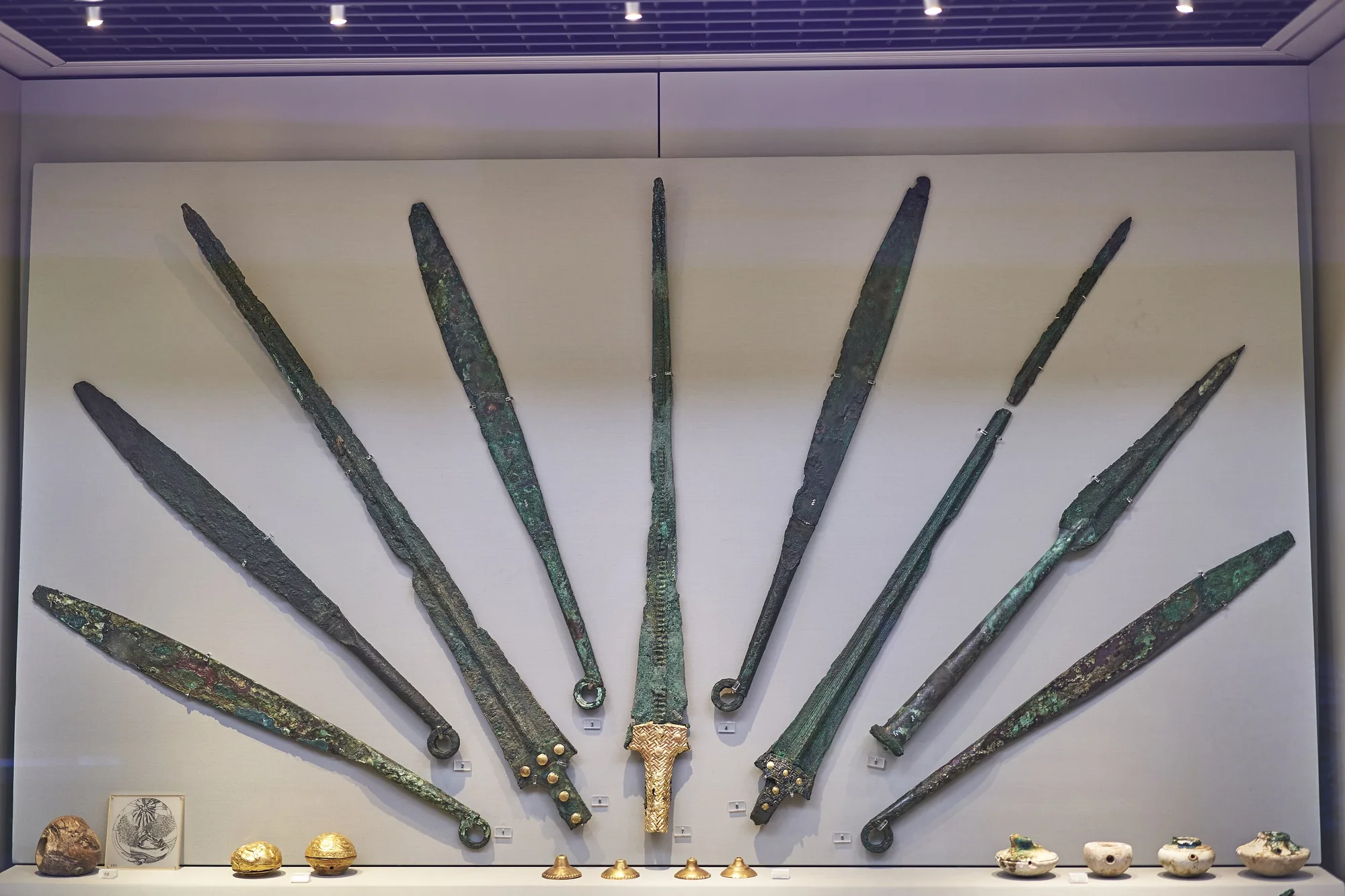
Mycenaean weapons from the sixteenth century BC. Five knives, three Type B swords and a bronze spearhead from Grave IV in Grave Circle A at Mycenae. The swords, designed primarily for thrusting, illustrate the specialised armament of warrior elites during the Bronze Age. National Archaeological Museum, Athens. Photograph: George E. Koronaios / Wikimedia Commons, CC BY-SA 4.0.
Archery also plays a role in Homeric warfare. Although individual encounters between great warriors dominate many episodes, Homer also depicts the use of bows and arrows in battle. Pandarus wounds Menelaus with an arrow (Iliad 4.105–147), while Teucer fights as an archer from behind Ajax’s shield (Iliad 8.266–272).
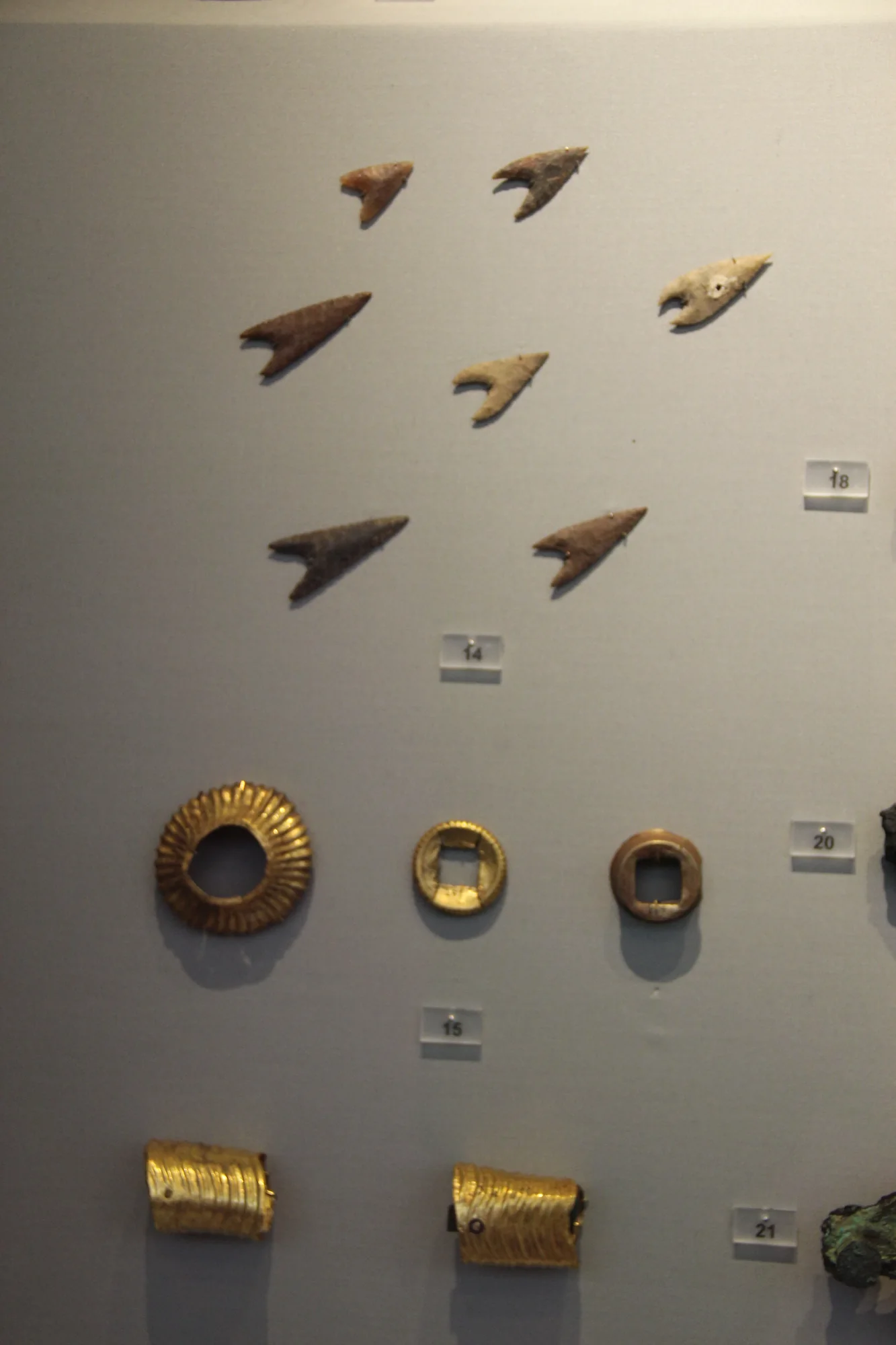
Mycenaean bronze arrowheads. Group of arrowheads and gold objects from the Bronze Age, held by the National Archaeological Museum, Athens. Arrows formed part of Mycenaean armament and also appear in the battles described by Homer, notably in the actions of archers such as Pandarus and Teucer. Photograph: Gary Todd / Wikimedia Commons, public domain (CC0 1.0).
Homer was therefore familiar with different types of offensive weapons and their uses. Whether the prominence he gives to certain forms of combat reflects historical military practices or the demands of epic storytelling is another question.
Bronze and Iron
Sección titulada «Bronze and Iron»The mixture of periods is also evident in the materials Homer describes. The heroes of the Iliad fight chiefly with bronze weapons. Bronze appears repeatedly in descriptions of swords, spears, helmets, cuirasses and shields. Yet Homer is also familiar with iron, which appears as a material for tools, a commodity in trade, a form of wealth and a prize in competitions.
Pandarus even uses an iron-tipped arrow (Iliad 4.123). The poems thus portray a heroic world in which bronze predominates in warfare, while also revealing a familiarity with iron.
Continue to Part II: Houses and Everyday Life
Sources and Method
Sección titulada «Sources and Method»See Also
Sección titulada «See Also»What Did Homer Know About the World He Described? II: Houses and Everyday Life