Helen
The woman around whom the war turns.
In Homer, yes: Helen is in Troy. She speaks with Priam, identifies the Achaean leaders and participates fully in the life of the city during the war. But other ancient traditions imagined a radical alternative: the real Helen never reached Troy; only an image, a double or an appearance was there, while she herself remained in Egypt.
These are not two details that can be reconciled within a single biography. They are two different ways of telling the story of the war and of assigning responsibility to Helen.
Where is Helen in the Iliad?
Sección titulada «Where is Helen in the Iliad?»The Iliad places Helen physically in Troy. In Book 3 she speaks with Priam from the walls and identifies Agamemnon, Odysseus and Ajax for him (Iliad 3.121–244). Her presence beside Paris and her troubled relationship with Aphrodite form part of the same scene. In Book 6 she speaks with Hector, reproaches herself for her situation and acknowledges the shame she has brought about (Iliad 6.344–358). At the end of the poem she joins in the lament for Hector (Iliad 24.761–776).
In the Homeric tradition, then, Helen is not a distant pretext: she is a character living in Troy during the war, aware that her name is bound up with the destruction around her.
And what does the Odyssey tell us?
Sección titulada «And what does the Odyssey tell us?»In the Odyssey, Helen has returned to Sparta with Menelaus. When Telemachus arrives, she recalls that Odysseus entered Troy in disguise and that she recognised him (Odyssey 4.242–264); she also recalls the wooden horse and how she walked around it imitating the voices of the Achaeans’ wives (Odyssey 4.271–289). These memories again presuppose that she was in Troy.
That does not make her character any simpler. Homeric Helen can lament her fate, attribute part of what happened to Aphrodite and judge herself harshly. In any case, she is condemned to live with herself.
Was Helen guilty?
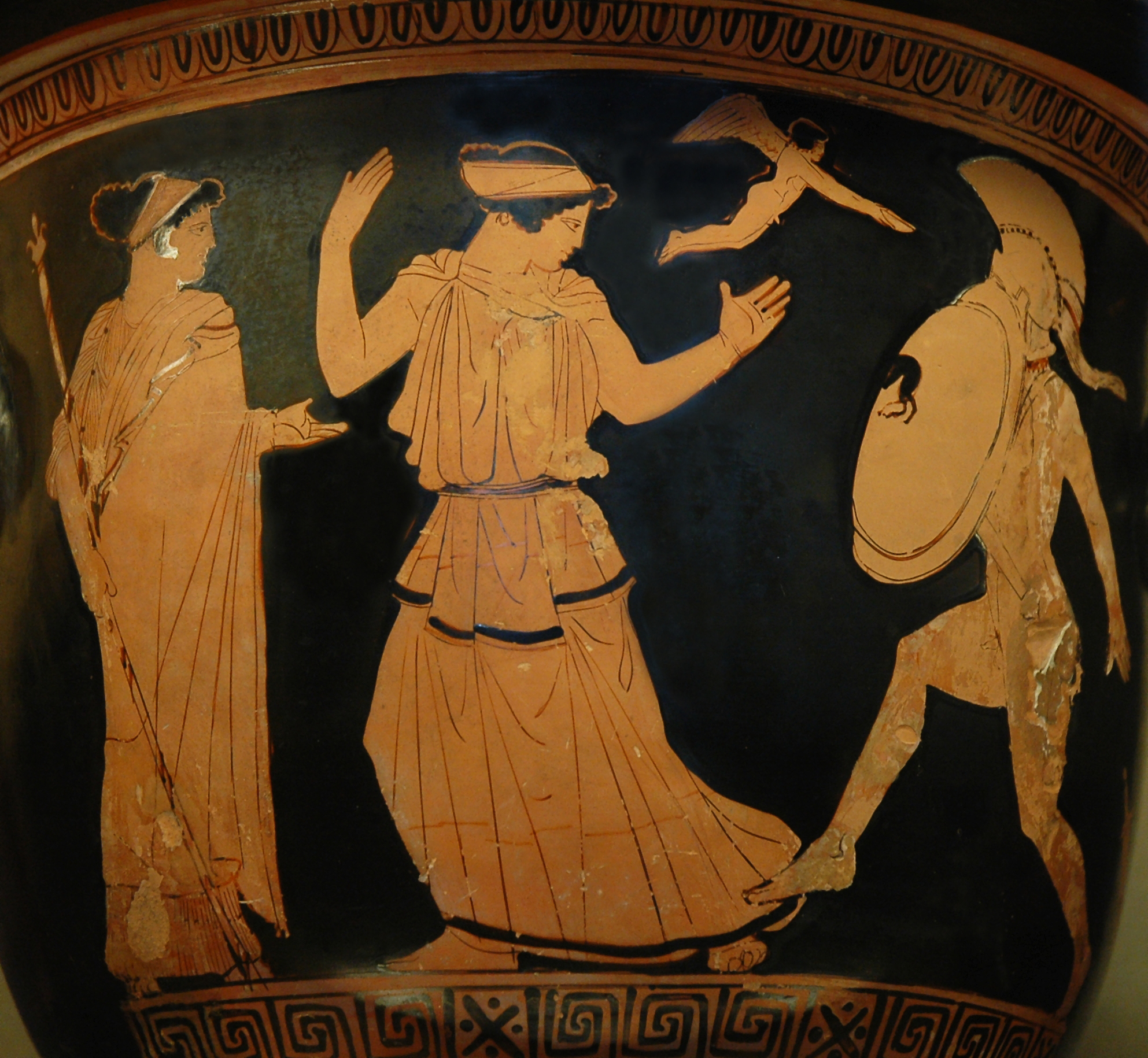
Sección titulada «Was Helen guilty?»Homer does not offer a simple moral verdict. Helen calls herself a cause of suffering and wishes that she had died before; at the same time, Aphrodite intervenes decisively, and the poem does not reduce the war to a single choice made by Helen. The versions that place her in Egypt change the problem completely: if she did not travel with Paris or live in Troy, she cannot bear the same responsibility as the Homeric Helen.
Beauty as a Path to Ruin compares this question of responsibility with other stories in which beauty becomes entangled with desire, violence and power.
Why did Stesichorus say that Helen was never in Troy?
Sección titulada «Why did Stesichorus say that Helen was never in Troy?»Tradition attributes to Stesichorus (ca. 630–555 BC), an Archaic lyric poet, a Palinode, literally a retraction of an earlier song against Helen. His verses survive only in fragments and through later testimonia, not as a complete poem. The most famous fragment says: “That story is not true; you did not board the well-benched ships, nor did you reach the citadel of Troy” (Stesichorus, fr. 192 PMGF).
The story that Stesichorus was blinded for offending Helen and recovered his sight after retracting his words is a later tradition associated with the Palinode, not a verifiable biographical fact. What is secure is more limited, but more important: an Archaic voice associated with Stesichorus denied that Helen had gone to Troy.
If Helen was not there, whom were they fighting for?
Sección titulada «If Helen was not there, whom were they fighting for?»In the tradition of the double, what reaches Troy is an εἴδωλον (eídōlon): an image, appearance or simulacrum in Helen’s form. It is not a “hologram” or a clone in the modern sense; the word denotes a visible presence that can be mistaken for the person it represents.
The narrative consequence is extreme: Achaeans and Trojans can fight for years over a Helen who is not the real Helen. Euripides turns that paradox into a war fought for an empty appearance, while the real woman remains far from the conflict.
What did Herodotus do with this story?
Sección titulada «What did Herodotus do with this story?»Herodotus, Histories 2.112–120 offers another Egyptian solution, but not one involving an eídōlon. Paris and Helen reach Egypt; King Proteus condemns Paris’ conduct, keeps Helen and the stolen property, and allows the Trojan to leave. When the Achaeans reach Troy, the Trojans say that Helen is not there. Herodotus reasons that they would not have endured the destruction of their city simply to keep her if they had actually been able to return her.
In this version, the real Helen is indeed in Egypt, but there is no image of her in Troy. Herodotus presents an inquiry and an argument about inherited stories; he does not apply modern historical verification or establish what happened in a historical war.
What does Euripides tell us in Helen?
Sección titulada «What does Euripides tell us in Helen?»Euripides explicitly brings Egypt and the double together. At the beginning of the play, Helen explains that Hera gave Paris not her, but a living eídōlon, resembling her and made of ether; Hermes carried the real Helen to Egypt, to the house of Proteus (Helen 31–49). After the fall of Troy, Menelaus arrives there, and their reunion makes the duplication the dramatic engine of the play.
According to this tragedy, the most famous war in myth may therefore have been fought over an illusion. Euripides does not quietly correct Homer: he radically transforms the story, its irony and Helen’s reputation.
What exactly is Helen’s eídōlon?
Sección titulada «What exactly is Helen’s eídōlon?»In Helen, the eídōlon is an appearance sent to Troy and capable of being mistaken for the real woman. It is a poetic and religious device, not a technical explanation. It allows us to think about the distance between what is seen, what is believed and what is real: Trojans and Achaeans act upon an image and organise a war around a mistaken identity.
We do not know with certainty how Euripides’ eídōlon relates to the lost formulations of Stesichorus. We can say that both traditions converge in denying Helen’s journey to Troy; we should not simply attribute every theatrical device used by Euripides to the Palinode.
Why Egypt?
Sección titulada «Why Egypt?»Egypt offered an alternative setting already familiar within the Greek narrative world. Herodotus makes it the place where Proteus keeps Helen; Euripides places there the woman rescued by Hermes. Their versions of Proteus and their narrative structures are not the same. The Odyssey also includes Egypt among Menelaus’ travels (Odyssey 4.351–586), but that episode does not by itself establish the Egyptian version of Helen.
The connection helps us see that Egypt is not an arbitrary geographical addition, without turning epic into a map of verifiable events. See also How Far Did Homer’s World Extend?
What happens to Helen’s guilt if she was never in Troy?
Sección titulada «What happens to Helen’s guilt if she was never in Troy?»The Homeric Helen participates in the Trojan world and is aware of the harm attached to her name, although the poem complicates her responsibility through Aphrodite, Paris and the war itself. The Helen of the eídōlon is almost exonerated from the accusations against her: she did not really flee to Troy, did not live there with Paris and was not the presence for which the armies fought.
The variant can also be read as a reflection on two disjunctions. The Helen who bears public blame is separated from the real woman; and the epic magnitude of the war can no longer be explained simply by the supposed infidelity of a wife. We do not know whether this was Stesichorus’ exact intention: it is one possible interpretation suggested by the motif of the double, later developed by Euripides.
This transformation does not prove that one version is truer than the other. It shows what a tradition can do with the same character: turn an implicated and ambiguous figure into the victim of an image, of the gods and of a false reputation.
Which version is the oldest?
Sección titulada «Which version is the oldest?»We cannot reconstruct a single point of origin. Homer and Stesichorus both belong to the Archaic world, but we know Helen through the surviving Homeric poems and the Palinode through fragments and later testimonia. The exact chronological priority of each variant, and its relationship to other early traditions, cannot be established from the surviving evidence. “Homer” does not automatically mean “the absolute original version”, nor does “Stesichorus” mean an invention that we can date or explain completely.
Table of versions
Sección titulada «Table of versions»| Source / tradition | Is Helen in Troy? | Where is the real Helen? | What reaches Troy? |
|---|---|---|---|
| Iliad | Yes | Troy | Helen herself |
| Odyssey | Yes, in memories of the war | Later, Sparta with Menelaus | Helen herself |
| Stesichorus, Palinode | No | Not securely established by the surviving fragments | The exact form of the substitute cannot be reconstructed with confidence |
| Herodotus, Histories 2.112–120 | No | Egypt, kept there by Proteus | No eídōlon is placed in Troy |
| Euripides, Helen | No | Egypt, in the house of Proteus | An eídōlon resembling Helen |
Sources and method
Sección titulada «Sources and method»See also
Sección titulada «See also»- How Do We Know What Happened in the Trojan War?
- Was Iphigenia Sacrificed?
- How Far Did Homer’s World Extend?