Who Worked in Odysseus’ World?
The table does not fill itself
Sección titulada «The table does not fill itself»When the Odyssey begins, Odysseus’ palace still appears wealthy. The suitors eat his meat, drink his wine and consume his stores as though the house had no master. The offence is visible because the poem shows it again and again at the table: slaughtered animals, bread being distributed, kraters of wine, music, seats filled with guests. Heroic wealth is easy to see. Much less visible is the work that makes it possible.
It is worth pausing there before speaking of freedom, slavery or hierarchy. For that table to exist, someone has had to raise animals, tend herds, bring them to the town, grind the grain, fetch water, prepare the food, distribute the portions, wash the utensils and maintain the house. The banquet is not merely a moment of aristocratic consumption: behind every meal lies a chain of labour, most of which the poem does not narrate as heroic action.
Odysseus’ own house gives us glimpses of that chain. At the beginning of the poem, serving women wash the diners’ hands, bring bread and mix the wine; young men and heralds perform other tasks at the table (Odyssey 1.136–148). In Book 20 twelve women appear grinding grain. One of them, exhausted, wishes that this may be the suitors’ last meal: they have been grinding without rest for the men who devour the household’s wealth (Odyssey 20.105–121). The detail matters in itself. Flour does not arrive at the table by itself; an anonymous woman, whose name and story we do not know, feels in her body the weight of other people’s abundance.
It is easy to read the palace only from the point of view of those who command or eat. The narrative invites us to do so: Telemachus, Penelope, Odysseus and the suitors occupy the centre. But the question opening this page is different: who materially kept Odysseus’ world running? We are not looking for a single answer or an impossible census. We are looking again at what the poems do show: people who care, make, transport, serve, sing, heal, manage and work the land, and relationships of very different kinds between those people and the household they serve.
The first conclusion is simple, though important. The heroic world is not sustained only by those who fight, make decisions or receive honours. It also depends on everyday labour that epic usually leaves at the margins of the main action. That narrative discretion does not make the work disappear. On the contrary, it helps explain why the suitors’ occupation of Odysseus’ palace is more than a breach of courtesy. They do not merely consume stored goods; they consume the material capacity of a household to feed, clothe and protect those who live within it.
Outside the house: land and herds
Sección titulada «Outside the house: land and herds»Odysseus’ household extends beyond the hall. It also includes the fields, orchards, enclosures and herds that supply Ithaca. There we find the most important character for understanding this side of the poem: Eumaeus, the swineherd.
When Odysseus reaches his hut disguised as a beggar, Eumaeus is not a mere background figure. He has a carefully constructed piggery, with pens, fences and animals; he prepares a meal for the stranger, organises the work and speaks of his master’s pigs (Odyssey 14.24–28, 59–67, 100–104). The holding is not a vague scene of rural life. Eumaeus tends concrete resources belonging to Odysseus’ household and, while the owner is absent, plays a decisive role in preventing the estate from disappearing altogether.
His biography makes it impossible to reduce him to a simple label. Eumaeus says that he was born in Syria, in a royal household, and that as a child he was abducted by Phoenician sailors and later sold to Laertes (Odyssey 15.390–492). The account is autobiographical in form: it is told by a character, not recorded in an administrative register. Even so, the poem leaves no doubt about two decisive facts in his history: abduction and sale. His presence in Odysseus’ household does not arise from an employment contract we can read, or from simple friendship between families.
Eumaeus is enslaved, but his position within Odysseus’ household is more complex than that word alone might suggest. He manages the swine herd, has helpers and makes ordinary decisions about food, animals and hospitality. He receives Odysseus without knowing who he is; later he receives and protects Telemachus.
The poem also gives him some capacity to dispose of resources of his own: during Odysseus’ absence, Eumaeus bought Mesaulius on his own account, a servant who later appears attending the meal in the piggery, and he did so with goods he had accumulated himself (Odyssey 14.448–455). Later, Odysseus promises him a house, a plot of land and a wife if he succeeds in recovering his position (Odyssey 14.526–527).
The purchase of Mesaulius proves that Eumaeus could dispose of resources in that particular case; it does not tell us where they came from or what limits were placed on them. Odysseus’ promise shows recognition and the possibility of reward; it does not prove that Eumaeus already possessed what is being promised to him.
That is precisely what makes Eumaeus interesting. He is neither an independent farmer who helps an absent king only out of affection, nor a figure without agency, reduced to carrying out orders. Odysseus’ household controls the herds and the products of his labour; Eumaeus knows the land, directs tasks and manages everyday resources. His case brings together dependence, trust, responsibility and practical decision-making.
Other rural characters broaden the picture without simply repeating it. Philoetius, the cowherd, brings cattle to the palace and remains loyal to Odysseus’ household (Odyssey 20.185–239; 21.188–244). The poem does not say that he was purchased or specify his legal status. Melanthius tends Odysseus’ goats but sides with the suitors (Odyssey 17.212–253; 20.169–183). Dolius works around Laertes’ orchard and appears connected to the family in the final scenes (Odyssey 24.205–234, 383–390). Tending livestock does not by itself define a social position: Polyphemus tends his own flocks, milks them and processes the milk (Odyssey 9.244–249). What matters is who controls the resources and what ties bind each person to a household.
Inside the house: work and hierarchies among women
Sección titulada «Inside the house: work and hierarchies among women»Inside the palace, the situation is more complex still. Much of the visible work is done by women: grinding, spinning, weaving, fetching water, preparing beds, serving, cleaning, tending rooms and carrying messages. But “women” do not form a single social category. The poem places queens, nurses, serving women and female companions side by side, without treating them in the same way or giving them the same degree of agency.
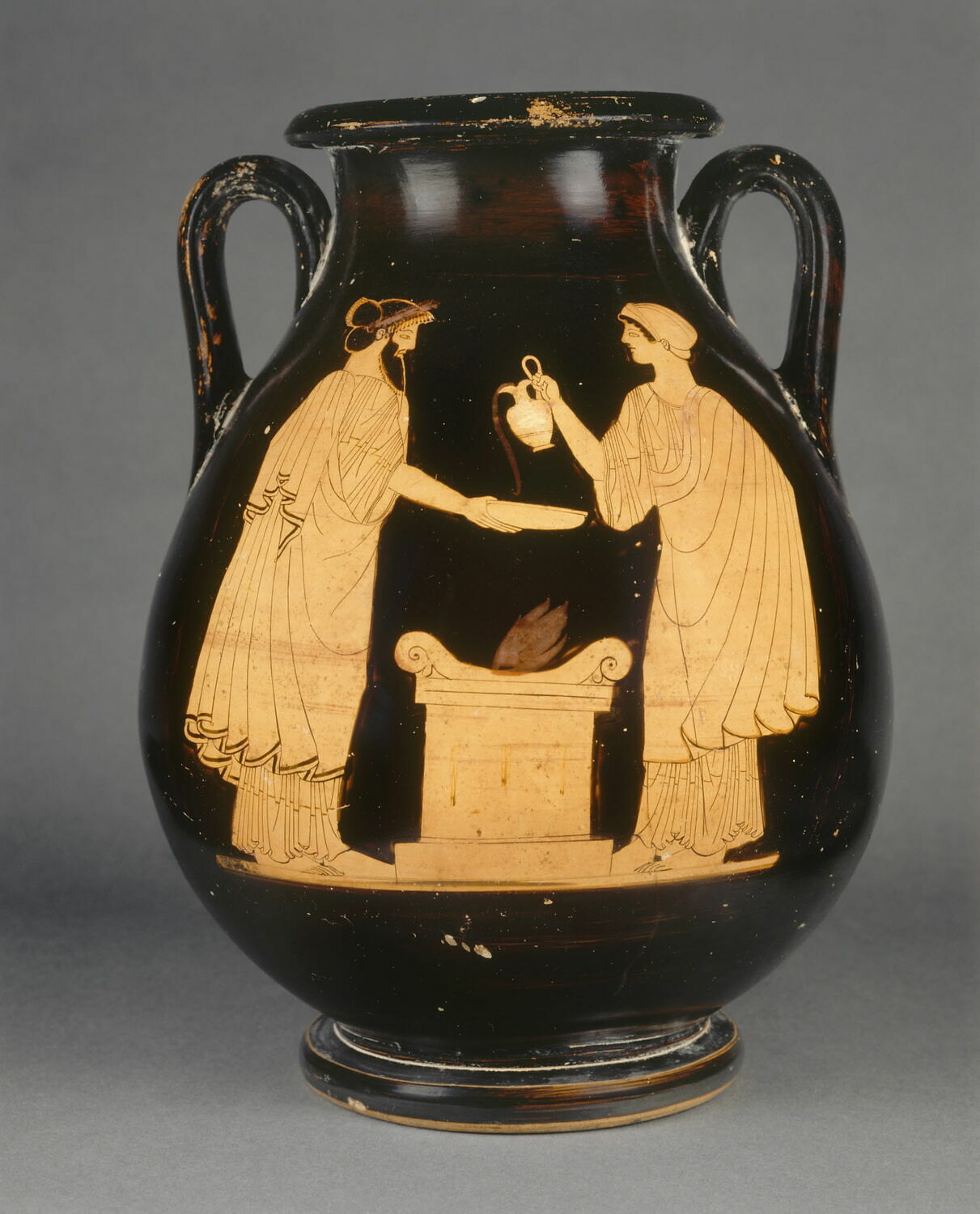
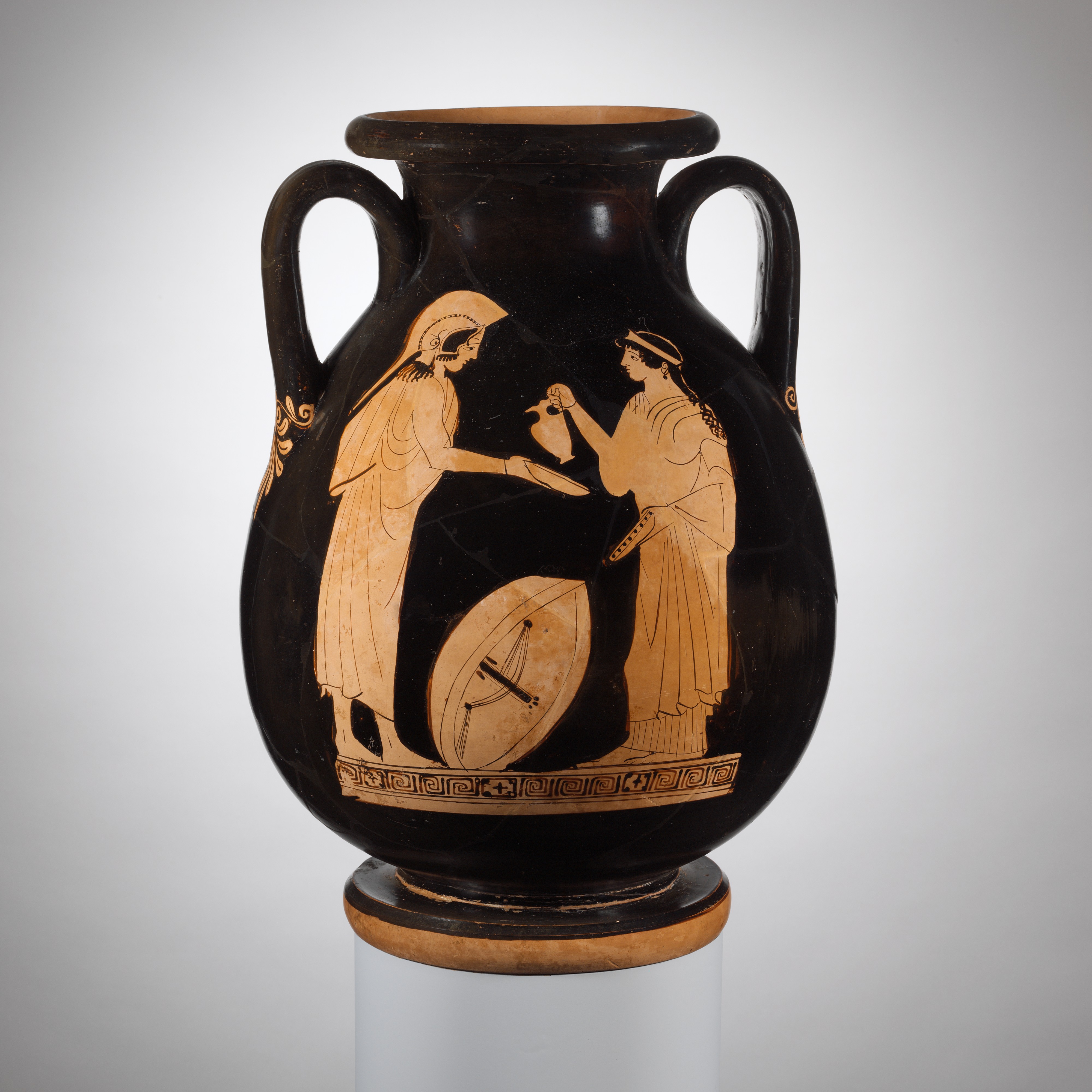
These two scenes belong to Athens in the early fifth century BC, not to the period in which the poems are set. They serve here as a reminder that fetching water and preparing ritual objects could be female tasks embedded in shared public and domestic practices, not isolated gestures confined to the private sphere.
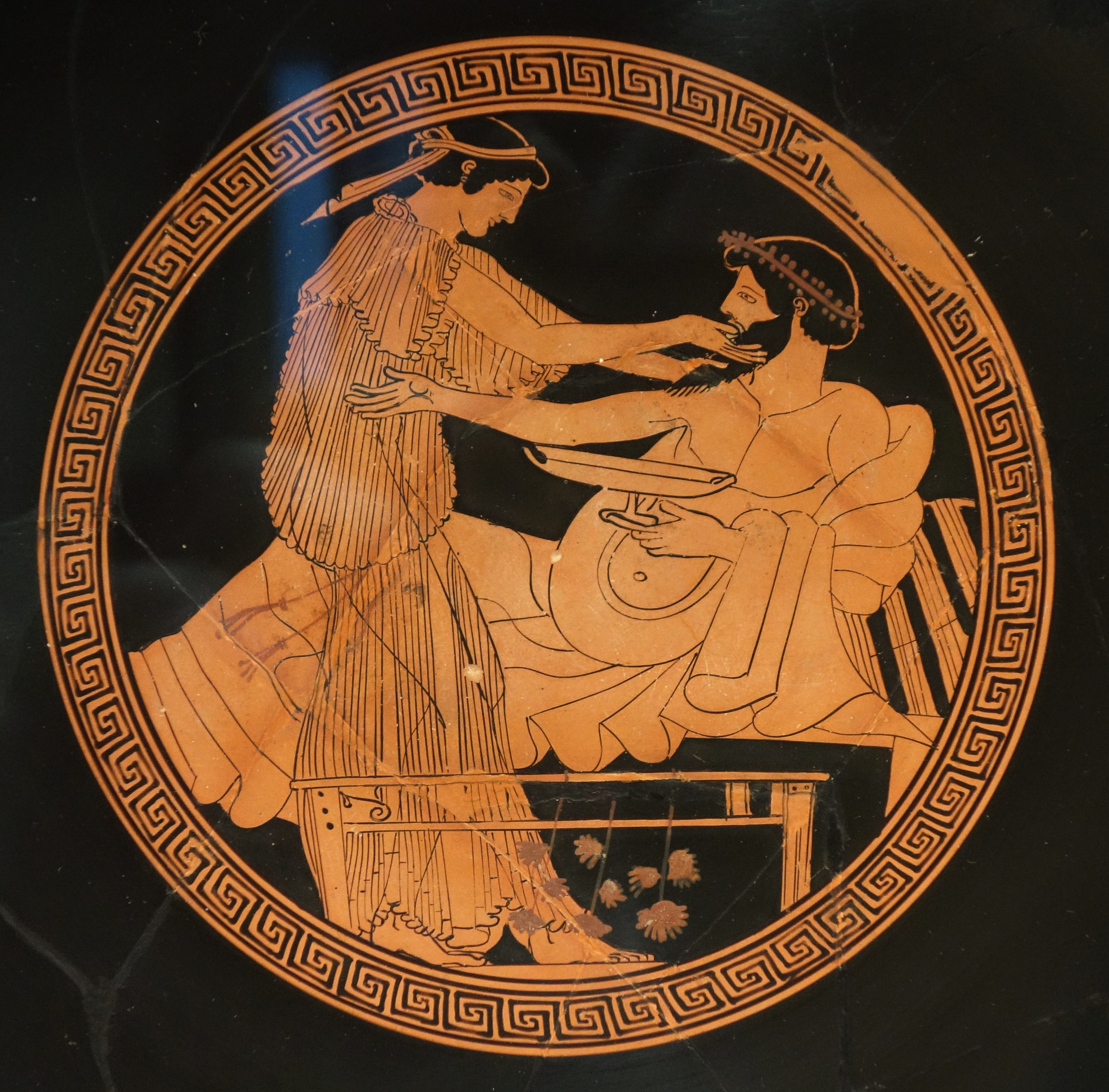
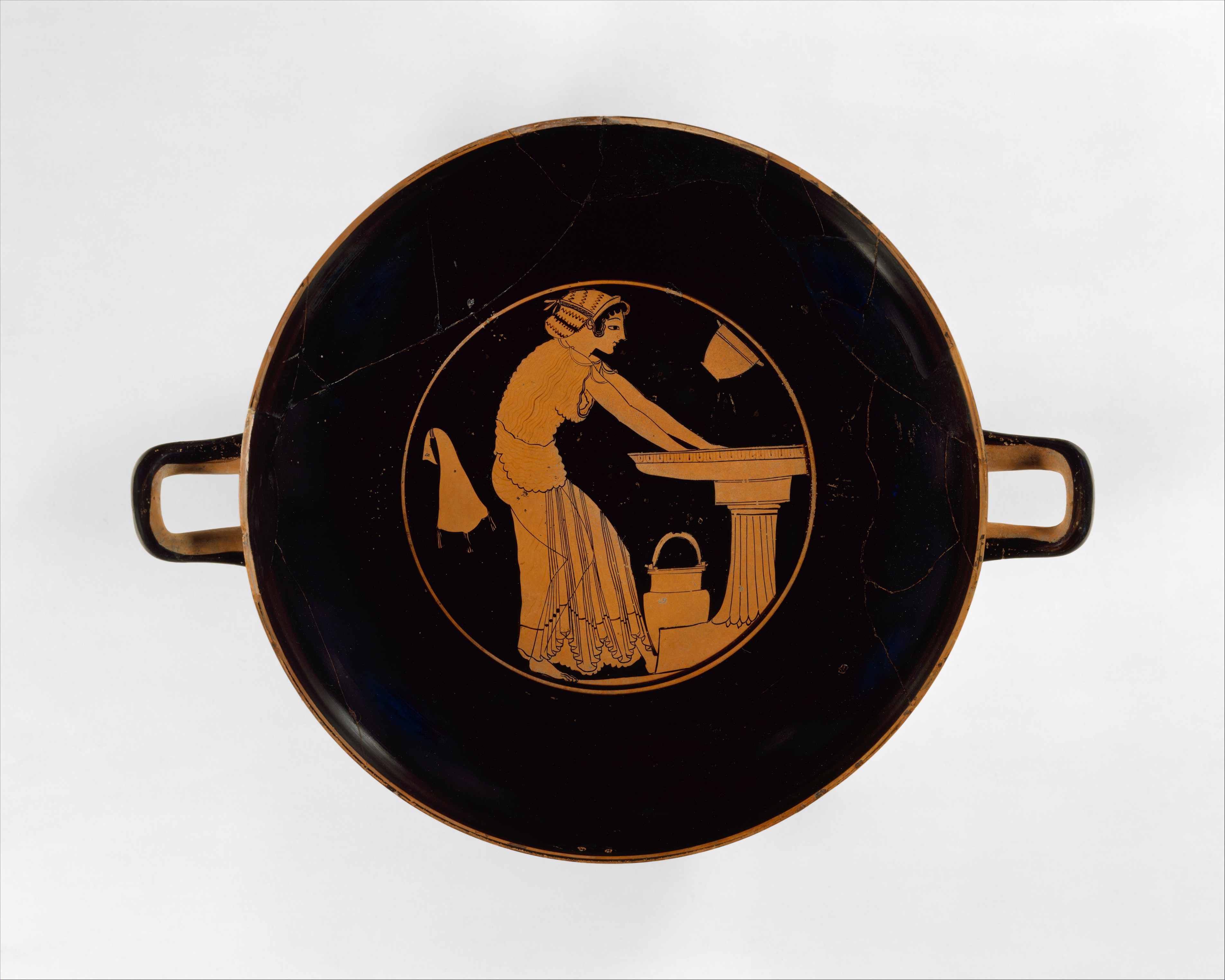
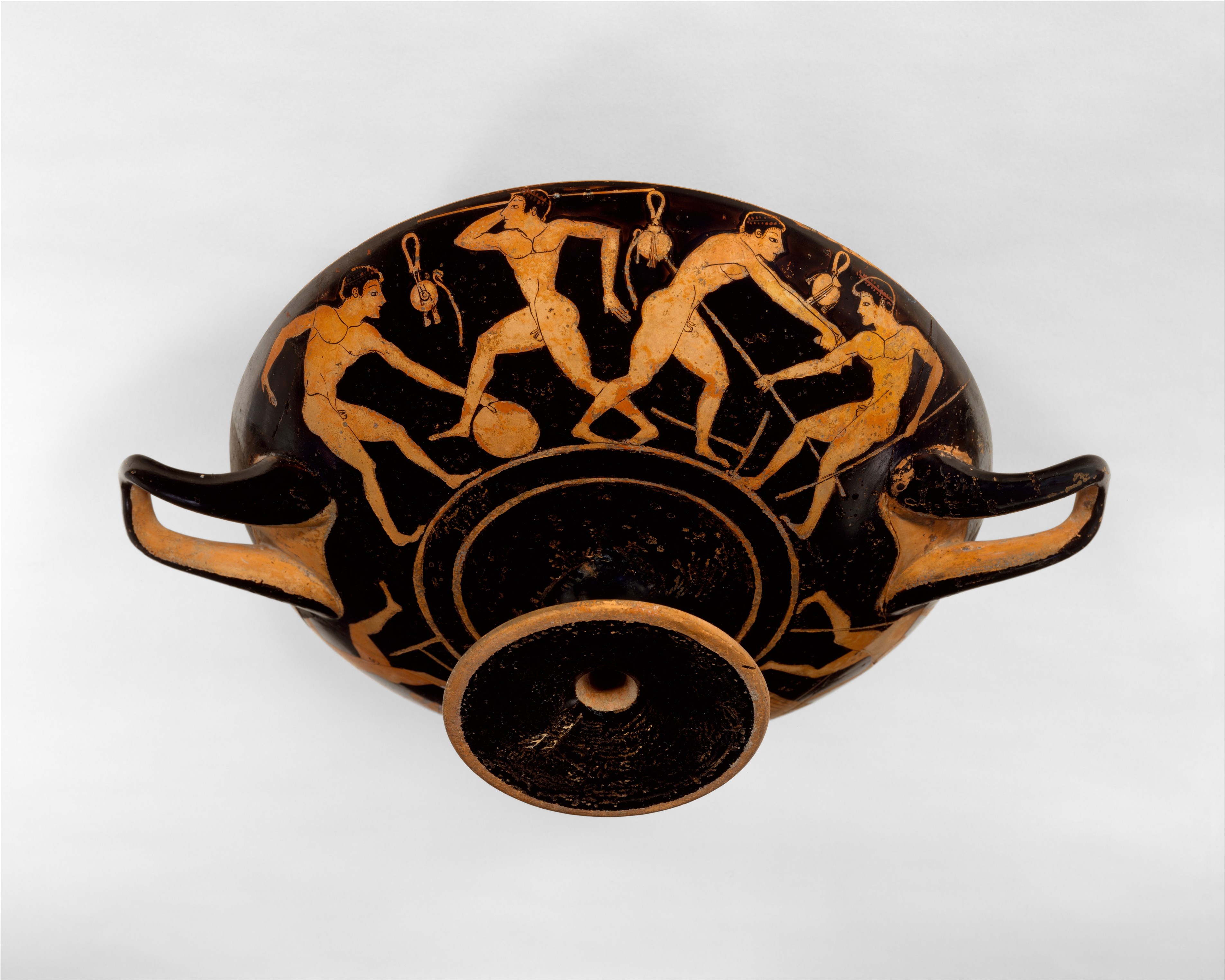
Eurycleia concentrates much of this complexity. Laertes bought her when she was young for the value of twenty oxen, but the poem adds that he honoured her in the household as he did his own wife and never slept with her, so as to avoid his wife’s anger (Odyssey 1.430–433). The purchase establishes a relationship of subordination; respect and sexual restraint show that such a relationship could coexist with limits, affection and recognition within the household.
She was Odysseus’ nurse and, in the next generation, cared for Telemachus as he grew up. The poem does not present these two relationships as identical, but as bonds of care with two members of the household. She preserves memories, knows domestic secrets and performs supervisory functions. When she washes the stranger’s feet, she recognises Odysseus’ scar before anyone else; he orders her to keep silent, and she understands the danger of speaking (Odyssey 19.317–399). Elsewhere, she identifies the disloyal women and acts within the organisation of the household (Odyssey 21.381–387; 22.419–473).
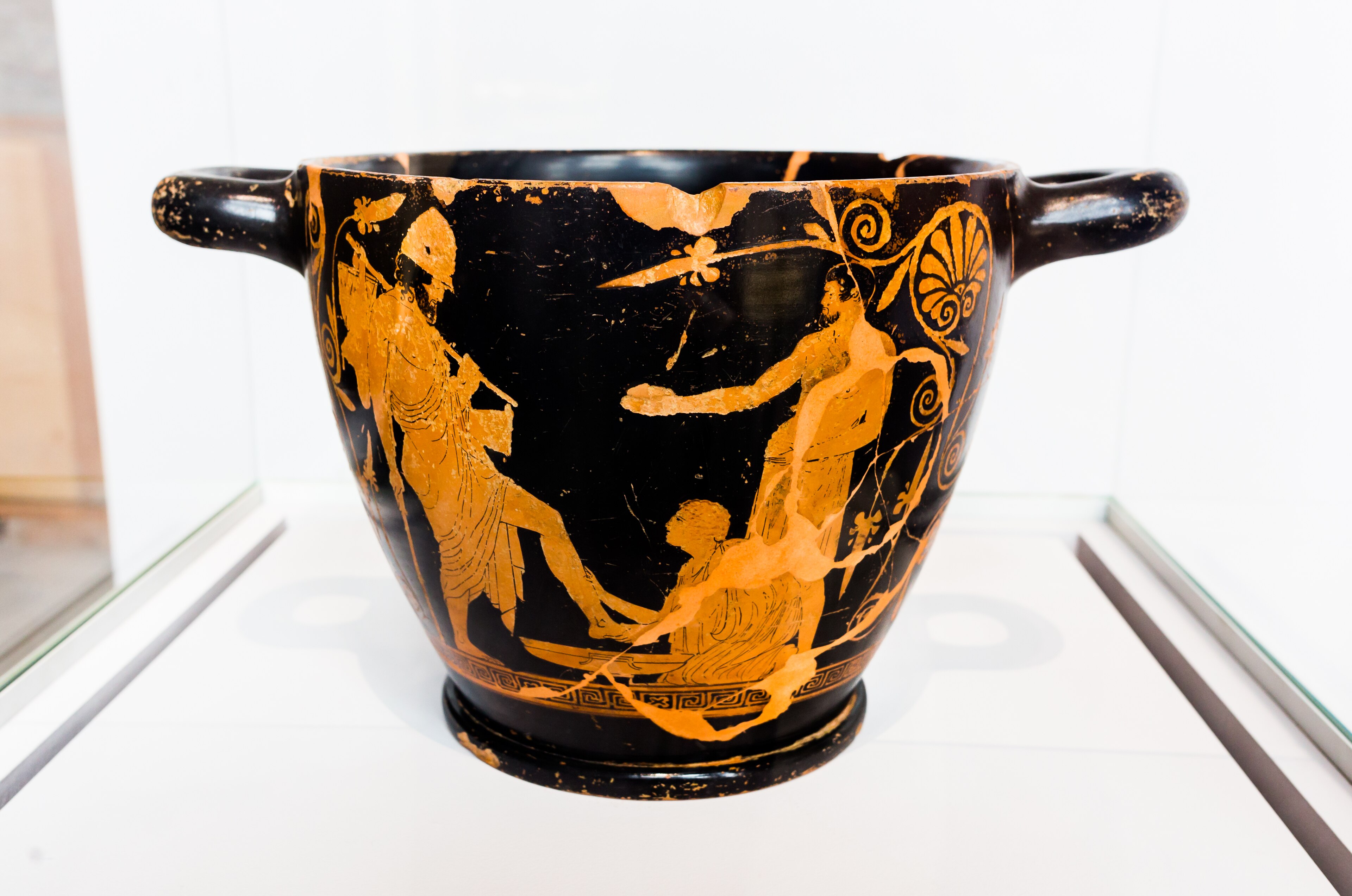
Her authority is real, but it has clear limits. Eurycleia can supervise other women, carry decisive news or retain information that Penelope does not possess at a particular moment. That does not make her Penelope’s equal or erase the fact that Laertes bought her. Her case shows that an enslaved person could occupy a central position within the oikos: preserve its memory, take part in raising two generations, exercise authority over other serving women and maintain a deep emotional bond with the family, while still remaining in a relationship of dependence.
Grinding offers one of the harshest contrasts. In a room near the palace, twelve dmōai work at the mills, grinding wheat and barley. Eleven have already finished their task and are asleep; one alone is still working because, the narrator says, she is the weakest of them all and has not managed to finish her share. She is exhausted: the labour has weakened her knees.
The scene occurs just after Odysseus, still concealed, asks Zeus for a sign that he will recover his house. Zeus thunders in a clear sky and, almost at the same moment, the woman stops the millstone and voices a wish: may this be the last meal she has to grind for the suitors. Odysseus hears her words and receives them as the second sign he had requested.
We do not know her name, her origin or what she receives for her work. But for a few lines the Odyssey lets us hear directly the voice of an anonymous worker and makes her exhaustion part of the omen of the suitors’ fall.
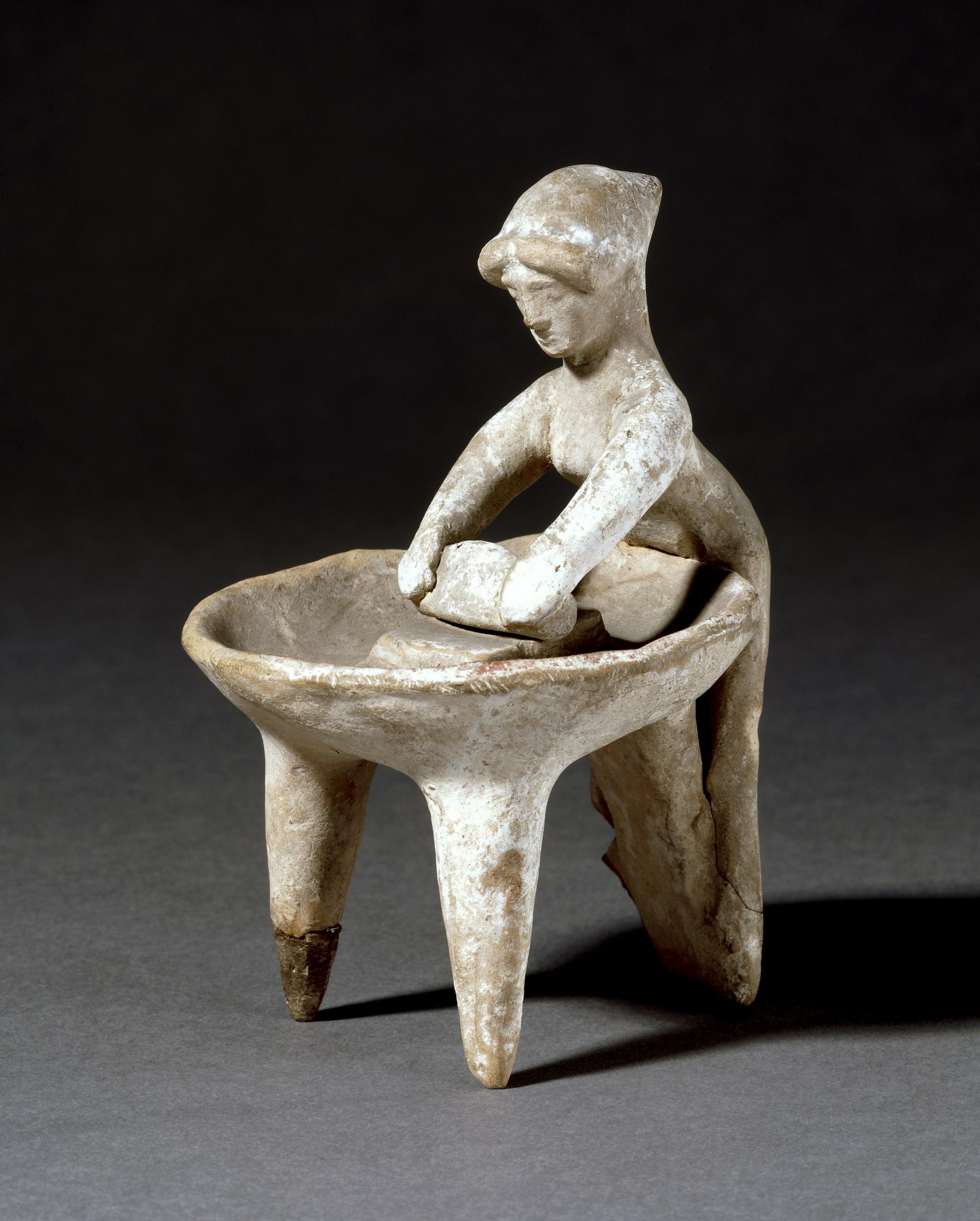
Later, after the killing of the suitors, Eurycleia identifies, among the fifty dmōai of the palace, twelve enslaved women who had relations with the suitors and whom she regards as disloyal to Penelope and Odysseus. Odysseus orders them to clean the hall and remove the bodies. He then orders them taken outside to be killed; Telemachus rejects death by the sword and decides that they are to be hanged (Odyssey 22.419–473).
The scene is narrated from the perspective of restoring the oikos: the poem presents the women as disloyal, but it does not give us the same biographical depth that it gives Eumaeus or Eurycleia. The household can be a space of welcome and affection, but also of command, threat and extreme violence.
Textiles reveal another intersection of social positions. Penelope weaves and unweaves her cloth as a strategy for postponing the decision about her marriage. Helen weaves at Troy a cloth representing the war (Odyssey 2.94–110; Iliad 3.125–128). In Book 1, Telemachus tells Penelope to return to the loom and order the women of the house to continue their work (Odyssey 1.356–358): the scene presupposes a domestic hierarchy surrounding textile production. Weaving is a material activity and a form of domestic authority, but not a single social condition.
Something similar happens with Nausicaa. The princess goes to wash clothes with her companions, while servants prepare the wagon (Odyssey 6.74–99). The episode does not define the status of all the young women around her in the same way; it is enough to show that washing does not determine the status of the person doing it. There are high-ranking women who weave, supervise and decide; purchased women who preserve memory and organise the household interior; anonymous women who grind and serve; women forced to clean under threat. Their tasks may partly overlap, but their positions do not.
The work Homer leaves in the background
Sección titulada «The work Homer leaves in the background»The Odyssey gives particular individuality to those who surround Odysseus’ household. The Iliad, centred on the war at Troy, offers a different kind of evidence. It speaks of heroes, kings and battles, but in order to make that world intelligible it repeatedly draws on forms of labour familiar to its audience.
There is a beautiful paradox in the Shield of Achilles: a weapon of war contains an extensive image of the civilised world that war threatens. Its scenes show cities, fields, herds, harvests, weddings, judgements, dancing and everyday work. Among the workers we see ploughmen, reapers, sheaf-binders, young people gathering grapes, shepherds, herdsmen, women and girls. There is ploughing, reaping, grapes carried in baskets, livestock and a meal prepared at the end of the harvest (Iliad 18.541–617).
They are not workers in the action at Troy, but figures represented on the shield Hephaestus makes for Achilles. Yet that is precisely why they are so significant: to represent the world worth defending — or capable of being destroyed — the poem shows not only palaces and warriors, but also the everyday labour that feeds a household, sustains a community and ensures the continuity of a family or a kingdom.
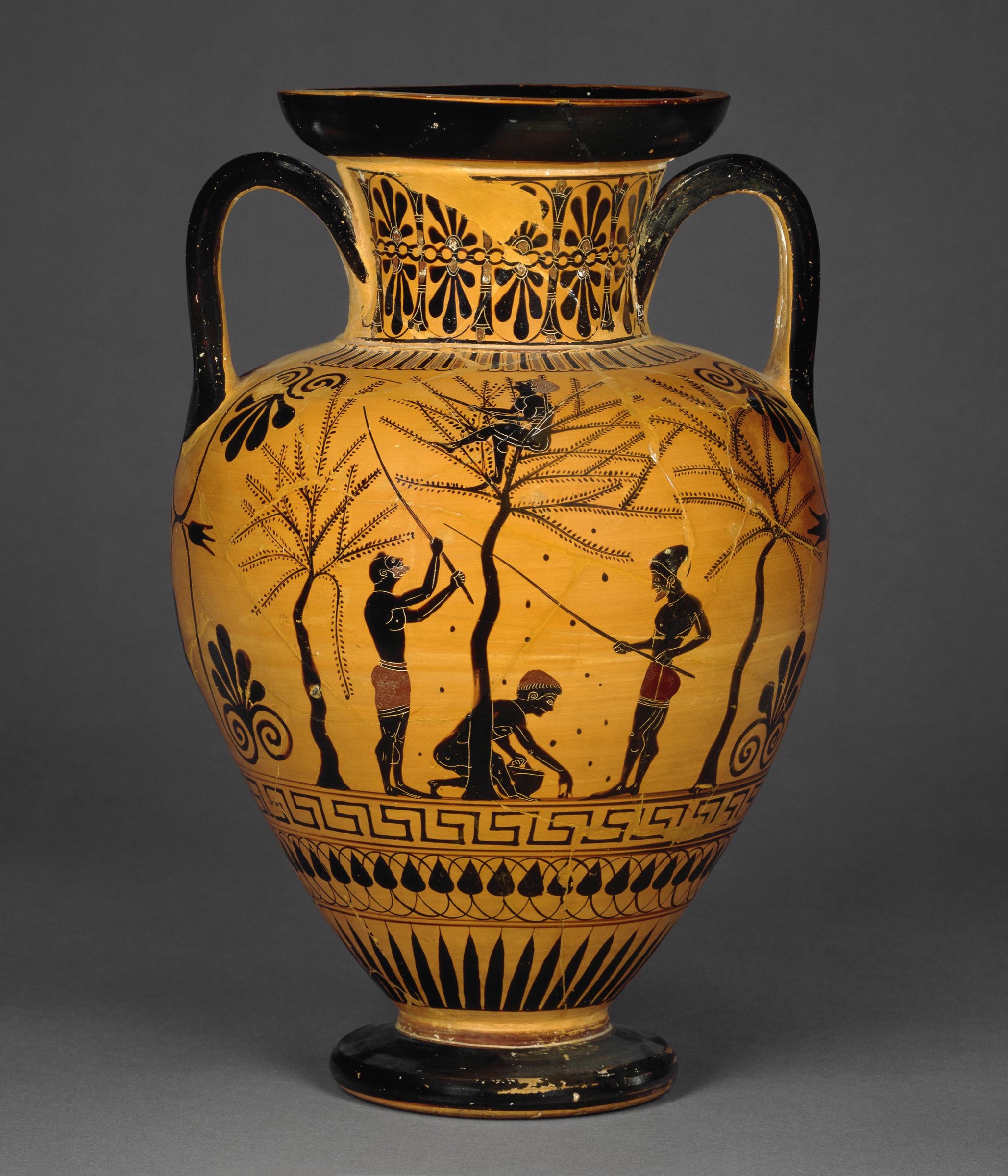
Elsewhere, Homer compares the ranks of battle to reapers advancing through a field (Iliad 11.67–71). Even when narrating war, the poet turns to everyday labour to make it visible.
That representation matters. Heroic life is imagined against a horizon where people plough, reap, tend cattle, prepare food and sing during the vintage. The Iliad usually leaves such labour in the background of similes and representations; the Odyssey brings it closer to the plot because the threat to Odysseus’ oikos makes those tasks decisive.
There is also a difference in narrative attention. On the Shield, the king watches the harvest and helpers prepare the meal; the poem does not pause to tell the story of each reaper. In Ithaca, by contrast, the exhaustion of a woman at the mill or the loyalty of a swineherd can directly affect Odysseus’ return. This does not mean that one reality is more “historical” than the other. It means that each poem chooses where to direct its gaze and which forms of labour to bring into the foreground.
The comparison therefore serves to broaden the landscape of labour, not to replace the particular problem of Odysseus’ household with a catalogue of activities.
Doing a task was not the same as having an occupation
Sección titulada «Doing a task was not the same as having an occupation»Material work does not in itself indicate subordination. Odysseus cuts down trees, bores holes in them and joins them together to build the raft on which he leaves Ogygia (Odyssey 5.234–261). He also built his marriage bed around a living olive tree; the technical description of that bed becomes a means of recognition between him and Penelope (Odyssey 23.183–204). The poem shows that a king can exercise technical skill without losing his rank; it does not require us to call him a professional carpenter.
Laertes works in his orchard during his son’s absence. Penelope and Helen weave. Nausicaa washes clothes. Achilles and Patroclus prepare food and hospitality for the Achaean embassy, and Patroclus treats Eurypylus’ wound (Odyssey 24.205–234; Iliad 9.205–221; 11.832–848).
These are scenes of survival, domestic strategy, hospitality and care. They do not prove that aristocrats normally worked as farmers, craftsmen, cooks or doctors. They show, more simply, that performing a practical task is not enough to determine the rank of the person who performs it.
The fact that heroes perform material tasks does not erase differences of position. Odysseus builds a raft because he needs to escape Ogygia; Nausicaa washes clothes on an exceptional outing; Patroclus treats a wounded companion. These are real tasks, but occasional ones tied to specific circumstances: they do not by themselves define the usual social position of the person performing them.
Very different is the position of those who work continuously to sustain someone else’s household. Eumaeus tends Odysseus’ herds every day; the women at the mills grind the grain that feeds the palace; other women weave, serve or clean. That is why the task alone is not enough to tell us the status of the person performing it. We must also ask for whom they work, how regularly, who controls the resources and how much freedom they have to make decisions.
Outside the oikos: hired labourers and specialists
Sección titulada «Outside the oikos: hired labourers and specialists»Not everyone who works belongs to a household in the same way. The poem knows the figure of the thēs, a man who can be hired to dig, plant and plough. When Eurymachus offers such work to the beggar Odysseus, he mentions food, clothing and footwear in return (Odyssey 18.357–364). The offer is insulting in context because the man he addresses appears to be a destitute wanderer, not because cultivating the land is in itself a contemptible activity.
Achilles says in Hades that he would rather serve a poor man on earth than rule among the dead (Odyssey 11.489–491). The term thēs is not simply equivalent to “slave”, “servant” or “poor man”. It helps us separate dimensions that modern vocabulary easily conflates: a person may not be someone else’s property and yet depend on another for subsistence or lack stable membership in an oikos.
There are also the dēmiourgoi, people called upon for a particular skill. Eumaeus lists the doctor, seer, shipwright and bard (Odyssey 17.382–387); Penelope applies the term to heralds (Odyssey 19.134–136). Nestor’s sacrifice offers a concrete image: to cover the victim’s horns with gold, a goldsmith is summoned with anvil, hammer and tongs (Odyssey 3.425–438). Specialisation exists, even though the poem does not explain how the goldsmith is paid, where he lives or whether he travels regularly.
Something similar happens with the helmsman. On Menelaus’ voyage, Phrontis steers the ship with the rudder and excels at the task (Odyssey 3.279–283). The Phaeacians provide the marvellous contrast: their ships need neither pilots nor rudders because they know the routes themselves (Odyssey 8.557–562). Hired labourer, doctor, bard, herald, goldsmith and helmsman do not form a single class; they show that production and services were not all integrated into a household in the same way.
It is important not to fill this gap with institutions the poem does not name. We do not know whether these specialists lived permanently in a town, came only at certain seasons, what they received for their work or how far they depended on a powerful household. We do know that skill could be recognised and valued because it was necessary: someone is summoned because he knows how to heal, interpret signs, build a ship, sing at a banquet, transmit an order or work metal. That need gives technē a distinct place, without automatically making the person who possesses it a figure of high status.
Capture, buy, sell
Sección titulada «Capture, buy, sell»So far we have seen competence, responsibility, affection and functional authority. It would be easy for those features to soften the picture too much. We therefore need to return to the ways in which some people became part of a household.
Eumaeus was abducted and sold. Eurycleia was bought. War provides another route, more visible still. In the Iliad, Chryseis, daughter of Chryses, priest of Apollo, is in Agamemnon’s possession as part of his booty; Briseis, captured after the fall of Lyrnessus, is allotted to Achilles and then taken from him by Agamemnon when Chryseis has to be returned. Both women form part of the distribution of booty; Briseis, moreover, is given a voice of her own in the poem and expresses her grief.
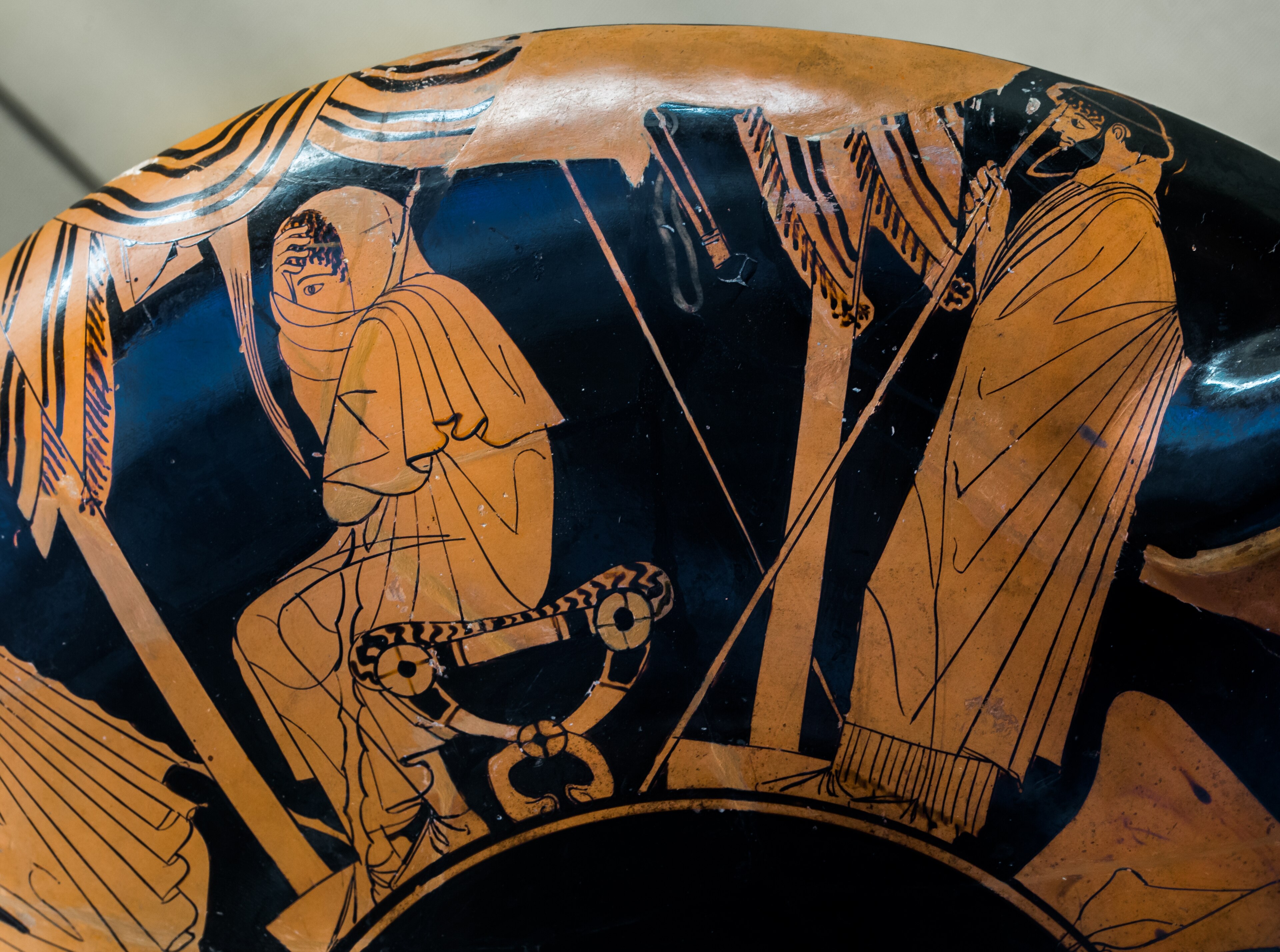
The Odyssey shows the same mechanism without disguising it: Odysseus says that, after sacking Ismarus, city of the Cicones, his men killed the men and divided the women and the booty among themselves (Odyssey 9.39–42). Abduction, capture, purchase, sale and war are thus different routes by which a person could end up incorporated into another household and subjected to its control.
There is no need to impose the law of slavery in Classical Athens on these passages in order to recognise their violence. The poem shows people captured, bought, transported against their will and made to work for another household. The exact status conveyed by each Homeric term, the rules governing marriage and children, or possible routes to freedom do not form a code that we can reconstruct securely. But the absence of such a code does not turn purchase or coercion into metaphor.
This matters especially when reading Eumaeus and Eurycleia. Eumaeus’ ability to manage the piggery does not erase the fact that he was sold. Eurycleia’s memory, her authority within the household and her closeness to Telemachus do not erase the fact that Laertes bought her. The poem can present loyalty from the viewpoint of the household whose order is being restored; that viewpoint does not erase dependence.
Their paths are also different. Eumaeus was the victim of maritime abduction; Eurycleia was purchased; Trojan captives belong to the world of conquest. Not every dependent person enters a household through war, and not every capture necessarily leads to the same situation. What these cases show is that control over one’s own life can be subordinated to the will of another household.
Centuries later, Gortyn: when status changes the rule
Sección titulada «Centuries later, Gortyn: when status changes the rule»In the world represented by Homer there are free people, people who have been bought, war captives, hired workers and servants tied to a household for years. There are obligations and punishments, but the poems do not show us a code we can open to find out which rule applies in each case. Norms exist and are enforced in other ways: through authority, custom, oaths, witnesses, reputation and decisions made within the community or the oikos.
The scene of the twelve enslaved women in Odysseus’ household, subject to the authority of the oikos, shows this with particular harshness. Eurycleia identifies the twelve women whom the poem presents as disloyal because they had relations with the suitors. Odysseus, king of Ithaca and master of the household he has just recovered, orders them to clean the hall and then orders their deaths; Telemachus decides that they are to be hanged. In this scene the poem cites no rule establishing the penalty, nor do we see a court assembled to determine it. We see authority in action; we do not see the rule that determines or limits the punishment set out explicitly.
In fifth-century BC Gortyn, the documentary situation is very different. Some of these distinctions are carved in stone, as can be seen in more detail in When Nobody Signed Anything, and we can examine how far a person’s status could alter the legal consequences of the same situation.
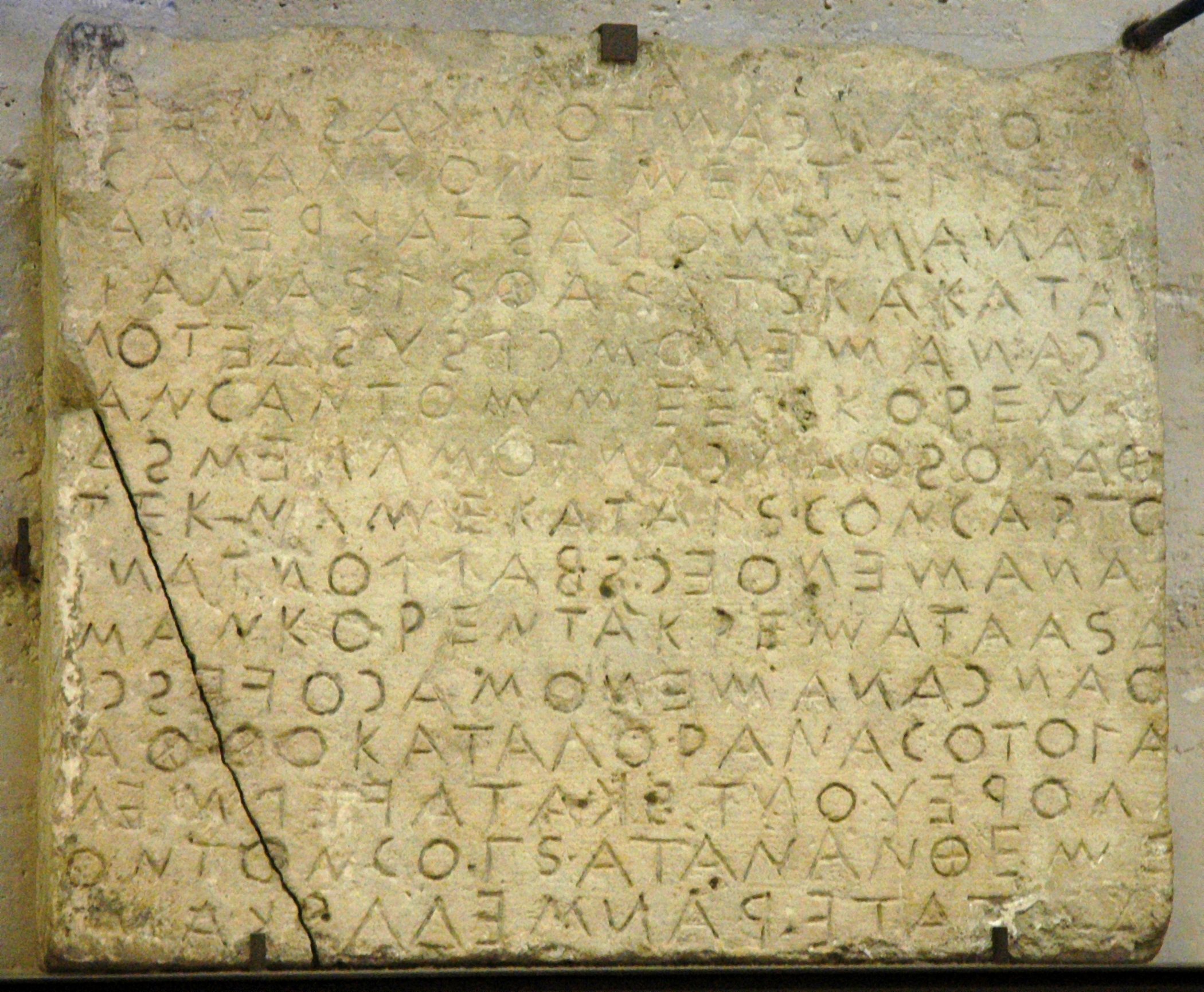
The contrast is particularly stark in the rules concerning sexual violence. The Great Inscription establishes compensation of one hundred staters when the victim is a free man or woman. If the victim is an enslaved woman belonging to the perpetrator’s own household and is a virgin, the amount falls to two staters. If she is no longer a virgin, the penalty falls still further: one obol if the offence occurs by day and two if by night. With twelve obols to a stater, one hundred staters equal 1,200 obols: the difference between 1,200 and one or two makes strikingly clear how radically the victim’s legal status affected the compensation prescribed.
But the same provision introduces an important nuance. The oath of the enslaved woman could have a specific evidentiary value within the procedure. Her position was not equivalent to that of a free person — the amounts themselves make that clear — but her word was not legally irrelevant either.
Other provisions show that such differences extended into many areas of life. The law itself provides for cases in which one party claims that a person is free and another that the person is enslaved; testimony and judicial decision are used to resolve the dispute. It also regulates unions between people of different status and the consequences for children and property. A separated woman who gives birth must present the child at her former husband’s house before three witnesses; other rules concern fugitive slaves, sales, the responsibilities of buyers and temporary forms of debt dependency.
None of this means that we can apply the laws of Gortyn to Eumaeus, Eurycleia or the women executed by Odysseus. Between the heroic past recreated by the poems, traditionally associated with the end of the Bronze Age — see The Bronze Past — and fifth-century BC Gortyn lie some seven or eight centuries, as well as very different historical conditions. Eumaeus and Eurycleia belong to that heroic past recreated by Homer; Gortyn belongs to a historical polis in which some rules and procedures were publicly set down in writing.
The contrast serves another purpose. In Homer we see relationships in operation: Eumaeus was sold but manages an estate; Eurycleia was bought but occupies a central place in the memory and organisation of the oikos; Odysseus punishes those he considers to have betrayed his household. In Gortyn we can begin to see in writing what distinctions a community recognises, what consequences it assigns to status, what role it gives to witnesses and oaths, and what problems it considers necessary to regulate.
Gortyn lets us read some rules. Homer lets us see relationships, decisions and conflicts in action, without giving us the code that orders them.
What Homer does not let us know
Sección titulada «What Homer does not let us know»The Odyssey allows us to see a great deal, but not everything. We do not know how many people worked for Odysseus or what proportion were free, enslaved, permanently dependent or hired workers. We do not know what wages or other forms of compensation were usual, if any, or how specialists were organised. We cannot always determine the status of those who work for the household. Philoetius tends Odysseus’ herds and Dolius works in Laertes’ orchard, but Homer does not tell us how they came to occupy those positions or define their dependence in legal terms. Nor does he allow us to reconstruct a general rule governing marriage, children, property or the freedom of movement of those who lived in someone else’s household.
Nor should we fill those silences with later institutions. Gortyn, Athens or the Mycenaean tablets can help us compare different problems, but they cannot supply Homer with a code his poems do not contain. Homeric language and the situations the poems describe do not automatically correspond to the legal categories of other centuries.
These limits do not, however, require us to abandon every conclusion. The poems represent purchase, sale, capture, booty, dependent labour, hired labour, technical specialisation and material tasks carried out by people of high rank. They also represent the difference between controlling resources and working with them, between belonging to a household and having control over one’s own life, between receiving trust and being subject to another’s will.
Let us return, then, to the table with which we began. The abundance of the heroic household is not explained only by the wealth of its master or by the prestige of the person who occupies the place of honour. Behind it stand the people who raise, cultivate, grind, weave, transport, serve, repair and remember how the household works. The poem does not give them all the same name, the same voice or the same story. That is precisely why it is worth making visible the labour it leaves in the background.