Polyxena
The Children of Priam
Sección titulada «The Children of Priam»Priam, king of Troy, had an extraordinarily large family. When he visits the Achaean camp to recover Hector’s body, he tells Achilles that he had fifty sons when the war began. Nineteen were born to the same mother, generally identified as Hecuba, his principal wife; the others were sons of different women (Iliad 24.495–497).
Homer names some of these women explicitly. Laothoe, daughter of Altes, king of the Leleges, was the mother of Lycaon and Polydorus, while Castianeira, from Aesyme, was the mother of Gorgythion. Hecuba, however, held a prominent position in the royal household and is the most prominent of Priam’s wives in the poem, particularly in scenes involving Hector.
The palace reflected the size of this family. In Book 6 of the Iliad (242–250), when Hector returns to Troy, Homer describes fifty chambers of polished stone, built side by side, where Priam’s sons lived with their wives. Across the courtyard stood another twelve chambers for his married daughters and their husbands.
Of these many sons, Homer names twenty-two: Hector, Paris—also called Alexander—Deiphobus, Helenus, Polites, Troilus, Mestor, Polydorus, Lycaon, Cebriones, Gorgythion, Antiphus, Isus, Echemon, Chromius, Democoon, Doryclus, Agathon, Pammon, Antiphonus, Hippothous, and Dius.
Some, such as Hector, Paris, and Helenus, play important roles in the poem. Others are barely mentioned, sometimes only when they die in battle or when Priam recalls the sons he has lost.
Homer names just three daughters: Laodice, whom he describes as the most beautiful of Priam’s daughters (Iliad 6.252); Medesicaste, born to another woman and married to the warrior Imbrius (13.171–173); and Cassandra, who watches from the walls as her father returns with Hector’s body (24.699–706).
The remaining sons and daughters of Priam are unnamed in the surviving Homeric poems.
Homer never mentions Polyxena. He says nothing about her death, her sacrifice at Achilles’ tomb, or a possible love affair with the hero.
Yet other poets and artists of antiquity knew of Polyxena, a Trojan princess and daughter of Priam and Hecuba, and gave her a prominent place in their works, even though they assigned her very different fates.
Her story offers a way to understand how Greek myths took shape and changed. We are not dealing with an unchanging biography, but with a figure shaped by successive generations of poets and artists through epic and lyric poetry, tragedy, visual art, and later narratives.
Polyxena in Greek Art
Sección titulada «Polyxena in Greek Art»Greek art shows that Polyxena was already known in the Archaic period. Several sixth-century BCE vase paintings depict episodes associated with her, particularly Achilles’ ambush of her brother Troilus and the sacrifice of the princess, which literary sources place at Achilles’ tomb.
An Attic black-figure hydria depicts Achilles lying in wait for Troilus, a son of Priam. The young man approaches a fountain, riding one horse and leading another. Polyxena walks ahead of him, carrying a hydria—a vessel used to fetch water. Achilles remains in hiding, waiting to attack. A raven seems to foreshadow Troilus’ fate: he will not escape alive.
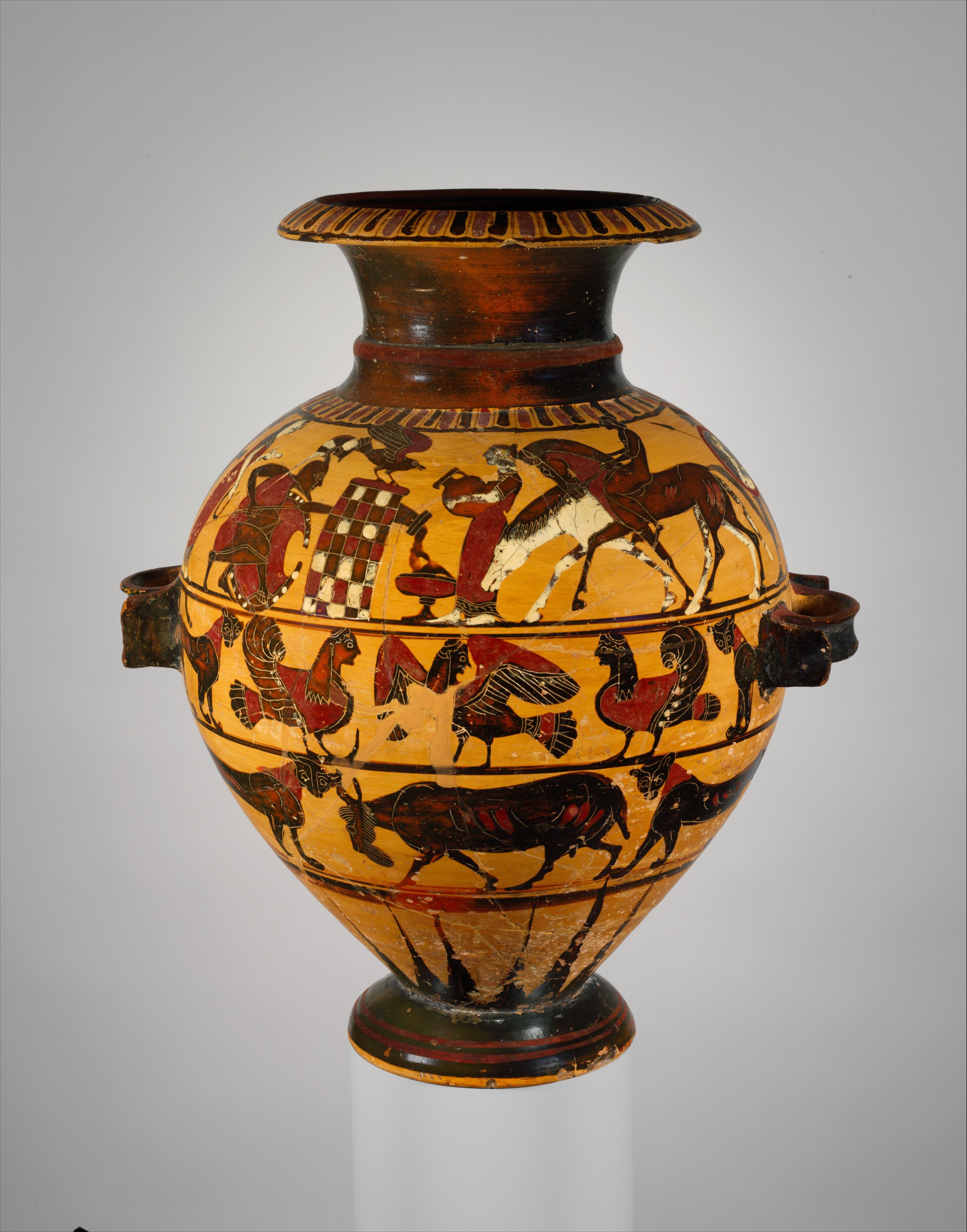
This scene links Polyxena to one of the cruelest acts attributed to Achilles.
The next image is even more disturbing. An Attic black-figure amphora depicts the sacrifice of Polyxena. The young woman is held horizontally by three Achaean warriors while Neoptolemus, Achilles’ son, cuts her throat. Her blood flows onto an altar. Inscriptions identify several participants, including Polyxena and Neoptolemus, so we are not relying solely on modern interpretations of the image.
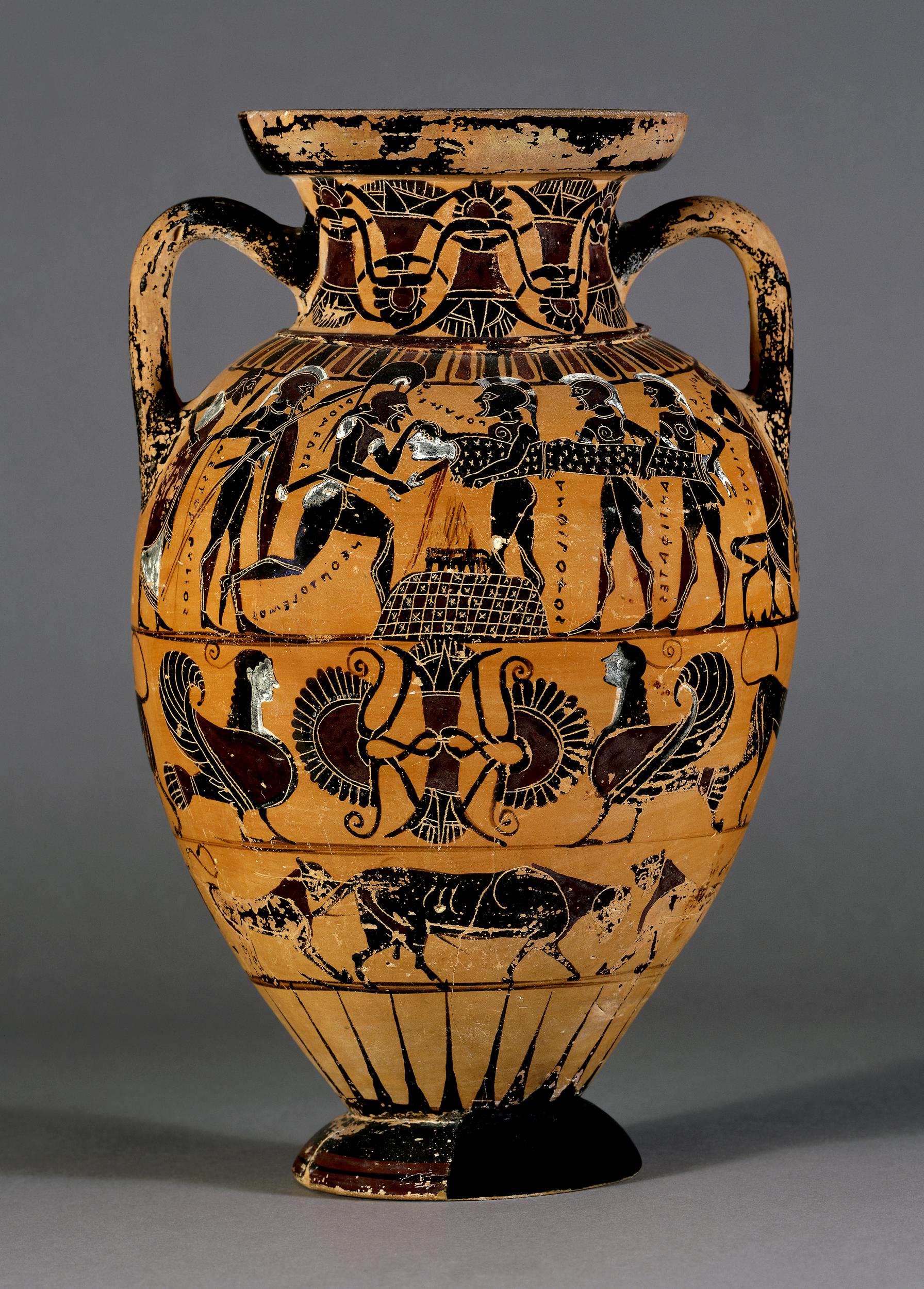
This image demonstrates that the story of Polyxena’s sacrifice was already circulating in the Archaic period. On its own, however, it cannot tell us which poem narrated the event or how the sacrifice was explained.
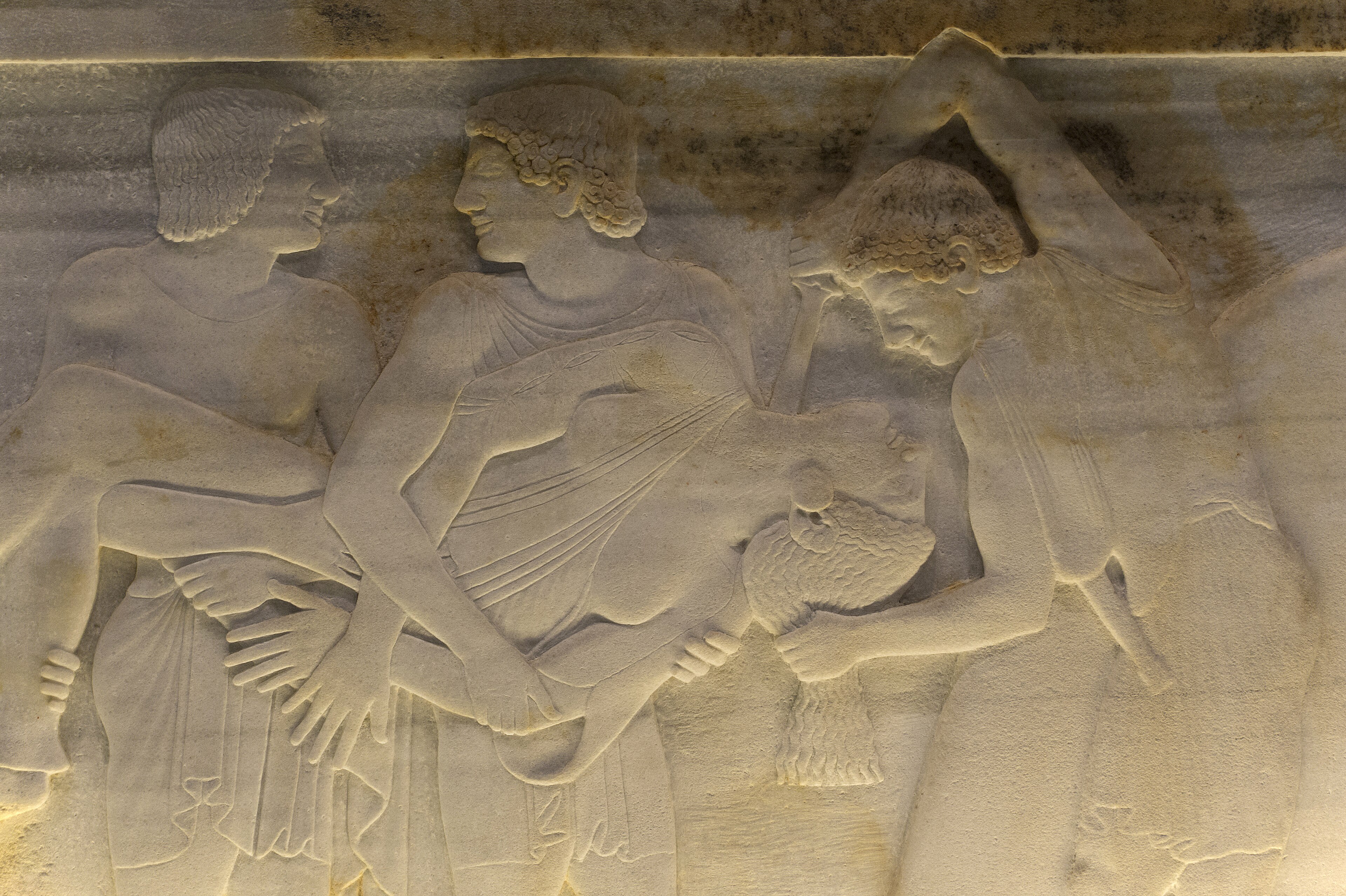
Another important example is the so-called Polyxena Sarcophagus, discovered in 1994 in the Kızöldün burial mound near Gümüşçay (Biga, northwestern Turkey). Dating from the late sixth century BCE, it is now on display at the Troy Museum in Çanakkale.
One of its reliefs depicts a scene identified as the sacrifice of Polyxena. Several figures hold the young woman horizontally while another, generally identified as Neoptolemus, prepares to cut her throat.
The sarcophagus takes its name from this scene, although the human remains found inside belonged to an adult man. We do not know for whom it was originally made.
Fifteen Centuries in the Making of a Character
Sección titulada «Fifteen Centuries in the Making of a Character»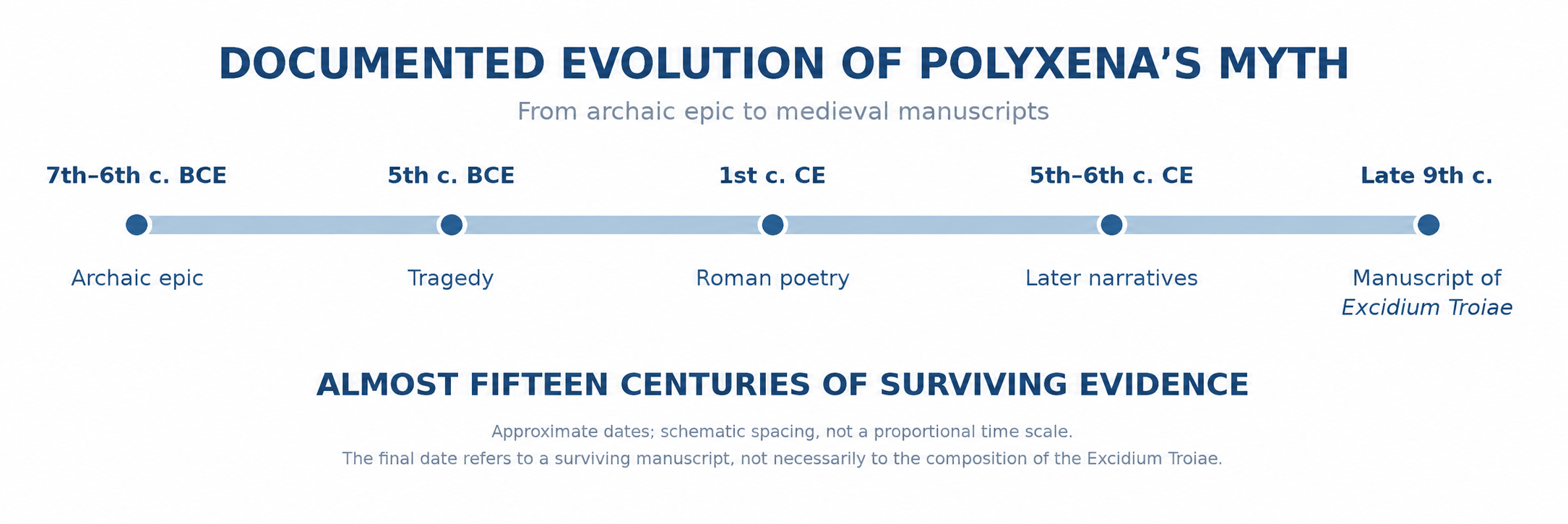
The images we have just examined depict acts of violence that we cannot fully understand from the images alone. Greek artists portrayed the ambush of Troilus and the sacrifice of Polyxena, but their works do not reveal the reasons behind those acts or how they were explained in the stories of their time.
The earliest written testimonies do not answer all our questions either. Some concern poems that are now lost and whose contents are known only through fragments, summaries, and ancient commentaries. We know that different versions of Polyxena’s death existed, but we cannot always reconstruct the circumstances. The surviving accounts differ and, at times, contradict one another.
Over the centuries, poets, playwrights, and storytellers returned to her story and gave it new meanings. Some portrayed her as a victim of Achaean warriors during the fall of Troy; others as a young woman sacrificed at Achilles’ tomb; still others as someone who chose to take her own life. Medieval manuscripts also preserved versions that may have drawn on much older traditions.
Before examining these different accounts, it is worth placing the sources in chronological order and distinguishing surviving works from those known only through indirect testimony.
| Date and source | Polyxena in the evidence | What survives |
|---|---|---|
| Cypria (attributed to Stasinus). 7th–6th c. BCE. | According to a scholium, Polyxena dies from wounds inflicted by Odysseus and Diomedes during the fall of Troy and is buried by Neoptolemus. | Lost poem. Report in a scholium on Hecuba 41, citing Glaucus of Rhegium. The attribution is problematic given the poem’s chronology. |
| The Sack of Ilium (attributed to Arctinus). 7th–6th c. BCE. | Polyxena is sacrificed at Achilles’ tomb after the destruction of Troy. | Lost poem. Summary by Proclus. |
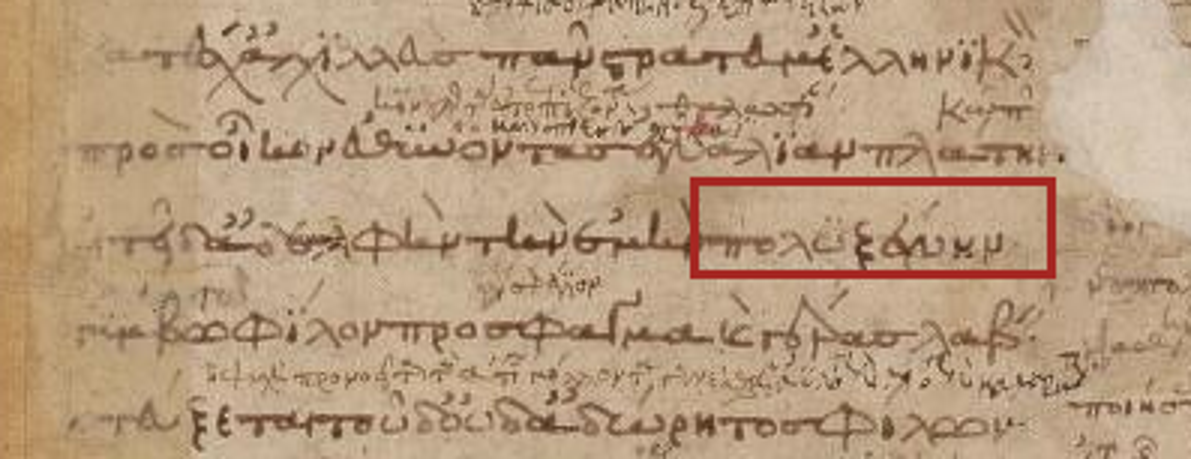
| Stesichorus, The Sack of Ilium. First half of the 6th c. BCE. | Possible mention of Polyxena, without sufficient context to establish her fate. | Papyrus fragments; identification proposed in fragment S135. |
| Attic vase paintings. c. 570–550 BCE. | Achilles’ ambush of Troilus, who is accompanied by Polyxena; the sacrifice of the princess. | Surviving vases with figurative representations. |
| Ibycus of Rhegium. 6th c. BCE. | An ancient report attributes to him a version in which Neoptolemus sacrifices Polyxena. | Indirect evidence: scholium on Hecuba 41; original verses lost. |
| Polyxena Sarcophagus. c. 520–500 BCE. | Relief identified as depicting the sacrifice of the princess. | Surviving monument at the Troy Museum. |
| Sophocles, Polyxena. 5th c. BCE. | A fragment quoted by Strabo shows Menelaus and Agamemnon disagreeing about when to leave Troy. It does not reveal Polyxena’s fate. | Lost tragedy; fragments preserved indirectly. |
| Euripides, Hecuba. Late 5th c. BCE. | Sacrifice demanded by Achilles; Polyxena’s dignity and Talthybius’s account of her death. | Complete tragedy. Exact date disputed. |
| Euripides, The Trojan Women. 415 BCE. | Andromache tells Hecuba of Polyxena’s death. | Complete tragedy. |
| Glaucus of Rhegium. Late 5th or early 4th c. BCE. | Ancient scholar cited in a report concerning Polyxena’s death. | Lost work; mentioned in the scholium on Hecuba 41. |
| Ovid, Metamorphoses 13. c. 8 CE. | Achilles demands the sacrifice without explaining why he has chosen Polyxena. She asks that her body be returned to her mother without payment of a ransom. | Surviving poem. |
| Seneca, The Trojan Women. 1st c. CE. | The sacrifice is presented as a marriage to the dead Achilles; the story is linked to the fate of Astyanax. | Surviving tragedy. |
| Pseudo-Apollodorus, Epitome 5.23. 1st–2nd c. CE. | Polyxena is sacrificed at Achilles’ tomb. | Surviving mythographical summary. |
| Pausanias, Description of Greece. 2nd c. CE. | Descriptions of paintings depicting Polyxena; condemnation of the cruelty of her sacrifice. | Surviving text describing paintings that are now lost. |
| Fabulae attributed to Hyginus, 110. Imperial period; date disputed. | Achilles wishes to marry Polyxena and is killed by Paris and Deiphobus. She is subsequently sacrificed at his tomb. | Surviving mythographical account; attribution and dating debated. |
| Philostratus, On Heroes. 3rd c. CE. | Mutual love between Achilles and Polyxena, followed by her voluntary death at his tomb. | Surviving prose narrative. |
| Quintus of Smyrna, Posthomerica 14. 3rd–4th c. CE. | Achilles appears to Neoptolemus in a dream and demands Polyxena’s sacrifice. | Surviving epic poem. |
| Tryphiodorus, The Sack of Troy. 3rd–4th c. CE. | Brief reference to Polyxena’s blood being shed at Achilles’ tomb. | Surviving poem, containing a brief allusion. |
| Dictys Cretensis, The Trojan War. 4th c. CE (Latin version). | Odysseus demands that Polyxena be handed over to Neoptolemus for sacrifice. | Surviving Latin narrative, based on a Greek account. |
| Dares Phrygius, The Fall of Troy. 5th–6th c. CE. | Physical description of Polyxena, Achilles’ love for her, and her execution by Neoptolemus. | Surviving Latin narrative presented as a historical account. |
| John Malalas, Chronicle. 6th c. CE. | Physical description of Polyxena; states that she was eighteen when she died. | Surviving Byzantine chronicle. |
| Excidium Troiae (anonymous). Oldest manuscript: late 9th c.; date of composition uncertain. | Hector’s body is weighed against gold; Achilles marries Polyxena; she reveals his vulnerable spot, and Neoptolemus later buries her alive in Achilles’ sarcophagus. | Surviving Latin narrative. Atwood and Whitaker’s 1944 edition is based on three manuscripts. |
Chronological note: All dates are approximate, and some remain disputed. The chronological order of works from the sixth century BCE cannot always be established with precision. In the case of lost poems, we must distinguish their probable date of composition from the date of the commentator or manuscript that preserves a reference to them.
The Excidium Troiae survives in medieval manuscripts. The oldest manuscript used by Atwood and Whitaker dates to the late ninth century, although the work may draw on an earlier Latin tradition. Its date of composition remains uncertain.
Homer does not appear in the table because Polyxena is not mentioned in the surviving Homeric poems. Nor have we included The Returns (Nostoi) as direct evidence: the surviving summary mentions the appearance of Achilles’ ghost but does not associate it with Polyxena.
The Cypria and the Sack of Ilium
Sección titulada «The Cypria and the Sack of Ilium»Two poems of the Epic Cycle provide particularly important evidence: the Cypria and the Sack of Ilium. Both are lost, and what we know of them comes from fragments, summaries, and reports preserved by later writers.
The Cypria. An ancient scholium on line 41 of Euripides’ Hecuba preserves a very different account of Polyxena’s death. The commentary attributes to the author of the Cypria the report that the princess died during the capture of Troy from wounds inflicted by Odysseus and Diomedes. It adds that Neoptolemus buried her and cites Glaucus of Rhegium, a scholar of Greek poetry active in the late fifth or early fourth century BCE.
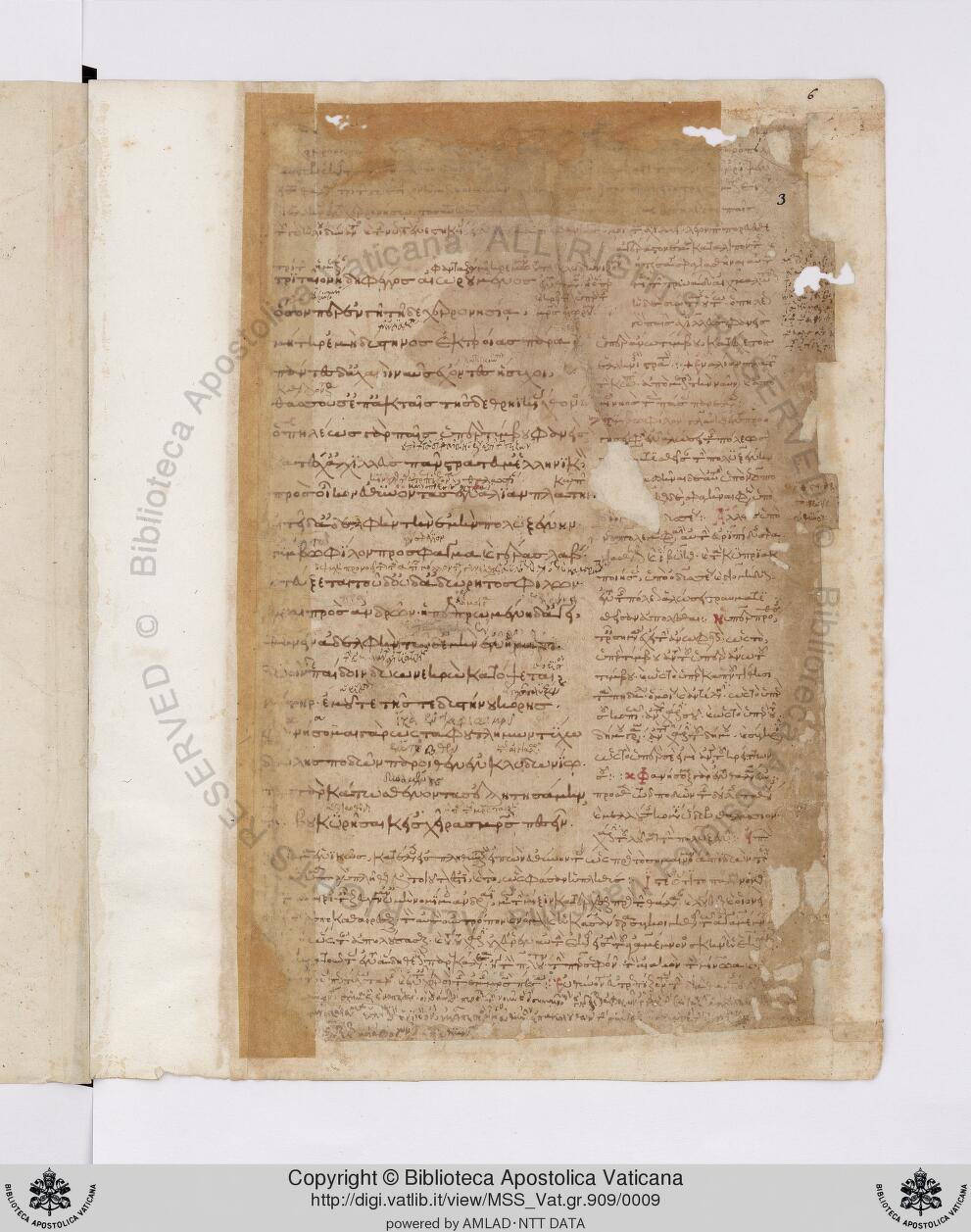
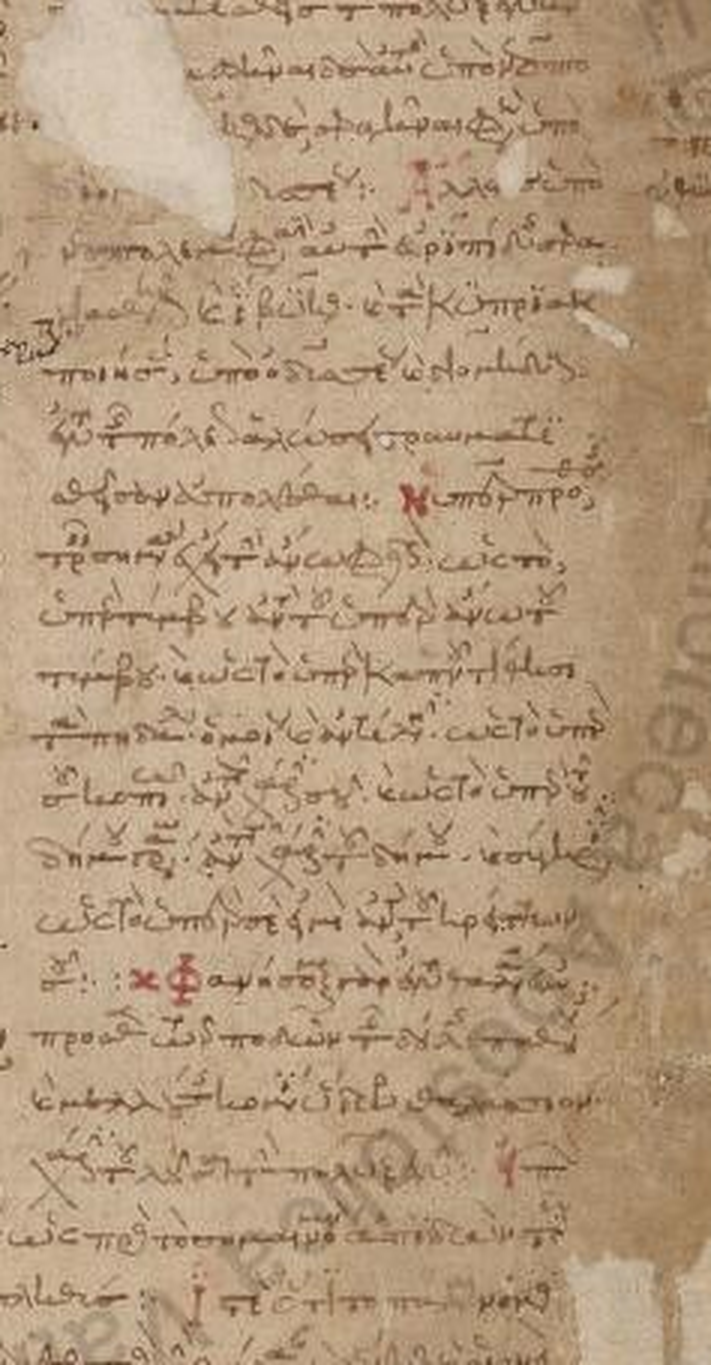
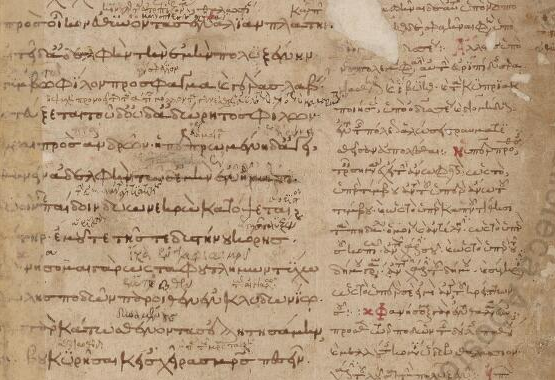
The lines of the Cypria to which the scholiast refers have not survived, nor has Glaucus’s work. We know this version only from the report preserved in the ancient commentary.
The attribution poses a problem. The Cypria chiefly concerned events preceding those of the Iliad, whereas the death reported by the scholiast takes place at the end of the war.
Alberto Bernabé, who includes the testimony as fragment 34 of the Cypria, notes the doubts surrounding this attribution. One possibility is that the poem foreshadowed Polyxena’s death, mentioning it without actually narrating the fall of Troy. But we cannot verify this: the original context of the passage is unknown.
The Epic Cycle’s Sack of Ilium. A different version comes from the poem attributed to Arctinus of Miletus, whose plot is known chiefly through Proclus’s summary.
According to this account, after setting Troy on fire, the Achaeans sacrifice Polyxena at Achilles’ tomb. The summary does not, however, explain why the young woman was chosen or identify the person who performed the sacrifice.
We must be cautious about such omissions. Proclus provides a synopsis, not the full text of the poem. The fact that he does not mention certain details does not prove that they were absent from the original. We simply cannot attribute them to it with confidence.
A summary of another poem in the Cycle, the Returns (Nostoi), tells how, after the destruction of Troy, Achilles’ ghost appears to Agamemnon and his men as they prepare to sail home to Greece. The dead hero tries to prevent their departure by warning them of the disasters awaiting them. Proclus, however, does not connect this appearance with Polyxena’s sacrifice.
The distinction matters: we cannot use the ghost’s appearance in the Returns to explain the sacrifice in the Sack of Ilium, since the surviving evidence establishes no such connection.
What Do We Know About Ibycus and Stesichorus?
Sección titulada «What Do We Know About Ibycus and Stesichorus?»Two major poets of the Archaic period, Ibycus and Stesichorus, also provide evidence concerning Polyxena, although the nature of that evidence is very different.
The same scholium on Hecuba 41 that preserves the report about the Cypria states that, according to Ibycus and Euripides, Polyxena was sacrificed by Neoptolemus, son of Achilles.
This is significant because it suggests that the attribution of the sacrifice to Neoptolemus was not confined to Euripides’ tragedy. However, Ibycus’s verses on this episode have not survived, so we do not know how he presented the scene.
The case of Stesichorus is different.
He composed a poem entitled The Sack of Ilium, of which only badly damaged fragments survive, chiefly on papyri from Oxyrhynchus in Egypt. This is not the same poem as The Sack of Ilium of the Epic Cycle, attributed to Arctinus.
Fragment S135 contains the sequence of Greek letters πολυξε[, which has been interpreted as the beginning of Polyxena’s name. Other fragments associated with the poem contain references to Achilles and the destruction of Troy.
Yet the surviving fragments are too incomplete to reconstruct any scene in which Polyxena is wounded, sacrificed, or buried. We do not know what fate Stesichorus assigned her.
Why Was Polyxena Sacrificed?
Sección titulada «Why Was Polyxena Sacrificed?»The fullest explanation appears in Euripides’ Hecuba.
The tragedy takes place after the fall of Troy. The Achaeans hold the city’s women captive and are preparing to return home.
Achilles’ ghost appears above his tomb and prevents the ships, their sails already raised, from departing. He demands that Polyxena be sacrificed in his honour. His demand provokes a dispute between those who favour the sacrifice and those who oppose it.
Agamemnon favours sparing Polyxena, although his position seems to arise from personal motives: Cassandra, the young woman’s sister, has been assigned to the Achaean commander as a captive and concubine. The two sons of Theseus, traditionally identified as Acamas and Demophon, support the sacrifice, arguing that the honours owed to Achilles must take precedence over Agamemnon’s private interests.
The dispute is not settled until Odysseus intervenes. Through his skill as a speaker, he persuades the army that it would be ungrateful to deny Achilles, the greatest of the Achaeans, the honours he demands. He argues that the dead warriors might reproach the survivors for leaving Troy without acknowledging those who gave their lives for Greece.
His intervention decisively turns the Achaean army in favour of sacrificing Polyxena (Hecuba 130–140).
But the sacrifice also serves a purpose connected with the army’s return. Before killing Polyxena, Neoptolemus offers Achilles the young woman’s blood and asks him, in return, to look favourably upon the Achaeans, allowing them to cast off their moorings and sail home (Hecuba 534–541).
The situation creates a terrible contradiction: the victors wish to return to their former lives, yet believe that to do so they must kill a captive girl.
There is also a striking symmetry with the fate of Iphigenia. At the beginning of the expedition, the Achaeans prepare to sacrifice Agamemnon’s daughter so that they can sail for Troy. At the end of the war, they sacrifice Priam’s daughter at Achilles’ tomb before sailing home. At both ends of the expedition, the sacrifice of a young woman is presented as a condition for putting to sea.
The two victims occupy very different positions: Iphigenia is the daughter of the expedition’s commander; Polyxena, the daughter of the conquered city’s king. The consequences are also very different. In Aeschylus’ Oresteia, Iphigenia’s sacrifice sets in motion a chain of revenge that will drench Agamemnon’s household in blood. Polyxena’s death, by contrast, goes unavenged. Her father is dead, her family has lost its power, and her mother has been enslaved.
Who will hold the victors to account for the death of an enslaved woman?
In Euripides’ version, Neoptolemus performs the sacrifice. Yet the tragedy distributes responsibility among several figures: Achilles’ ghost demands the offering; the Achaeans accept the demand after Odysseus intervenes; Odysseus then defends the decision before Hecuba; and Neoptolemus finally wields the sword.
This is not an isolated murder. It is a public act, prepared and carried out by the victorious army according to a terrible logic of its own.
Nor does the tragedy portray every Achaean as equally unfeeling. Talthybius’s account will show that some are moved by the young woman’s courage. Yet admiration for the victim does not diminish the responsibility of those who allow her to be sacrificed.
Why Does Polyxena Accept Her Death?
Sección titulada «Why Does Polyxena Accept Her Death?»In Hecuba, Euripides gives Polyxena a voice of her own.
When she learns her fate, the young woman does not simply lament. She reflects on what it would mean to go on living after Troy’s destruction.
She recalls that she was born into a royal family, grew up surrounded by honour, and expected a marriage suited to her rank. Now she faces a life in which she might be sold to a master who would make her prepare bread, sweep the house, or work at the loom. She even fears being forced to share a bed with a slave, when she had once hoped to marry a king.
Her thinking reflects the aristocratic values of the world to which she belongs: for a princess raised in freedom, enslavement represents an unbearable loss of status.
We can admire Polyxena’s courage without necessarily agreeing that death is preferable to a life in slavery. Euripides places her decision within a society in which the difference between being free and enslaved profoundly shapes a person’s place in the world.
But we must not lose sight of one essential point: Polyxena did not choose to be sacrificed. The Achaeans have already decided her fate, and she has no power to reverse that decision. When she declares that she would rather die than live as a slave, she is not freely choosing her destiny. She is expressing how she wishes to face a death imposed by others.
This is the last freedom left to her: the freedom to decide how she will face her death. The tragedy presents a young woman capable of confronting death with dignity, but that does not absolve those who have decided to kill her.
How Does Euripides Describe the Sacrifice?
Sección titulada «How Does Euripides Describe the Sacrifice?»Euripides does not show Polyxena’s death directly to the audience.
The sacrifice takes place offstage. Talthybius, the Greek herald, then appears and tells Hecuba what happened (Hecuba 518–582).
His account opens with the army gathered around Achilles’ tomb. Neoptolemus pours a libation to his father and asks him to accept the young woman’s blood. He then draws his sword and signals to several warriors to hold her.
Then Polyxena speaks.
Addressing the Achaeans, she demands that no one lay a hand on her. She declares that she will face death of her own accord, but asks to die without being restrained: as the daughter of kings, she would be ashamed to be counted a slave even among the dead.
The crowd voices its approval. Agamemnon orders the soldiers to release her.
This detail is particularly revealing. The Achaean commander grants her request, but only as regards the manner of the sacrifice. No one suggests overturning the sentence.
After Agamemnon’s order, Polyxena takes hold of her garment at the shoulder and tears it down almost to her navel. She exposes her breasts and chest, whose beauty Talthybius compares to that of a statue (Hecuba 557–561).
Then, lowering one knee to the ground, she offers Neoptolemus a choice: he may strike her in the breast or the neck. The young man, both willing and unwilling, is moved by pity for her, but finally cuts her throat.
Talthybius also describes how the young woman falls to the ground, striving to preserve her modesty even as she dies. The Achaeans then pay her funeral honours: some scatter leaves over her body, others gather wood for the pyre, while those who bring nothing are reproached for failing to offer clothing or ornaments.
The herald admits that what he witnessed has moved him deeply. He wept beside the tomb and weeps again as he recounts what happened.
The scene is extraordinarily powerful because we do not witness the sacrifice directly. We learn of it through the words of a Greek herald who saw Polyxena die and must now tell Hecuba how her daughter was killed.
Euripides does not allow admiration for Polyxena to erase her mother’s grief. Nor does he turn the sacrifice into an admirable ceremony merely because its victim knew how to die with dignity.
How Does Euripides’ Polyxena Differ from the One Depicted in Archaic Art?
Sección titulada «How Does Euripides’ Polyxena Differ from the One Depicted in Archaic Art?»The comparison between Archaic images and Euripides’ account is revealing.
On the British Museum amphora, several warriors hold Polyxena down while Neoptolemus cuts her throat. She is physically restrained by her enemies. On the relief of the so-called Polyxena Sarcophagus, several figures likewise restrain her while another prepares to cut her throat.
In Euripides’ Hecuba, by contrast, Polyxena demands that the soldiers release her, and Agamemnon grants her request.
The images foreground the physical violence inflicted on the victim. Euripides does not conceal that violence, but shifts some of the attention towards Polyxena’s words and her determination to face death without being restrained.
The difference lies not in the young woman’s fate but in how it is represented. In both cases, others have decided that she must die. Yet Euripides allows her to speak for herself.
Polyxena in the Paintings Described by Pausanias
Sección titulada «Polyxena in the Paintings Described by Pausanias»Pausanias, a Greek writer and traveller of the second century CE, saw several paintings depicting Polyxena. His descriptions are especially valuable today because those paintings have not survived.
At Delphi, he saw a large painting by Polygnotus of Thasos, a fifth-century BCE artist, decorating a building known as the Lesche of the Cnidians. It showed the aftermath of Troy’s capture: the Achaeans were preparing their ships for departure while the Trojan women, now captives, mourned their fate.
Among them were Andromache, with her son clinging to her breast, Medesicaste, another daughter of Priam, and Polyxena. Pausanias draws attention to a detail: Andromache and Medesicaste had their heads covered, whereas Polyxena wore her hair braided in the manner customary for unmarried girls (Description of Greece 10.25.9–10).
Polygnotus had not depicted the sacrifice, but the princess still alive among the women of the defeated city. Her hairstyle marked her as an unmarried young woman and distinguished her from the other captives.
Pausanias then adds that poets sang of Polyxena’s death at Achilles’ tomb and that he himself had seen paintings of her tragic fate both in Athens and in Pergamum, near the River Caicus.
One such painting was in a building to the left of the Propylaea, at the entrance to the Acropolis in Athens. Pausanias explains that some of the images could still be made out despite the passage of time. Among them was Polyxena about to be sacrificed beside Achilles’ tomb (Description of Greece 1.22.6).
He does not say who held her or who was about to kill her. The painting nevertheless prompts him to make a personal judgement: he considers that Homer was right to omit so cruel an act.
The comment is surprising. The Iliad ends with Hector’s funeral, while Achilles is still alive and Troy has not yet fallen. Polyxena’s sacrifice therefore belongs to a later stage of the story than the events narrated in the poem. Nor does the Odyssey recount the episode.
We do not know whether Homer was familiar with that tradition or deliberately chose to exclude it. What we do know is Pausanias’s judgement: he regards the sacrifice as an atrocity and praises Homer for omitting it, although its absence does not demonstrate that the poet consciously chose to leave it out.
It is also striking that, among the paintings in the same Athenian building, Pausanias mentions another scene: Orestes killing Aegisthus. The writer draws no connection between the two images, but their presence invites us to recall the different consequences of Iphigenia’s and Polyxena’s deaths, and the chain of vengeance that followed the sacrifice of the former.
The paintings at Delphi, Athens, and Pergamum have been lost. Thanks to Pausanias, we know that they existed and have some idea of their contents. Above all, we can distinguish two very different images of Polyxena: the young woman still alive among Troy’s captives, and the victim awaiting death at Achilles’ tomb.
Was Achilles in Love with Polyxena?
Sección titulada «Was Achilles in Love with Polyxena?»What did Polyxena look like? The earliest sources provide no detailed physical portrait, but some later storytellers dwelt on her appearance.
Dares Phrygius, in The Fall of Troy (12), describes her as tall and fair-skinned, with a long neck, beautiful eyes, and long blond hair. According to the author, she was well-proportioned, with slender fingers and straight legs. Her beauty surpassed that of other women, although Dares also stresses her simple and kindly nature.
John Malalas, a sixth-century CE Byzantine chronicler, offers a different portrait in his Chronicle. Polyxena was tall, with very fair skin, large eyes, black hair brushed back, delicate features, a small mouth, and rosy lips. He even states that she was eighteen when she was killed.
The two authors agree on her exceptional beauty but differ over details such as her hair colour. These are imagined portraits, composed many centuries later, which reveal how each writer gave shape to a figure from Greek myth.
The love story, too, appears in different versions.
Philostratus, in On Heroes (51.1–6), places the beginning of the romance between Achilles and Polyxena during the recovery of Hector’s body. According to his account, the young woman accompanies Priam to the Achaean camp to recover her brother’s body. There Achilles meets her, they fall in love, and plans are made for their marriage.
In the Iliad (Book 24), Homer tells how Priam visits Achilles to recover Hector’s body, but Polyxena takes no part in the episode.
Dares Phrygius tells another story. Achilles sees Polyxena when the Trojan royal family visits Hector’s tomb on the first anniversary of his burial, and falls deeply in love. He wishes to marry her and is prepared to abandon the war to do so (The Fall of Troy 27).
Dictys Cretensis likewise connects Achilles’ love with Polyxena’s beauty, but places their first meeting during religious ceremonies in honour of Apollo, attended by Hecuba and Cassandra. Achilles is captivated by the young woman and offers to bring the war to an end in exchange for marrying her (The Trojan War 3.2–3).
Philostratus explicitly states that Polyxena returned Achilles’ love. Dares and Dictys, by contrast, describe the hero’s passion without telling us whether she shared his feelings.
In these narratives, Polyxena’s beauty inspires the love of the greatest Achaean warrior, to the point that Achilles considers abandoning the expedition against Troy in order to marry her. Yet far from protecting her, that passion becomes part of her misfortune.
The Excidium Troiae also connects their romance with the recovery of Hector’s body, but introduces a crucial difference: Achilles and Polyxena actually marry, and the young woman later plays a decisive part in the hero’s death.
What If Polyxena Had Died for Love?
Sección titulada «What If Polyxena Had Died for Love?»Philostratus presents an unusual version in On Heroes (Heroikos 51.1–6).
As we have seen, he places the beginning of Achilles and Polyxena’s love during the recovery of Hector’s body. The young woman accompanies Priam to the Achaean camp, where she and Achilles fall in love.
Achilles proposes marriage and promises to persuade the Achaeans to abandon the siege of Troy. Priam agrees to negotiate the marriage, but the hero’s trust ultimately leads to his death.
Achilles goes unarmed to the sanctuary of Apollo Thymbraeus to formalise the agreement through oaths and sacrifices. There he is treacherously killed. Philostratus recalls that, according to Homer, Paris and Apollo were responsible for his death, but he does not describe the exact circumstances of the killing or identify those who arranged the ambush.
After Achilles’ death, Polyxena leaves the Trojan side and flees to the Achaean camp. Agamemnon receives her and offers her protection, treating her with the care and respect she would have enjoyed in her father’s house.
Three days after Achilles’ burial, the young woman goes to his tomb at night. There she speaks of her love and grief, asks the hero to continue loving her and to receive her as his wife, and takes her own life by falling upon a sword.
This story completely transforms the traditional account of Polyxena’s sacrifice.
She does not die because the victors have decided to offer her to Achilles, nor because Odysseus and Diomedes wounded her during the fall of Troy. She dies by her own hand, in a narrative that presents her death as the final expression of a love cut short.
The chronology changes as well: Polyxena dies soon after Achilles, before Troy has fallen, and not as a consequence of the Achaean victory.
In both Euripides and Philostratus, Polyxena faces death with determination. But in Euripides she tries to preserve her dignity in the face of an execution imposed upon her, while in Philostratus she chooses to take her own life for love. These are profoundly different interpretations of the same mythical figure.
What If Polyxena Had Betrayed Achilles?
Sección titulada «What If Polyxena Had Betrayed Achilles?»The Excidium Troiae, an anonymous Latin narrative preserved through medieval transmission, offers another version of the story of Achilles and Polyxena. It must not be confused with The Fall of Troy attributed to Dares Phrygius. Its author turns the recovery of Hector’s body into the beginning of a relationship that will ultimately lead to both their deaths.
In the Iliad 22.349–354, Achilles tells the dying Hector that he will not return his body even if Priam offers its weight in gold. The Excidium Troiae transforms that rejected possibility into a scene in which the corpse and the gold are actually placed on a set of scales.
Priam, Hecuba, and Polyxena watch from Troy’s walls as Hector’s body is dragged behind Achilles’ chariot. They beg for its return in exchange for gold equal to its weight. Moved by their pleas, Achilles agrees to the weighing: the body is placed in one pan of the scales and the gold in the other.
But the wealth they have gathered is not enough to balance Hector’s weight. Polyxena then throws her bracelets and armlets onto the scales. On seeing her, Achilles falls in love and offers to return both the body and the gold to Priam on one condition: that he receive Polyxena as his wife. Priam agrees and gives her to him in marriage.
The story then takes a different turn. Priam and Hecuba wish to avenge Hector and ask their daughter to discover Achilles’ vulnerable spot. They promise that, after the hero’s death, she will be free to marry someone else.
Polyxena obtains the secret through caresses and displays of affection. Achilles tells her that his heel is vulnerable: it was the part by which his mother held him when she dipped him into the waters of the Styx. The young woman passes the information to her parents. See also Is Achilles invulnerable in the Iliad?.
Priam and Hecuba then pretend to arrange a sacrifice in Apollo’s temple and invite Achilles and Polyxena to take part. The hero agrees. Following the custom described in the story, he enters the sanctuary unarmed and barefoot. While he offers incense, Paris, hidden behind the god’s statue, shoots a poisoned arrow into his heel. Mortally wounded, Achilles seizes burning brands from the altar and kills those within his reach before dying.
Polyxena’s fate is decided later, during the fall of Troy. Neoptolemus, Achilles’ son, captures her and takes her to his father’s tomb. He opens the grave, places the young woman, still alive, in the sarcophagus containing Achilles’ body, and closes it, sealing it with lead (Excidium Troiae, pp. 12–13 and 20, ed. Atwood and Whitaker).
This version stands in sharp contrast to Philostratus. In On Heroes, Polyxena loves Achilles and takes her own life at his tomb. In the Excidium Troiae, she participates in the conspiracy that leads to his death and is subsequently buried alive with him by Neoptolemus.
The meaning of her death changes too. In this story, Priam and Hecuba use their daughter to avenge Hector, and Neoptolemus subsequently punishes Polyxena for revealing the secret that made his father’s murder possible.
One act of revenge thus leads to another. Instigated by her parents, Polyxena takes part in the first and becomes the victim of the second.
What Do the Other Ancient Authors Add?
Sección titulada «What Do the Other Ancient Authors Add?»Polyxena’s story continued to develop over many centuries.
Sophocles wrote a tragedy entitled Polyxena, now lost. Strabo (Geography 10.3.14) preserves lines concerning the Achaeans’ departure: Menelaus wishes to leave Troy as soon as possible, while Agamemnon wants to remain for a time to appease Athena.
The fragment places a scene from the play after the capture of Troy, but does not allow us to reconstruct its plot or establish how Sophocles portrayed Polyxena’s fate.
Euripides mentions her death again in The Trojan Women (622–628). Andromache tells Hecuba that her daughter has been sacrificed at Achilles’ tomb. She herself saw the body, covered it with a cloak, and mourned over it. Hecuba calls the sacrifice impious. In this tragedy, the news is delivered not by a Greek herald, as in Hecuba, but by Andromache, Hector’s widow, who has seen Polyxena’s lifeless body.
Ovid, in Book 13 of the Metamorphoses (439–532), describes the appearance of Achilles’ ghost and his demand for a sacrifice. The hero complains that the Achaeans are preparing to depart, forgetting all he has done for them, and demands Polyxena’s death as an honour owed to his tomb.
Ovid does not explain why Achilles demands Polyxena in particular. The hero claims funeral honours but offers no reason for choosing the young woman. The poet says nothing about an earlier romance or a promise of marriage. If we recall the traditions in which Achilles falls in love with Polyxena, his demand opens up new and disturbing possibilities of interpretation, but none is stated explicitly in Ovid’s account.
Polyxena faces death bravely and asks that her body be given to Hecuba without her mother having to pay a ransom. The poet then dwells on Hecuba’s lament.
The request is especially moving because it recalls another scene from the Trojan tradition: Priam had to surrender treasures to recover Hector’s body. Now his daughter, herself a captive, asks that her mother be allowed to receive her body without paying anything.
Seneca, in The Trojan Women, develops an even darker motif: the sacrifice is presented as a marriage to Achilles in the world of the dead. Helen initially deceives Polyxena by announcing that she is to marry Neoptolemus, Achilles’ son, when in fact she is being prepared for sacrifice and marriage to the dead hero.
The ceremony that ought to promise a shared life becomes the path towards death.
Seneca also connects Polyxena’s fate with that of Astyanax, Hector’s son, whom the Achaeans have condemned to be thrown from a tower. In the messenger’s account, the boy ultimately leaps from the tower himself, although the decision to kill him has already been made. Both are victims of the victors’ decisions and embody the destruction of what remains of Troy’s royal family.
Quintus of Smyrna, in Book 14 of the Posthomerica, gives the episode a new form within an extensive epic narrative.
Achilles appears to Neoptolemus in a dream and demands that Polyxena be sacrificed at his tomb. If the Achaeans disobey, he threatens to prevent their return by raising storms at sea.
Neoptolemus conveys the order to the army and performs the sacrifice. Polyxena weeps as she is led to the tomb, compared to a calf torn from its mother and dragged away for slaughter. It is a very different image from the composure with which Euripides and Ovid portray the princess facing death.
After the sacrifice, the Achaeans hand Polyxena’s body over to Antenor, an elderly Trojan counsellor who had brought her up in his household as a prospective bride for his son Eurymachus. Antenor buries her in Troy, near his own home.
This version combines themes we have already encountered: the dead hero’s demand, his son’s authority, and the need to secure a safe return.
Other sources offer shorter accounts. The Epitome attributed to Apollodorus (5.23) mentions the sacrifice at Achilles’ tomb; the Fabulae attributed to Hyginus (110) connect Achilles’ wish to marry Polyxena with the hero’s death; and Tryphiodorus, in The Sack of Troy, alludes to the shedding of the princess’s blood at the tomb. These testimonies attest to the circulation of different traditions, although they do little to develop Polyxena’s character.
Who Really Created Polyxena?
Sección titulada «Who Really Created Polyxena?»We cannot attribute her creation to any single poet.
Polyxena does not appear in the surviving Homeric poems, but we know that stories about her were already circulating in the Archaic period, probably also through oral tradition.
Vase paintings depict her during Achilles’ ambush of Troilus and at her own sacrifice. A scholium attributes an account of her death during the capture of Troy to the author of the Cypria. The summary of the Sack of Ilium places her sacrifice at Achilles’ tomb. Ibycus is cited among those who attributed her death to Neoptolemus, while a fragment of Stesichorus may preserve the beginning of her name.
Euripides gives her a voice capable of moving even her enemies. Ovid makes her death deepen Hecuba’s suffering. Seneca transforms the sacrifice into a wedding with Achilles in the world of the dead. Quintus of Smyrna reworks the episode within an epic narrative.
Dares and John Malalas describe her physical appearance, while Dictys and Dares develop different accounts of Achilles falling in love with her. Philostratus portrays Polyxena as a woman who takes her own life for love. The Excidium Troiae presents her as the hero’s wife, a participant in the conspiracy that leads to his death, and ultimately a woman buried alive in his tomb.
Each testimony belongs to a particular period, a particular work, and a particular understanding of myth. Over the centuries, authors emphasised different aspects of Polyxena, changed the circumstances of her death, and attributed to her motives and emotions that cannot always be reconciled.
Yet one element remains constant in the stories of her death: Polyxena dies in the bloom of her youth. What changes is the path that leads her to that end, the reasons offered to explain it, and the responsibility of those involved in her fate.
We cannot identify a single creator of Polyxena. What we can identify are the poets, artists, and storytellers who, over the centuries, helped shape her story.