The Economy of Debt
Homer does not present every act of revenge as the settling of a debt, but he frequently draws on the language and practices of payment, repayment, compensation and retribution to depict particular wrongs and the responses they provoke. Some losses can be compensated; others cease to have a price. And when retaliation causes a fresh loss, it may in turn give rise to another claim.
The metaphor of an outstanding debt can illuminate many situations in these poems, provided we do not turn it into a rule that Homer never formulated. In the Iliad and the Odyssey, there is no single response to harm. Sometimes property is returned; sometimes compensation is paid for a death; sometimes a ransom is offered; sometimes the response to a death passes to a son. But there is also anger that will accept no compensation. Then payment does not bring peace: it comes too late, or the attempt to exact it becomes another act of violence.
The gift and the invisible debt
Sección titulada «The gift and the invisible debt»In the Homeric world, a debt does not arise only from an offence, a loss or something that needs to be put right. It can also arise from a benefit received. A gift creates a relationship between giver and recipient, and that relationship may last far beyond the moment of giving.
M. I. Finley drew attention to the reciprocal character of these exchanges. In the society he reconstructs from Homer, giving often begins a relationship that calls for some form of return: another gift, a service, help, hospitality or recognition. The return need not be immediate or equivalent, but the bond remains open.
This also helps us understand the distinctive character of heroic wealth. Cups, tripods, cauldrons, metal objects and valuable textiles may remain stored away for years. Finley sums up this logic with a paradox: these treasures are meant both to be kept and to be given away. Their value depends not only on their usefulness, but also on their ability to confer prestige, forge alliances and create obligations as they pass from hand to hand.
The fact that a gift creates reciprocity does not necessarily mean that the giver expects something in return. A gift may be freely given, yet leave its recipient feeling that one day something ought to be given in return.
Our Christmas customs preserve something of this logic. In many families and groups of friends, everyone owes everyone else a present. Nobody signs a contract or demands an exact equivalent, but an excessively expensive gift can cause embarrassment, while one that seems too modest can disappoint. This is only a partial modern analogy: the exchange is not commercial, but expectations of reciprocity still matter.
That is precisely why a gift can be freely given without being socially neutral.
The Odyssey is full of relationships of this kind. Hospitality gives rise to gifts and commitments; help received may be remembered years later; compensation attempts to restore a broken balance. At the opposite extreme, an offence, an act of abuse or a death may leave another kind of debt outstanding. Giving can create an obligation; so can causing harm.
When an offence has a price
Sección titulada «When an offence has a price»Ajax provides the clearest example in Book 9 of the Iliad. Trying to persuade Achilles to abandon his anger towards Agamemnon, he reminds him of a familiar practice: even for the death of a brother or a son, a man may accept a ποινή (poinḗ), a form of compensation for a death. The killer provides substantial compensation and may remain among his own people; the bereaved man restrains his anger after receiving it (Iliad, Book 9, lines 632–636).
The scene does not reduce grief to a sum of money. Rather, it shows one way of containing violence and restoring the possibility of living together. In that sense, it makes a world shattered by killing liveable again.
The shield of Achilles presents another situation. A man has been killed, and compensation for his death is in dispute. One man claims that he has paid in full; the other contests his claim. The Greek also allows another interpretation: one man offers compensation, while the other refuses to accept it. Unable to settle their disagreement, they seek a decision before the community. The elders, seated in a circle, hear the case and deliver their judgements in turn (Iliad, Book 18, lines 497–508).
Two talents of gold lie in the centre. They may be intended as a reward for whoever delivers the fairest judgement, although their precise function remains disputed. Homer does not tell us how the case ends. What matters is that a death may lead not only to retaliation, but also to a dispute over compensation brought before the community.
With these scenes in mind, we can turn to Homer’s vocabulary. ποινή (poinḗ) can denote compensation or retribution connected with a death. ἄποινα (ápoina), by contrast, refers to goods offered to recover something or make amends: they may serve as ransom for a captive or to recover a corpse, but the term also appears in the gifts with which Agamemnon attempts to reconcile himself with Achilles.
These are not rigidly defined legal categories. Their meanings depend on the circumstances in which Homer uses them, although the distinction between compensation for a death and goods offered as ransom remains useful for understanding the scenes.
Taken together, Ajax’s words and the scene on Achilles’ shield show how important the acceptance of compensation could be. It was not always enough for someone to offer payment: the possibility of containing anger and restoring relations also depended on whether the injured party was prepared to accept it.
Being Right Is Not Enough
Sección titulada «Being Right Is Not Enough»In the Homeric world, having a claim to redress does not guarantee that it will be satisfied. M. I. Finley stresses that the enforcement of claims remains largely a private matter: its effectiveness depends on the strength of the injured party and the support they can muster — family, dependants, allies or guest-friends.
Telemachus demonstrates this clearly. He can denounce the suitors’ abuses before the assembly, but he does not yet possess sufficient strength or a network of supporters capable of compelling them to make amends. He has a claim, but not the means to enforce it. Odysseus’ return changes that balance.
This does not mean that Homeric society operates simply on the principle that ‘might makes right’. There are recognised norms, claims and expectations of redress, but no public authority that can reliably enforce them regardless of the strength and support of the parties involved. The claims exist; what remains uncertain is who has the power to uphold them. Where there is no authority capable of securing redress, the task may fall to the injured party and those who stand with them.
Nor is the community indifferent. Telemachus tries to bring the suitors’ abuses before the assembly and turn a problem within his oîkos into a public matter, but he cannot yet persuade the dêmos to act. The inaction of others favours those who already possess greater strength. Finley notes, however, that collective opinion can change: the suitors themselves fear that Telemachus may turn the people against them.
On Ithaca, public opinion does not govern, but it carries weight. It cannot replace force, yet it can alter the balance between the parties. The community is therefore not simply a passive audience: its willingness to intervene, or its refusal to do so, helps determine whether a claim can be enforced.
The community is built upon households
Sección titulada «The community is built upon households»The Homeric community does not replace the oîkos. M. I. Finley observes that production, protection, kinship, dependence and obligations are largely organised within households and through personal networks. The oîkos is not isolated: it maintains relationships with other households through hospitality, alliances, rivalries and mutual assistance.
The community brings together households and family groups of differing rank without erasing their autonomy. Some conflicts remain primarily matters for the parties involved and those who support them; others concern the community as a whole, such as defence, war and deliberation in the assembly. The dêmos may carry weight, but it does not thereby replace the household or the authority of those who lead it.
The vocabulary helps us recognise this continuity. Finley points out that anássein, ‘to be lord’ or ‘to rule’, can apply both to a king and to the head of an oîkos. This is an indication, not conclusive proof: the difference in scale remains, but the two forms of authority are not entirely distinct. The king leads a community while retaining some features of the authority exercised within a household.
The Homeric community does not arise by erasing households: it is built upon them. Political authority still retains something of the character of household authority exercised on a larger scale.
When the price is not enough
Sección titulada «When the price is not enough»Book 9 of the Iliad puts precisely this possibility of redress to the test. Agamemnon acknowledges his mistake and offers Achilles extraordinary gifts to appease him: tripods, gold, women, cities and even one of his daughters in marriage. He calls them ἄποινα (ápoina), goods with which he hopes to make amends for the offence and restore his relationship with his finest warrior (Iliad, Book 9, lines 119–120 and following).
Achilles refuses to accept that these gifts can make up for the wrong done to him or bring his anger to an end. By recalling the ποινή (poinḗ) that other men accept even for the death of a son or brother, Ajax makes the contrast sharper: he is not claiming that every wrong must have a price, but reproaching Achilles for refusing any compensation at all.
The Odyssey presents another situation in the hall of Odysseus’ house on Ithaca. After Antinous has been killed, Eurymachus attempts to negotiate. The suitors will repay everything they have eaten and drunk, and each will offer a further payment in bronze and gold equivalent to the value of twenty oxen, until Odysseus’ heart is appeased (Odyssey, Book 22, lines 55–59). They thus acknowledge, at least, the material damage: they have consumed another man’s wealth and offer to repay it with additional compensation.
Homer often expresses value through equivalents in cattle. In Book 1 he tells us that Laertes bought Eurycleia when she was still young for the price of twenty oxen. Although she was enslaved, he subsequently honoured her as much as his own wife, but never shared her bed, for fear of his wife’s anger (Odyssey, Book 1, lines 429–433). The coincidence of the figure does not make the two situations equivalent, but it helps us appreciate the scale of Eurymachus’ offer: besides returning what they have consumed, each suitor proposes an additional payment equivalent in value to the price Laertes had paid for Eurycleia.
Odysseus rejects that equivalence. Even if they restored all his property and added still more, he replies, he would not stay his hand from slaughter until the suitors had paid for their ὑπερβασίη (hyperbasíē), their transgression (Odyssey, Book 22, lines 61–64). For Odysseus, the wrong goes beyond what they have eaten and drunk. It includes the occupation of his house, their designs on Penelope, their plots against Telemachus and the abuses committed during his absence.
Achilles and Odysseus do not respond in exactly the same way. Agamemnon has insulted Achilles within a military alliance; Eurymachus speaks for a group that has occupied another man’s house for years and is now trying to save their lives. Yet the two scenes illuminate one another: in both, material compensation is offered and the injured party refuses to accept it as sufficient. The question left open is the same: when does a wrong cease to admit an equivalent?
So far, compensation has been offered directly to the person who suffered the wrong. But a death can leave a demand for retribution that someone else eventually takes up.
Retribution passes to another
Sección titulada «Retribution passes to another»At the beginning of the Odyssey, Zeus recalls the fate of Agamemnon. While the king was fighting at Troy, Aegisthus seduced Clytemnestra and, when Agamemnon returned, took part in his murder. Hermes had warned Aegisthus not to kill him or take his wife, because Orestes, Agamemnon’s son, would eventually avenge him. Zeus uses the word τίσις (tísis), ‘retribution’, for this future revenge: Aegisthus had committed the wrong, but it would be the dead man’s son who exacted retribution. When Orestes grew up and killed Aegisthus, Zeus could say that he had ‘paid for it all at once’ (Odyssey, Book 1, lines 35–43).
Nestor returns to the same example when speaking to Telemachus. Orestes not only punished his father’s murderer: he also won lasting fame (Odyssey, Book 3, lines 195–206). Agamemnon’s death does not vanish with him. The claim passes to the next generation, and Orestes becomes the one who acts upon it. That is why his story also serves as an example for Telemachus, another son whose father has been absent for years and whose house has been occupied.
Here we should pause over Homer. Nestor also mentions that Orestes held funeral rites for both Aegisthus and his mother, Clytemnestra, but the Odyssey does not explicitly say that Orestes killed her (Odyssey, Book 3, lines 309–310).
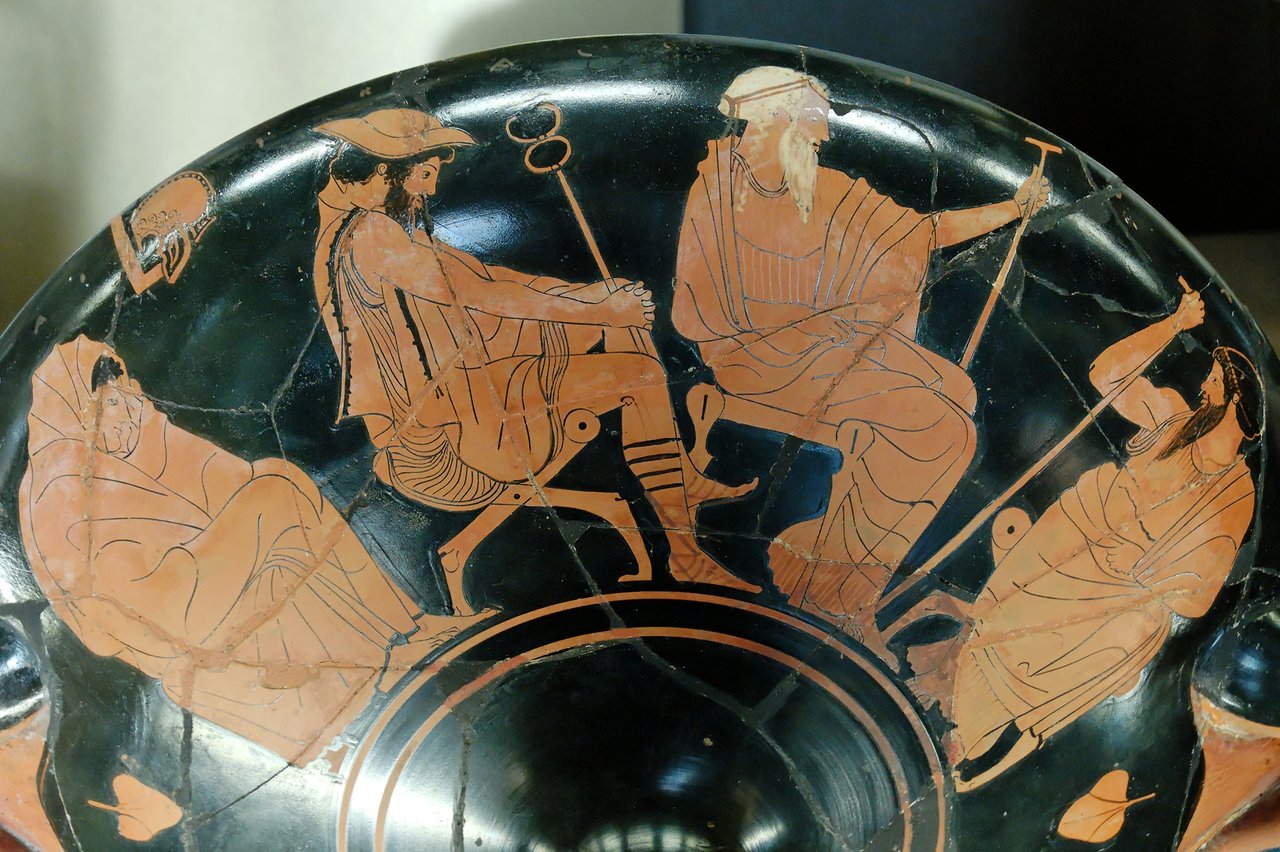
Later tradition develops the story in a much more complex direction. Orestes also kills Clytemnestra and is pursued by the Erinyes, the divinities who avenge the shedding of blood within the family. Their pursuit reveals a disturbing paradox. Orestes has avenged his father by killing his mother; but who can now avenge Clytemnestra? Her children are also the children of Agamemnon, the man she murdered. The blood debt remains, but the family itself no longer provides an obvious human avenger who can exact it. The Erinyes give that unresolved demand for retribution a terrifying presence.
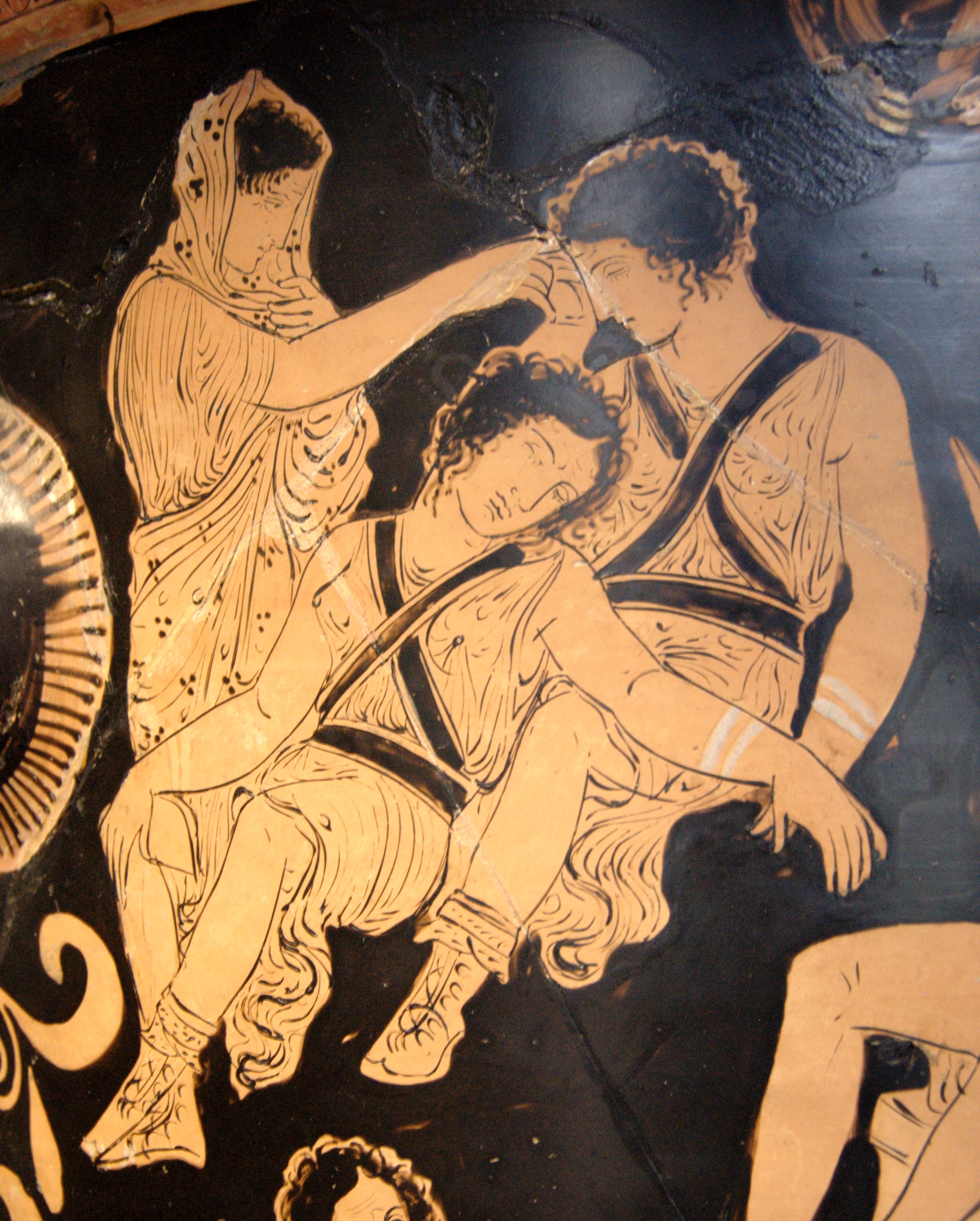
In the later Oresteia, Aeschylus carries the conflict through to the trial of Orestes. This belongs to a development of the myth that the Odyssey does not explicitly recount. For Homer, a simpler idea is enough: a death may leave a demand for retribution that another member of the family eventually fulfils.
But a demand for retribution need not pass from a murdered father to his son. Someone who has suffered a wrong may also call upon another person with greater power to avenge it.
Polyphemus presents a different case because he is first the perpetrator of an offence and then the victim of an injury. When Odysseus reaches his cave, he invokes the obligations of hospitality under Zeus’s protection. The Cyclops openly rejects them, declares that the Cyclopes have no regard for Zeus or the other gods, and devours several of the men who have entered his cave. Within the logic of the poem, Polyphemus has already committed an offence against the strangers and against the order protected by Zeus. In the terms of our reading, he has already given rise to a claim for redress, even before losing his eye.
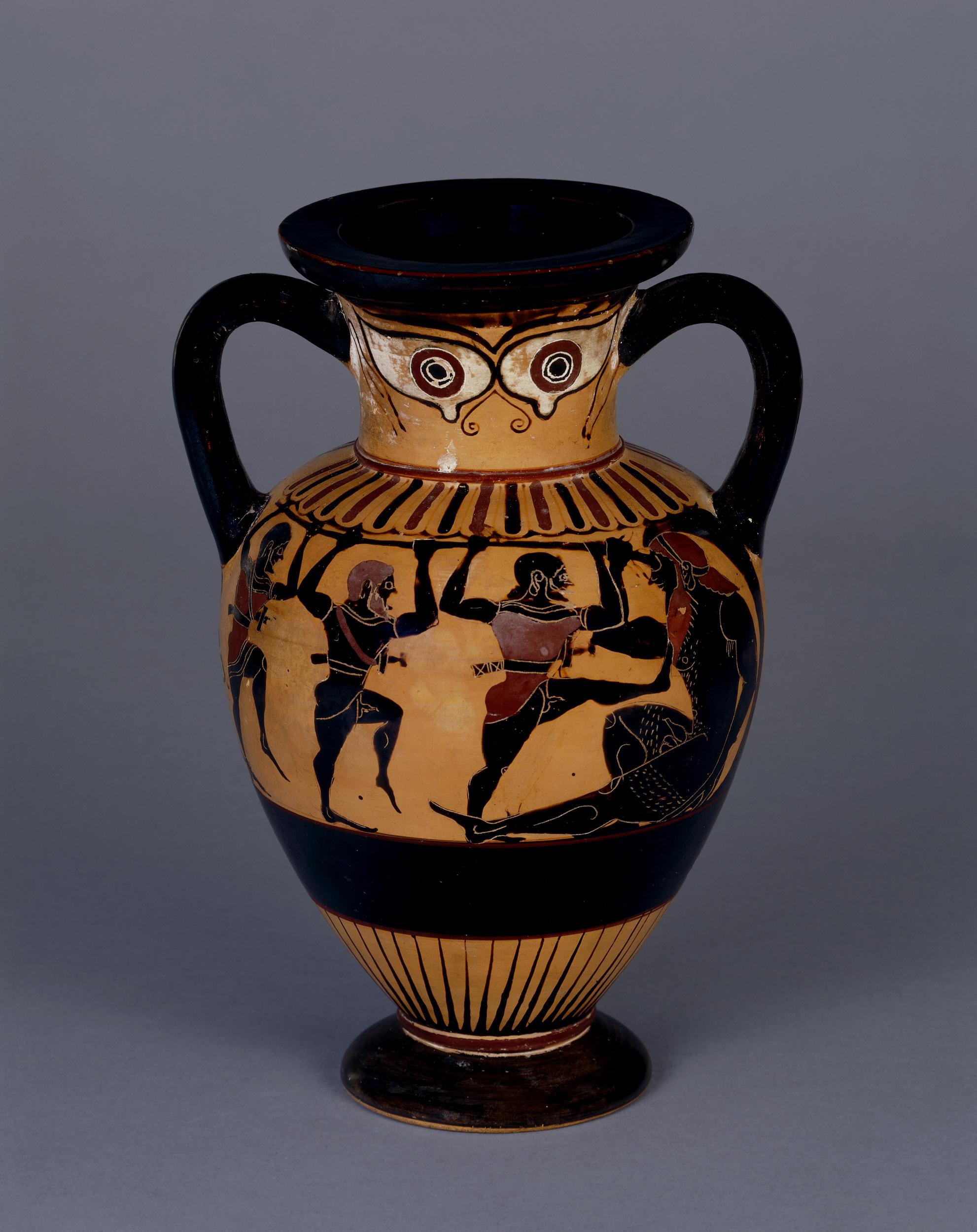
After escaping the cave and putting out to sea, Odysseus makes the mistake of revealing his real name. Polyphemus now knows who has blinded him and calls upon his father, Poseidon. He asks the god to prevent Odysseus from ever returning home or, if he is destined to reach Ithaca, to make him arrive late, after losing all his companions, aboard another man’s ship, and to find trouble awaiting him at home (Odyssey, Book 9, lines 526–535).
The situation thus becomes more complex: Polyphemus first commits an offence and then suffers an injury. Unable to pursue Odysseus across the sea himself, he turns to his father to avenge him. Poseidon possesses the power that the Cyclops lacks. This is not a transfer of debt in any legal sense: Homer describes nothing of the kind. What we see is someone who has suffered an injury appealing to another — in this case a god, who is also his father — to punish the man responsible.
That does not mean Poseidon is responsible for every disaster of the voyage. The Cicones kill several Achaeans after the sack of Ismarus; the Laestrygonians destroy almost the entire fleet; Scylla seizes six men; and Zeus destroys the last ship after Odysseus’ companions slaughter the cattle of Helios. Poseidon’s anger shapes one of the main obstacles to Odysseus’ return, but the poem attributes the losses to different causes and agents.
The sacrifice prescribed by Tiresias does not erase Polyphemus’ offence against hospitality. It concerns another relationship: the one that remains unsettled between Odysseus and Poseidon. Tiresias foretells that, after killing the suitors, Odysseus must travel inland carrying an oar until he reaches people who know nothing of the sea. There he must offer Poseidon a ram, a bull and a boar. He is then to return home and make sacrifices to the other gods. Tiresias also foretells that Odysseus will die peacefully in old age (Odyssey, Book 11, lines 121–137).
Homer does not call the sacrifice ποινή (poinḗ) or τίσις (tísis). It is better understood as a ritual act intended to restore a relationship that has not yet been pacified, rather than as the literal payment of a debt.
When collecting a debt creates another claim
Sección titulada «When collecting a debt creates another claim»The death of Patroclus changes Achilles profoundly. Until then, he had rejected Agamemnon’s gifts because he believed that no wealth could make amends for the insult he had suffered. Now he no longer seeks compensation. He wants the Trojans to pay with their lives for the death of his friend.
In the fighting by the river, Achilles captures twelve young Trojans alive and sets them aside to be sacrificed at Patroclus’ funeral pyre. Homer uses the word ποινή (poinḗ) to describe their fate: they are to serve as retribution for the dead man (Iliad, Book 21, lines 27–28).
The contrast with Ajax’s earlier words is striking. In Book 9, poinḗ was compensation that could help contain anger after a death. Here, the same word is used for the sacrifice of twelve captives. What could serve to restrain violence has become a means of exacting it.
Soon afterwards, Lycaon, one of Priam’s sons, begs Achilles to spare his life, reminding him that he had previously been captured and released for ransom. Achilles now rejects the very idea of ἄποινα (ápoina): since Patroclus died, he will no longer accept a ransom in exchange for an enemy’s life (Iliad, Book 21, line 99).
The language of payment becomes still more explicit when Achilles declares that the Trojans must pay for Patroclus and for the Achaeans killed during his absence from battle. Confronting Hector, he brings this logic to its most violent expression: ‘Now you will pay, all at once, for the grief caused by the deaths of my companions’ (Iliad, Book 22, lines 271–272).
But payment here no longer means compensation that might be accepted and bring a conflict to an end. For Achilles, retribution has become a demand for blood. He does not seek anything equivalent to Patroclus — nothing could bring his friend back — but seeks to inflict suffering on those he holds responsible for the loss.
When the mortally wounded Hector begs Achilles to return his body to his family for burial, Achilles refuses, declaring that no ransom will persuade him to surrender it (Iliad, Book 22, lines 338–354). After Hector dies, Achilles dishonours the corpse, dragging it behind his chariot (Iliad, Book 22, lines 395–404).
Yet the Iliad does not end with Achilles in this state. In Book 24, Priam enters his tent by night and begs him to return Hector’s body. He does not ask Achilles to forget Patroclus or pretend that his death can be compensated. He asks for something different: that a father be allowed to recover his son’s body and give him a proper burial.
Priam reminds Achilles of his own father, Peleus. They weep together: Priam for Hector, Achilles for Patroclus and for the father he may never see again. Only then does Achilles accept the ἄποινα (ápoina) brought by Priam and return Hector’s body so that it may receive funeral rites (Iliad, Book 24, lines 477–507 and 555–595).
The distinction matters. Priam’s gifts do not compensate for the death of Patroclus. They ransom Hector’s body. Between Book 22 and Book 24, what has changed is not the material value of a ransom, but Achilles’ willingness to accept one. The scene suggests that an act of reparation can succeed only when the person who receives it is prepared to recognise it as sufficient for what it can actually put right.
The Odyssey poses a similar problem at its close. From the perspective of Odysseus and his household, the suitors have already received retribution for their abuses. Tiresias had foretold that Odysseus would punish them, and after the slaughter Eurycleia celebrates the fact that they have paid for their transgression (Odyssey, Book 11, line 118; Book 23, lines 55–57).
But the suitors were also sons and brothers of other families on Ithaca. The very slaughter that seems to settle a claim for Odysseus’ household creates a new loss for those families. Eupeithes, the father of Antinous, sees events from the opposite side: for him, his son’s death has not settled a debt but created another. He rallies relatives of the dead who are prepared to follow him and marches against Odysseus (Odyssey, Book 24, lines 465–471).
The Odyssey thus reaches another limit of revenge. After the suitors’ deaths, their relatives seek retribution for the blood that has been shed. In the later story of Orestes and Clytemnestra, the family itself can no longer provide an obvious human avenger for the murdered mother. Here the problem is almost the opposite: there are too many willing avengers, not too few. More relatives are ready to collect the debt, and nothing within the logic of retaliation itself prevents their vengeance from provoking another act of violence. The chain could continue indefinitely.
Who can declare the account closed?
Sección titulada «Who can declare the account closed?»The Odyssey does not end with Odysseus’ victory, but with the danger that his victory may set the violence in motion again. Halitherses warns the Ithacans not to pursue Odysseus: the suitors have paid for their own excesses, and responsibility lies with those who ignored earlier warnings. More than half of those assembled withdraw, but the others side with Eupeithes and prepare to fight (Odyssey, Book 24, lines 451–471).
That is why Zeus and Athena intervene. Their purpose is not to avenge anyone, but to prevent further bloodshed. Zeus declares that Odysseus should remain king, that solemn oaths should be sworn, and that the deaths of sons and brothers should be made to fade from memory, so that peace and prosperity may return (Odyssey, Book 24, lines 472–486).
Yet some of the relatives still march against Odysseus. Laertes kills Eupeithes, and the fighting threatens to continue. Athena orders the combatants to stop, but Odysseus still attempts to pursue the fleeing men. Zeus then hurls a thunderbolt, and Athena commands Odysseus to lay down his arms. Finally, she establishes a sworn peace between the two sides (Odyssey, Book 24, lines 523–548).
The solution is not to find a larger compensation or to calculate which death can pay for another. It is to prevent the next act of vengeance.
In the later story of Orestes, the Erinyes embody a demand for vengeance that the family can no longer resolve without turning against itself. In the Odyssey, Zeus and Athena intervene when there are too many willing avengers and the cycle of retaliation threatens to continue without end. In both cases, the logic of blood vengeance has reached a point at which it can no longer bring peace by itself.