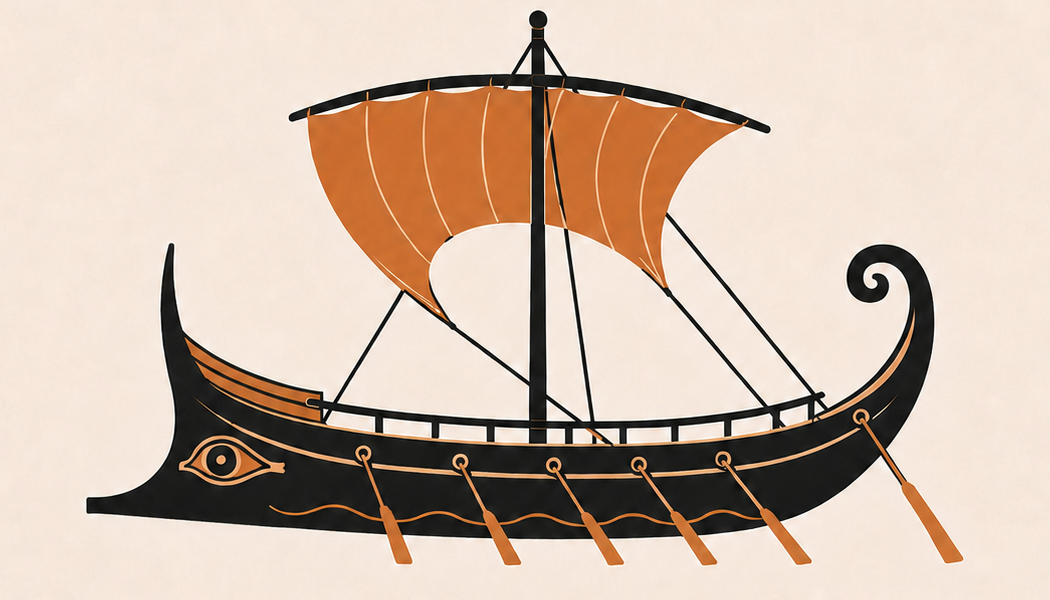
Odysseus’ Wanderings
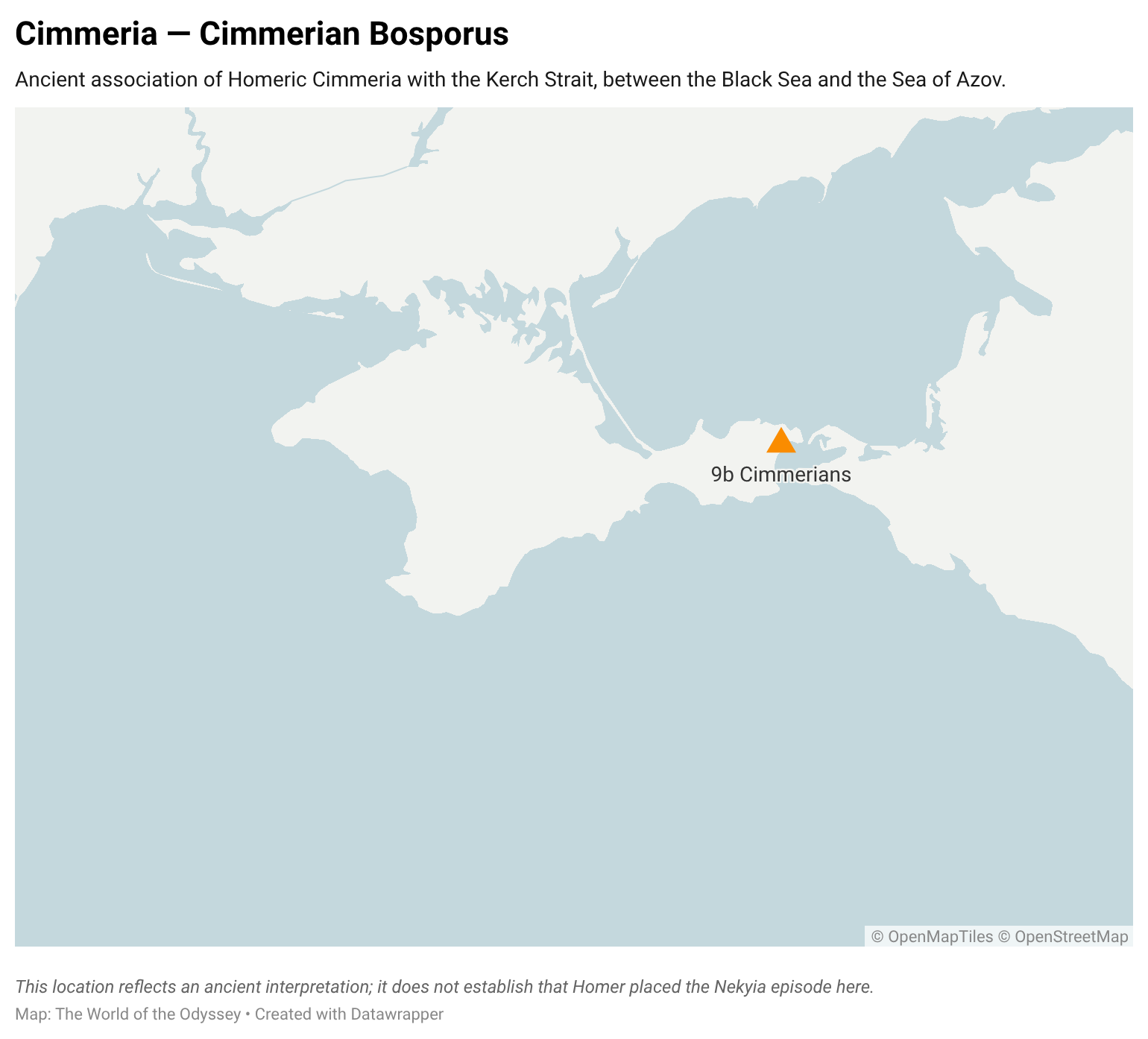
This is the gateway to Odysseus’ complete journey, from Troy to his final arrival in Ithaca. The wanderings form a narrative sequence of journeys and maritime episodes; the map brings together recognisable places and associations proposed by later readers, without turning them into a demonstrated route.
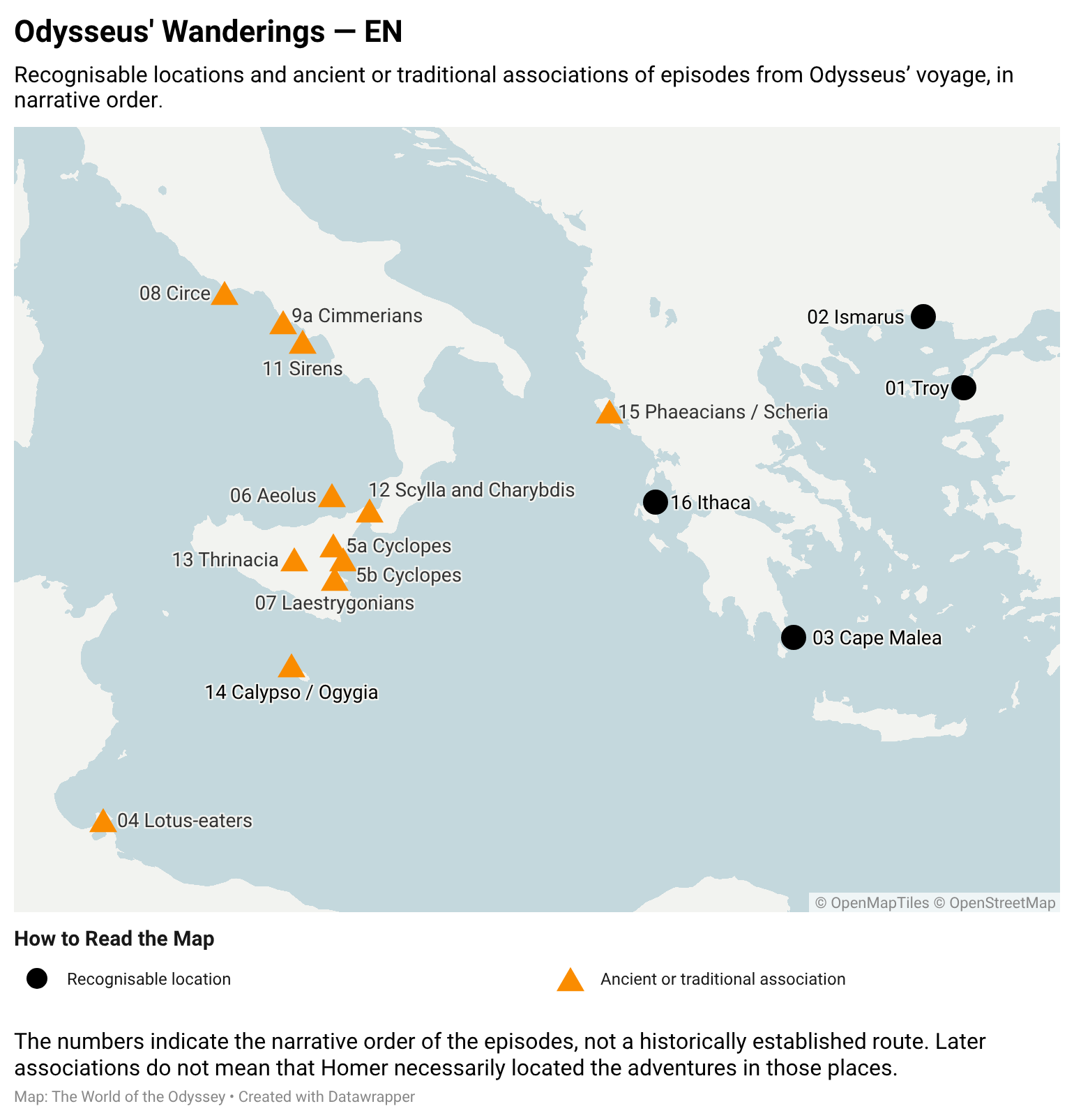
Cimmeria falls outside the extent of the main map. Ancient tradition also placed the Cimmerians around the Cimmerian Bosporus, the modern Strait of Kerch.
Map references
Sección titulada «Map references»The letters a and b do not indicate successive stages: they mark alternative locations assigned by tradition to the same episode. Thus 9a (Cumae–Avernus) and 9b (Cimmerian Bosporus) are two distinct ancient associations for Homeric Cimmeria, and therefore for the same consultation with the dead.
- 01 — Troy — Hisarlik. Recognisable place.
- 02 — Ismarus / Cicones — Thracian coast. Recognisable place.
- 03 — Cape Malea — Peloponnese. Recognisable place.
- 04 — Lotus-Eaters — Meninx / Djerba. Ancient association.
- 5a — Cyclopes — Sicily / Etna. Ancient association.
- 5b — Cyclopes — Aci Trezza. Later traditional association.
- 06 — Aeolus — Aeolian Islands. Ancient association.
- 07 — Laestrygonians — Leontini / Sicily. Later association.
- 08 — Circe / Aeaea — Mount Circeo. Ancient association.
- 9a — Cimmerians / Nekyia — Cumae–Avernus. Ancient association.
- 9b — Cimmerians / Nekyia — Cimmerian Bosporus. Ancient association.
- 10 — Return to Aeaea. Returns to the same place as 08; therefore no new marker is added.
- 11 — Sirens — Sirenuses / Li Galli. Ancient association.
- 12 — Scylla and Charybdis — Strait of Messina. Ancient association.
- 13 — Thrinacia — Sicily. Ancient association.
- 14 — Calypso / Ogygia — Gozo. Traditional association.
- 15 — Phaeacians / Scheria — Corfu. Ancient association.
- 16 — Ithaca — present-day Ithaki. Strong traditional identification; this does not amount to absolute proof of every Homeric topographical detail.
From narrative sequence to map
Sección titulada «From narrative sequence to map»Can we reconstruct Odysseus’ wanderings on a map?
Sección titulada «Can we reconstruct Odysseus’ wanderings on a map?»Only partly. Troy, Ismarus and Cape Malea belong to a recognisable geography; after Malea, we know the sequence of the episodes, but not a secure chain of coordinates. Later locations should be read as traditions, associations or proposals, not as a route that the poem allows us to trace point by point.
What do we know as far as Cape Malea?
Sección titulada «What do we know as far as Cape Malea?»The beginning allows a clear geographical sequence: Troy, the Thracian coast at Ismarus and Cape Malea. This is the only sector that can be presented as a recognisable sequence. Even here, the map serves to orient the reading, not to turn the poem into a modern nautical route.
What happens after Malea?
Sección titulada «What happens after Malea?»The poem preserves the narrative order of the Lotus-Eaters, the Cyclopes, Aeolus, the Laestrygonians, Circe, the Nekyia, the Sirens, Scylla and Charybdis, Thrinacia, Ogygia, Scheria and Ithaca. But the order of the story does not by itself fix their coordinates. Djerba, Sicily, the Aeolian Islands, Circeo, Messina, Gozo or Corfu are associations with different histories and different degrees of strength, not demonstrated stops on a single voyage.
This is also a brief application of Pietro Janni’s approach: a narrative sequence, knowledge of routes and a modern cartographic representation are not the same thing. The chain of interpretation should be kept clear: Homeric text → Janni’s model → later reception → modern representation.
Locations and associations of Odysseus’ wanderings
Sección titulada «Locations and associations of Odysseus’ wanderings»The figure does not locate a “true” land of the Cyclopes, Aeaea, Ogygia or Scheria. Instead, it indicates where different traditions have placed them. A single episode may have several associations: Cumae–Avernus and the Cimmerian Bosporus, for example, are different receptions of Homeric Cimmeria, not two ports visited by Odysseus.
The complete narrative itinerary
Sección titulada «The complete narrative itinerary»The map does not replace the order of the poem. This itinerary allows the reader to follow the stages and to distinguish what has its own page from what still functions as a narrative sub-stage. The itinerary numbering develops that of the map and incorporates some returns and narrative sub-stages that do not have their own marker.
With the crew
Sección titulada «With the crew»- Troy, the starting point of the return.
- Ismarus, land of the Cicones.
- Cape Malea, the last point in a recognisable geography.
- The Lotus-Eaters.
- Polyphemus and the Cyclopes.
- Aeolus: the bag of winds, the frustrated return and Aeolus’ rejection.
- The Laestrygonians.
- Circe and Aeaea.
The return with warnings
Sección titulada «The return with warnings»- Consultation with the dead, at the edge of Ocean.
- Return to Circe: the goddess explains the dangers that lie ahead; this sub-stage belongs to the Circe episode.
- The Sirens.
- Scylla and Charybdis, first passage.
- Thrinacia and the cattle of Helios.
Odysseus alone
Sección titulada «Odysseus alone»Up to Thrinacia, Odysseus travels with companions and, after Telepylus, with a single ship. After the destruction of that last ship, the poem follows a single survivor. This is a narrative guide, not a rigid theory about the structure of the poem.
- Destruction of the ship: all the companions die.
- Second passage past Charybdis: Odysseus clings to the fig tree and survives on the mast and keel; Scylla and Charybdis explains both encounters.
- Drift to Ogygia and stay with Calypso.
- Construction of the raft and departure from Ogygia.
- Storm sent by Poseidon and arrival in Scheria.
- Meeting with Nausicaa, Phaeacian hospitality, Odysseus’ account to Alcinous and Arete, and departure in a Phaeacian ship.
- Ithaca: Odysseus’ final return, asleep in the Phaeacians’ ship.
Some sub-stages still do not have a page of their own, but the geographical itinerary ends in Ithaca. From Eumaeus onward, another phase of the story begins: the vengeance of Odysseus and Telemachus. It is not a new leg of the wanderings, but their conclusion in Ithaca.
Sources and method
Sección titulada «Sources and method»See also
Sección titulada «See also»- How Far Did Homer’s World Extend?
- Why Were So Many of Odysseus’ Adventures Located in Sicily?
- Peoples and Communities in the Iliad and the Odyssey