Who Was Polyphemus?
Homer’s Polyphemus differs in important ways from the figure that later tradition would make of him. In the Odyssey, he is a man-eating shepherd, a son of Poseidon, whose monstrous nature is revealed not only through his violence but also through his rejection of the obligations of hospitality. Hesiod’s Cyclopes belong to a different mythological tradition. The association with Sicily and Mount Etna, and the story of Polyphemus as a shepherd in love with Galatea, are later developments.
The Polyphemus of the Odyssey
Sección titulada «The Polyphemus of the Odyssey»Odysseus arrives at Polyphemus’ cave with twelve companions after describing the land of the Cyclopes (Odyssey 9). Polyphemus lives apart from the others, tending his flocks, milking his animals and making cheese. Homer compares him to a wooded mountain peak, an image that suggests both his immense size and his isolation. His strength is equally formidable: the great boulder with which he closes the entrance is far beyond the power of ordinary men to move. He is also described as the mightiest of the Cyclopes (Odyssey 1.68–75).
He is the son of Poseidon and Thoosa, daughter of Phorcys. This parentage is more than a genealogical detail: the blinding of Polyphemus will become a decisive cause of Poseidon’s anger against Odysseus. But before he calls upon his father, Polyphemus reveals his monstrous nature through his treatment of the strangers: he traps them inside the cave and devours several of them, turning the obligations of hospitality into their opposite.
The Odyssey repeatedly refers to Polyphemus’ ‘eye’ in the singular during the blinding: the stake enters it, and he pulls it out covered in blood (Odyssey 9.382–400). Yet the verse describing the burning uses plural forms for the eyelids (bléphara) and eyebrows (ophrýas). The detail is striking. The episode strongly suggests a one-eyed Cyclops, but Homer nowhere explicitly describes him as having a single eye in the middle of his forehead. Nor do the plurals establish that he had two eyes: they may refer to the parts surrounding the injured eye. Hesiod, by contrast, explicitly describes the single central eye of his Cyclopes, who belong to a different mythological tradition.
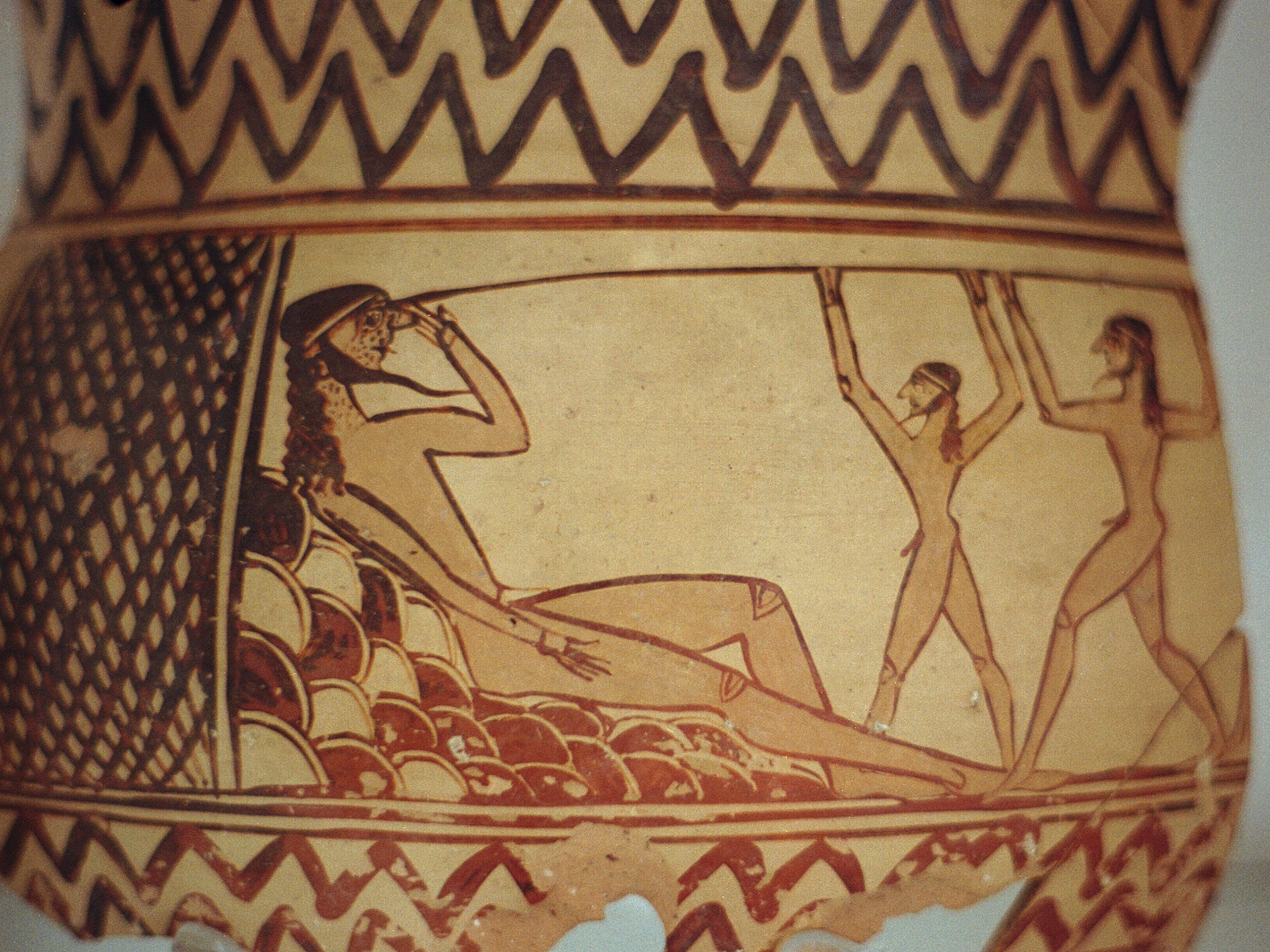
An exceptionally early image adds another dimension to the question. On a fragment of a Proto-Argive krater dated to around 670–650 BC, Polyphemus is shown in profile, with his visible eye in the usual position for a face seen from the side, rather than unmistakably in the middle of his forehead. This does not establish whether the painter imagined him with one eye or two: even a one-eyed figure might have been represented according to the conventions of profile drawing.
The vase dates from a period remarkably close to the formation of the Homeric poems. We cannot establish whether its painter knew the Odyssey, another version of the episode or a narrative tradition shared by both. What we can say is that the blinding of Polyphemus was already being represented in art at this early date.
Cave, flocks and a community without hospitality
Sección titulada «Cave, flocks and a community without hospitality»Homer’s Cyclopes have no assemblies in which they deliberate together and no shared rules governing the community. Each head of a household exercises authority over his wife and children, without concerning himself with the affairs of others (Odyssey 9.105–115). Nor do the Cyclopes have ships or the shipwrights to build them (Odyssey 9.125–130). They live apart and make no collective use of the possibilities offered by their surroundings.
Living together requires thémis
Sección titulada «Living together requires thémis»The Cyclopes are not presented as lacking civilisation simply because their way of life is relatively simple or because Polyphemus is violent. Odysseus stresses that they have no deliberative assemblies and no thémistes: each rules his own household independently, without shared institutions or concern for the affairs of others (Odyssey 9.105–115).
M. I. Finley cautions that thémis does not simply mean ‘law’. Depending on the context, it can refer to a legitimate custom, a proper procedure, an accepted order or the will of a god. Its force lies in establishing what a community recognises as the proper way to act.
Thémis is not a written code of laws. It is closer to the authority of ‘this is how things are done’ and ‘this is not done’. In the world of the Odyssey, civilisation is not merely a matter of having houses or cultivating land; it also involves living with others under shared customs and procedures.
This does not mean that the Cyclopes lack practical skills. Polyphemus raises livestock, milks his animals, makes cheese and manages his flocks competently. The contrast drawn by the poem is not simply between ‘civilisation’ and a total absence of culture. It concerns isolation rather than cooperation, the absence of seafaring and exchange, and the lack of institutions shared between households. In Polyphemus’ case, it also involves a deliberate rejection of the obligations of xenía.
This is not an anthropological description of a historical people, nor does it require us to describe the Cyclopes as ‘primitive’, ‘prehistoric’ or ‘savage’.
The neighbouring island sharpens the contrast. Odysseus describes a harbour, fresh water, goats, fertile soil and land where vines and grain could grow. Yet the Cyclopes make no use of it: they have neither ships nor the shipwrights needed to build them (Odyssey 9.116–141). The resources are there, but not the collective organisation that could turn them into settlement, cultivation and exchange.
Some modern studies compare this passage with the Greek experience of sailing to fertile shores and establishing settlements far from home. From that perspective, the neighbouring island raises a concrete question: besides a good harbour and productive land, what is needed to settle and make use of it? The comparison helps explain the narrative’s attention to resources the Cyclopes leave untouched. It does not mean, however, that the episode conceals a single, unambiguous colonial allegory or that the Cyclopes represent a historical population.
The decisive test is xenía. Odysseus expects protection, food and a guest-gift; he appeals to Zeus as the protector of guests and suppliants (Odyssey 9.252–271). Polyphemus turns these expectations upside down. He traps the strangers in his cave, dismisses the authority of Zeus and devours several of them. Later, in a grotesque parody of hospitality, he promises to eat ‘Nobody’ last as his guest-gift (Odyssey 9.369–370). He is not an atheist in any simple sense — he will later appeal to Poseidon — but he rejects the authority of Zeus invoked by Odysseus and the obligations of xenía.
‘Nobody’: cunning, name and fame
Sección titulada «‘Nobody’: cunning, name and fame»After entering the cave and seeing the cheeses and flocks, Odysseus’ companions advise him to take what they can and return immediately to their ship. He decides instead to wait for the owner, hoping to receive a guest-gift (Odyssey 9.224–230). That expectation is understandable within his aristocratic world, but his decision is also imprudent: he exposes himself and his companions to a danger they might have avoided. None of this diminishes Polyphemus’ responsibility for devouring the strangers.
When the Cyclops asks his name, Odysseus replies Οὖτις (Oûtis, ‘Nobody’). After the blinding, the other Cyclopes understand his cries to mean that nobody is attacking him, and they go away (Odyssey 9.403–414).
The trick depends on Odysseus’ mêtis, his cunning intelligence. There is also a play on words in the Greek: μή τις (mḗ tis, ‘no one’), used by the other Cyclopes, sounds almost identical to μῆτις (mêtis, ‘cunning intelligence’). The connection is phonetic rather than etymological, but Homer makes it meaningful. Odysseus himself rejoices that his false name and his mêtis have deceived them (Odyssey 9.413–414).
Of all the identities Odysseus assumes and the disguises he adopts, ‘Nobody’ is perhaps the most perfect. Elsewhere, he conceals his identity behind invented stories or changes in appearance. Here he does something more ingenious: he turns the absence of a name into a name. Homer’s humour lies in the simplicity of the trick: the most effective disguise is not to become someone else, but to become nobody at all.
His opponent’s name, Πολύφημος (Polýphēmos), combines polý- (‘much’, ‘many’) with a family of words associated with speech, report and fame. It may be understood approximately as ‘much spoken of’ or ‘widely famed’. We need not assume that Homer intended a precise etymological pun within the episode. Nevertheless, the name invites a suggestive contrast: Polyphemus bears a name associated with renown, while Odysseus temporarily conceals his own identity beneath the name Nobody.
The escape beneath the rams is a triumph of intelligence and cooperation over brute strength. But Polyphemus’ words to his leading ram introduce an unexpected touch of humanity: pain, affection and attachment to his animals (Odyssey 9.447–460). They do not make the man-eater innocent; they prevent us from reducing him to a monstrous being devoid of voice or vulnerability.
Once he has escaped, Odysseus reveals his true name, his father and his homeland: Odysseus, son of Laertes, from Ithaca (Odyssey 9.473–505). He reclaims his identity and the glory of his achievement, but also gives Polyphemus the information he needs to appeal to Poseidon. His extraordinary ingenuity coexists with excessive pride: the man who devised the perfect disguise cannot bear to remain ‘Nobody’ once he is safe. His desire for recognition leads him to undo the very deception that saved him.
The price of revealing a name
Sección titulada «The price of revealing a name»Once Polyphemus learns the identity of the man who has blinded him, he recalls a prophecy by Telemus, who had foretold that he would lose his sight at the hands of Odysseus. But Polyphemus had expected a much larger and more formidable opponent, not the man whose cunning has defeated him. He then prays to his father, Poseidon, asking that Odysseus never return home or, if his return is fated, that he arrive late, having lost his companions, aboard another man’s ship, and find trouble awaiting him at home (Odyssey 9.507–535).
The prayer anticipates Odysseus’ eventual homecoming with remarkable precision, although it does not account for every misfortune of the voyage. The poem had already presented Poseidon’s anger as a consequence of the blinding of the mightiest of the Cyclopes (Odyssey 1.68–75).
The revelation of Odysseus’ name therefore comes at a narrative price. Concealing his identity as Nobody has saved him; his pride now drives him to reclaim his name and the glory of his achievement. In doing so, he gives Polyphemus the means to direct his appeal to Poseidon against him. What seemed a complete victory becomes the beginning of a lasting misfortune.
Hesiod’s Cyclopes belong to another tradition
Sección titulada «Hesiod’s Cyclopes belong to another tradition»The Cyclopes of Hesiod’s Theogony are not simply Polyphemus’ neighbours with different biographies. Brontes, Steropes and Arges are sons of Gaia and Ouranos, primordial beings who give Zeus thunder and fashion his thunderbolt (Theogony 139–146; 501–506). Hesiod explicitly states that each has a single eye in the middle of his forehead.
Here too, we should avoid reading later developments back into the early texts. Homer presents Polyphemus as a shepherd; Hesiod associates his Cyclopes with the thunderbolt of Zeus and attributes remarkable craftsmanship to them. Their later depiction as smiths working alongside Hephaestus, sometimes in volcanic settings associated with Mount Etna, belongs to subsequent developments of the myth.
It is more precise to speak of distinct Cyclopean traditions, which later writers sometimes brought together, than to construct a single, continuous mythological ‘race’.
How Polyphemus came to Sicily
Sección titulada «How Polyphemus came to Sicily»Did Polyphemus live in Sicily in Homer? Homer does not say so. Odyssey 9 mentions neither Sicily nor Mount Etna, nor any identifiable coastline. Thucydides records a tradition according to which the Cyclopes and Laestrygonians were among the earliest inhabitants of Sicily, but acknowledges that he cannot say who they were, where they came from or where they went. He leaves the matter to the poets and to what was generally known about them (History of the Peloponnesian War 6.2). His account shows that the association of Cyclopes with Sicily was already established in his time; it does not demonstrate that Homer located Polyphemus’ adventure there.
In his satyr play Cyclops, Euripides places Polyphemus unmistakably in Sicily, near Mount Etna, and introduces Silenus and the satyrs. The Homeric episode thus enters a different theatrical genre. The humour already present in Homer takes on a more openly comic and burlesque character. This is a Classical reinterpretation with an explicit geographical setting, not evidence for a location concealed within the Homeric poem.
Sicily and the Wanderings of Odysseus examines the history of these geographical associations without treating them as a map supplied by Homer himself.
From man-eater to lovesick shepherd
Sección titulada «From man-eater to lovesick shepherd»The tradition did more than give Polyphemus new locations: it transformed the kinds of stories that could be told about him. Cyclops or Galatea, by Philoxenus of Cythera, probably composed after 406 BC and certainly before 388 BC, is an important early witness to the story of the Cyclops in love. The work survives only in fragments, however, and its treatment of the story cannot be reconstructed with certainty.
In Theocritus’ Idyll 11, Polyphemus is a young shepherd in love with the sea-nymph Galatea. He sings of his longing, becoming a figure at once comic and touching. We are not discovering a previously hidden romantic side of Homer’s Polyphemus, but encountering a different literary treatment of the character, shaped by Hellenistic pastoral poetry.
Ovid’s Metamorphoses takes the story in a more violent direction. Galatea loves the young Acis, while Polyphemus pursues her. When the Cyclops discovers them together, his jealousy turns to fury: he hurls a huge rock at Acis and crushes him. Galatea then transforms her dead lover into a river (Metamorphoses 13.738–897). Acis has no place in Homer’s account.
The transformation is revealing. The man-eater of the Odyssey has become a shepherd who sings of love, but his capacity for terrible violence has not disappeared. In Ovid’s Polyphemus, the lovesick singer and the murderous giant coexist.
Polyphemus and the traditional tale
Sección titulada «Polyphemus and the traditional tale»The episode shares a recognisable pattern with tales classified under ATU 1137, ‘The Blinded Ogre’: confinement, a false name, blinding and escape by hiding beneath animals. ATU stands for Aarne–Thompson–Uther, a modern catalogue of traditional tale types. The classification helps identify a narrative pattern found in different traditions; it does not establish that Homer borrowed any particular tale or reveal a single route by which the story was transmitted.
What is Homeric, and what came later
Sección titulada «What is Homeric, and what came later»Hesiod’s primordial Cyclopes belong to a different early mythological tradition, not to a later development of Homer’s Polyphemus. The association of Polyphemus with Sicily and Mount Etna, the volcanic forge and the shepherd in love with Galatea belong to other developments of a tradition that continued to transform the character over the centuries.
Keeping these traditions distinct does not diminish Polyphemus. It allows us to understand more clearly how a figure from the Odyssey could become so many different things.
Sources and method
Sección titulada «Sources and method»See also
Sección titulada «See also»- Sicily and the Wanderings of Odysseus
- Odysseus’ Wanderings
- What Do Greek Vases Tell Us?