How Many Combatants Could Have Taken Part in the Trojan War?
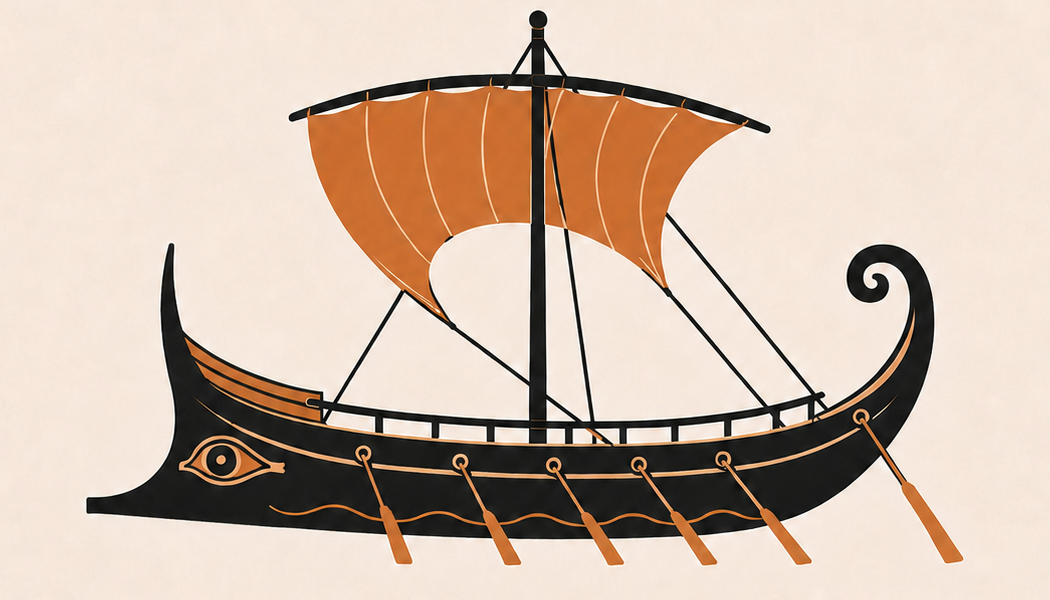
The Iliad allows us to make estimates, but it does not provide a verifiable military return. The poem gives us the so-called Catalogue of Ships — the long enumeration of the Achaean contingents, their leaders and the number of ships supplied by each (Iliad 2.494–759) — together with two explicit crew complements. From there, calculations can be made using different assumptions. That does not turn the result into the verified size of a historical army before Troy.
Three levels should always be kept separate: the epic figure, the estimate derived from that figure, and historical reconstruction. They are not the same thing.
What can be calculated from the Catalogue of Ships?
Sección titulada «What can be calculated from the Catalogue of Ships?»There is no single figure. For the Achaean side, the Catalogue allows us to total the ships and test several results according to the complement assigned to each vessel. For the Trojan side, the poem offers no equivalent basis. The clearest answer is not a final number, but a range of calculations produced from incomplete data.
How many ships did the Achaean coalition take?
Sección titulada «How many ships did the Achaean coalition take?»The Catalogue is usually organised into 29 Achaean contingents. The sum of the transmitted figures for all of them is 1,186 ships.
That is the most solid quantifiable figure in the poem, but a fleet does not automatically translate into a number of combatants.
How many men could each ship carry?
Sección titulada «How many men could each ship carry?»Homer gives only two explicit complements. The Boeotians carry 120 men in each of their 50 ships (Iliad 2.494–510). In Philoctetes’ seven ships, each has 50 oarsmen, all of them archers (Iliad 2.716–728). For the other contingents, no comparable figure is given.
Those two figures are not an official average supplied by the poem. Nor do they describe functions on board in exactly the same way: Philoctetes’ fifty men are oarsmen and archers; the 120 Boeotians are simply those who embark, without further breakdown. We should therefore not impose a single complement on the entire fleet as though it were a Homeric datum.
Can we multiply the number of ships by an average figure?
Sección titulada «Can we multiply the number of ships by an average figure?»We can do so as a calculation, provided that the assumption is made explicit. Applying 50, 85 or 120 men to the 1,186 ships does not uncover a hidden figure in the Iliad: it shows how the result changes when the hypothesis changes.
Thucydides reasoned explicitly from those two extremes. He took 120 as the maximum capacity and 50 as the minimum, but he did not give a total number of men. The average of 85 and the resulting totals are modern calculations based on that reasoning.
Nor should we assume that all Homeric ships were the same size. In the Odyssey, Athena asks Telemachus for a ship with twenty oarsmen (Odyssey 1.280). The passage does not determine the capacity of the ships in the Catalogue, nor does it allow twenty oarsmen to be equated with twenty people on board, but it shows that the Homeric world itself knew vessels of different sizes. The figures in the table are therefore calculation scenarios, not a reconstruction of a uniform fleet.
What can Odysseus’ fleet tell us?
Sección titulada «What can Odysseus’ fleet tell us?»Odysseus’ fleet makes the problem particularly clear. His twelve ships form a relatively modest contingent beside the Catalogue of Ships as a whole: the traditional sum of the Achaean contingents reaches 1,186 vessels. But the number of ships does not tell us how many companions each carried, nor does it justify assuming a uniform complement.
The Odyssey later provides some partial figures. After the fighting with the Cicones, six companions from each ship are killed (Odyssey 9.60–61): seventy-two among the twelve. Polyphemus later devours another six (Odyssey 9.287–293, 311–312 and 344–347). Before the arrival among the Laestrygonians, therefore, we can count seventy-eight dead, although that total is ours: Homer never states it as such. The Laestrygonians then destroy eleven of the twelve ships, but the poem does not say how many men perish with them (Odyssey 10.125–132). Later, when only Odysseus’ ship remains, Scylla seizes and devours another six companions (Odyssey 12.245–259). After Thrinacia, all the remaining companions will also die and only Odysseus will survive (Odyssey 12.403–419), but once again the poem does not allow us to know how many men then made up the crew of the last ship.
The poem thus allows us to identify some specific losses, but not to reconstruct the total number of people who originally made up the expedition. We know the number of ships far better than the number of combatants who travelled in them.
What estimates result from different assumptions?
Sección titulada «What estimates result from different assumptions?»| Scenario | Ships | Assumed per ship | Estimated total |
|---|---|---|---|
| Estimate using minimum complement | 1,186 | 50 | 59,300 |
| Average of the two extremes | 1,186 | 85 | 100,810 |
| Estimate using maximum complement | 1,186 | 120 | 142,320 |
The operation can be checked: ships × men per ship = estimate. The difference between the results is precisely the lesson: the poem permits arithmetic models, not a fixed military figure.
Robert Graves chose a different narrative scale: about a thousand ships with roughly thirty men in each. Multiplying those two figures gives about 30,000 members of the expedition; that is not a figure stated literally by Graves. Nor does he derive those thirty men from the two Homeric complements: it is a modern reconstruction, not a fourth result that the Catalogue compels us to accept.
The multitude and the hero
Sección titulada «The multitude and the hero»The Iliad imagines a war of enormous dimensions, but it does not narrate it as a military report. Homer does not normally tell us that a hundred Trojans advanced against fifty Achaeans, nor does he follow the fighting through units, positions and collective manoeuvres. When battle begins, names start to emerge from the multitude.
M. I. Finley drew attention to this peculiarity: even when tens of thousands of combatants occupy the field, the poet’s gaze returns again and again to Achilles, Hector, Ajax, Diomedes or Aeneas. Men enter and leave the fighting, seek opponents, protect a corpse or try to recover weapons. That apparent disorder should not simply be read as a literal tactical description: it also shows that the true narrative interest lies in individual heroes.
The multitude does not diminish the hero: it allows him to stand out in all his greatness. The army gives the war its scale; the individual gives it meaning. Homer recreates a heroic world that looks back to the Bronze Age, but his interest does not lie in counting that war. From the mass he singles out a man who challenges another, who is afraid, who kills, who loses a friend, who tries to recover a body, or who knows that he may die.
For that reason, the Homeric war cannot be reduced to figures. Numbers help us imagine the scale of the conflict, but the poem is seeking something else: to show how, within a collective war, human experience becomes concentrated in individual destinies. The war belongs to many; the poem makes it visible through a few.
Were all the men transported combatants?
Sección titulada «Were all the men transported combatants?»We cannot quantify that distinction reliably. In Philoctetes’ ships, the oarsmen are also archers; Thucydides assumes that the men both rowed and fought. Modern categories of crew, oarsmen, sailors and infantry cannot be imposed mechanically on every ship in the Catalogue.
For that reason, the table speaks of men embarked or of an expeditionary force according to the assumption being used, not of infantry counted with precision.
Can we also calculate how many fought on the Trojan side?
Sección titulada «Can we also calculate how many fought on the Trojan side?»Not on a comparable basis. The Catalogue of Trojans and allies (Iliad 2.816–877) lists leaders and groups — Trojans, Dardanians, Lycians, Phrygians, Carians, Mysians, Paphlagonians, Paeonians, Thracians and others — but gives no figures for ships, men or an overall total.
Book 8 imagines a thousand watchfires before Ilios and fifty men beside each one (Iliad 8.560–565). Multiplication gives 50,000, but this is a nocturnal image of a camp: it does not identify who is present or amount to a count of the entire army. The fact that we cannot calculate the Trojan side in the same way does not mean that it was small; it means that the poem does not provide the same quantitative basis.
Would an army of that size be plausible?
Sección titulada «Would an army of that size be plausible?»Logistics make us cautious about the higher figures, but they do not point to a single true historical number. Sustaining 30,000 people already requires continuous supplies of grain, water and firewood, as well as space, maritime transport and labour; 50,000 or 100,000 multiply those demands. This is a plausibility check, not a demonstration of what happened.
Archaeology and Late Bronze Age texts do not provide a census of an army belonging to Achilles, Hector or Agamemnon. The Hittite evidence concerning Wilusa in the Tawagalawa Letter (VAT 6692), discussed in The Bronze Past may preserve a historical background relevant to Troy, but it does not turn the epic figures into archaeological data. The size of the army and the traditional duration of ten years are, moreover, separate problems: the epic duration deserves a question of its own if it is developed later.
Are these figures historical?
Sección titulada «Are these figures historical?»Not directly. An arithmetically correct estimate based on Homer remains an estimate derived from the data constructed by the poem, not an archaeological measurement of the historical war that may have inspired it. The conclusion must preserve the three levels: epic figure → derived calculation → historical reconstruction, without confusing them.