The Bronze Past
Two Worlds Separated by Several Centuries
Sección titulada «Two Worlds Separated by Several Centuries»When we speak of the Bronze Age and the Iron Age, we are not yet speaking of mythical ages or of the heroes of the poems. They are archaeological categories used to organise periods in which certain metals played a prominent role in tools, weapons and exchange. They are not exact boundaries: bronze and iron coexisted for a long time, and different regions did not change at the same pace.
Homeric epic took shape in an Iron Age Greece, but it sings of a heroic world whose possible historical background belongs to the end of the Bronze Age. Between the two lie four or five centuries of transformation and transmission.
| Period | Approximate dates |
|---|---|
| Aegean Bronze Age | c. 3000–1050 BC |
| Mycenaean world | from c. 1600 BC |
| Fully documented Mycenaean palatial phase | c. 1400/1350–1200 BC |
| Collapse of the palaces | around 1200 BC |
| Early Iron Age | c. 1100–800 BC |
| Revival during the Geometric period | especially 9th–8th centuries BC |
| Main crystallisation of the Iliad and the Odyssey | late 8th century or, according to other proposals, early 7th century BC |
The Mycenaean World
Sección titulada «The Mycenaean World»Bronze occupied a central place in that system. Producing it required copper and tin, and neither raw material was equally available throughout the Aegean. Copper arrived in large quantities, especially from Cyprus, one of the main producing centres of the eastern Mediterranean. Tin posed an even greater problem: it was far scarcer and could travel enormous distances before reaching the workshops where it was alloyed with copper.
The Uluburun shipwreck gives some idea of the scale of that network. The ship, which sank around 1320 BC off the southern coast of Anatolia, carried approximately ten tonnes of copper and one tonne of tin, as well as other goods. Much of its copper is associated with Cyprus; the precise origin of much of the tin remains debated. Its cargo makes visible the extent to which bronze depended on very long supply networks connecting the Aegean with Cyprus, Anatolia and the eastern Mediterranean.
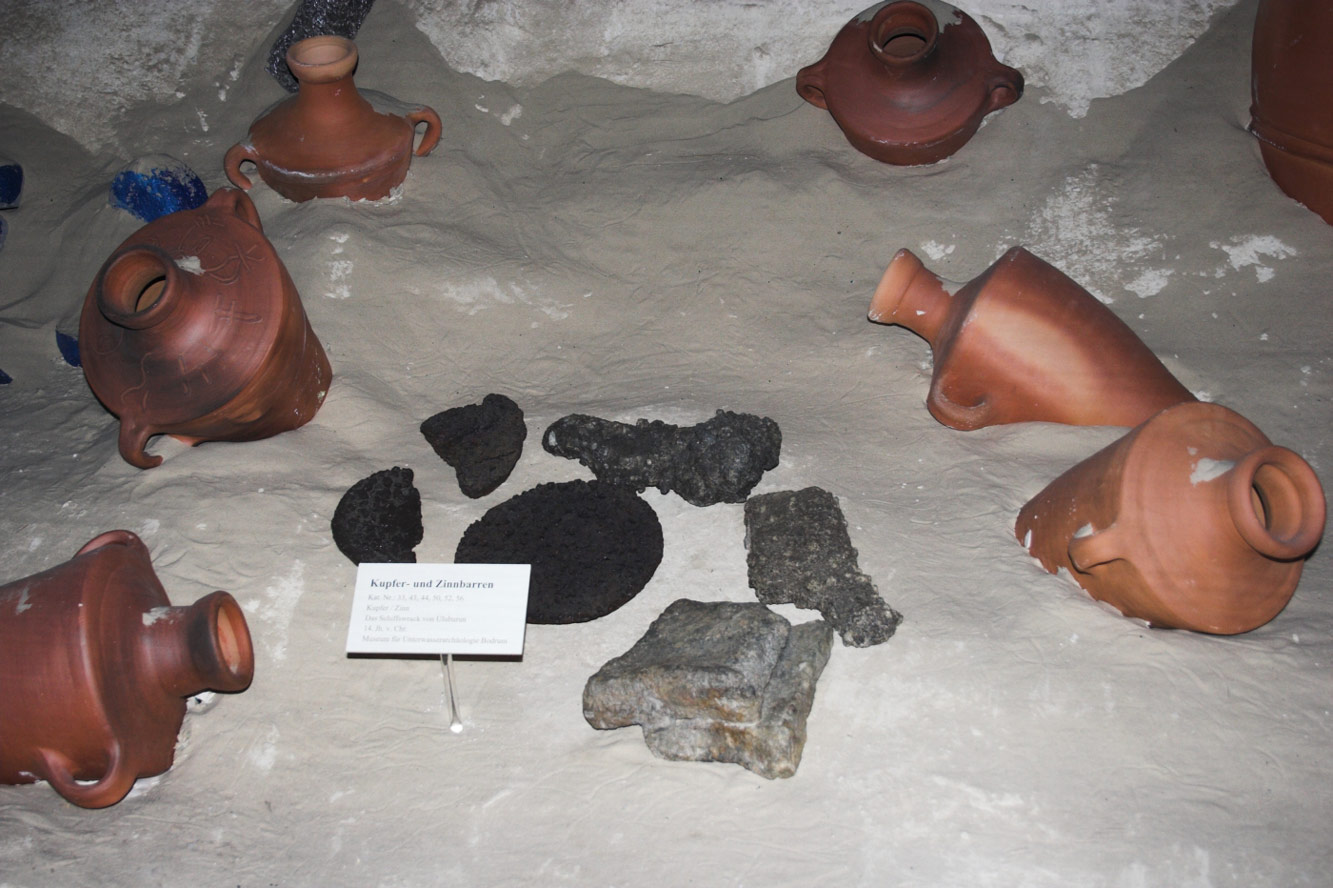
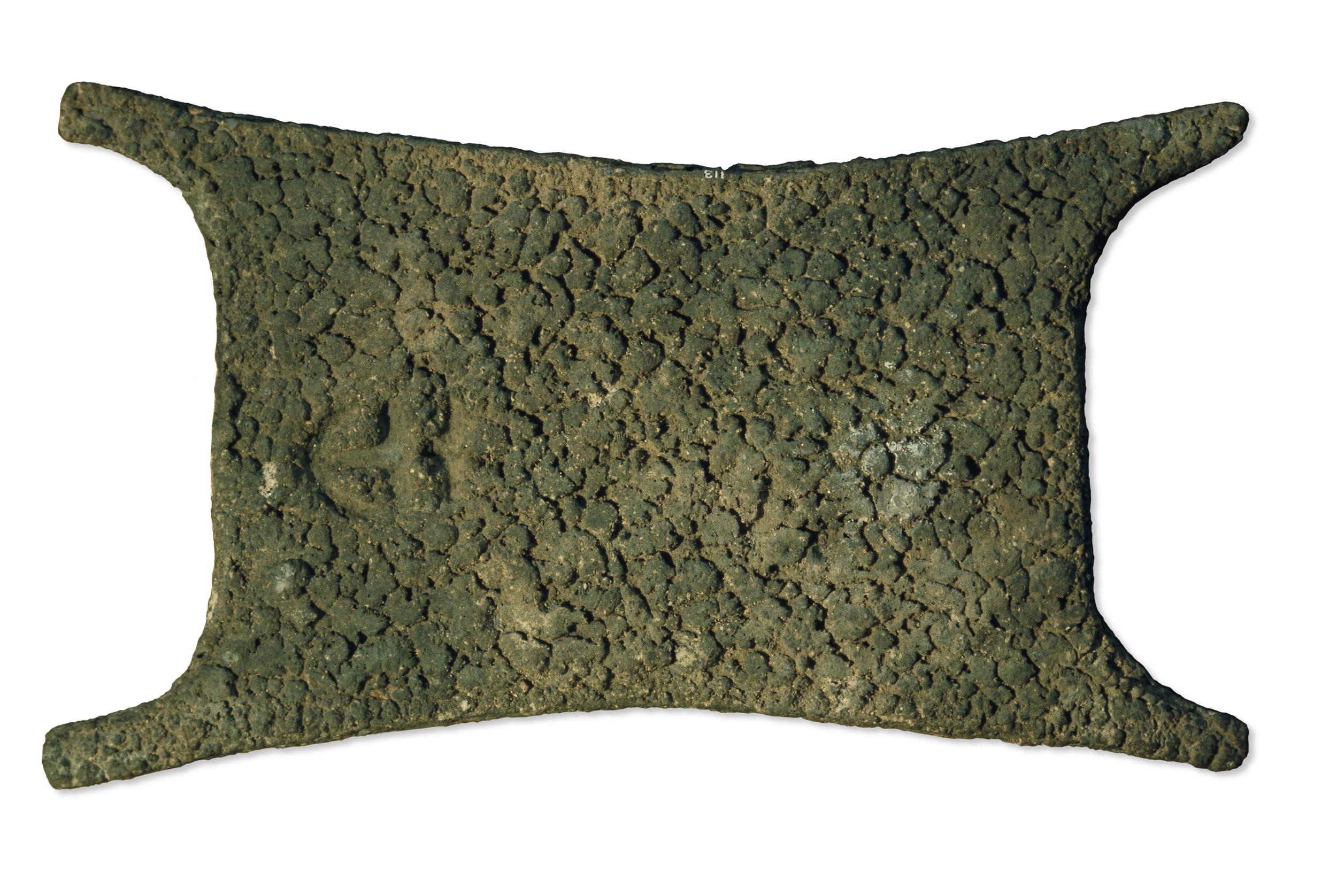
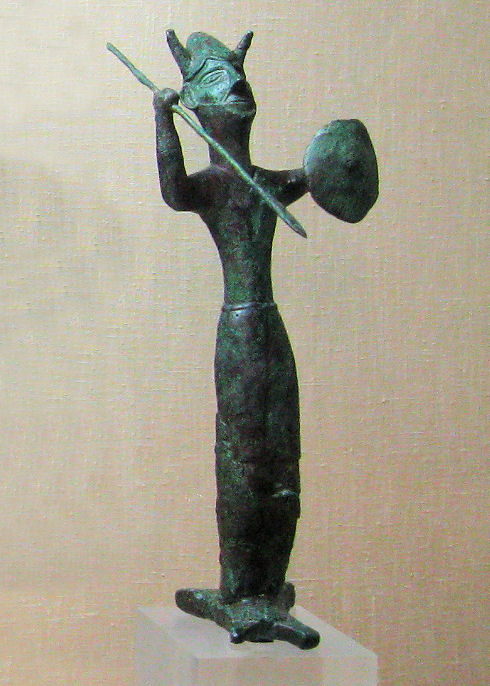
The Pylos tablets show the other side of the process: once the metal had arrived, the palatial administration could account for it and distribute it among numerous craftsmen.
Bronze and Iron in the Tablets
Sección titulada «Bronze and Iron in the Tablets»The Linear B tablets allow us to observe the Mycenaean world from inside its administration. They contain ka-ko, a form related to later χαλκός (khalkós), ‘copper’ or ‘bronze’ depending on context, and ka-ke-we, metalworkers or bronzesmiths. At Pylos, the Jn series records quantities of metal distributed among craftsmen in different localities. The documents therefore show that the palace accounted for and allocated metal; by contrast, we do not know of any secure Linear B word equivalent to later σίδηρος (sídēros), ‘iron’.
Three Pylos Tablets on the Administration of Metal
Tablets: PY Jn 310, PY Jn 829 and PY Jn 410 + 413. In these sigla, PY identifies Pylos, Jn the documentary series, and the number distinguishes each tablet within the series.
- Origin
- Palace of Nestor, Pylos, Messenia. 13th century BC.
- What they are
- Administrative records written in Linear B by palace scribes. They belong to the Jn series, concerned mainly with the control and distribution of metal.
- What they say
- Among other things, they record quantities of metal delivered or allocated to workers and localities.
- Notable forms
ka-ke-we— metalworkers or bronzesmiths.ka-ko— copper or bronze, depending on context.- Why they matter
- They show that the palatial administration controlled and distributed metal among numerous craftsmen.
Limit. By themselves, they do not allow us to know which specific object was made from each quantity of metal.
Philological data: DĀMOS, CC BY-NC-SA 4.0; selection and editorial presentation are our own.
The Collapse around 1200 BC
Sección titulada «The Collapse around 1200 BC»Around 1200 BC many palatial centres were destroyed, abandoned or lost their former functions. With them disappeared the administration known to us from the tablets and the Linear B script. Exchange networks did not vanish completely, but they contracted and changed scale unevenly from region to region.
Iron did not cause that collapse: it began to spread afterwards, gradually. But the disappearance of the palaces altered the conditions that had made it possible to obtain and distribute copper and tin on a large scale. In that new world, iron could acquire increasing importance.
The Early Iron Age
Sección titulada «The Early Iron Age»The expression ‘Dark Age’ was once commonly used for the centuries following the palatial collapse. Today, ‘Early Iron Age’ is generally preferred. The name does not imply an absence of culture; it refers to the loss of administrative documentation and to the contrast with the preceding world. Nor was the period uniform.
Iron gradually became more widespread in weapons and tools.
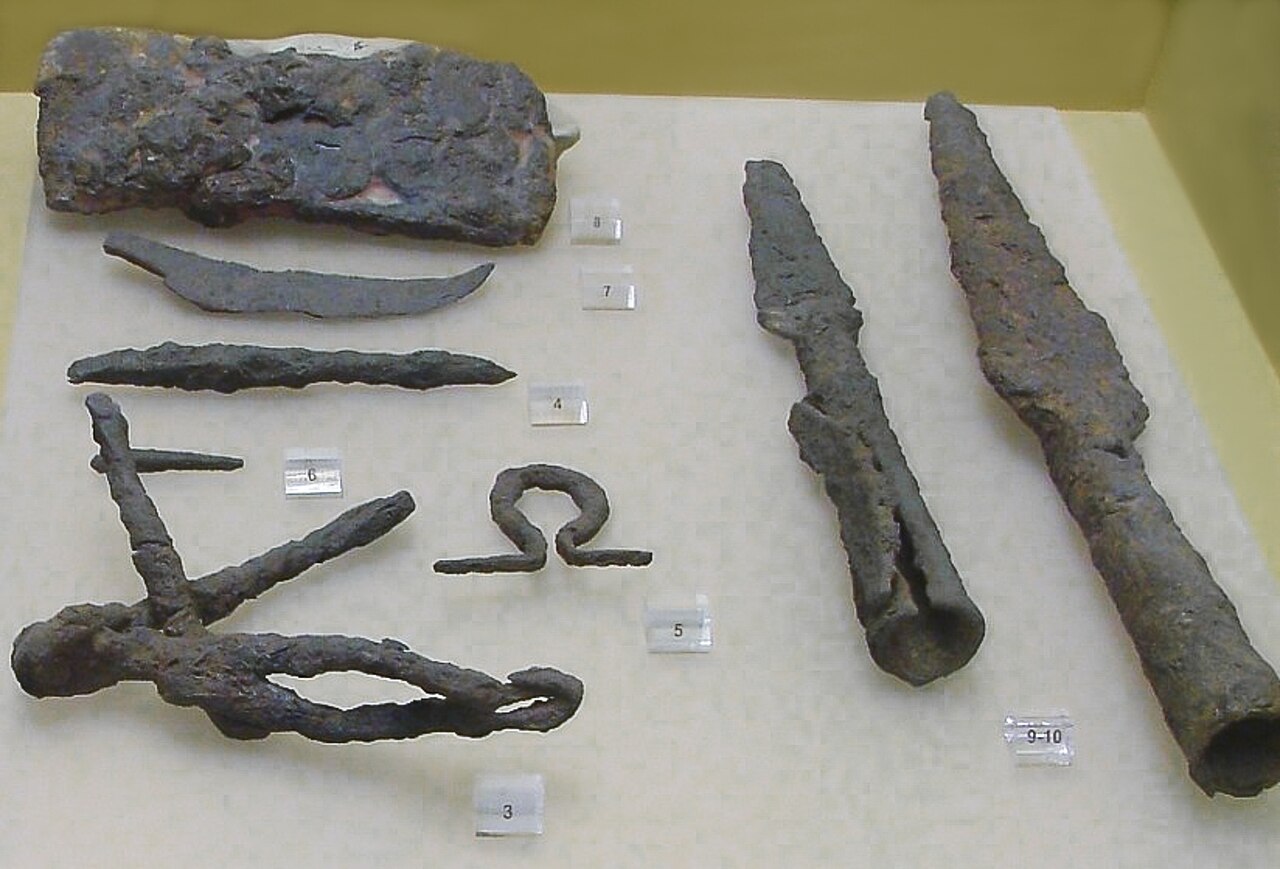
Unlike the tin needed to make bronze, iron ores were much more widely distributed: exploitable deposits existed in Euboea, Macedonia, Thrace and other parts of the Aegean. This allowed more local or regional supplies and reduced dependence on the long-distance commercial networks required for bronze production. We do not, however, know of a single dominant source, nor can we securely identify the mine from which most of the earliest iron objects came.
The simple opposition is misleading. The Bronze Age was not a period in which everything was made of bronze, nor the Iron Age one in which bronze disappeared. In some contexts, iron was increasingly used for work and cutting edges; bronze retained ornamental and visible value.
The Trojan War
Sección titulada «The Trojan War»There is no date that we can simply call ‘the historical date of the Trojan War’. We do not even know whether behind the Homeric tradition there was a single war resembling the one narrated in the Iliad. Even so, there are several reasons for placing its possible historical background towards the end of the Bronze Age.
The Greeks themselves traditionally dated the Trojan War to the end of the 13th or the beginning of the 12th century BC, although those dates were later reconstructions, not contemporary testimony. The archaeology of Troy documents destructions at the end of the Bronze Age, but none of them by itself proves the war narrated by Homer.
Hittite archives of the 14th and 13th centuries BC mention Wilusa, a territory that scholarship probably connects with Ilios/Troy, and Ahhiyawa, widely associated with the Mycenaean world. The treaty between Muwatalli II and Alaksandu of Wilusa confirms the existence of that polity in Hittite diplomacy; the Tawagalawa Letter refers to an earlier dispute over Wilusa that had already been settled, although we do not know its nature or scale. These documents show relations and conflicts in western Anatolia without thereby identifying a historical Trojan War.
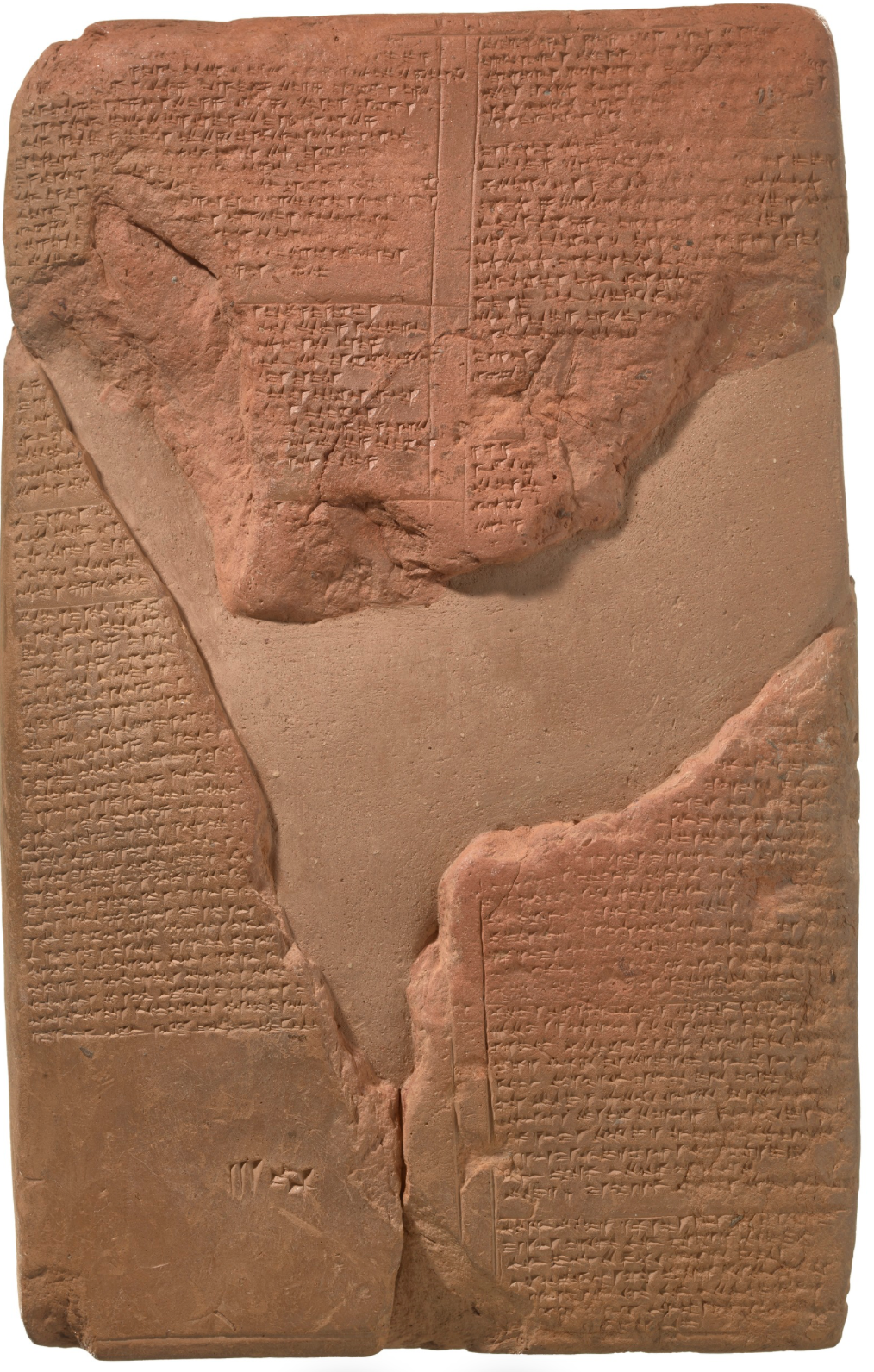
None of this proves the war of the Iliad, but it places elements connected with the Trojan tradition within the final horizon of the Bronze Age.
The Past through the Eyes of the Present
Sección titulada «The Past through the Eyes of the Present»If the tradition of the Trojan War preserves any historical background, it belongs to the final horizon of the Mycenaean palatial world, around the end of the 13th or the beginning of the 12th century BC. Between that possible past and the formation of the Iliad and the Odyssey lie four or five centuries.
During that time, it was not only the stories Greeks told about Troy that changed. The material world in which those stories were told changed as well: exchange networks were transformed, bronze no longer occupied the same place in the economy, and iron acquired an increasing presence in weapons, tools and everyday objects.
Homer does not transmit an intact memory of the Bronze Age, nor simply a portrait of his own present. Epic preserves and transforms a heroic past from within a society already living in a different material world. Homer looks at the past through the eyes of the present.
The Linear B tablets of the Mycenaean period mention Poseidon, Zeus and Hera. But they are administrative documents, not stories or epics. Between the fall of the palaces and the Homeric poems, stories must have been transmitted mainly orally. That transmission could preserve ancient names, scenes and formulas, but also reorganise them and give them new meaning.
Between the late 9th and the 8th century BC, the Greeks adapted an alphabet of Semitic origin, closely related to Phoenician, and introduced signs to represent vowels. By the 8th century, Greek alphabetic inscriptions already appear, some everyday and others poetic.
The Iliad, the Odyssey and the poems of Hesiod took shape between the late 8th and early 7th centuries BC, according to the various proposed datings. Orality and writing then began to interact, although we do not know exactly when or how the Homeric poems were fixed in writing.
The Strength of Heroes
Sección titulada «The Strength of Heroes»Epic makes the distance between the age of heroes and the present visible by measuring their strength against that of men ‘now’.
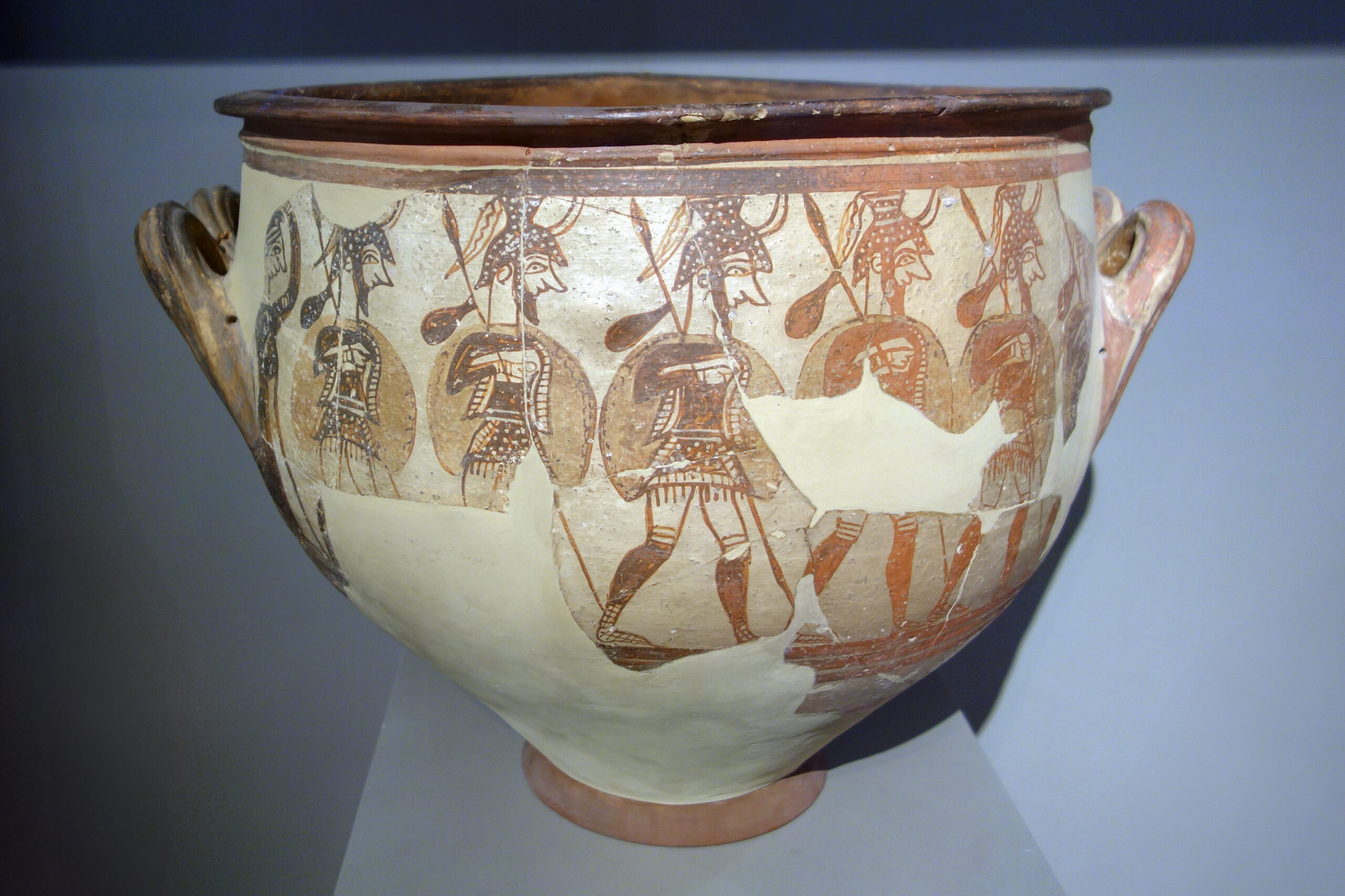
In the Iliad, Book 5, lines 302–304, Diomedes lifts a stone that two men ‘of today’ could not carry and wields it alone with ease. The poem does not merely say that Diomedes is strong: it measures his strength against that of present-day mortals.
The device returns at decisive moments in battle. Ajax hurls from the wall a stone that a man of today could not easily hold even with both hands (Iliad, Book 12, lines 378–383). Hector handles the stone at the gates that two of the best men of the present could not easily lift; the poem adds that Zeus lightens its weight (Iliad, Book 12, lines 445–450). Aeneas takes up another that two present-day mortals could not carry and wields it alone against Achilles (Iliad, Book 20, lines 285–287).
That superiority appears on both sides: Diomedes and Ajax are Achaeans; Hector and Aeneas are Trojans. It does not necessarily mean that the heroes were taller: what the poem explicitly compares is their strength, their ability to perform actions that ‘mortals now’ can no longer equal.
These comparisons do not allow us to date the verses or identify precisely who those men of the present were. But their effect is unmistakable: the Trojan War belongs to a physical scale different from the time from which it is being told. The poem presents the warriors of old as physically superior.
A Heroic Past within the Heroic Past
Sección titulada «A Heroic Past within the Heroic Past»In the Odyssey, Book 8, lines 221–225, Odysseus himself claims to surpass the mortals who live now as an archer, but refuses to compare himself with earlier heroes such as Heracles and Eurytus. The passage does not set Odysseus against the poet’s contemporaries; it introduces a distance within heroic time itself: even the men of Troy can recognise a greatness older than their own.
Nestor uses the same distance for his own purposes in the Iliad. When he asks Achilles and Agamemnon to accept his advice, he recalls Pirithous, Dryas, Caeneus, Exadius, the Lapith Polyphemus and Theseus: the strongest men he had known, victors over the Centaurs (Iliad, Book 1, lines 247–272). He does not evoke a lost age out of nostalgia. He reminds them that those heroes listened to his words; Achilles and Agamemnon should do the same.
Epic therefore does not draw a simple line between a perfect past and a degraded present. It creates several depths of time: the heroes of Troy are superior to men ‘now’, but some of them in turn acknowledge figures older still.
The story of Ereuthalion and Areithous adds a material nuance. Areithous had been a famous warrior who fought with an iron club. After his death, his armour passed to Ereuthalion, who wore it when he challenged the men of Pylos. Nestor recalls how, while still young, he accepted the challenge and killed him (Iliad, Book 7, lines 124–160). Iron can therefore also belong to an ancient heroic memory: it is not an automatic sign of modernity or decline.
Opulence in the Past
Sección titulada «Opulence in the Past»Heroic distance is not expressed only through strength. The world of the heroes is also loaded with visible wealth. Homer rarely leaves value as an abstract word: he makes it concrete in metals, livestock, tripods, cauldrons, textiles, weapons, horses and people reduced to slavery.
When Agamemnon tries to reconcile with Achilles, he offers splendid gifts as compensation: gold, tripods, cauldrons, horses, women, cities and even a daughter in marriage (Iliad, Book 9, lines 120–158). The funeral games for Patroclus again display comparable wealth through prizes of great value (Iliad, Book 23). And in the Odyssey, the palaces of Menelaus and Alcinous gleam with gold, silver, bronze, ivory, textiles and an abundance of service and feasting (Odyssey, Book 4, lines 71–75; Book 7, lines 81–132).
These passages do not prove that Iron Age Greece was poor, nor that Homeric palaces reproduce the magnificence of Mycenaean palaces. The palace of Alcinous, for example, clearly belongs partly to the marvellous. What they do show is that epic is lavish with luxury and wealth when it recalls that mythical past.
The extraordinary strength of the heroes is accompanied by a world of extraordinary objects. Epic imagines the past not only as a time of stronger men, but as a time in which wealth is displayed, exchanged and risked on an exceptional scale.
Bronze, Iron and a Composite Tradition
Sección titulada «Bronze, Iron and a Composite Tradition»In the Odyssey, Book 1, lines 182–184, Athena, in the guise of Mentes, says that she is sailing to Temese in search of copper and is carrying shining iron to trade. The passage reflects a world in which iron can be a useful, transportable and valuable commodity.
Iron also appears within heroic memory. Areithous fights with an iron club, and Achilles offers a great mass of iron as a prize in the funeral games for Patroclus (Iliad, Book 23, lines 826–835). It can be weapon, wealth, raw material and prize.
Bronze, however, dominates the language of heroic warfare far more visibly: spears, swords, armour and flashes of light repeatedly belong to that metal.
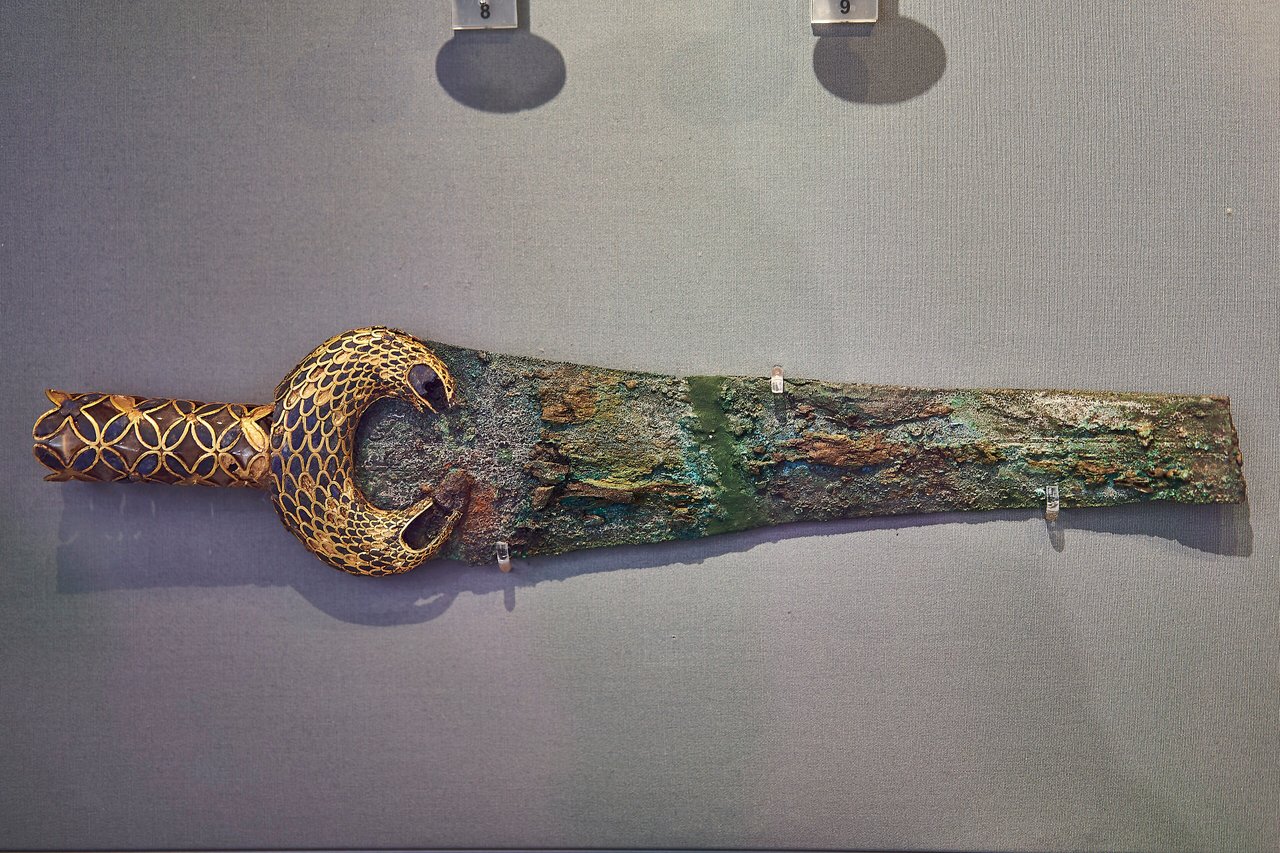
We cannot divide the poems into two simple worlds — bronze for the past, iron for the present — or turn the metals into a moral scale. Iron does not automatically represent decline, nor bronze nobility.
Some of the language of bronze may belong to formulas transmitted by tradition and to the setting through which epic represents heroic warfare. For an Iron Age audience, that same bronze could also create an effect of antiquity, brilliance and prestige.
Not every occurrence of χαλκός (khalkós, ‘copper’ or ‘bronze’ depending on context) need perform the same function, but traditional vocabulary could continue to evoke a time different from the present.
The mixture of iron, bronze and practices from different periods is not a defect of reconstruction. It is the result of a tradition transmitted over centuries, preserving some older elements, transforming others and incorporating later features. The Homeric world belongs wholly to neither the Bronze Age nor the Iron Age: it is a composite past, constructed from materials of different periods.
Quantifying Bronze and Iron in the Iliad and the Odyssey
Sección titulada «Quantifying Bronze and Iron in the Iliad and the Odyssey»A study by Natale Musso, published in the Journal of Classics Teaching by Cambridge University Press, counted references to bronze and iron in the Iliad and the Odyssey. The analysis also took the Greek text into account and grouped under bronze or iron some terms that English translations had rendered as copper, brass or steel. The results show a very marked difference between the two poems.
| Iliad | Odyssey | |
|---|---|---|
| Bronze — all occurrences | 323 | 81 |
| Iron — all occurrences | 22 | 25 |
| Bronze / iron ratio | 14.7 : 1 | 3.2 : 1 |
| Bronze, excluding references connected with weapons | 55 | 24 |
| Iron, excluding references connected with weapons | 18 | 23 |
The first difference is striking. In the Iliad, bronze appears almost fifteen times for every occurrence of iron; in the Odyssey, a little over three. Iron, by contrast, occurs with very similar frequency in the two poems: 22 appearances against 25. The study itself notes that, once references connected with weaponry are excluded, iron shows no statistically significant difference between the two poems.
The enormous disparity in bronze first needs a simple explanation. The Iliad narrates a war, and the war of its heroes is fought mainly with bronze weapons. Spears, blades, helmets, cuirasses, shields and greaves necessarily multiply references to the metal. The Odyssey, set in the same heroic universe, devotes much more space to journeys, households, feasts, human relationships and everyday work.
That is precisely why it is useful to repeat the calculation after excluding occurrences connected with weapons. The gap narrows greatly: from 323 mentions of bronze in the Iliad against 81 in the Odyssey to 55 against 24. But it does not disappear. In Musso’s classification, bronze still appears more frequently in the Iliad; by contrast, the difference in iron between the two poems is too small to be statistically significant.
This allows us to refine what we had already observed. The Iliad clothes the Trojan War in bronze. Much of its extraordinary density of bronze vocabulary comes from combat, but not all of it. Bronze continues to appear with especially high frequency even after references to weaponry are removed.
Iron, meanwhile, is fully integrated into both poems. It can appear as wealth, tool, useful material, prize or metaphor. As early as the beginning of the 20th century, Andrew Lang had observed a significant distribution: when Homer specifies the metal of swords and spears, they are bronze, while iron is especially associated with tools, goods and other uses.
The result does not turn the Iliad into a photograph of the Bronze Age or the Odyssey into an Iron Age poem. It shows something more precise: the traditional language of heroic warfare is closely associated with bronze, while iron also belongs, with other functions, to the material world of both poems.
The Hesiodic Parallel
Sección titulada «The Hesiodic Parallel»Hesiod helps us measure the limit of this interpretation. In Works and Days, lines 109–201, he orders the generations of gold, silver, bronze, heroes and iron. The fighters at Thebes and Troy do not belong to the race of bronze: they form the generation of heroes. Hesiod explicitly places his own generation in the age of iron, an age of labour, suffering and the deterioration of human bonds.
The two columns do not establish chronological equivalences. The first describes historical periods; the second, a mythical succession.
| Archaeology and history | Hesiod, Works and Days |
|---|---|
| The Aegean Bronze Age extends approximately from c. 3000 to 1050 BC. | Hesiod imagines a mythical succession: gold, silver, bronze, heroes and iron. |
| The Mycenaean world belongs to the Bronze Age; its palatial phase is documented above all between c. 1400/1350 and 1200 BC. | The race of bronze is a warlike and terrible generation; Hesiod says that it did not yet know ‘black iron’. |
| The possible historical background of the Trojan tradition, if there was one, would lie around the end of the 13th or beginning of the 12th century BC. | The fighters at Thebes and Troy belong to the generation of heroes, distinct from the race of bronze and ‘more just and better’ than it. |
| The Early Iron Age extends approximately from 1100 to 800 BC; Homer and Hesiod compose around the late 8th or early 7th century. | Hesiod places his own present in the race of iron. |
That poem shows that in Archaic Greece it was possible to use the past to judge the present. It does not show that Homer does exactly the same. The Iliad and the Odyssey do not construct a succession of ages or declare contemporary men morally inferior. They do establish a distance between the age of heroes and the present from which their deeds are told, but they do not turn that distance into an explicit theory of decline.
Let us return to Diomedes’ stone. Homer does not give us the Bronze Age as it really was. He shows us how an Iron Age society could imagine a world several centuries in the past. The bronze past is not a photograph of the Bronze Age. It is the way epic turned a remote and vanished world into one that was stronger, more opulent and worthy of memory.
Sources and Method
Sección titulada «Sources and Method»See Also
Sección titulada «See Also»What Did Homer Know About the World He Described? I: Objects and Techniques
What Did Homer Know About the World He Described? II: Houses and Everyday Life