Homer and the Dead
The Iliad and the Odyssey are among the earliest surviving works of Greek literature. Yet the beliefs and mythological stories on which Homeric poetry drew were older, handed down orally over generations. The Mycenaean tablets, written several centuries earlier, consist mainly of administrative records, including references to deities and religious offerings, but they contain no narratives that would tell us how those Greeks imagined the fate of the dead. Archaeological evidence from burials provides further clues, although it cannot establish with certainty what they believed about the afterlife.
We therefore do not know which elements of Homer's portrayal of Hades came from older beliefs, which were reshaped by tradition, and which belonged to the poet's own cultural world. The poems are not necessarily the source of those beliefs; rather, they are among the earliest literary sources through which we can learn about them.
The Life That Is Lost and What Remains
Sección titulada «The Life That Is Lost and What Remains»When Odysseus meets Achilles among the dead, he tries to console him. He reminds Achilles that the Achaeans honoured him like a god while he lived and that he now holds a position of great authority among the dead. But Achilles rejects this comfort: he would rather work as a hired labourer for a poor man than rule over all the dead (Odyssey 11.483–491).
The reply is surprising from the hero of the Iliad, who had considered dying young in return for undying glory (Iliad 9.410–416). Is he contradicting himself? Perhaps it is more revealing to consider the perspective from which each Achilles speaks. The Achilles of the Iliad contemplates death from the standpoint of life, with its desires, expectations, and uncertainties; the Achilles of the Odyssey looks back on life from the standpoint of death. The first understands the cost of glory but still has a choice. The second knows what he has lost and can never regain it.
Achilles Confronts Death
Sección titulada «Achilles Confronts Death»In Book 9 of the Iliad, Achilles explains that his mother, Thetis, has foretold two fates. If he remains at Troy, he will never return home, but he will achieve undying glory. If he goes home, he will lose that glory but may enjoy a long life (Iliad 9.410–416).
This choice does not mean that he holds life in contempt. Only a few lines earlier, he declares that no treasure can make up for a life lost: possessions can be recovered, but life, once it has escaped, does not return (Iliad 9.401–409). Achilles understands what is at stake and still considers the possibility of going home.
Patroclus' death transforms the dilemma. Grief for his companion, self-reproach for having failed to protect him, and the desire to avenge him outweigh the prospect of a long life. Thetis warns Achilles that his own death will follow soon after Hector's. Achilles accepts that fate and decides to return to battle to avenge Patroclus. He later kills Hector (Iliad 18.95–126; 22.326–366).
His decision is no longer driven solely by the wish to win undying glory, although Achilles still hopes to gain it. He knows that his revenge will hasten his death, and yet he is willing to carry it out.
What Remains of a Person
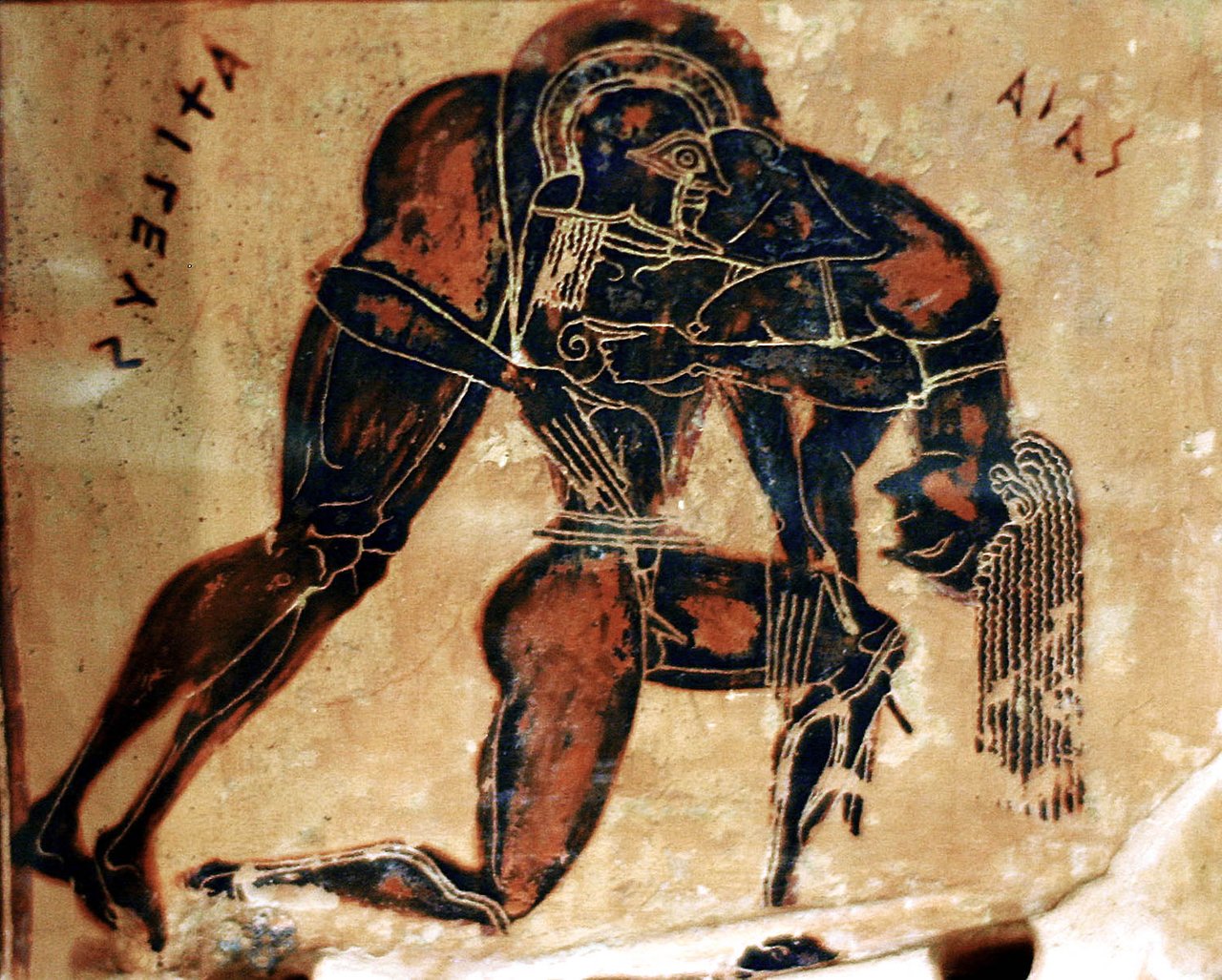
Sección titulada «What Remains of a Person»When Patroclus dies, his psychḗ departs for Hades, lamenting the youth and vigour he has lost (Iliad 16.855–857). Later he appears to Achilles in a dream, retaining his appearance, his voice, and his clothing. He asks Achilles to perform his funeral rites: as he explains, the other shades prevent him from crossing the river and joining them while he remains unburied. He also wishes their bones to rest together after Achilles' death. He recalls how he came to Peleus' household as a child and became Achilles' companion. Achilles tries to embrace him, but the shade vanishes like smoke (Iliad 23.62–107).
Achilles thus discovers that something remains in Hades: a psychḗ, an eídōlon, a likeness of the dead. His exclamation about the absence of phrénes does not necessarily mean that Patroclus is entirely without thought: he has just spoken, remembered, and made his requests quite clearly. What astonishes Achilles is that something so like his companion no longer has the substance needed to receive an embrace (Iliad 23.99–107).
In Book 11 of the Odyssey, Odysseus has a similar experience when he meets his mother, Anticleia. Three times he tries to take her in his arms, and three times he fails. She explains that after death the sinews no longer hold flesh and bones together, while the psychḗ flits about like a dream (Odyssey 11.204–224). Her son recognizes her, hears her voice, and can speak with her, but he can no longer embrace her.
Both encounters express the same reality: death does not mean that someone who has lived disappears entirely. Something recognizable remains, although the person has lost bodily life. In Homer, psychḗ can refer to the life that departs at death and also to the shade of the deceased. Poetic images link these two senses without turning them into a doctrine of a soul separate from the body. We should not simply identify the Homeric psychḗ with the immortal soul conceived by some later philosophical traditions.
The dead also retain their ties to the living. Patroclus asks for his funeral rites, and Elpenor asks Odysseus to burn his body, raise a mound by the sea, and plant upon it the oar he used in life, so that future generations will know of him (Odyssey 11.51–83; 12.8–15). Yet the poems do not always make burial a necessary condition for reaching Hades: Elpenor is already a shade before his funeral. Those still alive continue to have obligations towards those who have died. Burial and remembrance preserve that bond, although nothing can restore the dead to life.
Memories That Do Not Die
Sección titulada «Memories That Do Not Die»Odysseus' consultation of the dead raises another question: what do the shades remember, and what can they know? The ritual of the pit, the libations, and the blood plays an important role in his encounters, although its effects do not appear to be the same in every case. Tiresias retains exceptional understanding by Persephone's favour and recognizes Odysseus before drinking the blood, whereas Anticleia recognizes her son immediately after tasting it (Odyssey 10.490–495; 11.90–99, 152–154). The precise significance of the blood is not entirely clear. In some encounters it seems to facilitate recognition and communication, but other dead people, such as Elpenor, can speak without having drunk it.
What is beyond doubt is that some shades retain memories, feelings, and personal bonds. When Agamemnon drinks the blood and recognizes Odysseus, he bursts into tears and stretches out his arms towards him, although he no longer has the strength to reach him. He recounts how Aegisthus and Clytemnestra murdered him on his return from Troy. Death has erased neither that suffering nor his memory of what happened. He also asks about Orestes, for he does not know what has become of his son (Odyssey 11.385–466). He remembers the past but does not necessarily know what is happening among the living.
Anticleia offers another possible indication of this limitation. She describes the situation in Ithaca as she knew it, perhaps as it was when she died, even though she speaks of it in the present tense. We cannot infer from this scene a rule that applies to every shade, but it does suggest that the dead do not automatically receive news of everything happening among the living (Odyssey 11.174–203).
Ajax, for his part, still resents the award of Achilles' armour to Odysseus. When Odysseus tries to speak to him, Ajax refuses to answer and walks away in silence (Odyssey 11.541–567). Not even death has reconciled the former comrades. His silence also leaves Odysseus' account of the judgement unanswered: we hear the winner's words, not those of the man who felt wronged.
Events that take place after death can, however, still reach the departed. Achilles asks about his son Neoptolemus and his aged father Peleus, whose authority he fears may have weakened. Odysseus knows nothing of Peleus, but tells him how Neoptolemus fought at Troy. Hearing this, Achilles walks away rejoicing through the asphodel meadow (Odyssey 11.492–540). The hero who had rejected Odysseus' consolation for his condition among the dead can still take joy in his son's achievements.
At the beginning of Book 24, other souls arrive in Hades: those of the suitors killed in Ithaca. Amphimedon tells Agamemnon of Odysseus' return and the slaughter in the palace. Agamemnon then praises Penelope's fidelity, so different from Clytemnestra's conduct (Odyssey 24.1–202). News and judgements concerning the world of the living continue to circulate among the dead.
The shades appear to be untouched by ageing. Patroclus appears to Achilles with the appearance, voice, and clothing he had in life (Iliad 23.65–67). In the Odyssey we encounter young men, maidens, and old people who retain the identities by which they are remembered. The dead can learn of new events, but nothing indicates that they continue to age as the living do.
Whether they perceive the passage of time between one piece of news and another is another matter. Homer shows that events in the world of the living can still affect them, but he does not explain how they experience that continuity. Time continues to reach the dead, although it does not seem to change them as it changes the living.
The Weight of the Dead
Sección titulada «The Weight of the Dead»A modern comparison can help us imagine the size of that multitude. According to estimates of the total number of human births, there were nearly fourteen people who had died for every person alive in 2022. If we apply a hypothetical model of prehistoric population and birth rates to Homer's time, the resulting ratio would be far higher: hundreds of people who had died for every person then alive. These are not figures the Greeks knew, nor are they precise historical estimates; they depend on highly uncertain assumptions. The illustrative calculation is explained under “Sources and Method”.
They could not calculate how many dead had come before them, but they could feel the weight of vanished generations. They had been fathers, mothers, companions, ancestors, and kings. Their tombs were still there, and some of their names and stories continued to be told. The Homeric poems themselves show this admirably: Achilles, Hector, and Odysseus belong to a distant heroic past for those who heard their stories, yet remain present in song and memory.
We should, however, distinguish two ways of enduring. A person may live on in the memory of the living; in the poems, moreover, the dead may continue to exist as shades. The demographic comparison is not intended to count the shades Homer imagined in Hades or to explain the origin of that belief. Its purpose is to help readers picture the disproportion between the number of people alive and the number who have lived.
A Realm Apart from the World of the Living
Sección titulada «A Realm Apart from the World of the Living»Hades and Persephone rule over the world of the dead. They are the sovereigns of a realm that the living cannot ordinarily enter. Only an exceptional journey and ritual enable Odysseus to communicate with the shades.
Hermes, too, plays a part in the world of the dead. At the beginning of Book 24 of the Odyssey, he gathers the shades of the suitors killed by Odysseus and leads them to the asphodel meadow, where they meet other departed souls. On their way they pass the river Ocean, the White Rock, the Gates of the Sun, and the Land of Dreams (Odyssey 24.1–14).
The geography itself reinforces this separation. In Book 11 of the Odyssey, Odysseus sails to the outer reaches of Ocean and arrives in the land of the Cimmerians, shrouded in darkness beyond the reach of sunlight. There he performs the sacrifice that draws the shades from Erebus. Circe had spoken of Acheron, Cocytus, Pyriphlegethon, and the waters of Styx (Odyssey 10.508–540; 11.12–50). The Iliad offers a different image, placing Hades beneath the earth. When Poseidon shakes the world, Hades himself fears that the ground will split open and expose his dwelling to the sight of gods and mortals (Iliad 20.61–65). The association with concealment also appears in the helmet of Hades, which Athena puts on to remain unseen by Ares (Iliad 5.844–845). The poems offer different images of this realm and its approaches without establishing an entirely fixed geography.
The boundary between the two worlds is not merely geographical. When Odysseus' companions slaughter the cattle of Helios, the god threatens to descend to Hades and shine among the dead unless he receives redress. Zeus tells him to continue illuminating gods and mortals and undertakes to punish the offenders himself (Odyssey 12.374–388).
The threat is formidable: if Helios carried it out, he would bring to the realm of the dead the light that ordinarily shines upon the living. Homer does not describe the consequences of such a reversal; Zeus prevents it from happening. Yet the scene conveys how much the distribution of light matters in that universe. The dead have their realm and the living theirs. The boundary is not completely impermeable—Patroclus appears to Achilles and Odysseus speaks with the shades—but these are two worlds that cannot be crossed freely.
A Multitude, Not a Tribunal
Sección titulada «A Multitude, Not a Tribunal»When Odysseus performs the sacrifice to consult Tiresias, the dead come from Erebus. At first the poet does not present them as famous heroes but as a multitude of people of different ages and circumstances. Odysseus describes them to the Phaeacians as follows:
After invoking the multitudes of the dead with vows and prayers, I took the sheep and slaughtered them over the pit. Dark blood began to flow, and then the souls of the departed came from the gloom of Erebus: young wives, unmarried youths, old men who had endured many hardships, tender maidens whose hearts had only lately been wounded by grief, and many men struck down by bronze-tipped spears, warriors fallen in battle with their armour still stained with blood.
They came from every direction in great numbers and swirled around the pit with an overwhelming clamour. A fear that made me turn pale seized me.
The passage brings together people whose lives had barely begun and others who had endured a long existence. They gather not because they share merits or guilt, but because they have died. The common fate of the dead is not presented as a reward for the virtuous or a punishment reserved for the wicked.
The world of the dead is not, however, entirely uniform. Persephone has granted Tiresias an exceptional power of understanding (Odyssey 10.492–495); Minos is shown dispensing justice among the dead (Odyssey 11.568–571); Tityos, Tantalus, and Sisyphus undergo extraordinary torments (Odyssey 11.576–600). But the poem does not describe a general moral judgement determining the destiny of every soul.
Menelaus offers a different case. Proteus, an ancient sea deity endowed with prophetic knowledge, tells Menelaus that the gods will take him to the Elysian Plain, where he will enjoy a privileged existence (Odyssey 4.561–569). This is not a reward following a moral assessment, but a privilege connected to Zeus through Menelaus' wife, Helen. The prophecy says that Menelaus will not die in Argos; instead, the gods will take him to that place. Nor does this destiny describe the ordinary fate of the dead.
It would therefore be misleading to arrange Hades, Tartarus, the asphodel meadow, and the Elysian Plain into a system of rewards and punishments comparable to heaven, purgatory, and hell. In the Iliad, Tartarus appears as an abyss far below Hades into which Zeus threatens to cast disobedient gods (Iliad 8.13–16). The poems mention places and destinies of different kinds without organizing them into a single, coherent doctrine of the afterlife.
In Homer, Hades is not a place to which people are sent because they lived badly: it is the realm of the dead. One does not reach Hades because of what one has done in life, but because one has died.
What Achilles Knows
Sección titulada «What Achilles Knows»Let us return to Achilles. In the Iliad, he understands that death is irreversible, but he can still choose between the fates offered to him. After losing Patroclus, he accepts that his revenge will hasten his own end. In the Odyssey, now a shade, he remembers what it meant to be alive and knows that neither glory nor rank can restore that condition to him.
The other dead complete this picture: Patroclus appears to Achilles, but Achilles can no longer embrace him; Anticleia recognizes Odysseus and speaks with him, but her son cannot hold her in his arms; Agamemnon remembers his death, asks about Orestes, and praises Penelope's fidelity; Ajax still harbours his resentment. Enough memories and feelings persist among the dead for them to recognize what has been lost.
Perhaps this is the bitterest insight of these poems: death does not necessarily erase those who have lived, but it deprives them of life. It is not a philosophical doctrine formulated by Homer, but an interpretation of the words and gestures he attributes to the dead.