Agamemnon
The Iliad begins with the anger of Achilles, but it is Agamemnon’s actions that provoke it. King of Mycenae and leader of the Achaean expedition against Troy, he commands the largest contingent and bears the sceptre that symbolises his authority. Yet from the very beginning of the poem, Homer shows him making a decision that brings suffering upon the entire army. Agamemnon leads other kings and great warriors, but his authority does not place his decisions beyond question, nor does it make him immune to error.
The king who commanded other kings
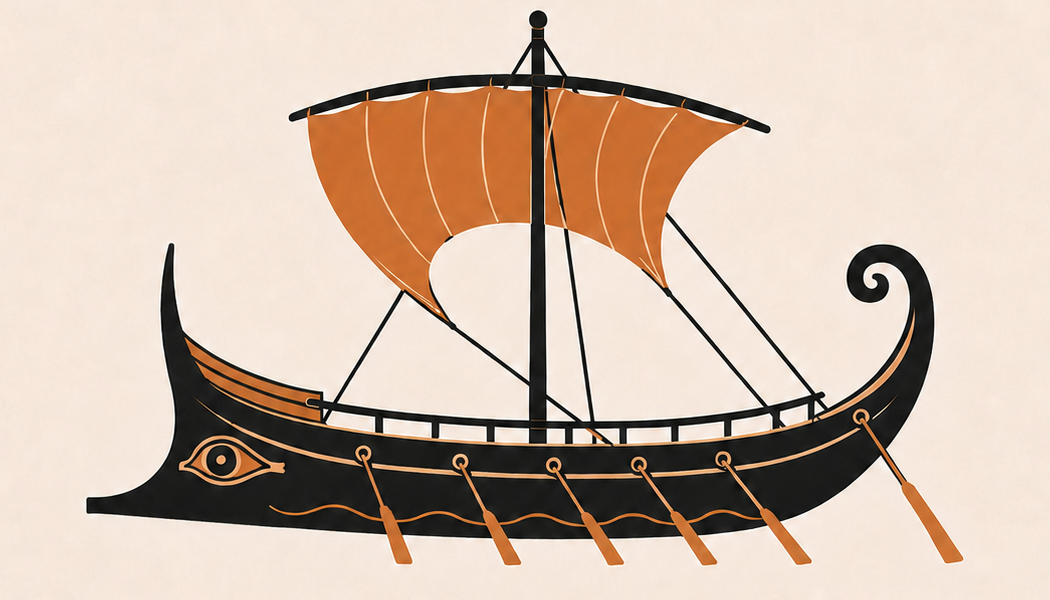
Sección titulada «The king who commanded other kings»Homer does not explain how Agamemnon came to lead the expedition against Troy. The Iliad presents him already at the head of a coalition of kings and military leaders, each retaining command of his own forces. In the Catalogue of Ships, Agamemnon commands a hundred ships from Mycenae and other communities, and the poet stresses that he leads by far the largest and finest contingent. His brother Menelaus commands a separate contingent of sixty ships from Lacedaemon. This numerical superiority helps to explain Agamemnon’s pre-eminence, although Homer does not explicitly say how he came to command the entire expedition (Iliad 2.569–590).
The sceptre he carries also gives his authority a dynastic and divine dimension. When Agamemnon rises to address the assembly, the poet traces the succession of the sceptre fashioned by Hephaestus: from Zeus it passed to Hermes; from Hermes to Pelops; from Pelops to Atreus; from Atreus to Thyestes, and from Thyestes to Agamemnon. The sceptre thus represents an inherited authority linked to the gods (Iliad 2.100–109).
But this authority does not mean that Agamemnon can always impose his will. When Nestor tries to reconcile him with Achilles, he urges the king not to take away the prize the Achaeans had awarded the warrior. He also urges Achilles not to challenge a king whose standing is greater because he rules over more men, even though Achilles is the stronger warrior. Nestor thus acknowledges Agamemnon’s authority while also pointing out the limits he ought to respect. Agamemnon’s difficulty lies in holding together an expedition whose leaders are not mere subordinates (Iliad 1.254–284).
The decision that brings the plague
Sección titulada «The decision that brings the plague»The first crisis of the Iliad begins with an offer of ransom. Chryses, a priest of Apollo, comes to the Achaean ships to recover his daughter Chryseis, who is Agamemnon’s captive. The Achaeans favour honouring the priest and accepting the ransom, but Agamemnon refuses, threatens Chryses and sends him away. He declares that the young woman will grow old in his house in Argos, far from her homeland, working at the loom and sharing his bed (Iliad 1.8–32).
Chryses then calls upon Apollo to make the Achaeans pay for his tears, and the god responds by sending a plague through their camp. When Achilles calls an assembly to discover its cause, the seer Calchas fears speaking openly and asks Achilles to protect him from Agamemnon. The king reacts angrily to his explanation and even declares that he prefers Chryseis to his wife Clytemnestra. He eventually agrees to return the young woman, but demands another prize to replace her. His initial refusal has brought suffering upon the army; now the attempt to end the plague sets off another conflict (Iliad 1.33–120).
Briseis and the division of spoils
Sección titulada «Briseis and the division of spoils»Agamemnon must return Chryseis, but he refuses to be left without a prize. He argues with Achilles, who reminds him that the spoils have already been divided among the Achaeans and cannot simply be taken back and redistributed to compensate him. Achilles proposes waiting until Troy is taken, when Agamemnon can receive an even greater reward. Agamemnon refuses and threatens to seize another leader’s prize. He singles out Briseis, the captive awarded to Achilles. When his heralds come to take her away, Homer notes that she goes with them unwillingly. In the world of the Iliad, such prizes are visible signs of a warrior’s public honour. By taking Briseis, Agamemnon does more than deprive Achilles of his prize: he humiliates him before the other leaders (Iliad 1.118–187; 1.318–348).
Achilles, for his part, is hardly a model of restraint. He insults Agamemnon, begins to draw his sword before Athena intervenes and eventually withdraws from the fighting, with terrible consequences for his comrades. He even asks his mother Thetis to appeal to Zeus on his behalf, so that the Trojans may gain the upper hand and the Achaeans will understand how much they need him. Yet his anger and desire for revenge do not invalidate his complaint: Agamemnon has deliberately overturned an agreed distribution of prizes on which relations among the allies depend. His authority over the other leaders does not entitle him to disregard the arrangements that hold the expedition together (Iliad 1.188–244; 1.348–412).
A fallible commander, a formidable warrior
Sección titulada «A fallible commander, a formidable warrior»The crisis does not end with Achilles’ withdrawal. In Book 2, Zeus, who has promised Thetis that he will favour the Trojans to restore her son’s honour, sends Agamemnon a deceptive dream announcing that the capture of Troy is at hand. The king believes victory is near and decides to test his troops’ resolve by urging them to return home. He has already instructed the other leaders to prevent the soldiers from leaving, but the test gets out of hand: the Achaeans rush towards the ships, and Odysseus has to intervene to stop them. Agamemnon has been deceived by Zeus, but the decision to put his men to that test is his own (Iliad 1.493–530; 2.1–83 and 2.109–210).
Nor does he always judge the effect of his words. During an inspection of the ranks, he reproaches Menestheus and Odysseus for holding back, although their troops are waiting for other Achaean contingents to advance. Odysseus protests, and Agamemnon immediately withdraws his criticism. He then finds Diomedes standing beside his horses and chariot and compares him unfavourably with his father Tydeus, recalling his exploits in battle. Diomedes remains silent out of respect for the king, but his companion Sthenelus protests, insisting that they have surpassed their fathers. Diomedes silences him in turn, arguing that Agamemnon is entitled to urge his men into battle (Iliad 4.327–421).
When the fortunes of war turn against the Achaeans, Agamemnon more than once proposes retreat. In Book 9, Diomedes opposes his suggestion that they return to Greece. In Book 14, with the Trojans fighting at the ships, Agamemnon proposes putting the vessels nearest the water afloat, with a view to launching the rest that night if the fighting subsides. Odysseus sharply rebukes him: launching the ships in the middle of battle could undermine the army’s resolve and hasten defeat. Agamemnon’s inclination to retreat contrasts with the determination of his companions, who insist on continuing the fight (Iliad 9.9–51; 14.65–105).
Yet it would be unfair to portray Agamemnon as a commander who only gives orders from behind the lines. In Book 11, Homer devotes a long sequence to his fighting: he kills numerous Trojans, drives the enemy back and continues to fight even after he is wounded, withdrawing only when the pain becomes unbearable. He is a formidable warrior in his own right, not merely the leader of other warriors (Iliad 11.15–283).
Making amends
Sección titulada «Making amends»When Achilles’ absence threatens the army’s survival, Agamemnon admits that he has acted wrongly and offers him lavish compensation: precious objects, horses, captive women, the return of Briseis and even the hand of one of his daughters in marriage. Yet he ends his offer by insisting that Achilles must yield to him because he is the greater king and the older man. Agamemnon is willing to make amends for the offence, but still believes that his superior position entitles him to demand deference (Iliad 9.115–161).
In Book 19, when reconciliation becomes possible, Agamemnon returns to the subject of his conduct. This time he declares that he was not to blame: Zeus, Fate and the Erinys, he says, placed atē — the blindness of judgement that led him to seize Achilles’ prize — in his mind. He acknowledges that he himself took the prize, but attributes the error that led him to do so to divine intervention. He remains willing to compensate Achilles, although he now places the ultimate responsibility for his actions upon the gods (Iliad 19.78–144).
So far we have followed the Agamemnon of the Iliad: a powerful and courageous commander, sometimes capable of reconsidering his decisions, but also capable of harming his allies when he confuses his rank with the right to impose his will. In other traditions, the conflicts between authority, duty and responsibility extend into his own family.
Iphigenia: a story the Iliad does not tell
Sección titulada «Iphigenia: a story the Iliad does not tell»The Iliad does not narrate the sacrifice of Iphigenia. In Book 9, Agamemnon offers Achilles the hand of one of his three daughters and names them: Chrysothemis, Laodice and Iphianassa. The poem makes no mention of an attempt to sacrifice a daughter at Aulis, and we cannot simply assume that Homer’s Iphianassa is the Iphigenia of other traditions (Iliad 9.141–147).
In the Cypria, a lost poem of the Trojan Epic Cycle known to us in part through an ancient summary transmitted under the name of Proclus, Agamemnon incurs Artemis’ anger by killing a deer and boasting that he is a better hunter than the goddess herself. She prevents the fleet from sailing by sending stormy weather, and Calchas declares that Iphigenia must be sacrificed to appease her. The girl is summoned on the pretext that she is to marry Achilles, but at the last moment Artemis saves her, substitutes a hind in her place and takes her to the land of the Taurians, where she makes her immortal (Cypria, summary attributed to Proclus).
Aeschylus presents the episode differently in his Agamemnon. The chorus recalls the adverse winds that prevent the fleet from sailing and the king’s dilemma: to sacrifice his daughter or abandon the expedition. In the end, Agamemnon accepts the sacrifice and orders Iphigenia to be silenced so that she cannot cry out a curse upon his house. The chorus describes the girl’s pleading looks, but stops short of narrating the final moment. The king’s decision thus becomes part of the violence that will bring tragedy upon his family (Agamemnon 184–249).
In Iphigenia at Aulis, Euripides explores Agamemnon’s hesitation in greater depth. Having agreed to sacrifice his daughter, the king summons her to the camp with the promise of marriage to Achilles, who knows nothing of the deception. He soon regrets his decision and tries to prevent her arrival by sending a second letter, but Menelaus intercepts the messenger. Later, Menelaus himself changes his mind and withdraws his demand for the sacrifice. Agamemnon, however, fears that the army will force him to carry it out once the men learn of Calchas’ prophecy. Euripides thus presents a father who tries to reverse his decision but comes to regard himself as powerless to prevent its consequences (Iphigenia at Aulis 80–163; 303–439; 473–537).
The different versions of the sacrifice and Iphigenia’s fate, including the tradition that Artemis saved her, are examined in greater detail on our page devoted to Iphigenia.
The testimony of Clytemnestra
Sección titulada «The testimony of Clytemnestra»The ancient sources offer different explanations for Clytemnestra’s conduct. In the Odyssey, Nestor relates that Aegisthus sought to win her over during Agamemnon’s absence. At first she rejected his advances, being a woman of sound judgement. Agamemnon had left a bard to watch over his wife, but Aegisthus took him to a deserted island and abandoned him there. Eventually, Clytemnestra went willingly with Aegisthus to his house. Nestor’s account places Aegisthus’ pursuit of Clytemnestra and the subsequent murder of Agamemnon at the centre of the story, without mentioning Iphigenia’s sacrifice as a motive for her conduct (Odyssey 3.250–312).
In Aeschylus’ Agamemnon, we hear another explanation, voiced by Clytemnestra herself. When the chorus condemns her for killing her husband, she reproaches its members for having remained silent when Agamemnon sacrificed their daughter. She defends his murder as an act of vengeance for Iphigenia’s death. Aeschylus thus sets two accusations against one another: the chorus condemns the killing of Agamemnon, while Clytemnestra claims to have avenged her daughter (Agamemnon 1412–1425; 1521–1529).
Aegisthus also offers his own justification. At the end of the tragedy, he recalls how Atreus, Agamemnon’s father, served his brother Thyestes, Aegisthus’ father, a banquet made from the flesh of Thyestes’ own children. When Thyestes discovered what had happened, he cursed the descendants of Atreus. Aegisthus sees Agamemnon’s murder as revenge for that atrocity and claims responsibility for planning it. The same tragedy therefore presents two different motives for vengeance: Clytemnestra invokes Iphigenia’s death; Aegisthus, the crimes committed against his father and brothers (Agamemnon 1577–1611).
Euripides takes Clytemnestra’s accusation further. In Iphigenia at Aulis, she reminds Agamemnon that before marrying him she had been the wife of Tantalus and the mother of an infant child. According to her account, Agamemnon killed her husband, tore the child from her breast and dashed it to the ground, then forced her to marry him. Clytemnestra declares that despite this beginning she had been a faithful wife. Now she reproaches him for intending to sacrifice Iphigenia so that his brother Menelaus can recover Helen. Euripides gives Clytemnestra a history of suffering at Agamemnon’s hands that does not appear in Homer’s account (Iphigenia at Aulis 1146–1208).
These accounts do not allow us to reduce Agamemnon’s death to a single cause. In Aeschylus, Clytemnestra and Aegisthus invoke different wrongs to justify it; in Euripides, Clytemnestra’s accusation includes earlier acts of violence within her own family. Each account adds a perspective to a story in which acts of vengeance follow one another from generation to generation.
The victor who died on his return
Sección titulada «The victor who died on his return»Agamemnon leads the expedition that ultimately conquers Troy, but he does not live to enjoy his homecoming. In Book 11 of the Odyssey, Odysseus encounters his shade among the dead. Agamemnon explains that he was neither killed in a storm sent by Poseidon nor slain by an enemy in battle: Aegisthus, with Clytemnestra’s help, murdered him after inviting him to a banquet. He recalls the floor covered in blood and the bodies of his companions, slaughtered alongside him. He also remembers Cassandra’s cries as Clytemnestra killed her beside him, and his wife’s final cruelty: she would not even close his eyes or mouth as he lay dying (Odyssey 11.385–434).
In Aeschylus’ Agamemnon, by contrast, we witness the king’s return and hear his cries as he is murdered inside the palace. Clytemnestra then appears beside the bodies of Agamemnon and Cassandra and openly admits to killing them both. The accounts differ in who strikes the fatal blow: in Homer, Agamemnon names Aegisthus as his killer, with Clytemnestra’s help; in Aeschylus, Clytemnestra herself claims responsibility. We need not choose one version to correct the other: in Homer we hear the dead king; in Aeschylus, the woman who killed him (Agamemnon 1343–1447).
The family tragedy extends still further in a tradition recorded by Pausanias, a Greek writer and geographer of the second century AD. In his Description of Greece, while describing the tombs at Mycenae, he mentions a grave shared by Teledamus and Pelops, twin sons attributed to Agamemnon and Cassandra. According to this tradition, Aegisthus killed them while they were still infants, after murdering their parents. Pausanias thus preserves a version in which the slaughter also claims the children of the Trojan princess. Homer makes no mention of these children (Description of Greece 2.16.6–7).
Agamemnon’s distrust
Sección titulada «Agamemnon’s distrust»Death does not soften Agamemnon’s bitterness. Speaking to Odysseus among the dead, he declares that by murdering him Clytemnestra has brought dishonour even upon women who have done no wrong. He advises Odysseus not to tell his wife everything he knows, but to reveal some things and keep others hidden. His experience with Clytemnestra has left him distrustful of women in general (Odyssey 11.427–443).
Yet Agamemnon himself acknowledges that Penelope is wise and prudent, and assures Odysseus that he will not die at his wife’s hands. He remembers leaving her a young bride, with the infant Telemachus at her breast, and imagines the joy of father and son greeting one another when Odysseus returns. He, by contrast, was killed before he could even see his own son, Orestes. Despite his praise for Penelope, Agamemnon advises Odysseus to bring his ship to Ithaca in secret, without announcing his arrival, because, he insists, women can no longer be trusted (Odyssey 11.441–456).
A song for Penelope
Sección titulada «A song for Penelope»In the final book of the Odyssey, the souls of the dead suitors arrive in Hades. Among them is Amphimedon, who tells Agamemnon how Odysseus returned to Ithaca and killed them. Among the episodes he recalls is the story of the shroud for Laertes, which Penelope wove by day and unravelled by night to delay choosing a new husband (Odyssey 24.121–190).
When Amphimedon finishes his account, Agamemnon’s thoughts turn to Penelope. He praises the woman whose ingenuity and loyalty have preserved her marriage (Odyssey 24.192–198):
“The fame of her virtue will never perish; the immortals will compose a beautiful song in praise of wise Penelope for people on earth.”