Before the Page, the Voice
Orality, writing and the fixing of Homeric poetry.
The voice before the text
Sección titulada «The voice before the text»Writing is so familiar to us that it is difficult to imagine a literature that does not depend on the written page. Yet speaking comes before writing, and hearing a story comes before reading it. A language can exist, change, name the world, transmit memories and organise a community without having a writing system to represent it. Writing does not create the voice: it comes later and gives it a lasting form.
Writing did not create language or poetry. It arrived in a world that already spoke, remembered, sang and transmitted stories.
Greek history also forces us to abandon an overly simple sequence. In the Bronze Age, the Mycenaean palaces already used writing; that system disappeared with the palatial world The Bronze Past; centuries later, the Greeks adopted the alphabet. Between the disappearance of one writing system and the adoption of another, generations continued to speak, sing, remember and transmit. The question is not whether culture began with the appearance of writing, but what changes when something that had previously had to be remembered — a quantity, an obligation, a rule or a poem — can be fixed outside human memory.
Before writing, we speak
Sección titulada «Before writing, we speak»The Gospel of John, written in Greek, begins with one of the most famous phrases in our tradition: “In the beginning was the Logos.” It does not speak about the historical origin of language, but it preserves an ancient intuition that our written culture tends to forget: the word was not born on a page.
Language and writing are not the same thing. Writing gives graphic form to a language that already exists. The simplest comparison can be seen in any child: a child learns to understand and speak long before learning to recognise letters. This does not mean that childhood development reproduces the history of humanity; it merely reminds us of a basic distinction that written culture tends to conceal. We can speak without writing, and we can preserve extraordinarily complex verbal structures without first turning them into text.
Milman Parry and Albert Lord observed this directly in the Balkans during the twentieth century. Singers who could neither read nor write were capable of performing epic poems thousands of lines long, comparable in scale to the great Homeric poems. They did not necessarily memorise a fixed text word for word: they worked with formulae, traditional scenes, rhythms and narrative structures that allowed them to recreate the poem as they performed it. Oral memory does not function like a page stored inside the head: it preserves a system capable of producing the story again.
We cannot write a language without relying on a system of sounds and meanings that precedes writing. Nor should we assume that literature must first have been written down in order to attain great length or complexity.
Writing comes after language: it does not create it; it represents it.
Writing requires us, in some way, to analyse the flow of speech and turn it into a recognisable sequence of signs. Speaking and writing are different operations; the second is built upon the first.
Before the reader comes the listener
Sección titulada «Before the reader comes the listener»The same is true of literature. A story does not need to be written down in order to exist, survive or acquire a recognisable form. For a long time it can live in memory and performance: someone learns it, sings or recites it; another person hears it and, in turn, makes it their own.
Rosalind Thomas reminds us that even in Classical Greece, when alphabetic writing had been in use for centuries, a large part of cultural life was still organised around voice and listening. The presence of texts did not eliminate orality.
Before the reader comes the listener; before the page, the voice.
It is useful, following Thomas, to distinguish between oral communication, oral composition and oral transmission. A poem can be composed in performance, transmitted from memory and later circulate in writing as well. These are not stages that must exclude one another. The same culture can sing, listen, read and copy.
Homeric poetry preserves traces of that world. Formulae, epithets and recurring scenes are not mere ornaments. They form part of a technique that facilitates composition, oral performance and listening. Milman Parry showed how thoroughly epic diction was organised for a poet working with inherited units and combining them during performance. Tradition does not remain identical in order to survive; it remains recognisable while it changes. For the technique of the singers, see Bards and Rhapsodes: How Was Homeric Poetry Made?.
The Bronze Age also knew writing
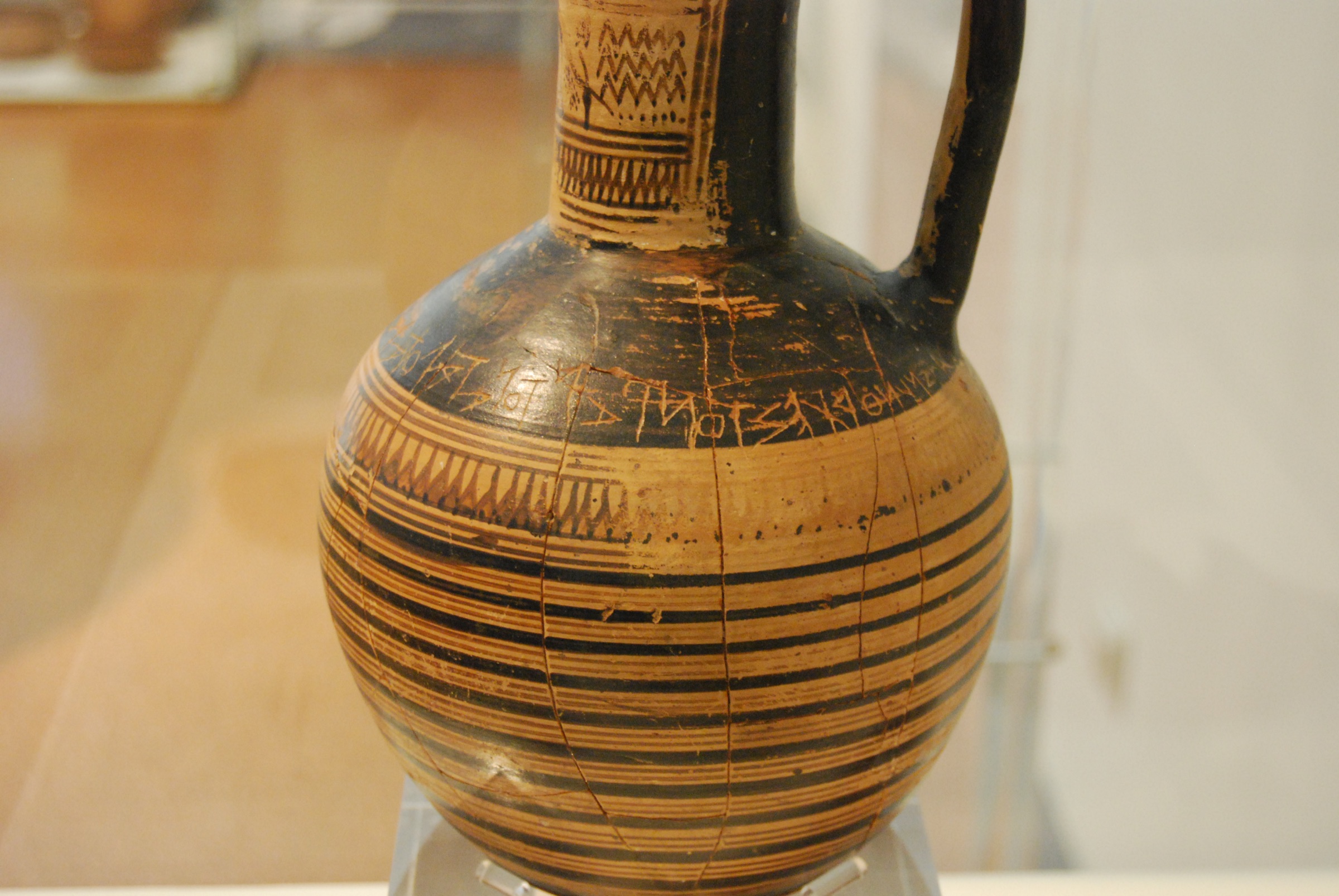
Sección titulada «The Bronze Age also knew writing»Here a decisive paradox appears. Long before the Iliad and the Odyssey reached the form in which we know them, Greek was already being written in the Mycenaean palaces. Linear B tablets from Knossos, Pylos, Thebes and Mycenae record an early form of the language and show that the palaces used writing for administrative purposes. Writing was used to count, allocate and keep track of people, goods, places and obligations. It was not only a way of remembering: it made it possible to organise a complex reality into manageable categories.
The comparison with a computer should be handled with caution. The tablets were not machines or digital files: they were objects made of clay and belonged to a system very different from our own. Even so, in a limited sense they performed a comparable function: they turned a dispersed reality — people, flocks, products, deliveries — into information that the palace could classify, compare and manage.
But the use of writing does not mean that this was a literate society in the modern sense. The surviving documentation is closely tied to the palatial environment and to specific functions. The 2024 edition of The New Documents in Mycenaean Greek continues and updates the major project begun by Ventris and Chadwick while preserving an essential caution: the use of writing that we can document was concentrated among a small number of people and primarily served administrative needs; we have no evidence of widespread literacy.
Administrative writing can exist without preserved written literature, and literature can exist without originally depending on writing.
Nor did that system appear from nowhere. Meißner and Steele stress that Linear B seems to adapt an earlier Minoan writing tradition, related to Linear A, in order to write Greek. Linear A, by contrast, can be partially transcribed because many of its signs are known, but the language it represents is still not satisfactorily understood and its texts cannot be translated with confidence. Inheriting a system of signs does not mean inheriting the language that system once represented, nor does it allow us automatically to project all the known values of Linear B backwards onto Linear A. Graphic continuity and linguistic continuity are different problems.
Writing for administration
Sección titulada «Writing for administration»The Mycenaean tablets do not attempt to record everything. They record what the palace needs to control: people, flocks, land, products, textiles, metals, weapons, chariots, deliveries, offerings and obligations. John Chadwick made the point with a simple comparison: a small administrative unit can be governed without complex records; as the territory and production under its control increase, the need for accounting becomes much greater.
What is written also tells us what the palace needed to remember.
Writing makes it possible to move some information out of individual memory and record it on a medium that can be consulted. An official can compare, add up, check deliveries, track responsibilities or keep an accounting record beyond a particular exchange. Externalising memory is not only a matter of preservation: it also makes administration possible.
The archive that has survived, however, is not a photograph of the whole society. The tablets were preserved largely by accident, through the destruction of the palaces, and the documents we possess correspond to particular moments in administrative cycles that were presumably much broader. Nor can we rule out the existence of texts written on perishable materials. Absence from the documentary record, therefore, does not automatically imply historical non-existence.
This caution is especially important with Linear A. Its surviving corpus is much smaller than that of Linear B. A sign or word absent from the corpus we have today may once have existed and simply failed to survive. The available archive is an accidental and partial selection, shaped both by what the administration chose to record and by what happened to be preserved.
When a writing system is lost
Sección titulada «When a writing system is lost»At the end of the Bronze Age, the palatial system that had produced those archives disappeared. With it disappeared the known use of Linear B. We should not imagine a switch that suddenly turns off every form of cultural continuity, but there was a profound institutional break: the organisation that had sustained this administrative writing was dismantled.
Greece did not simply pass from not writing to writing: it had known one writing system, lost the institutions that sustained it and, centuries later, adopted another.
Sigrid Deger-Jalkotzy has insisted that the twelfth century should not be seen as an instantaneous fall into absolute darkness: post-palatial continuities existed. But the world of the great palatial archives did not return. Chadwick, writing from an earlier scholarly perspective, observed that knowledge of Linear B was lost to such an extent that writing appears in the Homeric poems as something exceptional and marginal.
The loss of a writing system does not imply the loss of language, memory or stories. People continue to speak even when the archives that once recorded part of their world no longer exist. That creates the space in which oral tradition becomes so important.
What can cross the centuries
Sección titulada «What can cross the centuries»What can survive for generations once the archive that recorded it no longer exists? The answer must be cautious. Oral tradition can preserve names, places, formulae, practices, memorable objects and memories of a remote past; but it can also reorganise them, combine them with later experiences and give them new meanings.
Remembering is not copying the past, but reconstructing it.
Chadwick saw in precisely this capacity of tradition a possible explanation for certain Mycenaean echoes in Homer. He was not proposing that the poems be treated as a chronicle. On the contrary: he warned that oral epic can preserve information for centuries and at the same time transform it. That double possibility is what matters. An ancient name on a tablet and a similar name in Homer may point to linguistic continuity or cultural memory; they do not automatically turn the hero into a historical person. For specific cases, see Names and Places Before Homer.
The Pylos of the tablets and Homer’s “sandy Pylos” belong to two different planes. In one, the name appears within administrative records produced by a Bronze Age palace; in the other, it reappears centuries later within a poetic tradition, now accompanied by an epithet, characters and narrative memories. The name may preserve geographical or cultural continuity without the poem preserving intact the world that produced the tablets. Administrative writing records a city; poetry turns that place into memory.
The process does not end with the person who tells the story. It also reaches the person who hears it. A repeated narrative can create something like an acquired memory: we know places, characters and scenes we have never seen, yet can evoke them as though they formed part of our own memory. In a sense, Homer remembers things he did not live through, and his listeners learn to remember them with him. We ourselves remember what Homer tells us. Not because we were there, but because tradition has taught us to imagine and recognise that past.
Oral transmission does not need to preserve a poem word for word in order to preserve a tradition. It can maintain narrative structures, scenes, formulae and ways of speaking while each performance gives them shape anew. Asking about Homer’s “original text” is therefore not the same as asking about the antiquity of the tradition that feeds it. The form eventually fixed in writing may be later than some of the names, images and memories it contains. For the problem of the distance between those worlds, see The Bronze Past.
When the voice can be fixed
Sección titulada «When the voice can be fixed»Centuries after the end of the palaces, the Greeks adapted the Phoenician script to represent their own language. With that alphabet came a new possibility: a composition born and transmitted within an oral tradition could now be fixed in writing.
Barry B. Powell has taken this relationship much further, proposing that the Greek alphabet may have been adapted specifically to record hexameter poetry, perhaps even Homeric poetry. The hypothesis is suggestive, but it should be treated with caution.
Writing does not necessarily create the poem: it can stabilise a version. And once fixed in writing, a version acquires a different form of survival: it can be copied, consulted and transmitted without depending entirely on someone preserving every verse in memory. For the transmission of the Homeric texts, see Where Does Our Odyssey Come From?.
William V. Harris adds an important social caution. The existence of the alphabet did not immediately turn Greece into a society of readers. The ability to read and write remained unevenly distributed and limited to a minority for a long time. Writing could perform important functions without yet organising the everyday life of most people.
When the voice outlives the person who spoke it
Sección titulada «When the voice outlives the person who spoke it»Orality and writing, then, do not form two worlds that follow one another without contact. For centuries they coexist. People sing and write; a poem is heard and a text may also exist; an inscription is read aloud; a work fixed in writing still requires performers, readers and listeners.
But moving from voice to writing does not simply mean replacing sounds with signs. We do not speak as we write, and we do not write as we speak. Speech involves intonation, rhythm, pauses, gesture, context and the presence of those who listen. The relationship resembles that between performed music and a score: the score can preserve a sound structure, but by itself it does not contain the timbre, breathing, emphasis or every nuance of a particular performance. In the same way, writing can preserve the words of a voice without preserving the voice in its entirety.
Centuries later, the Greeks themselves would develop systems of musical notation capable of fixing part of a melody. But notation does not bring back the performance that once took place. And in the case of Homer, we do not even possess anything resembling a score: we have the text, not the voice of the aoidos who sang it before his listeners.
The situation in which the work exists also changes. Oral poetry is a shared performance. The singer stands before a group of listeners; his voice and the audience’s reaction form part of the event. The Odyssey itself shows Phemius and Demodocus singing before an assembled community. The poem is not merely heard: it happens between people. Writing introduces another possibility: the text can separate from the person who produced it, travel, wait, be reread and reach someone who never knew the singer. Reading will often continue to be public and aloud, but it no longer requires performer and audience to share the same place and moment. The encounter with the poem can also become individual.
What is truly new about writing is that words can remain outside the memory of the people who know them. An oral tradition lives while someone learns it, remembers it and puts it back into circulation. A text adds another possibility: words can remain available when neither the person who spoke them nor the person who learned them directly is still present.
That does not make writing truer than memory. It changes the conditions of preservation. A written version may have a survival advantage over others that depend only on oral transmission. Harris has pointed out that this permanence helps explain how certain texts can eventually acquire lasting authority while other voices disappear.
Writing does not create poetry; it changes the way poetry can survive.
And that transformation affects more than poems. Once something can be fixed outside memory — a quantity, a rule, a decision, an obligation — the way a society can remember also changes. That is the problem explored in When Nobody Signed Anything: what happens in a world where relationships exist and bind people even though nobody has signed them.
Sources and method
Sección titulada «Sources and method»See also
Sección titulada «See also»- Bards and Rhapsodes: How Was Homeric Poetry Made?
- Where Does Our Odyssey Come From?
- Names and Places Before Homer
- The Bronze Past
- When Nobody Signed Anything