What Did Homer Know About the World He Described? II: Houses and Everyday Life
The Heroes’ Houses
Sección titulada «The Heroes’ Houses»Back to Part I: Objects and Techniques
Much of the Odyssey takes place inside a house. When Athena arrives in Ithaca disguised as Mentes, she finds the suitors amusing themselves outside Odysseus’ house. Telemachus welcomes the visitor and leads her inside, where feasts are held. From that moment on, we gradually become familiar with the building as its inhabitants move through it. Homer offers no architectural description of the house, but his characters seem to move through a space whose layout the poet takes for granted.
Although Odysseus is king of Ithaca, we prefer to speak of his house rather than his palace. This is not to diminish its importance, but to avoid associating it too readily with the great Mycenaean palatial complexes. Homer does not use a term for the residence that corresponds unequivocally to our word “palace”. He speaks of the oîkos, the dómos or the dṓmata: terms that can refer to a dwelling but do not designate a fixed architectural category. The oîkos, in particular, encompasses far more than the building itself: the family, possessions, servants and others belonging to the household. It is the domestic and economic unit on which its owner’s position rests.
The poem itself helps us understand the distinction. In Book 20, Telemachus seats Odysseus, still disguised as a beggar, inside the mégaron, beside the stone threshold. He then warns the suitors that the house, the oîkos, is not a public place but his father’s property, over which he asserts his authority (Odyssey 20.257–265). Here, the mégaron is a particular space, the great hall where feasts are held; the oîkos is also an estate to which Telemachus lays claim.
The house also has an open courtyard, or aulḗ, entrances, storerooms and various chambers, or thálamoi. Penelope has a room upstairs, from which she hears Phemius singing and to which she returns by climbing a staircase. Telemachus has his own room, built on an upper level with a commanding view (Odyssey 1.425–427). The storerooms contain provisions, textiles, precious metals and weapons. When Penelope decides to propose the contest of the bow, she takes a bronze key with an ivory handle and goes to fetch her husband’s weapon, kept among his treasures (Odyssey 21.1–12).
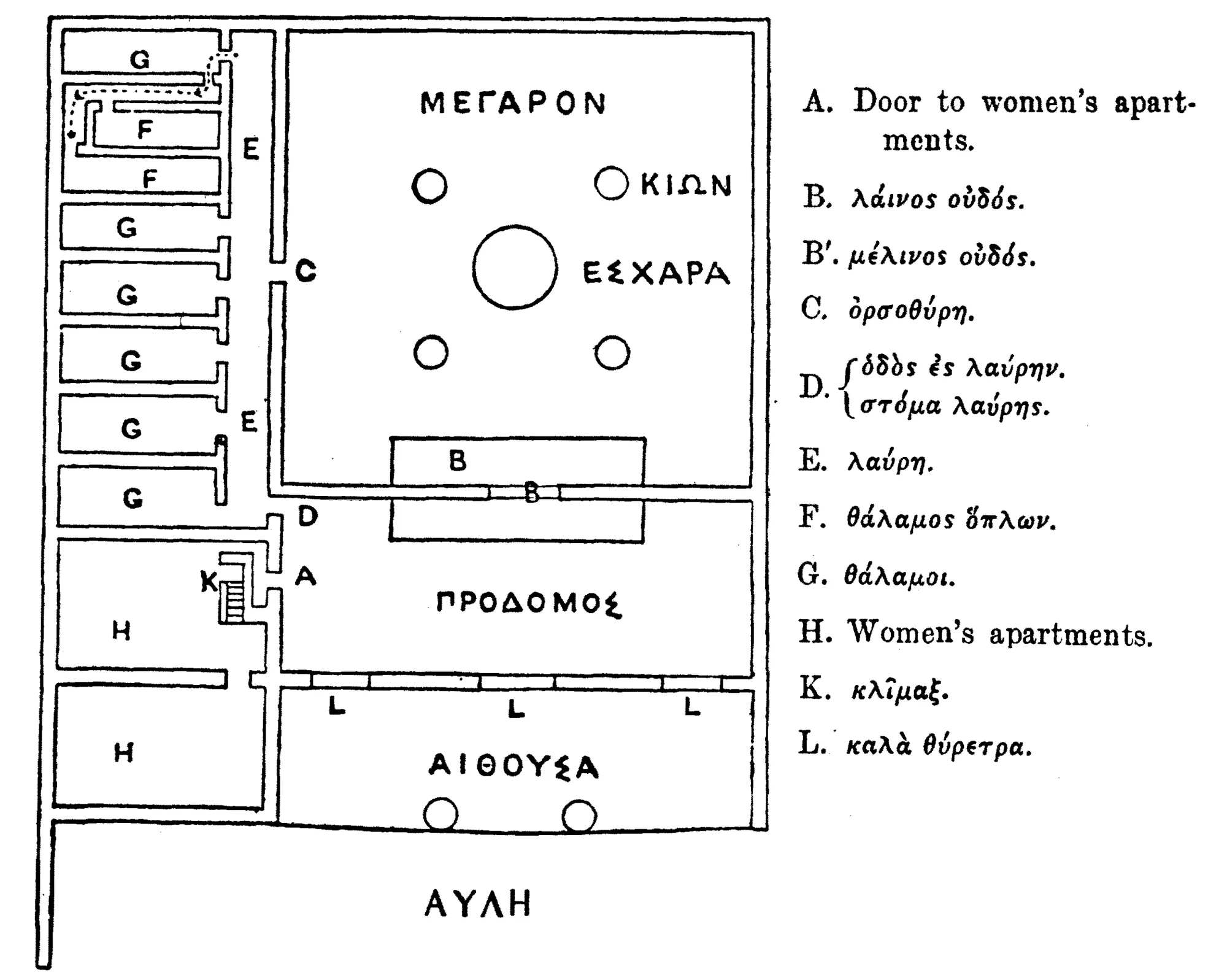
Bassett’s proposed layout of Odysseus’ house, as published in “The Palace of Odysseus”:
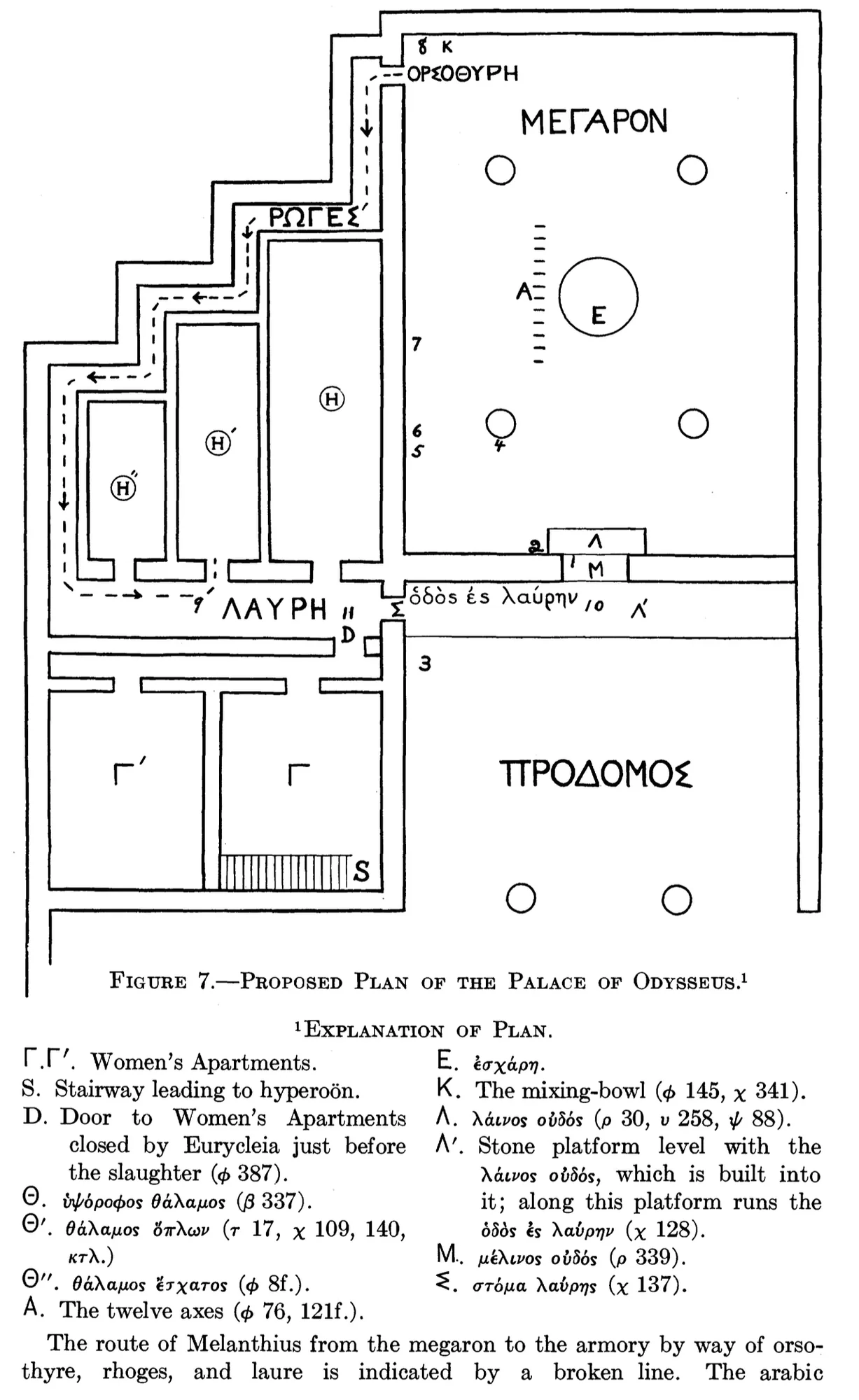
These rooms are not merely decorative details. They allow characters to withdraw and keep secrets; doors separate one person from another; storerooms hold possessions that must be protected. During the slaughter of the suitors, the entrances and the weapons storeroom become crucial. Eurycleia helps control the doors, while Odysseus, Telemachus and their loyal servants try to prevent their enemies from escaping or obtaining weapons. The layout of the house directly shapes the action.
But the arrangement of the house also tells us something about its inhabitants. The suitors occupy the great hall, where they feast, while Penelope usually remains in her own quarters. As Telemachus grows into adulthood, he begins to assert the authority the suitors deny him. Eurycleia, meanwhile, knows the private rooms, guards the provisions and keeps the family’s secrets.
Judith Fletcher has examined the importance of these spaces and the movements of characters within the house. Not everyone can enter every room or move freely through it. The organisation of domestic space thus reflects relationships of authority, dependence and trust among its inhabitants.
There is a moment when the relationship between the house and those who live in it becomes especially moving. When Penelope announces that she will leave with whoever wins the contest of the bow, she speaks of abandoning the beautiful home she shared with her husband, filled with possessions, which she will remember even in her dreams (Odyssey 21.76–79). And when, after the slaughter, Odysseus orders fire and sulphur to purify the house, Homer explicitly distinguishes the mégaron, the dôma and the aulḗ: the hall, the dwelling and the courtyard (Odyssey 22.492–494). Odysseus is reclaiming far more than a collection of rooms.
Finally, the house itself provides the proof that allows Penelope to recognise her husband. Odysseus had built their marriage bed around the trunk of an olive tree still rooted in the ground. Only someone who knew that secret could explain how the bed had been made and why it could not be moved without destroying it (Odyssey 23.177–206). The house thus preserves a memory that no stranger can share.
All these details suggest a complex residence, with spaces serving different purposes. Yet they do not allow us to reconstruct its floor plan with certainty. We can identify a courtyard, a great hall, upper-floor rooms, storerooms and secondary entrances, but not their exact arrangement. This does not mean that Homer imagined a collection of disconnected spaces. On the contrary, he seems to have had a recognisable house in mind, through which his characters move naturally. What remains uncertain is whether this image came from buildings he knew himself or from a much older poetic tradition.
Since the late nineteenth century, scholars have attempted to resolve this question. In 1882, Percy Gardner proposed a reconstruction of the house based on Homer’s descriptions. In 1919, Samuel E. Bassett paid particular attention to Penelope’s quarters and the movements of the characters during the slaughter of the suitors. Their proposed plans, like those of other scholars, differ in significant details. The poem allows for several architectural interpretations, none of which can be established with certainty in every respect.
Archaeology offers another approach. The Mycenaean palaces at Pylos, Tiryns and Mycenae had courtyards, great halls, storerooms and rooms connected by corridors. One of their most characteristic features was the mégaron, a principal hall approached through entrance spaces and centred on a hearth, often surrounded by columns. Some of these features have parallels in the residences Homer describes.
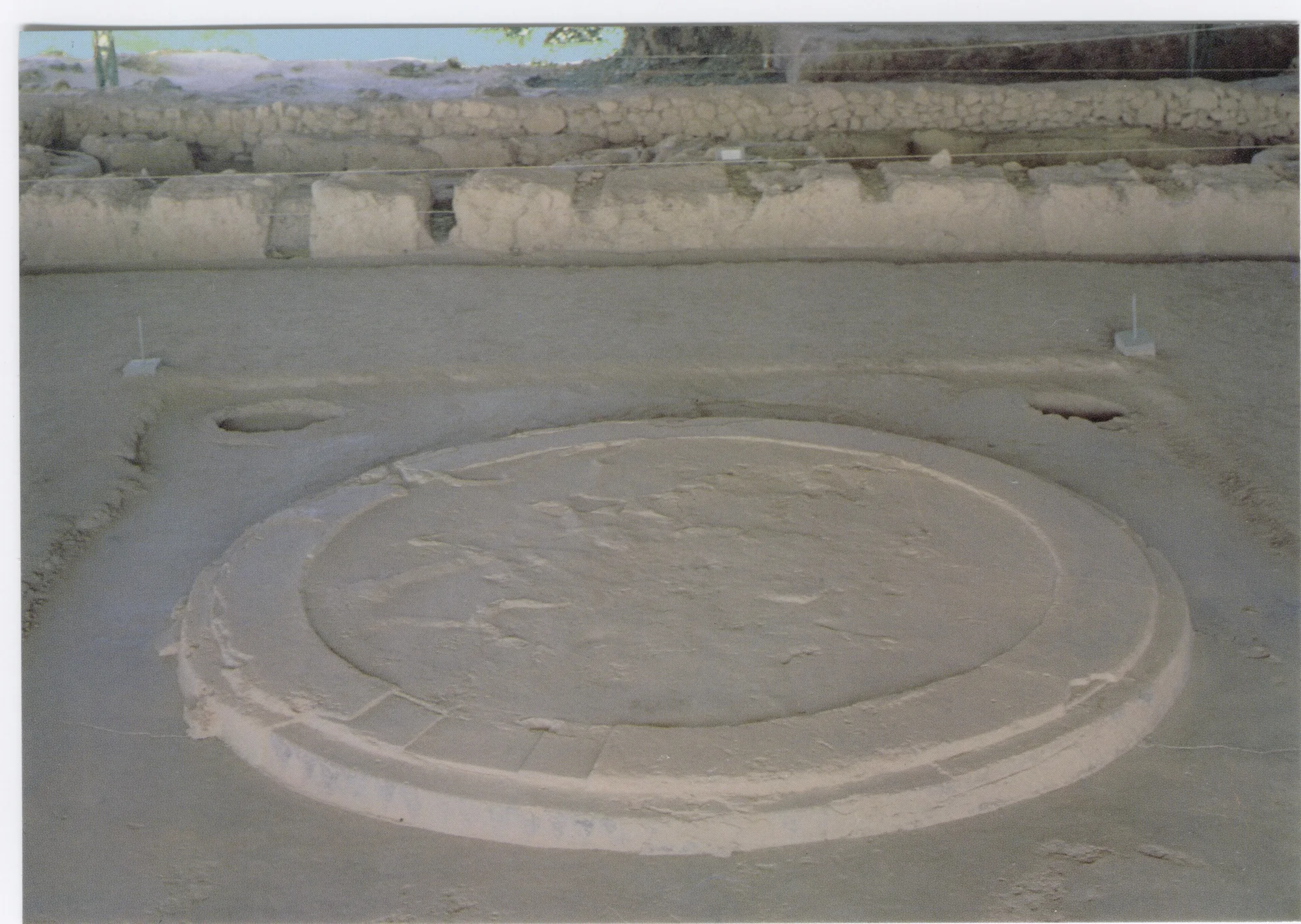
The great hall of the so-called Palace of Nestor at Pylos. The circular hearth survives at the centre of the mégaron, originally surrounded by four wooden columns. Photograph: YukioSanjo, Wikimedia Commons, CC BY-SA 3.0.
For an impression of how the palace may have looked, see the digital reconstruction by Dimitris Tsalkanis, with reconstructions of the frescoes by Filitsa Ioannidou.
Odysseus’ house, however, is not simply a reproduction of a Mycenaean palace. Such palaces could have painted floors, frescoes, bathing facilities and an administrative system documented in Linear B tablets. In Homer, by contrast, the floor can be dug into to set up the axes for the bow contest, rooms are lit by fires and braziers, and a bathtub is brought to wherever it is needed. Nor does Homer describe the administrative activities characteristic of Mycenaean palatial centres.
In 1955, Dorothea Gray considered two possible explanations: the survival of Mycenaean architectural models in altered form, or a traditional image of the heroes’ residences, enriched with elements familiar to the poets. She favoured the second explanation. Yet both may have played a part: the Homeric world brought together memories of different periods.
Homer seems equally at home describing the rooms of Odysseus’ house and the fields, orchards and flocks that form part of his oîkos. Not all royal residences are alike: Menelaus lives surrounded by riches (Odyssey 4.71–75), while Alcinous’ palace belongs almost to the realm of the marvellous (Odyssey 7.81–132). Odysseus’ house, by contrast, feels much more familiar. And perhaps that is why it is the most revealing: in imagining the homes of ancient heroes, Homer also offers us a glimpse of the world in which he lived.
The Works and Days of the Oîkos
Sección titulada «The Works and Days of the Oîkos»I would like to begin this section with a personal memory. In the mid-1970s, it was still possible to encounter ways of life in the countryside that seemed to have changed little over the centuries.
I remember treading grapes as a child, barefoot, in the winepress of an old masia (Catalan farmhouse) in the Baix Llobregat, near Barcelona. The floor was stone and the walls were wooden; we had to hold on to them to keep from slipping as the must drained away through an opening. The wine it produced was strong, rough and unrefined, but it was real wine. Beside the press stood a well from which we drew our drinking water, while a cistern collected rainwater for other household needs. The house had no running water.
Horse-drawn carts were still in use, with dogs tied to the back. Older women sometimes walked along the road carrying bundles of firewood on their heads. To me, a child from the city, everything seemed to belong to another century—even the people.
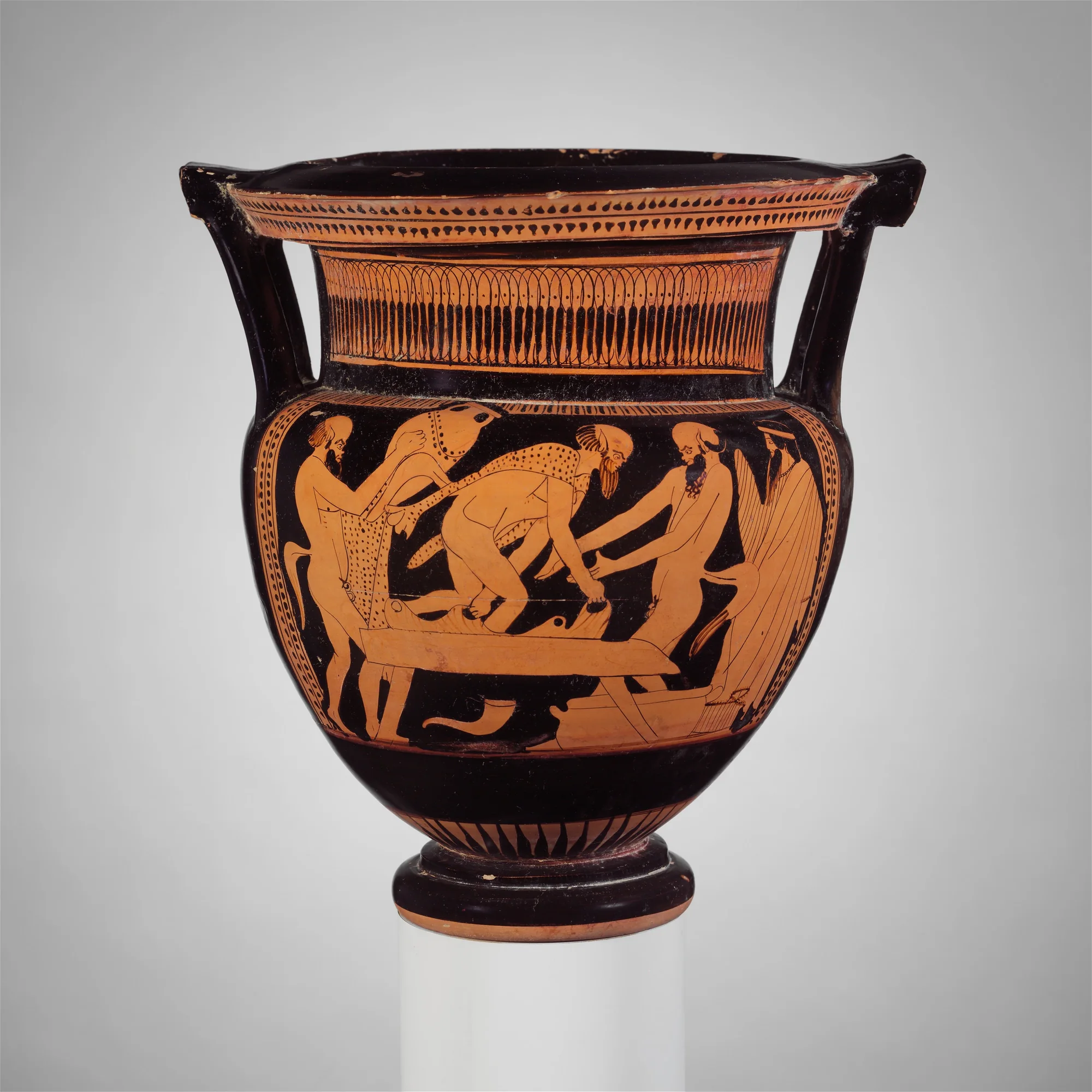
Grape-treading in ancient Greece. Satyrs tread grapes in the presence of Dionysus on an Attic red-figure krater attributed to the Cleveland Painter, c. 460–450 BC. The Metropolitan Museum of Art, New York, inv. 41.162.10. Museum collection record, public domain.
I remember those scenes because they remind me how certain kinds of work persisted across generations. Life had not stood still, but many activities still depended on the same resources: human and animal labour, knowledge of the land and the rhythm of the seasons. Water had to be drawn from the well, grapes harvested and pressed for their juice, and firewood gathered and left to dry for winter. Even the dogs had work to do.
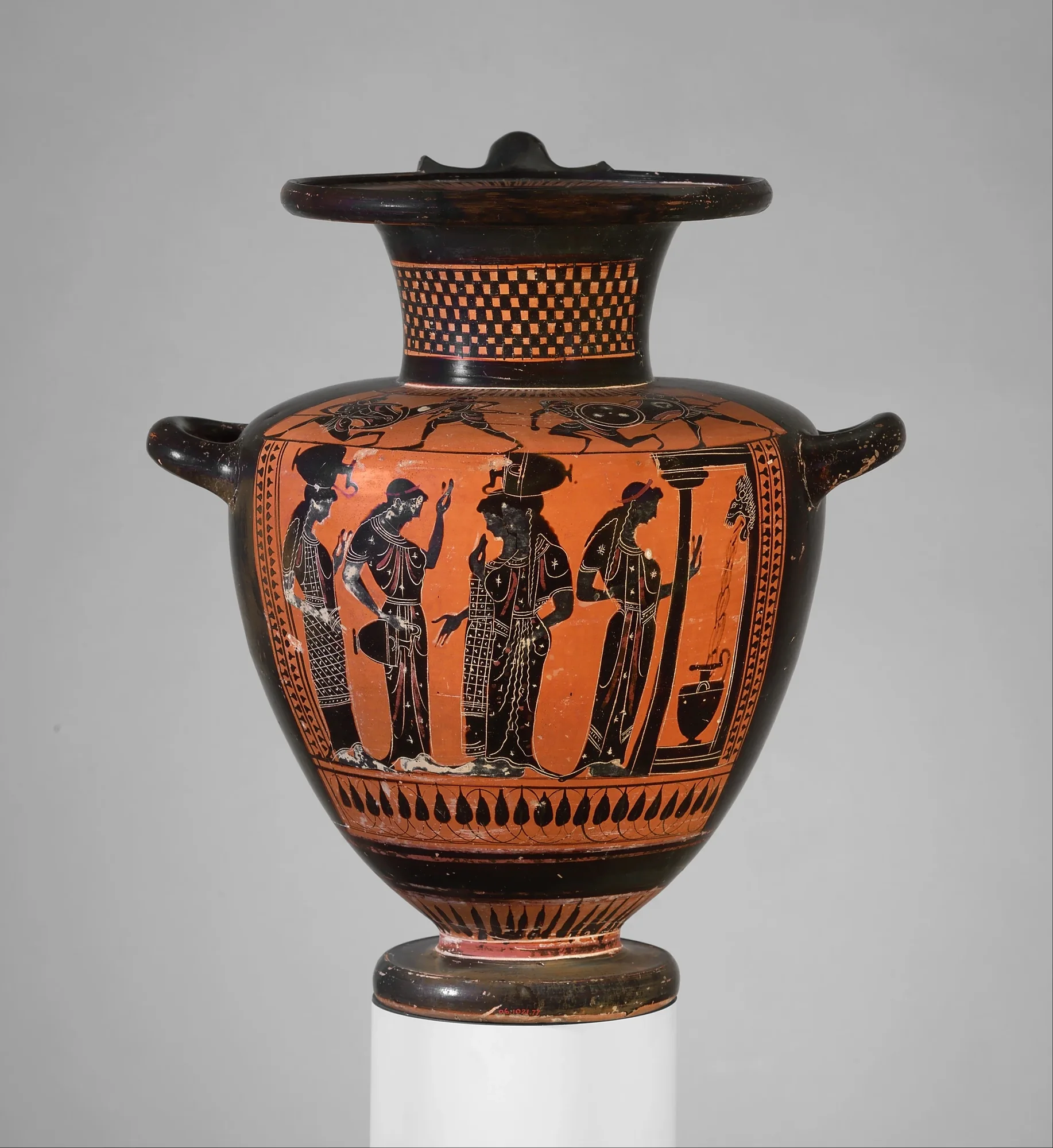
Women fetching water from a fountain. Attic black-figure hydria, c. 510–500 BC. The Metropolitan Museum of Art, New York, inv. 06.1021.77. Museum collection record, public domain.
That relatively recent experience helps us imagine how certain activities could persist over many centuries. In the Bronze Age, as in Homer’s time, grain had to be ground into flour, water fetched for cooking and washing, sheep shorn, and wool spun and woven into cloth. Fields had to be cultivated, olives and grapes harvested, wine made and animals raised. Some of these animals were sacrificed in honour of the gods, and their meat also helped feed the household. Most tasks relied on human and animal labour, while their success depended on knowledge of the land, rainfall and the seasons.
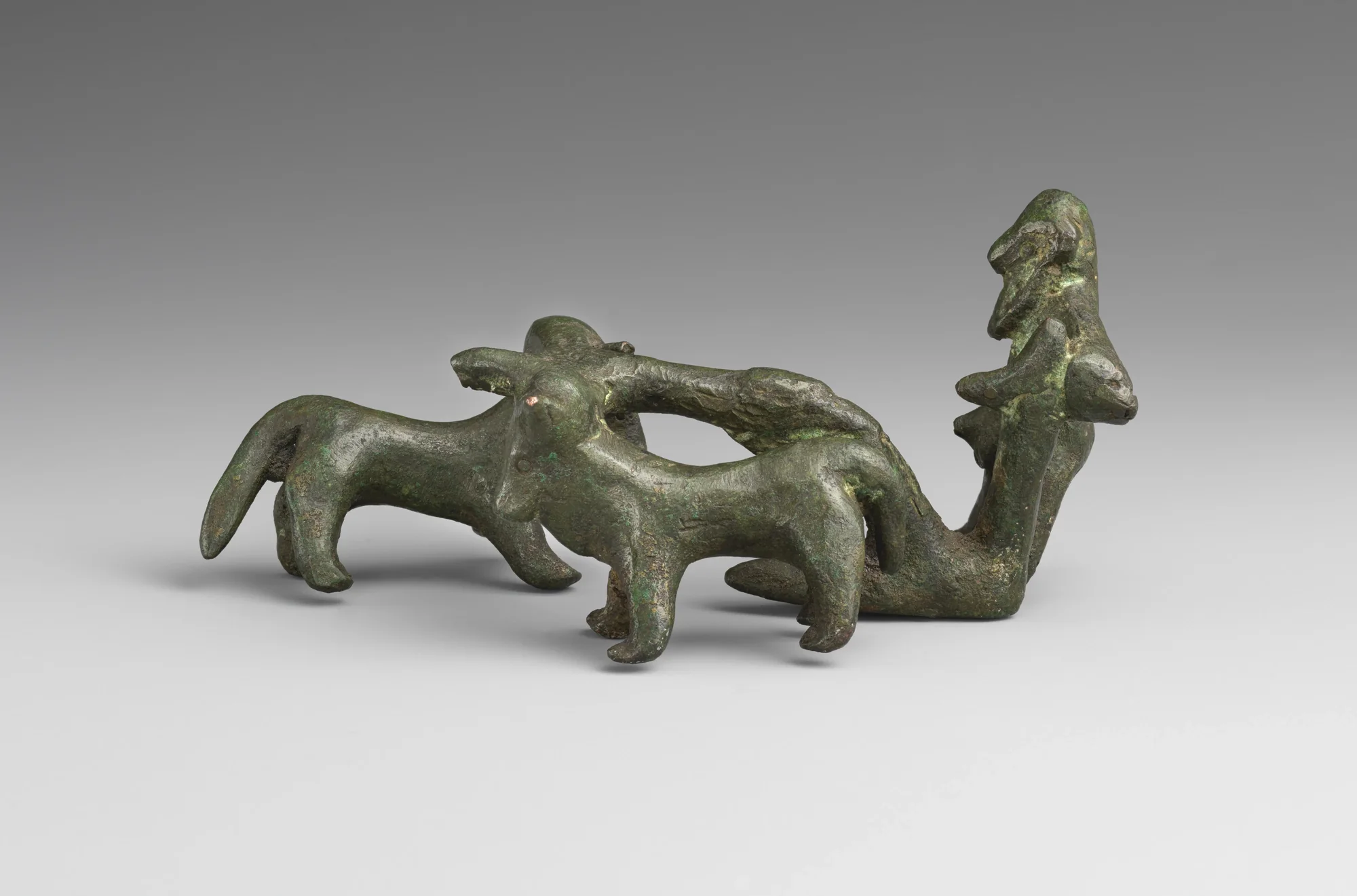
Ploughing with oxen. Small bronze sculpture from East Greece, first half of the sixth century BC, probably from the vicinity of Smyrna. The Metropolitan Museum of Art, New York, inv. 2024.1. Museum collection record, public domain.
For Hesiod’s agricultural knowledge and advice, see “The Field: Knowledge for Doing”.
Life followed a cycle that repeated itself year after year. After the harvest came new tasks; after winter, the preparation of the fields; after sowing, the wait. Tools might improve, but the sequence of tasks remained recognisable. It is easy to imagine that many of these activities were familiar both to the inhabitants of the Mycenaean world and to the Greeks who listened to Homer’s poems several centuries later.
How much of that past did Homer really need to reconstruct? When he describes the reapers, vineyards and shepherds depicted on Achilles’ shield (Iliad 18.541–589), or shows Laertes working among the trees in his orchard (Odyssey 24), he seems entirely at home in the world he portrays. We cannot know what personal experiences the poet drew upon, but it seems reasonable that he used scenes and activities familiar to both himself and his audience. Perhaps he imagined the everyday lives of ancient heroes through kinds of work that, in their essentials, had changed relatively little.
The wealth of an oîkos depended largely on such work. Fields provided grain; vineyards, grapes; olive groves, olives; and flocks and herds, meat, milk, wool and hides. These products had to be processed, stored and managed. The household of a lord such as Odysseus was not merely the building in which his family lived: it encompassed the land, animals, storerooms and people who worked on the estate. It was not simply a property, but a way of organising life.
Moses I. Finley drew attention to the relative self-sufficiency of these households. The oîkos sought to produce much of what it needed, although it could not provide everything for itself. Metals were a particularly important exception. Copper, tin and iron required access to mineral resources, specialised craftsmen and networks of exchange extending beyond the household.
Metals also reveal historical changes that agricultural work does not show so clearly. Bronze had played a fundamental role in the Mycenaean world, while iron became increasingly important in the centuries that followed. Both required supply networks, although the resources involved and the ways of obtaining them differed. Homer seems familiar with this world of exchange when Athena, disguised as Mentes, claims to have arrived in Ithaca with a cargo of iron to trade for copper (Odyssey 1.179–184).
It is therefore possible that the everyday life Homer attributed to his heroes was not so different from that of his contemporaries. The great palaces had disappeared, forms of power and economic relationships had changed, and iron had gained ground over bronze. Yet grain still had to be ground, wool spun and woven, water carried and, when the grape harvest came, someone still had to press the juice from the grapes.
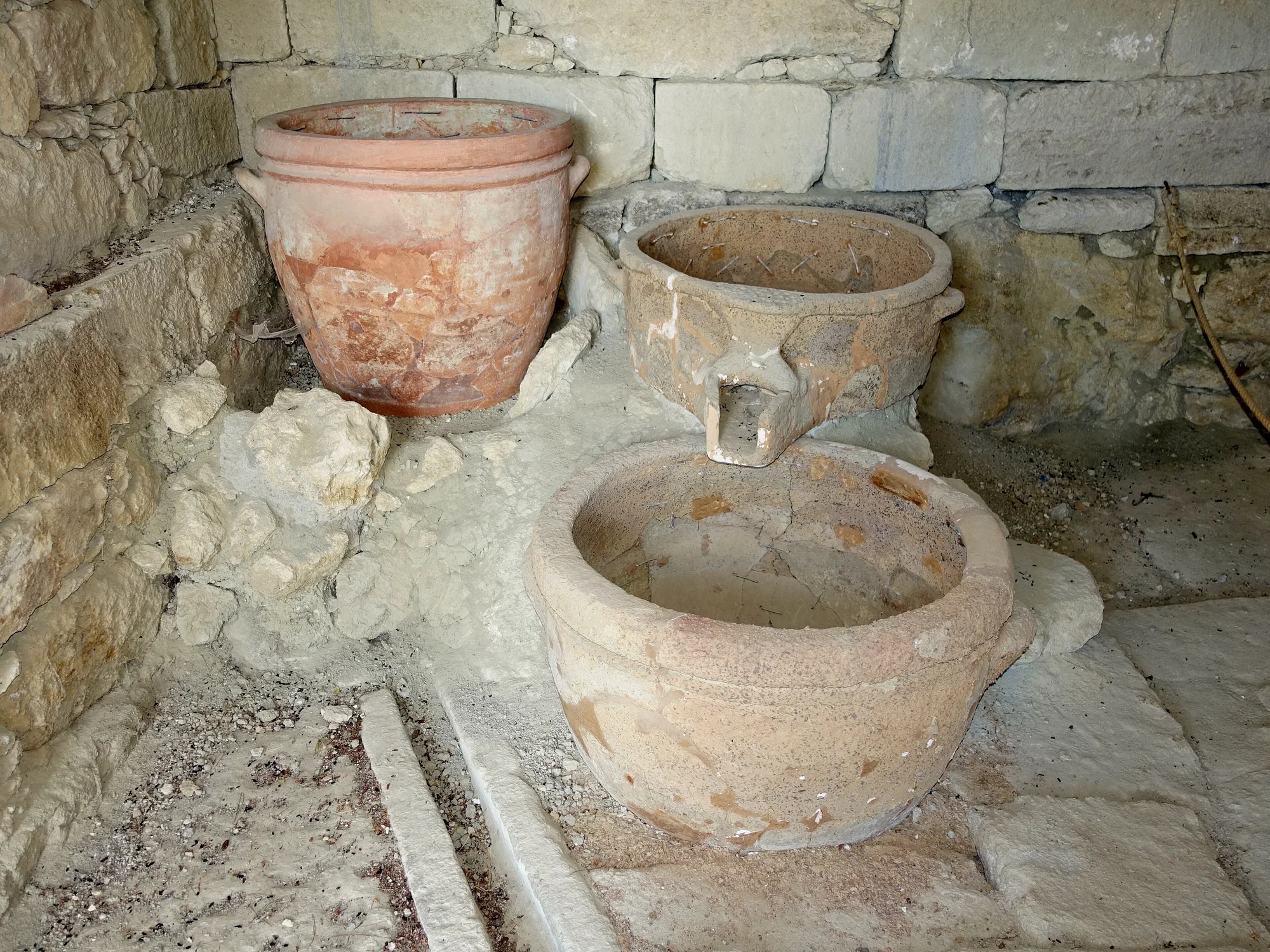
Minoan winepress at Vathypetro, Crete. Remains of a Bronze Age winemaking installation, illustrating the long history of agricultural processing techniques whose basic principles endured for centuries.
Photograph: Olaf Tausch, 2016. Wikimedia Commons, CC BY 3.0. Image reproduced without modification.
Perhaps it is in the repetition of these tasks, rather than in weapons or palaces, that Homer’s own time becomes hardest to distinguish from that of his heroes.
Yet one thing could profoundly disrupt the rhythm of work dictated by the seasons and the tasks that returned year after year: war. When men left their land to fight, fields still had to be tended, harvests gathered and animals fed. Life within the oîkos had to go on, even without those who normally directed or sustained it.
According to an ancient tradition, Odysseus tried to avoid joining the Trojan War. He feigned madness and began ploughing in a senseless manner, as though he no longer understood what he was doing. Palamedes exposed the deception by putting the young Telemachus in danger. Unable to maintain his pretence when his son was threatened, Odysseus was forced to join the expedition. This story does not appear in the Homeric poems, but belongs to other traditions of the Trojan cycle and is recorded, among others, by Hyginus (Fabulae 95).
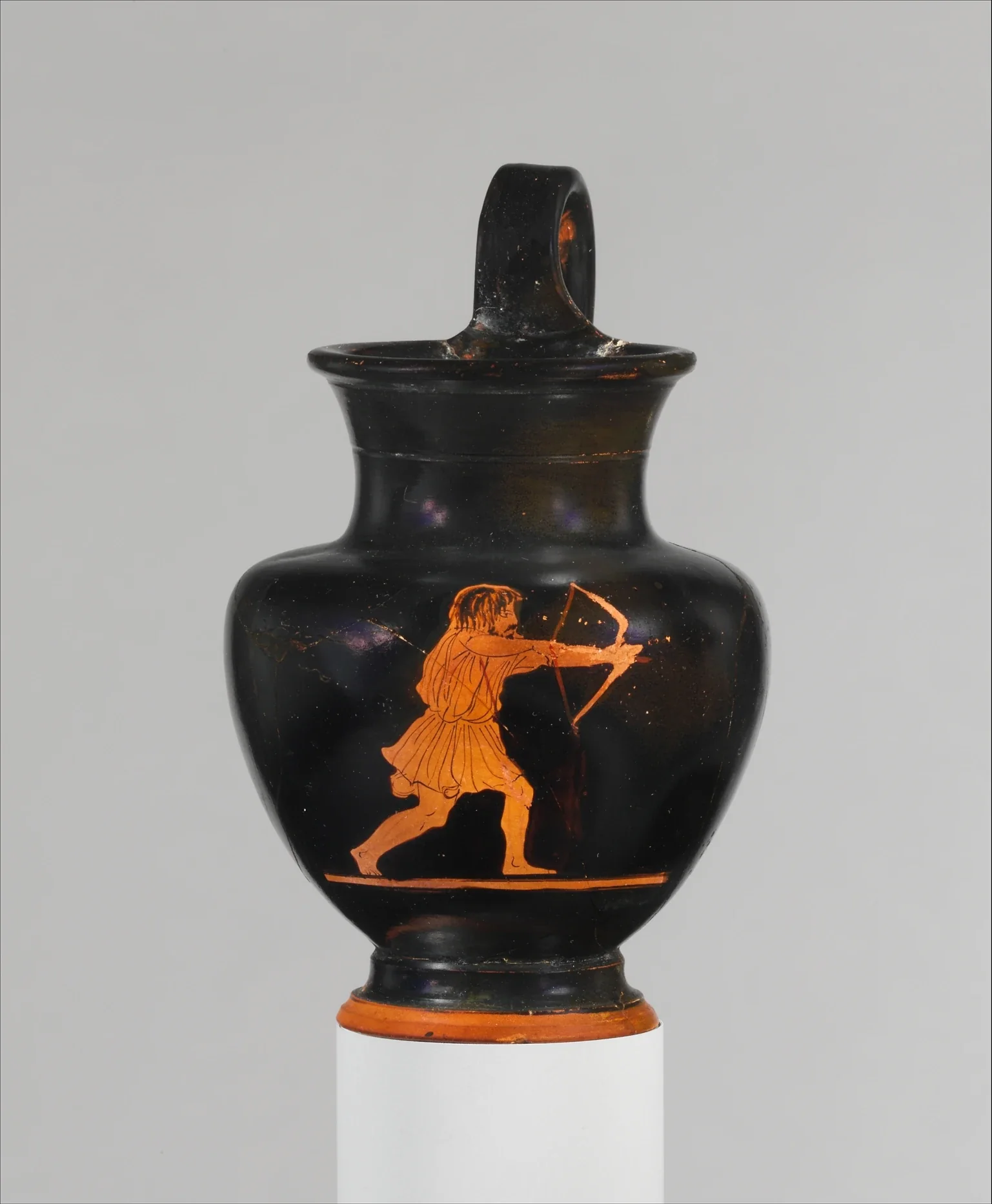
Odysseus, probably depicted during the slaughter of the suitors. Attic red-figure oinochoe attributed to the Disney Painter, c. 430–420 BC. The Metropolitan Museum of Art, New York, inv. 24.97.24. Museum collection record, public domain.
It is telling that Odysseus, one of the most famous heroes of the Trojan War, should appear in this tradition trying to remain in Ithaca, with his wife, his newborn son, his lands and his people. He left to fight and took twenty years to return. When he finally came home, he found his house occupied by men consuming his possessions, threatening his position and seeking to marry his wife. He had survived the war and the journey, yet still had to fight to reclaim what he had wanted to preserve from the very beginning.
A Past of Many Ages
Sección titulada «A Past of Many Ages»The world Homer describes does not belong to a single historical moment. His poems bring together memories passed down over generations, traces of vanished ages and realities familiar to the poet and his listeners. We cannot always distinguish among them, nor do we know how far Homer himself perceived those differences.
But Homer was not trying to reconstruct an age with historical accuracy. He told stories of a heroic past that had to seem distant yet recognisable to those who heard them. That world was made up of many different ages, and in describing it, Homer was also, inevitably, speaking of his own.
Sources and Method
Sección titulada «Sources and Method»See Also
Sección titulada «See Also»What Did Homer Know About the World He Described? I: Objects and Techniques