Part I. How Were Homer's Armies Organised?
Homer's Armies: I. Organisation · II. The Battlefield · III. Combat
When Homer assembles the Achaeans before Troy, he does not portray a uniform, undifferentiated army. Each contingent brings its own ships, men and commanders. Agamemnon holds a pre-eminent position, but he does not exercise absolute authority over every warrior. Achilles can withdraw his Myrmidons from the fighting; Nestor organises his own men; and the Trojan leaders divide their forces for the assault on the Achaean defences. Fighting a war requires them to act together, but that unity does not erase the differences between those who fight it.
How were these men assembled, whom did they obey, and why did they fight? The Iliad and the Odyssey offer answers, although they do not describe a clearly defined military system. Our purpose is to understand how these armies were organised as the poems present them, without imposing the military structures of later periods upon them.
A Coalition of Contingents
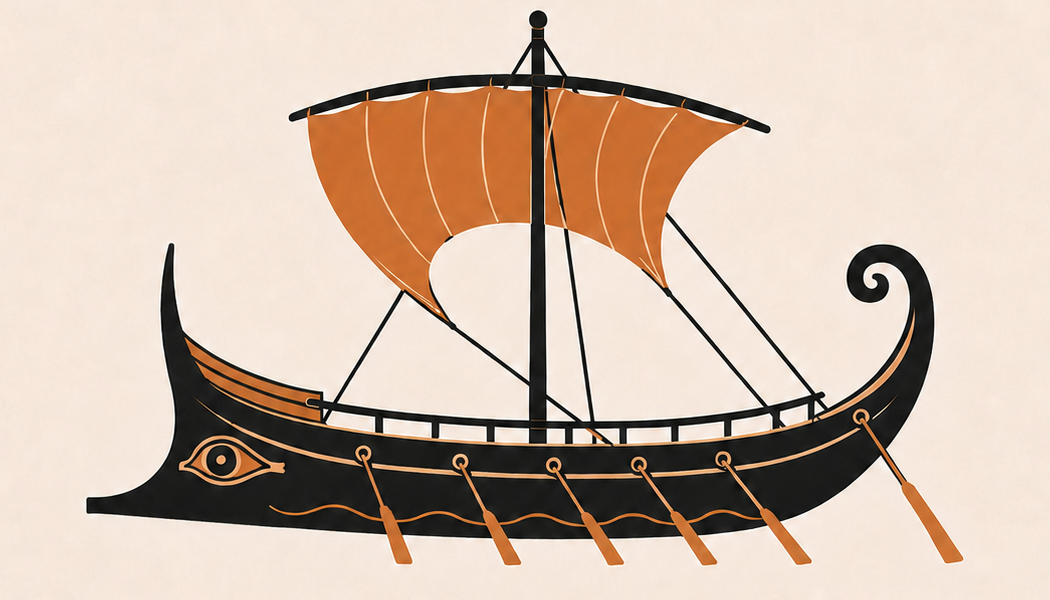
Sección titulada «A Coalition of Contingents»The Catalogue of Ships in Book 2 of the Iliad groups the Achaeans by their places of origin and the leaders who command them, and gives the number of ships supplied by each contingent. In the same book, the Trojan Catalogue lists the peoples and allies taking part in the defence of the city. Both portray armies made up of forces of different origins, brought together under separate commanders.
These catalogues do not, however, describe a uniform military organisation. The contingents are identified by territories, communities or leaders, but we do not know how all their men were organised internally or whether they followed a common command structure.
The Catalogue of Ships gives some idea of the expedition's scale, although it is not a verifiable census. The poems provide some figures for the number of men carried on individual ships, but they do not establish a fixed number that can be applied to the entire fleet. This question is examined in How Many Combatants Could Have Taken Part in the Trojan War? Here, our main concern is what the Catalogue reveals about the origins of the contingents and the relationships between them and their commanders.
Agamemnon Commands, but Must Persuade
Sección titulada «Agamemnon Commands, but Must Persuade»Agamemnon is the principal leader of the Achaean expedition. He summons the other commanders, assigns duties and attempts to coordinate the various contingents. In Book 4 of the Iliad, he moves through the ranks before battle: he praises those he finds ready, rebukes those he considers hesitant and reminds them of their obligations to the army (Iliad 4.327–421).
Yet his authority has limits. Although the Achaeans acknowledge his pre-eminent position, the individual contingents retain their own leaders. His dispute with Achilles demonstrates this from the very beginning of the poem: when Agamemnon dishonours Achilles by taking Briseis from him, Achilles withdraws from battle and keeps his Myrmidons out of the fighting, despite the consequences for the entire expedition.
The historian Hans van Wees argues that, in the Homeric world, wealth, lineage, reputation and personal ties of dependence helped leaders attract followers (Status Warriors, 1992, pp. 37–48 and 140–142). These relationships help explain how men could recognise Agamemnon's overall authority while remaining attached to their own commanders.
Agamemnon therefore had to lead a coalition whose members did not depend on him alone. His authority rested on his standing and prestige, but it also required the cooperation of the other leaders.
Was Going to War Compulsory?
Sección titulada «Was Going to War Compulsory?»Loyalty and the expectation of gaining honour or booty cannot, by themselves, explain why men went to war. In the Iliad, we also find indications of obligations and possible penalties for those who refused to fight.
One of the most interesting examples occurs in the story of Euchenor, son of the seer Polyidus. His father had foretold that he would die of an illness in Corinth or fall at the hands of the Trojans. Euchenor chooses to sail to Troy and, according to the poet, thereby avoids both the illness and the grievous thōḗ ‘of the Achaeans’ (Iliad 13.663–670).
Was this a fine for failing to join the expedition? Hans van Wees interprets thōḗ as a possible financial penalty imposed by the community (2018, pp. 13–14 of the accepted manuscript). The poem does not specify exactly what it involved, who would impose it or by what procedure. What matters is that Euchenor does not appear to have been free to remain at home without facing consequences.
Two further passages add nuance. In Iliad 24.396–400, Hermes, pretending to be a young Myrmidon, tells Priam that his supposed father, Polyctor, had seven sons and that they had drawn lots to decide which of them would accompany Achilles to Troy. Hans van Wees suggests that this episode could reflect an obligation placed upon a family to provide one of its members for the expedition, although Homer does not explicitly state that such an obligation existed.
In Odyssey 14.235–239, Odysseus, assuming a fictitious Cretan identity, says that he and Idomeneus could not refuse to lead the ships to Troy because pressure from the people made it impossible to reject the decision.
In both cases, the speaker is pretending to be someone else and telling an invented story. Nevertheless, the drawing of lots among brothers and pressure from the community must have seemed plausible to the poems' audiences.
Discipline once the war was under way is a different matter. Hector threatens those who withdraw from the fighting (Iliad 12.248–250), while Odysseus rebukes and strikes men who rush towards the ships in an attempt to return home, following the test Agamemnon had set his troops (Iliad 2.188–206 and 2.211–277). By contrast, when Achilles refuses to fight, Agamemnon tries to regain his cooperation by offering substantial rewards (Iliad 9).
These episodes show that going to war was not always a matter of individual choice. Prestige, loyalty to a leader and hopes of obtaining booty might encourage men to fight, but obligations, collective pressure and possible penalties could also play a part. We cannot reconstruct a general system of compulsory military service from these passages, although we can see that, for some men, going to war may have been an obligation difficult to evade.
Arranging Men by Tribes and Phratries
Sección titulada «Arranging Men by Tribes and Phratries»After the crisis that sends the Achaeans rushing towards their ships, Nestor advises Agamemnon to organise the army by phýla and phrêtrai, Greek terms usually translated as ‘tribes’ and ‘phratries’ (Iliad 2.362–368).
Arrange the men by tribes and phratries, Agamemnon, so that one phratry may come to the aid of another, and one tribe of another.
Nestor proposes that the warriors fight in groups based on the ties that connect them, so that members of the same community can support one another. He adds that this arrangement will enable Agamemnon to judge how bravely individual leaders and warriors fight, even when the gods favour or hinder their efforts.
But what exactly were these tribes and phratries? The former may have brought together larger communities, while the latter were associated with ties of kinship, whether real or traditional. We know more about the phratries of Classical Athens, which brought together families whose members shared religious ceremonies and recognised the admission of new members, especially children. We cannot, however, be certain that the phratries mentioned by Homer had the same organisation.
Nestor's advice does not describe a particular tactical formation. He proposes using existing relationships between men to encourage mutual support and strengthen the army's cohesion. Homer does not tell us whether Agamemnon ever put this arrangement into practice, but the passage shows that the organisation of combatants could be based on their social relationships, rather than solely on the authority of their leaders.
The Five Leaders of the Myrmidons
Sección titulada «The Five Leaders of the Myrmidons»The clearest example of internal organisation appears when Achilles prepares his Myrmidons to enter battle under Patroclus' command. Homer tells us that Achilles had brought fifty ships to Troy, each carrying fifty men. He then names five leaders entrusted with commanding them: Menesthius, Eudorus, Peisander, Phoenix and Alcimedon (Iliad 16.168–197). Each is placed in command of a stíx, a word that can mean a rank, line or group.
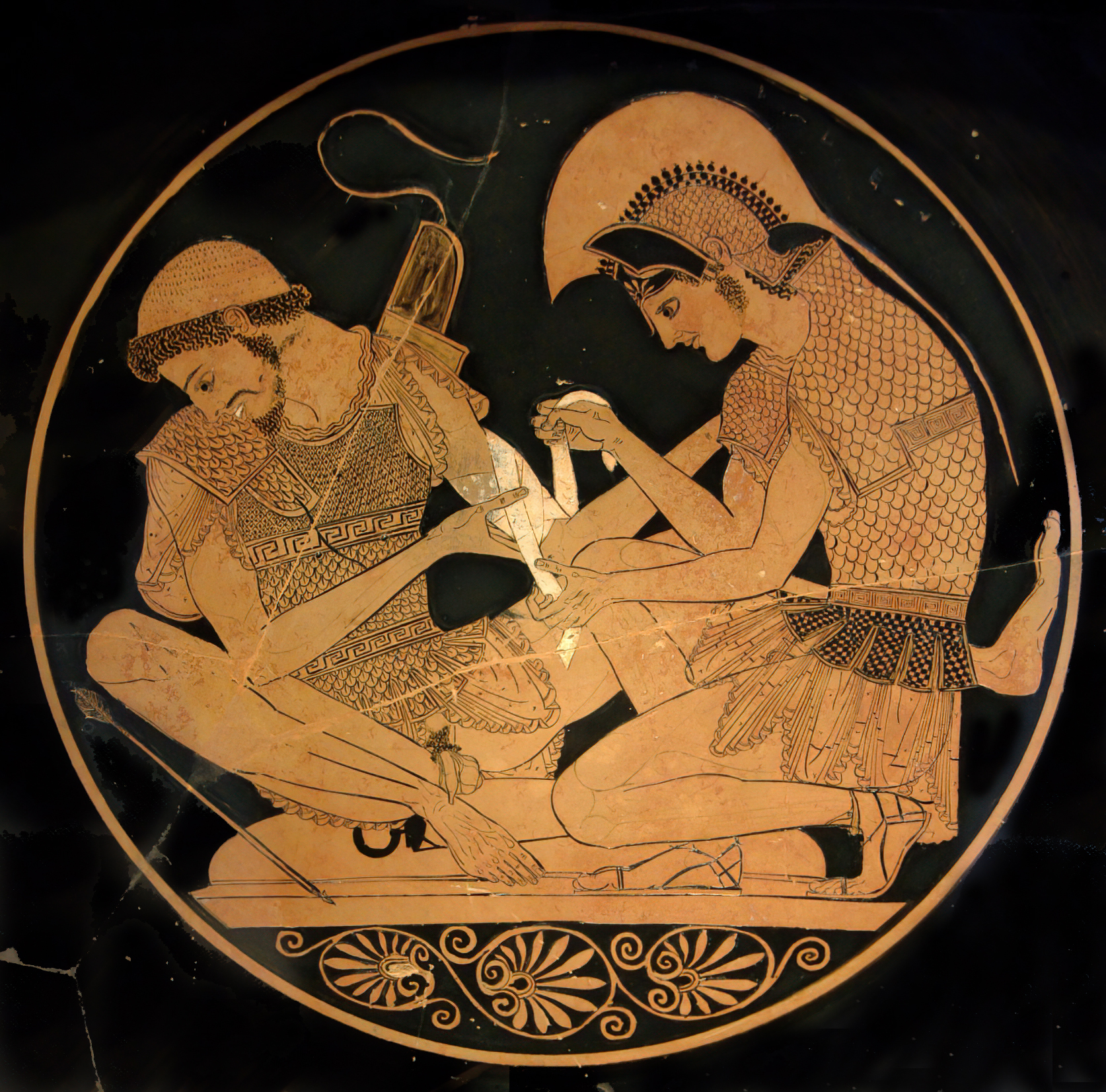
Achilles places his men under the authority of the five leaders and addresses them before Patroclus sets out (Iliad 16.198–218). The episode offers a glimpse of how a contingent could be organised for battle.
Although Homer's figures add up to 2,500 men, the poem does not state that each of the five groups contained exactly five hundred warriors, or that their composition always remained the same. We can identify an internal organisation and five commanders without assuming that each stíx was a military unit with a fixed number of men.
The Five Groups in the Trojan Assault
Sección titulada «The Five Groups in the Trojan Assault»Book 12 of the Iliad offers a revealing contrast. During the assault on the Achaean camp, the Trojans encounter a defensive ditch that makes it difficult for their chariots to advance. Polydamas advises continuing the attack on foot, and Hector accepts his proposal. The warriors dismount, leave their horses in the care of the chariot drivers and divide into five groups, each commanded by several leaders (Iliad 12.50–107). Among them are Hector and Polydamas, Paris, Helenus, Deiphobus, Aeneas and Sarpedon, alongside other commanders.
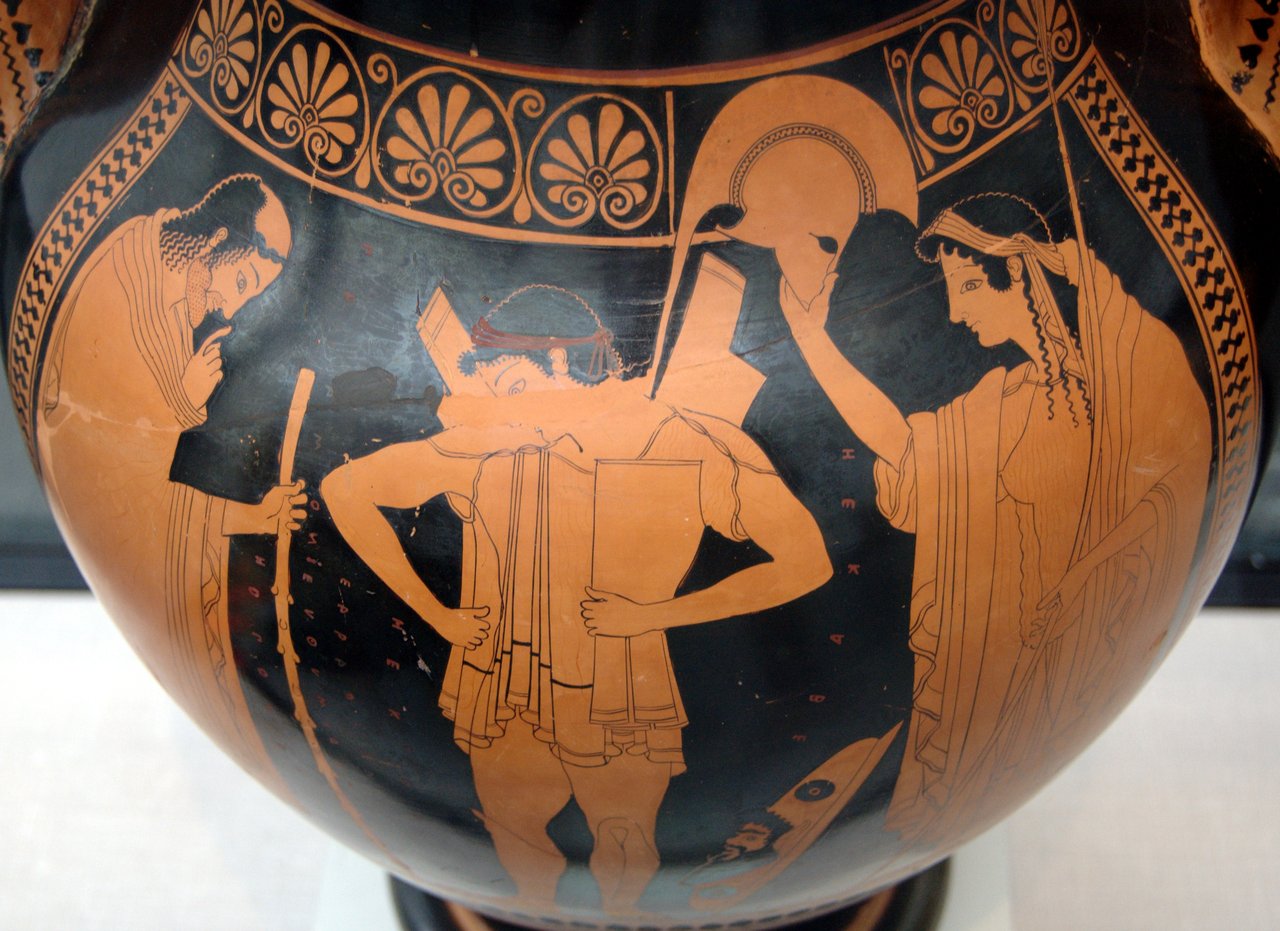
The ditch forces the Trojans to change their approach: they abandon their chariots, advance on foot and reorganise their forces. As with the Myrmidons, we find five groups under different leaders, but nothing indicates that they followed the same system of organisation or maintained an identical composition in other operations.
The Odyssey: Other Groups, a Different Scale
Sección titulada «The Odyssey: Other Groups, a Different Scale»The Odyssey also describes encounters between organised groups of combatants. At Ismarus, Odysseus and his men sack the city of the Cicones, but disobey his order to withdraw and remain on the shore, dividing the booty, drinking wine and slaughtering livestock. The survivors summon other Cicones from inland, who are more numerous and skilled in fighting from horseback and, when necessary, on foot (Odyssey 9.47–50). The reinforcements arrive at dawn, form up for battle beside the ships and eventually force Odysseus' men to retreat, with six men killed from each ship (Odyssey 9.39–61).
In the palace on Ithaca, Odysseus, Telemachus, Eumaeus and Philoetius fight together against the suitors (Odyssey 22). Here, instead of contingents facing one another in open country, we find a small group united by family ties, service and loyalty. After the slaughter, the relatives of the suitors gather, deliberate and take up arms to seek revenge. Fighting breaks out, but Athena's intervention brings the hostilities to an end (Odyssey 24.469–548).
These episodes show that the organisation of combatants was not confined to large military expeditions. It could also arise from personal relationships, family obligations and conflicts between communities.
Taken together, the Iliad and the Odyssey portray forces of different sizes, assembled under leaders whose authority depended both on their standing and on their ties with their men. The poems describe contingents, groups of warriors and decisions made by commanders, but they do not present a uniform military structure. Organisation existed, although its forms could vary according to those involved and the circumstances.