Before Olympus
The Birth of the Greek Gods
I · The Pelasgians: a Name for an Unknown Past
Sección titulada «I · The Pelasgians: a Name for an Unknown Past»We know far more about what the Greeks believed about the Pelasgians than we do about the Pelasgians themselves.
The name appears in the Homeric poems. Yet we do not know exactly who these peoples were, whether they shared a common language, or whether writers from different periods used the term “Pelasgian” to refer to different populations. Archaeology has documented different cultures in the territory of present-day Greece during the Bronze Age and earlier periods, but it has not identified a material culture that can confidently be attributed to all the peoples called Pelasgians in ancient texts.
The Pelasgians in Homer
Sección titulada «The Pelasgians in Homer»In the catalogue of Trojan allies, Homer mentions the Pelasgians, inhabitants of a city called Larisa, led by Hippothous and Pylaeus (Iliad, 2.840–843). Elsewhere he refers to a region in Achilles’ sphere as “Pelasgian Argos” (Iliad, 2.681–685). In the Odyssey, he lists the Pelasgians among the peoples of Crete, alongside Achaeans, Eteocretans, Cydonians and Dorians (Odyssey, 19.172–177).
The location of Larisa remains disputed. Strabo considered the various cities known by that name and judged Larisa Phriconis, near Cyme on the western coast of Anatolia, the most likely identification (Geography, 13.3.2–3). That identification, however, is not certain.
The passage from the Odyssey requires qualification. The description of Crete forms part of a story invented by Odysseus to conceal his identity from Penelope. He is not recounting a journey he actually made; his story must sound convincing and plausible. As with the false report he gives Eumaeus that Odysseus had gone to consult Zeus through the sacred oak at Dodona (Odyssey, 14.327–330), Odysseus draws on familiar references to make his deception credible.1
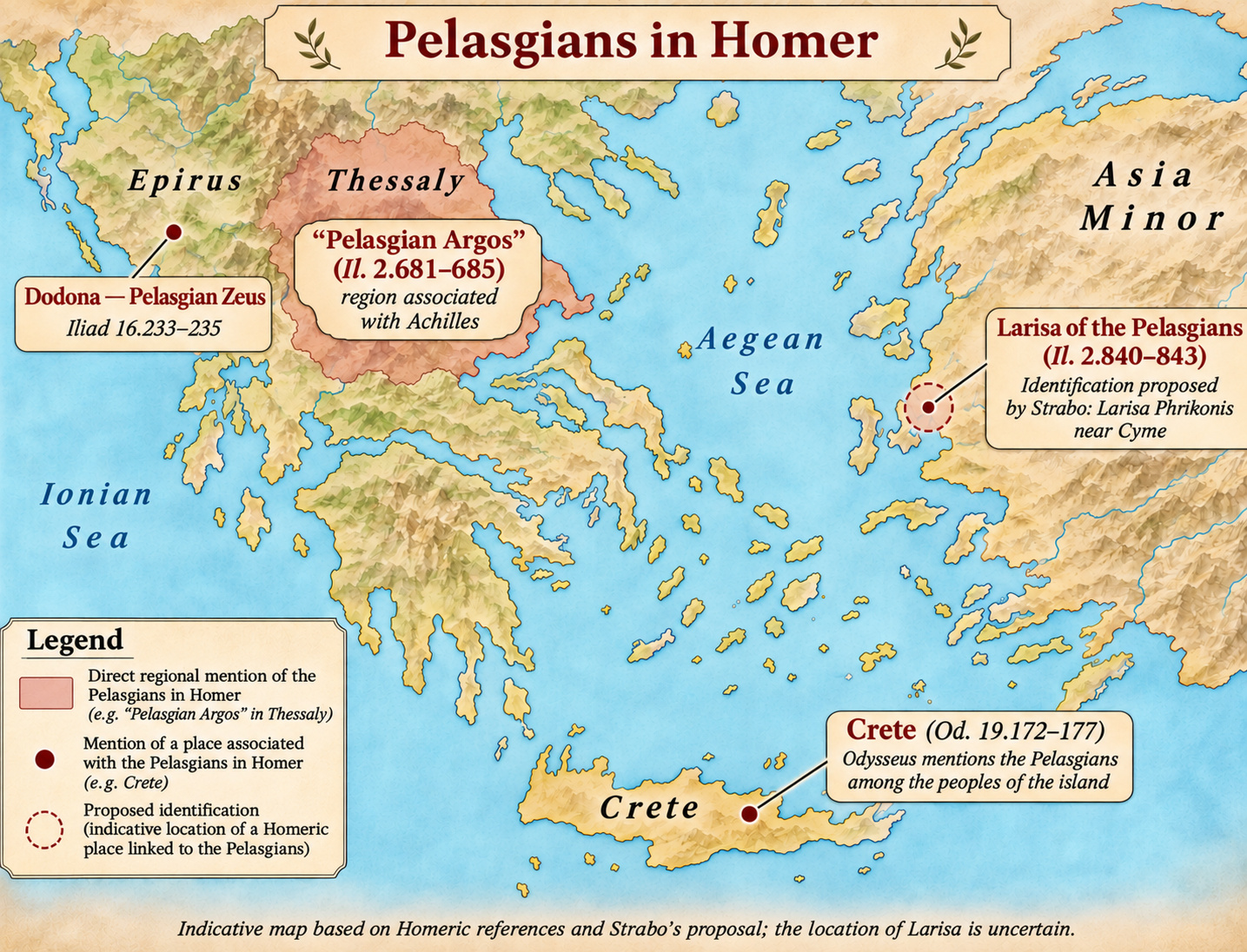
The Pelasgians in Homer. A map illustrating the Homeric references to the Pelasgians: “Pelasgian Argos” in Achilles’ region (Iliad, 2.681–685); the Trojan allies from Larisa (Iliad, 2.840–843); the Pelasgians of Crete (Odyssey, 19.172–177); and Achilles’ invocation of Pelasgian Zeus at Dodona (Iliad, 16.233–235). Strabo proposed identifying Homer’s Larisa with Larisa Phriconis, near Cyme (Geography, 13.3.2–3), although this identification remains uncertain. The geographical spread of these references may indicate that the name “Pelasgians” was applied to different peoples or communities, without allowing us to determine whether they shared a common origin. The map is intended as a geographical guide to the ancient sources, not as an exact cartographic reconstruction. Map by the author.
One detail is particularly striking in this context. Before sending Patroclus into battle, Achilles addresses Zeus in these words:
Ζεῦ ἄνα Δωδωναῖε Πελασγικὲ τηλόθι ναίων
Lord Zeus, Dodonaean, Pelasgian, dwelling far away.
The poet does not explain what “Pelasgian” means when applied to Zeus. The invocation associates the god with Dodona, the ancient sanctuary in Epirus, north-western Greece, famous for its oracle. There the will of Zeus was consulted, and his responses were associated with a sacred oak. But the epithet “Pelasgian” is not proof that Zeus originated in an identifiable Pelasgian religion. Above all, it tells us how the god could be invoked within the epic tradition. A fragment attributed to Hesiod and preserved by Strabo (Geography, 7.7.10) also refers to Dodona as a dwelling place of the Pelasgians. We are still unable, however, to determine the precise meaning of the epithet “Pelasgian”.2
In his study A History of the Pelasgian Theory (1907), J. L. Myres suggested that the adjective might evoke a remote antiquity, associated with a past preceding the Hellenic world, without necessarily implying that the inhabitants of Dodona were Pelasgians. Myres related this interpretation to the customs of the sanctuary’s priests, whom Homer describes as having unwashed feet and sleeping on the ground (Iliad, 16.234–235). In Myres’s view, such practices could suggest the preservation of ancestral rites. This explanation does not prove that Zeus was of Pelasgian origin, but it offers a possible interpretation of the epithet used by the poet.
Zeus was not the only deity described as “Pelasgian”. Apollonius of Rhodes calls Hera “Pelasgian” (Argonautica, 1.14); Dionysius Periegetes describes Samos as the home of “Pelasgian Hera” (Description of the Inhabited World, 534); and Pausanias mentions a sanctuary of “Pelasgian Demeter” at Argos (Description of Greece, 2.22.1). Pausanias attributes Demeter’s epithet to Pelasgus, son of Triopas, whom he identifies as the founder of the sanctuary.
The recurrence of this epithet deserves attention: it was applied to three deities of major importance in the Greek world. The adjective refers to the Pelasgians, whom ancient traditions associated with a past preceding that of the Hellenes. Yet even where an ancient author offers an explanation, as Pausanias does for Demeter, we cannot establish precisely what the designation meant in every context. It might indicate a connection with a place, a people or a religious tradition; it might also evoke a prestigious antiquity and enhance the dignity of the deity invoked. The sources do not allow us to conclude that it carried the same meaning in all three cases.
Herodotus: Investigating What He Had Heard
Sección titulada «Herodotus: Investigating What He Had Heard»Several centuries later, Herodotus approached the Pelasgians as a historical problem. In the Histories (1.56–58), he acknowledges that he cannot establish with certainty what language they spoke and looks for clues among communities of his own time that still bore the name. He observes that the inhabitants of Creston and Placia spoke a common language, different from those of their neighbours, and infers that the ancient Pelasgians may likewise have spoken a language other than Greek. His reasoning, however, depends on the assumption that these communities had preserved the language of their ancestors—something he was unable to verify.3
In another passage, particularly important for our inquiry into the birth of the gods, Herodotus says that at Dodona he heard a tradition about the Pelasgians’ ancient religious practices. According to this account, they originally invoked the gods without assigning individual names to them. Later, they learned names said to have come from Egypt, consulted the oracle about whether they should adopt them and eventually began using them in their sacrifices (Histories, 2.52). Herodotus concludes that the Hellenes subsequently received those names from the Pelasgians.
Herodotus is not describing a Pelasgian ceremony that he had witnessed. He transmits an explanation of the religious past that he received at Dodona, while also bringing his own interest in the relations between Egypt and Greece to the account. Nor does his narrative imply that the gods did not exist before they were named: he explicitly presents them as objects of worship before the adoption of individual divine names.
Herodotus then goes a step further. In the Histories (2.53), he maintains that Homer and Hesiod established for the Greeks the genealogies of the gods, their names, their honours and functions, and their outward forms. The historian himself distinguishes between the tradition received from the priestesses of Dodona, concerning ancient religious practices, and his own interpretation of the role played by the two poets. The passage does not demonstrate that Homer and Hesiod invented the Greek pantheon. Rather, it shows that a fifth-century BCE historian regarded them as fundamental to the way the Greeks had come to organise and explain their divine world.
Herodotus also preserves a political account concerning the Pelasgians who inhabited Attica. In the Histories (6.137), he reports the opinion of Hecataeus of Miletus, according to whom the Athenians unjustly expelled the Pelasgians. The Athenians had previously granted them land near Mount Hymettus as a reward for building a wall around the Acropolis. When they saw how successfully the Pelasgians had cultivated land that had formerly been poor and unproductive, they grew envious and drove them out. Herodotus also records a different account, favourable to the Athenians, which justified the expulsion by accusing the Pelasgians of wrongdoing. Here we find neither a creation myth nor a religious explanation, but a conflict whose memory was preserved through competing narratives.
Thucydides: From Pelasgians to Hellenes
Sección titulada «Thucydides: From Pelasgians to Hellenes»Thucydides also examined the Pelasgians, although his interests differed from those of Herodotus. At the beginning of the History of the Peloponnesian War (1.3.2–3), he explains that the inhabitants of Greece had not always been called “Hellenes”. In ancient times, different peoples had their own names, and that of the Pelasgians had been among the most widespread. According to his interpretation, the name “Hellenes” gradually spread after Hellen, son of Deucalion, and his descendants became powerful in Phthiotis and were called upon to assist other cities. Through their association with them, other communities gradually adopted the name.4
To support this explanation, Thucydides turns to Homer. He observes that the poet calls the Greeks who fought at Troy “Achaeans”, “Argives” or “Danaans”, but does not collectively refer to them as “Hellenes”. The latter name is restricted to the followers of Achilles from Phthia.
Thucydides thus preserves the idea that the Pelasgians occupied an important place in Greece’s past. Yet he neither explains exactly who they were nor demonstrates that all the populations known by that name belonged to a single people.
The historian also mentions a population of mixed origins, speaking two languages, in Acte, the peninsula of Mount Athos. Among its inhabitants he identifies Tyrrhenian Pelasgians who had formerly inhabited Lemnos and Athens, alongside other groups (History of the Peloponnesian War, 4.109). For Thucydides, therefore, “Pelasgians” was not merely a name belonging to the distant past. Yet we cannot determine whether these communities were related to the allies of Troy mentioned by Homer.
Other ancient sources preferred to personify the origins of the Pelasgians. Pausanias records an Arcadian tradition according to which Pelasgus was the first inhabitant of that region. He quotes verses by Asius of Samos in which Pelasgus emerges from the earth itself. Pausanias then credits him with building shelters, introducing clothing made from sheepskins and teaching people to eat edible acorns rather than potentially harmful plants (Description of Greece, 8.1.4–6). Pelasgus thus appears as a civilising ancestor.
In contrast to Homer’s geographically scattered references, the tradition recorded by Pausanias associates Pelasgus with a particular territory: Arcadia, where he appears as an ancestor born from the land itself and a figure who introduced fundamental practices of communal life.
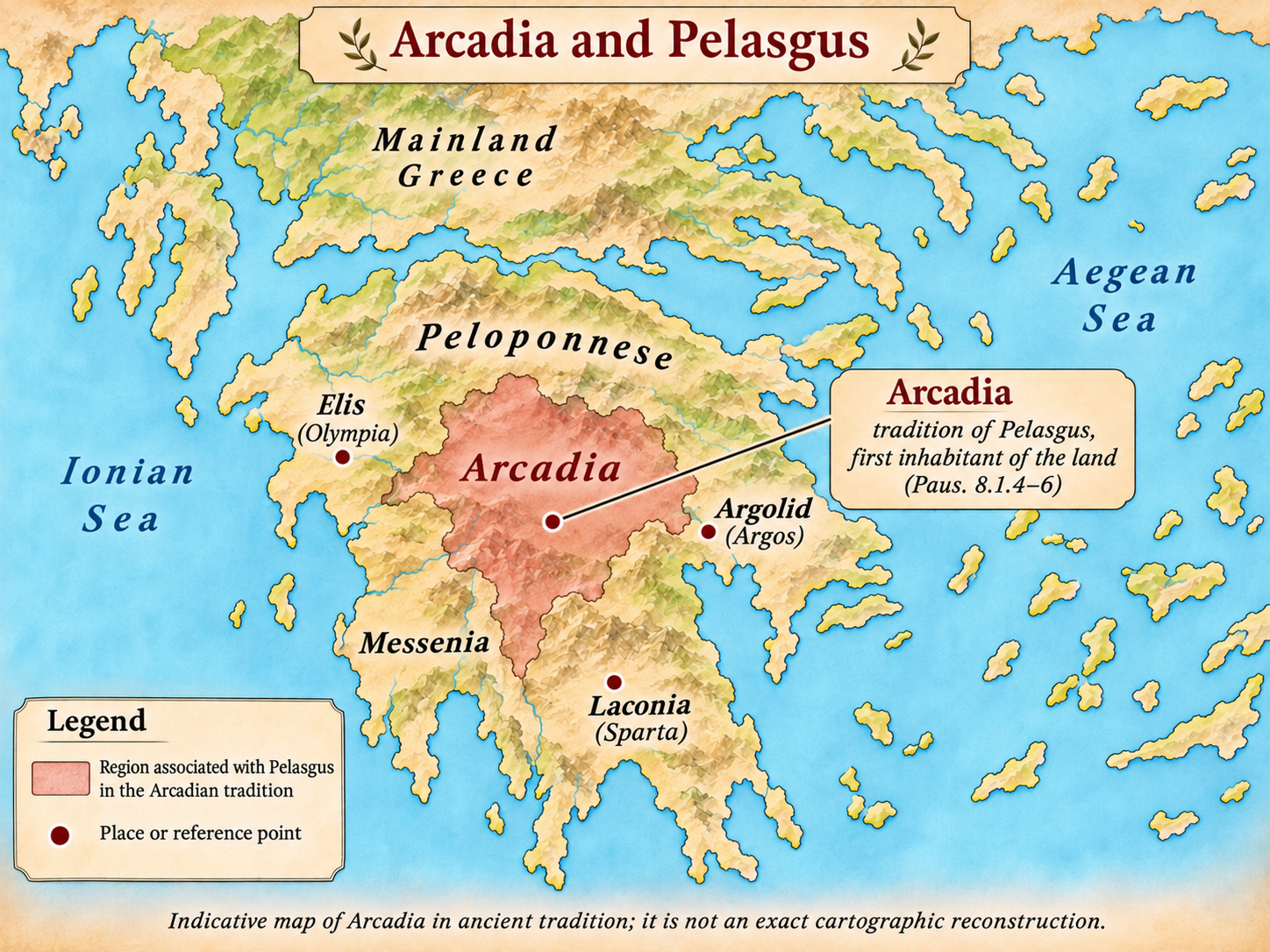
Arcadia and Pelasgus. A map of Arcadia, the mountainous region in the central Peloponnese. According to the tradition reported by Pausanias, Pelasgus was its first inhabitant and taught its people several practices essential to communal life (Description of Greece, 8.1.4–6). This local tradition personifies the origin of the Pelasgians in an ancestor born from the earth itself, without thereby establishing his historical existence or identifying all the peoples called Pelasgians with the inhabitants of Arcadia. The map is intended as an illustrative guide, not as an exact cartographic reconstruction. Map by the author.
By contrast, Acusilaus of Argos presents Pelasgus as the son of Zeus and Niobe and the brother of Argus, within a genealogy linking mythical ancestors to the origins of peoples and territories. This version survives in the Library attributed to Apollodorus (2.1.1), which explicitly names Acusilaus as its source. The anthology Hellenic Civilization also reproduces the testimony as fragment 12 among the excerpts from Acusilaus’ Genealogies.5
These different traditions cannot be combined into a single historical biography. In some accounts, Pelasgus springs from the earth; in others, he has divine parents, and the traditions associate him with different places. They help us understand what ancient writers sought to explain through his name, but they do not establish that a first man called Pelasgus actually existed.
Languages We Cannot Read
Sección titulada «Languages We Cannot Read»Our lack of knowledge also has a documentary dimension. Mycenaean tablets written in Linear B, a script used to record an early form of Greek, document administrative activities and the names of gods, some of whom are recognisable in the later Greek pantheon. No unequivocal mention of the Pelasgians has been identified in these texts. Linear A, used earlier in Minoan Crete, remains undeciphered. Although some of its signs have counterparts in Linear B, allowing scholars to propose approximate phonetic values, we still cannot reliably interpret the surviving inscriptions or identify their language with that of the Pelasgians.6
In Ancient Languages of the Balkans (1976), Radoslav Katičić examined a problem that often goes unnoticed: some linguists used “Pelasgian” as a conventional label for a language or linguistic substrate reconstructed from vocabulary and place names. Such a scholarly designation does not, in itself, identify its speakers with the Pelasgians mentioned by ancient authors. Katičić examined the proposals of Milan Budimir and Vladimir Georgiev, as well as the difficulties involved in attributing all traces of pre-Greek languages to a single linguistic source.
Later scholarship has not produced a single, generally accepted explanation. Beekes argued for a non-Indo-European Pre-Greek substrate, while Finkelberg examined possible connections with Anatolian languages. More recently, Friedman and Joseph (2025) have considered the possibility of different linguistic layers, including one or more that may have been Indo-European. These hypotheses, based mainly on vocabulary and place names, do not allow us to identify a distinct “Pelasgian” language or establish that all the evidence derives from a single population.7
J. L. Myres had already raised a methodological concern in A History of the Pelasgian Theory (1907): the testimonies of Homer, Herodotus, Ephorus and Pausanias should not be brought together as though they all described the same historical reality. His study examines how different theories about the Pelasgians developed and when particular claims first appeared. This approach helps us distinguish the history of what the Greeks believed from the history of what actually happened.8
At the end of this inquiry, we have not found a Pelasgian religion that we can describe with confidence. We know that certain Greeks attributed a language, ancestors and ancient religious practices to the Pelasgians. We also know that some divine names were documented long before Homer. What we do not know is whether any of those populations worshipped a creator goddess named Eurynome.
II · Eurynome: The Creation of the Universe According to Robert Graves
Sección titulada «II · Eurynome: The Creation of the Universe According to Robert Graves»The Pelasgian Creation Myth
Sección titulada «The Pelasgian Creation Myth»Robert Graves opens The Greek Myths, published in 1955, with an account entitled “The Pelasgian Creation Myth”. He attempts to reconstruct an ancient explanation of the origin of the universe which, in his interpretation, predates the religion of the Olympian gods.
In the beginning, there was only Chaos. From it emerged Eurynome, whom Graves calls the Goddess of All Things. She appeared naked but found nothing solid on which to rest her feet. She therefore separated the sea from the sky and began to dance alone upon the waters.
As she moved southward, her movements stirred a wind. Eurynome realised that she could use this force to begin creation. She turned, caught the north wind in her hands and rubbed it between them until an enormous serpent, Ophion, emerged.
The goddess continued dancing with ever greater intensity. Ophion, aroused by her movements, coiled around her body and mated with her. From their union, Eurynome became pregnant.
In due course, the goddess took the form of a dove and, resting upon the waters, laid an egg: the Universal Egg. At her request, Ophion coiled around it seven times and remained there until it split into two halves.
Everything that exists emerged from that egg: the Sun, the Moon, the planets, the stars and the Earth, with its mountains, rivers, trees, plants and animals. The universe had been born.
Eurynome and Ophion then made their home on Mount Olympus. Ophion, however, began claiming that he had created the world, provoking the goddess’s anger. Eurynome struck him on the head with her heel, kicked out his teeth and banished him to caverns beneath the earth.
She then organised the government of the universe. She created seven celestial powers, corresponding to the Sun, the Moon and the five planets known in antiquity, and placed a divine pair—a Titan and a Titaness—over each one. Theia and Hyperion were associated with the Sun; Phoebe and Atlas with the Moon; Dione and Crius with Mars; Metis and Coeus with Mercury; Themis and Eurymedon with Jupiter; Tethys and Oceanus with Venus; and Rhea and Cronus with Saturn.
Finally, Graves introduces the first man, Pelasgus, who sprang from the earth of Arcadia. Other men appeared after him. Pelasgus taught them to build shelters against the weather, wear skins and eat acorns.
Graves thus begins the history of humankind with a figure whose name coincides with that of the people who, according to numerous Greek traditions, had inhabited different regions before the spread of the Hellenes.
The narrative thus establishes a connection between the birth of the universe, the establishment of the first divine order and the appearance of the Pelasgians.9
The Sources Used by Graves
Sección titulada «The Sources Used by Graves»The narrative is coherent and contains all the elements of a cosmogony: the state before creation, a primordial deity, the emergence of the world, the establishment of an order among the gods and the birth of the first human beings.
It does not, however, survive as a complete narrative in any known ancient work.
Graves offers his own interpretation based on fragmentary evidence. To reconstruct it, he combines Greek texts, Near Eastern traditions, accounts of the earliest inhabitants of Greece and comparisons between religious traditions.
Let us examine the principal sources on which he draws.
1. Eurynome and Ophion: Apollonius of Rhodes and the Scholia to Lycophron
Sección titulada «1. Eurynome and Ophion: Apollonius of Rhodes and the Scholia to Lycophron»In the Argonautica of Apollonius of Rhodes (1.496–511), composed in the third century BCE, Orpheus sings to his companions about the origins and organisation of the world.
His song recalls a time when earth, sky and sea were joined together and describes how they were separated after a violent conflict. He then mentions Ophion and Eurynome, daughter of Oceanus, as the former rulers of Olympus.
Ophion lost his power to Cronus, while Eurynome yielded hers to Rhea. Both were cast into the waters of Oceanus. Cronus and Rhea then ruled over the Titans, while Zeus was still a child living in a cave on Mount Dicte.
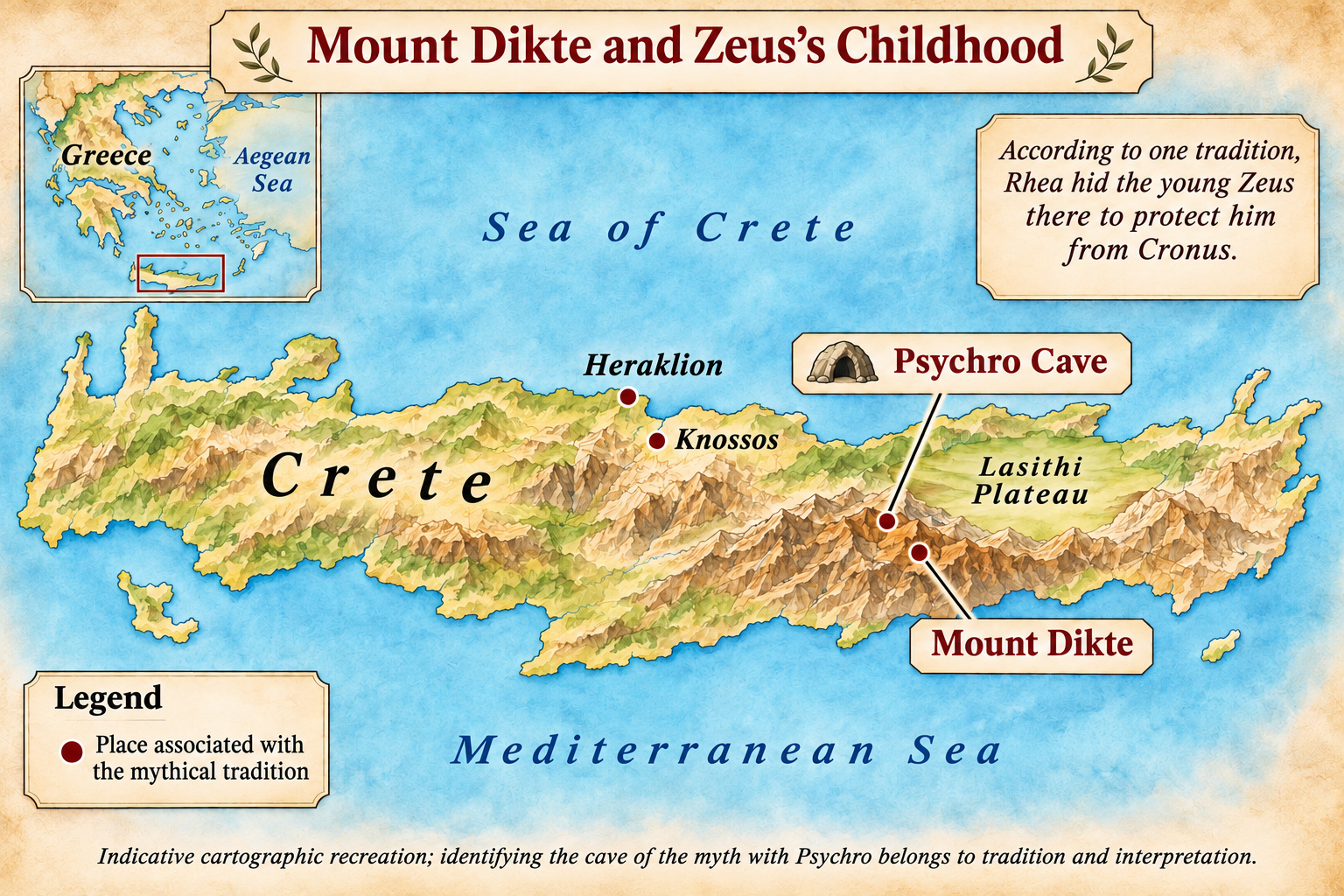
Mount Dicte and the Childhood of Zeus. A map of Crete showing the Dikte Mountains in the eastern part of the island. According to one ancient tradition, Zeus was hidden in a cave in these mountains during his childhood, protected from his father, Cronus. The cave of Psychro, near the Lasithi Plateau, is often identified with the mythical Dictaean Cave, although this identification remains uncertain. Archaeological evidence cannot establish the precise location of the events described in the myth. Map by the author.
This is one of the most important references for Graves’ reconstruction, as it attests to a tradition in which Eurynome and Ophion ruled before Cronus and Rhea.
A similar account appears in Lycophron’s Alexandra (1191 ff.) and in the ancient scholia explaining the passage. It recalls the reign of Ophion and Eurynome, daughter of Oceanus, over the gods, although it does not explain how they came to power. Other sources preserve differing traditions concerning their downfall: Apollonius of Rhodes (Argonautica, 1.503–506) relates that they were defeated by Cronus and Rhea and cast into Oceanus, while Lycophron describes Eurynome being hurled into Tartarus.
Both texts preserve a tradition of an earlier divine order in which Eurynome and Ophion held power. Neither describes Eurynome’s emergence from Chaos, her creative dance or the birth of the universe from an egg. These elements belong to Graves’ reconstruction, in which he brought together material from different traditions.10
2. Fertilisation by the Wind: Homer and Pliny
Sección titulada «2. Fertilisation by the Wind: Homer and Pliny»Graves finds a parallel for the union of Eurynome and Ophion in ancient beliefs about the fertilising power of the wind.
In the Iliad (20.221–229), Aeneas recounts how Boreas, the north wind, fell in love with mares belonging to Erichthonius. Taking the form of a dark-maned stallion, he mated with them. Their union produced twelve exceptionally swift fillies, capable of running over ears of grain without breaking them and across the waves of the sea.
Pliny the Elder records a different belief in his Natural History (4.35 and 8.67). In Lusitania, near Olisipo and the River Tagus, mares were said to conceive through the action of the west wind, without the intervention of a stallion. According to this account, the resulting foals were remarkably swift, although they lived no longer than three years.
Both authors preserve traditions about the fertilising power of the wind, but their accounts differ. In Homer, Boreas takes the form of a stallion and mates with the mares; in Pliny, the wind itself is believed to cause conception. Graves draws on this motif to explain Eurynome’s pregnancy, but neither author connects it with the goddess or identifies Boreas with Ophion.
3. The Primordial Egg and the Doves: Orphic Traditions and Hyginus
Sección titulada «3. The Primordial Egg and the Doves: Orphic Traditions and Hyginus»The egg as the source of divine beings or of the universe appears in several ancient traditions.
Some Orphic cosmogonies—accounts of the origins of the world and the gods attributed to the legendary Orpheus—describe a primordial egg from which a deity known as Phanes or Protogonos (“First-born”) emerges. This figure plays a central role in the origin and ordering of the universe. These traditions have survived in different versions and in testimonies from various periods.
Aristophanes provides another example in Birds (693–702). In a comic account of the origins of the world, the chorus of birds describes how Night lays an egg in the darkness of Erebus. From it emerges Eros, whose wings shine with gold. His subsequent actions make possible the birth of the gods and the world as we know it.
Graves also cites Hyginus, Fabulae, 197. According to this account, an enormous egg falls from the sky into the River Euphrates. Fish push it towards the bank, where doves settle upon it and keep it warm. From the egg emerges Venus, who was later called the Syrian Goddess.
The account preserved by Hyginus brings together three elements found in Graves’ reconstruction: water, an egg and doves. But Eurynome does not lay this egg, nor does the universe emerge from it.11
4. Divine Generations and the Titans: Hesiod and Other Authors
Sección titulada «4. Divine Generations and the Titans: Hesiod and Other Authors»To construct his system of seven divine pairs, Graves draws on names and relationships found in different ancient genealogies.
In the Theogony (133–138), Hesiod names six Titans and six Titanesses among the children of Gaia and Uranus. The Library attributed to Apollodorus (1.1.3) preserves a similar genealogy but includes Dione as a seventh Titaness.
Graves draws on these names, together with those of other deities such as Metis and Atlas, to divide the rule of the universe among seven divine pairs associated with the Sun, the Moon and the five planets known in antiquity.
However, these pairs do not form a system found in either Hesiod or Apollodorus. Some of the figures chosen by Graves belong to different divine generations, and neither source attributes the creation of this planetary order to Eurynome.
The arrangement is therefore Graves’ own reconstruction, combining mythological material and astrological associations drawn from different traditions.
5. Pelasgus, the First Man: Asius of Samos and Pausanias
Sección titulada «5. Pelasgus, the First Man: Asius of Samos and Pausanias»The final episode brings us back to the question of the Pelasgians.
In the Description of Greece (8.1.4–6), Pausanias records an Arcadian tradition according to which Pelasgus was the first inhabitant of the region. To explain his birth, he quotes verses by the poet Asius of Samos, in which Pelasgus emerges from the earth itself.
Pausanias adds that Pelasgus became king and taught his people to build huts to protect themselves from cold, rain and heat, to make clothing from animal skins and to eat edible acorns instead of plants and roots that might be harmful.
Graves draws on the main elements of this account but incorporates Pelasgus into his cosmogony as the first man to appear after the creation and ordering of the universe.
Pausanias establishes no connection between Pelasgus and Eurynome. Nor does he identify Ophion as the ancestor of the Pelasgians.
There is also a discrepancy concerning clothing: Graves mentions pigskins, whereas the Greek text of Pausanias refers to sheepskins. Some older English translations of Pausanias also mention pigskins, which may help explain the difference.
6. The Peloria: Athenaeus and the Thessalian tradition
Sección titulada «6. The Peloria: Athenaeus and the Thessalian tradition»Graves finds another possible connection with the origins of the Pelasgians in a festival called the Peloria, described by Athenaeus in the Deipnosophistae (14.639e–640a), drawing on an account by Baton of Sinope.
According to this tradition, while the Pelasgians were performing a communal sacrifice, a man named Pelorus brought news to Pelasgus that powerful earthquakes had opened a passage through the mountains at Tempe. The waters of a lake had begun to flow through the opening into the River Peneus. As the waters receded, vast plains of extraordinary size and beauty came into view.
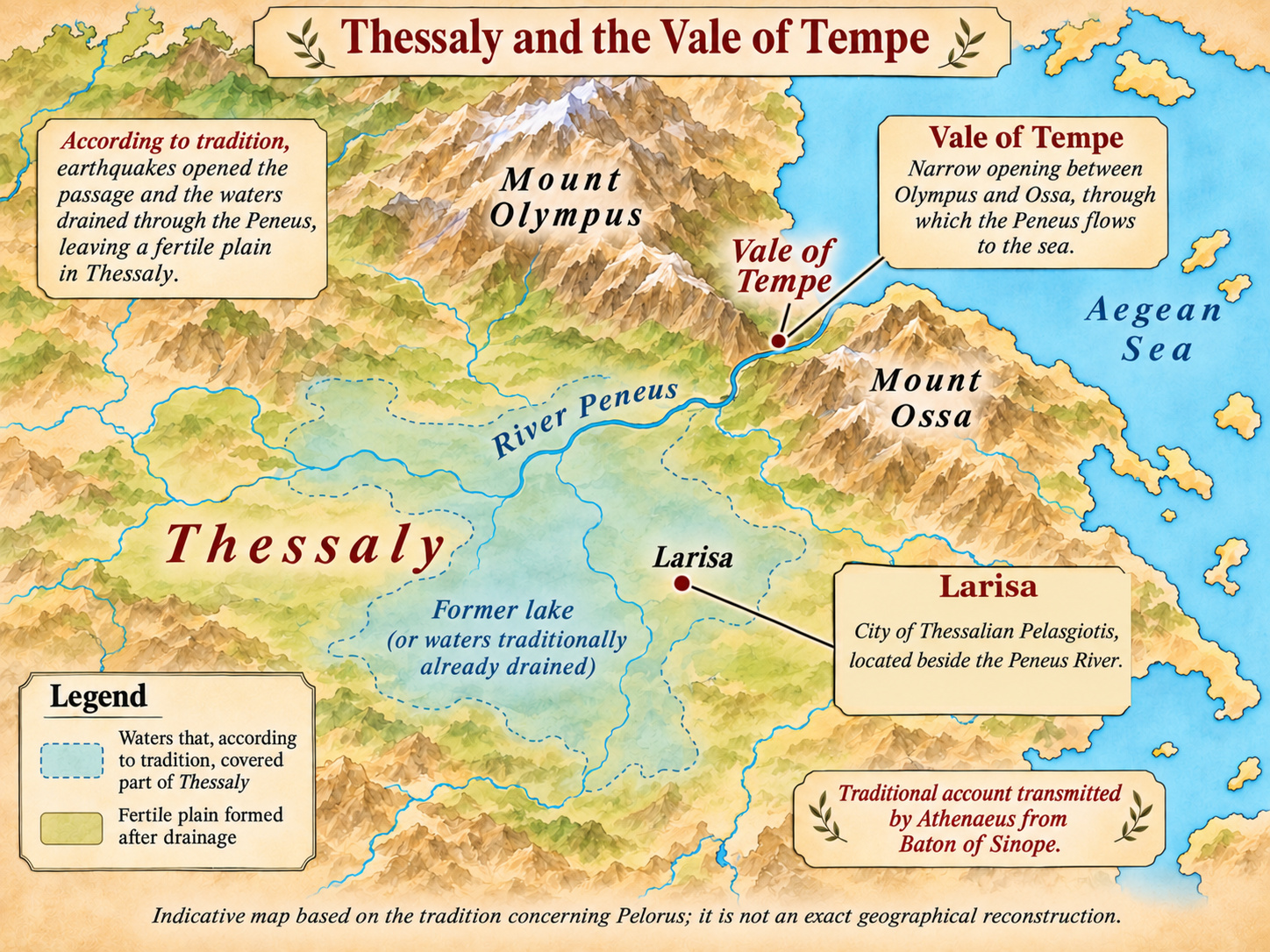
Thessaly and the Vale of Tempe. A map illustrating the tradition transmitted by Athenaeus from Baton of Sinope, according to which earthquakes opened a passage between Mount Olympus and Mount Ossa, allowing the waters of Thessaly to drain towards the sea through the River Peneus. Locations are approximate. Map by the author.
Pelasgus welcomed the messenger with a great banquet and served him personally, as did other leading figures. To commemorate the event, the Thessalians celebrated the Peloria, a festival at which sacrifices were offered to Zeus Pelorius, banquets were held and social relations were temporarily reversed: slaves were served by their masters.
Graves connects this celebration with Ophion, whom he interprets as a pelōr, a prodigious or monstrous serpent, and suggests that the festival preserved the memory of this primordial being. He even proposes that the Pelasgians were descended from Ophion, linking this idea to the mythical motif of men springing from a dragon’s teeth.
Athenaeus, however, does not mention Ophion or connect the origins of the Pelasgians with a serpent’s teeth. The festival described in his account was dedicated to Zeus Pelorius. The association with Ophion belongs to Graves’ reconstruction.
7. Eastern Traditions and Graves’ Interpretation
Sección titulada «7. Eastern Traditions and Graves’ Interpretation»Graves completes his reconstruction by drawing on other ancient cosmogonies. In the Babylonian account of Berossus, preserved indirectly through Alexander Polyhistor, Eusebius and George Syncellus, the god Bel divides Omorca, a primordial female figure associated with the sea, into two halves to form heaven and earth. Philo of Byblos, whose account is preserved by Eusebius (Preparation for the Gospel, 1.10.1–2), describes dark air, wind, desire and the emergence of Mot in a narrative about the origins of the universe that also includes an image of an egg. Damascius (On First Principles, 125), in turn, records different Phoenician traditions, including one attributed to Mochus of Sidon in which a primordial egg is associated with the separation of heaven and earth. These are distinct parallels, not versions of a single account concerning Eurynome and Ophion.
Graves further interprets the myth as a remnant of an ancient religion centred on a universal goddess, whose worship, in his view, preceded religious systems dominated by male deities.
In his commentary, he goes so far as to suggest that the Pelasgians descended from Neolithic populations that had reached Greece from Palestine, and that their society had been organised around female authority.
It is important to distinguish these hypotheses from what the ancient texts actually tell us. Neither the existence of female divinities nor the similarities between different creation myths demonstrate that the Pelasgians shared a single religion or that their society was governed by women.
These sources belong to different periods and traditions and, in some cases, have reached us through several intermediaries. Graves also maintains that his reconstruction is implicit in the Orphic mysteries and draws on what he regards as Canaanite elements in the Hebrew creation story. Some Orphic cosmogonies describe a primordial egg from which a deity, identified in certain versions as Phanes, emerges. In Genesis (1.2), we find primordial waters and the spirit or wind of God moving over them, depending on the interpretation of the Hebrew expression. None of these testimonies, however, identifies Eurynome as the creator of the universe or describes her union with Ophion. The similarities help us understand Graves’ comparative method, but they do not allow us to reconstruct a Pelasgian cosmogony.12
Why Does Graves Call This Myth “Pelasgian”?
Sección titulada «Why Does Graves Call This Myth “Pelasgian”?»The answer takes us back to the evidence examined in the preceding chapter. Greek authors placed the Pelasgians in different regions and associated them with a remote past. Homer mentions them among the Trojan allies and in a description of Crete put into the mouth of Odysseus. Herodotus attempts to discover what language they spoke, while Thucydides recalls that their name had once been among the most widespread before the name “Hellenes” came into general use.
There were also traditions in which Pelasgus, the supposed ancestor of the people who bore his name, was born directly from the earth.
Graves brings these accounts together and gives them a common interpretation: he regards the Pelasgians as the bearers of a religion that preceded the Olympian order, whose creation myth could be recovered through comparisons between different Mediterranean traditions.
The ancient evidence, however, does not confirm this reconstruction. Herodotus, for example, reports that the Pelasgians originally invoked the gods without giving them individual names and later adopted names said to have come from Egypt (Histories, 2.52). He does not mention Eurynome or present the Pelasgians as worshippers of a single goddess. Nor does Apollonius of Rhodes, who preserves the clearest surviving account of the former rule of Eurynome and Ophion, identify them as Pelasgian deities.
The importance of Graves’ account therefore lies in the interpretation he proposes. We are not dealing with the complete recovery of a lost ancient myth, but with a modern reconstruction that combines genuine ancient testimonies, mythological parallels and hypotheses about religions predating the Olympian order.
And that is precisely what makes his account interesting. It introduces us to an ancient tradition in which Eurynome and Ophion once ruled Olympus, allows us to recognise similarities between different cosmogonies and shows how scholars have attempted to reconstruct Greece’s religious past.
But it also brings us back to the difficulty with which our investigation began: we know far more about what the Greeks, and later modern scholars, believed about the Pelasgians than we do about the beliefs of the Pelasgians themselves.
We shall now leave Graves’ reconstruction aside and return to the ancient sources. Eurynome also appears in Homer and Hesiod, but in very different circumstances. Their poems will help us understand the place this goddess occupied in the Greek traditions that have come down to us.
III · Homer’s Gods: A World Already in Existence
Sección titulada «III · Homer’s Gods: A World Already in Existence»Homer as Narrator
Sección titulada «Homer as Narrator»Homer does not introduce his gods by beginning with the stories of their births. When the Iliad opens, Apollo can already punish the Achaeans, Athena intervenes to restrain Achilles’ anger, Hera argues with Zeus, and Olympus is home to a society of immortals with its own alliances, rivalries and hierarchies.
The gods have histories, family relationships and conflicts that the poet does not need to explain from the beginning. Homer recounts their actions and interventions in the human world. His poems do not set out to provide a complete account of the gods’ origins, but to tell stories in which gods participate alongside mortals, influence their decisions and sometimes determine their fate.
Nevertheless, the poems preserve allusions to an earlier divine past that deserves our attention. Some gods bear names or epithets whose antiquity and meaning cannot always be established; others recall events preceding the order established under Zeus or refer to family relationships that offer glimpses of different traditions about the origins of the gods.
These references must be interpreted with particular attention to who is speaking and under what circumstances. In the Homeric poems, characters remember, exaggerate, deceive and sometimes give different accounts of the same event. Their words should not automatically be treated as statements made by the narrator himself. To understand their value as evidence for mythological traditions, we must consider the context in which they are spoken.
Eurynome alongside Thetis
Sección titulada «Eurynome alongside Thetis»In the Iliad (18.394–405), Hephaestus recalls how his mother Hera, wishing to conceal him because of his lameness, caused him to fall from Olympus. Thetis, the Nereid and mother of Achilles, and Eurynome took him in and protected him in a cave surrounded by the waters of Oceanus. There he spent nine years making brooches, bracelets, necklaces and other ornaments in bronze. Homer explicitly identifies Eurynome as the daughter of Oceanus. The episode centres on the craftsman god’s gratitude towards those who saved him, rather than on the origins of these divinities.
In this account, Eurynome does not appear alone at the beginning of time, but alongside Thetis and with an established parentage. Nothing is said of Ophion, the primordial egg or the Pelasgians. This does not mean that Homer was denying the existence of other traditions about the goddess: he simply does not recount them. His silence marks a limit to our evidence, not a refutation.13
Oceanus and Tethys: A Different Origin
Sección titulada «Oceanus and Tethys: A Different Origin»In Book 14 of the Iliad, the Achaeans are in desperate straits. The Trojans have breached the camp’s defences and are fighting near the ships. Zeus favours the Trojans, while Hera, who supports the Achaeans, watches the course of the battle with concern. Poseidon has begun to help the Greeks, but is acting behind his brother Zeus’ back.
Hera decides to intervene. To prevent Zeus from discovering what is happening, she plans to seduce him and have him put to sleep. She carefully adorns herself and approaches Aphrodite, asking to borrow her power to inspire love and desire. Knowing that Aphrodite favours the Trojans, Hera conceals her true intention. Instead, she claims that she wishes to reconcile Oceanus and Tethys, an ancient divine couple who have long been estranged by a quarrel. This Tethys, the Titaness, is not the Nereid Thetis who had sheltered Hephaestus.
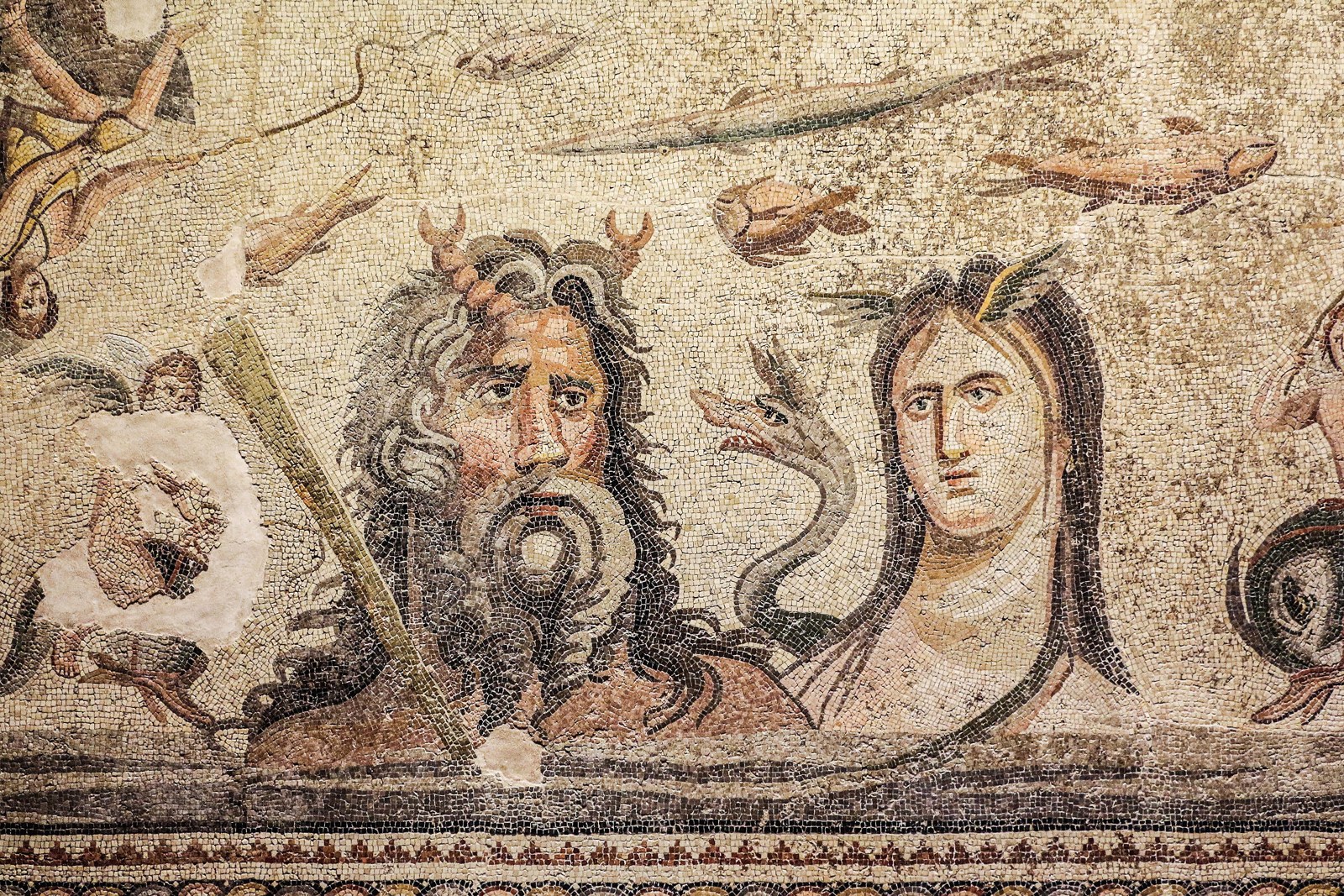
Oceanus and Tethys. Roman mosaic from Zeugma (present-day Türkiye), dated to the second or third century CE. The two marine deities are depicted alongside aquatic creatures. In the Iliad (14.200–204), Hera describes Oceanus as the origin of the gods and refers to Tethys as “mother”, recalling how the divine couple cared for her. The mosaic is much later than Homer, but illustrates the continued presence of this divine couple in ancient art. Zeugma Mosaic Museum, Gaziantep. Photograph by Bernard Gagnon, Wikimedia Commons, CC BY-SA 3.0. Original photograph and licence.
It is then that Hera speaks words of particular interest to our investigation:
I am going to the ends of the fertile earth, to Oceanus, the origin of the gods, and to mother Tethys, who welcomed me into their home and lovingly brought me up after receiving me from Rhea, when far-seeing Zeus cast Cronus beneath the earth and the barren sea.
The statement is extraordinary: Hera presents Oceanus as the origin of the gods and calls Tethys “mother”. The couple had taken her in from Rhea, her own mother, at the time when Zeus cast Cronus beneath the earth and the sea.
Aphrodite, unaware of Hera’s deception, gives her an embroidered girdle with the power to inspire love and desire. Hera has obtained what she needs, but must still ensure that Zeus falls asleep. She therefore seeks the help of Sleep, Hypnos, who initially refuses for fear of Zeus’ reprisals. He has suffered the supreme god’s anger before and does not wish to experience it again.
During this conversation, Sleep also mentions Oceanus. He claims that he could lull even the flowing waters of that god, whom he calls the “origin of all”, but that he would not dare approach Zeus without his consent (Iliad, 14.243–249).
Hera finally persuades Sleep by promising him Pasithea, one of the Charites, as his wife. The Charites were goddesses associated with beauty, grace and charm. Hera and Sleep then make their way to Mount Ida, where Zeus is watching the battle. When he sees Hera approaching, he is overcome by desire. She repeats her story: she intends to visit Oceanus and Tethys to reconcile them. Zeus proposes that she postpone the journey and remain with him.
The deception succeeds. Zeus and Hera make love, and Sleep then lulls Zeus to sleep. While he sleeps, Poseidon is able to intervene openly on behalf of the Achaeans.
For our investigation, the significant point is that Oceanus is associated with the origins of divine life in the speeches of two characters. Hera calls him the “origin of the gods”, an expression she repeats when speaking to Zeus, while Sleep calls him the “origin of all”. These words do not form part of a systematic account of how the universe came into being. They occur in conversations between characters pursuing other purposes.
The agreement between Hera’s and Sleep’s words suggests that Homer could draw on a tradition attributing a primordial role to Oceanus. The presence of Tethys beside him invites us to consider the significance of this ancient divine pair, although the verses provide no complete genealogy and do not allow us to reconstruct with confidence the wider narrative to which they may have belonged.
The difference from Hesiod is revealing. In the Theogony, Oceanus and Tethys are children of Gaia and Uranus and therefore belong to the generation of Titans. The comparison shows that the poems preserve different ways of presenting the earliest divine powers. We do not know whether these formulations arose from independent traditions, reflected different understandings of the generative power of water or belonged to larger narratives that have since been lost. What matters is to recognise these differences without attempting to resolve them through explanations that the sources themselves do not provide.14
Pelasgian Zeus and the Oak at Dodona
Sección titulada «Pelasgian Zeus and the Oak at Dodona»Let us return to Zeus. In the Iliad (16.233–235), Achilles invokes him as the god of Dodona and calls him “Pelasgian”. He also mentions the Selloi, interpreters of the god’s will, who slept on the ground and went with unwashed feet. In the Odyssey (14.327–330; 19.296–299), Odysseus, concealing his identity, tells Eumaeus and Penelope that Odysseus himself had gone to Dodona to consult Zeus’ will through the sacred oak. The account forms part of his invented stories, but it suggests that Dodona’s oracular tradition would have been familiar to the poem’s audience.
Archaeology provides further evidence of the sanctuary’s antiquity. Objects dating from the Bronze Age and early Iron Age have been found, some of which have been interpreted as votive offerings. However, no area specifically dedicated to worship before the eighth century BCE has been securely identified. These finds do not allow us to attribute such practices to the Pelasgians or to demonstrate that an earth deity was originally worshipped there and subsequently replaced by Zeus. The association between Zeus, Dodona and the Pelasgians does not reveal the god’s historical origins or allow us to identify a religion predating Mycenaean civilisation with Graves’ reconstruction. The precise significance of the epithet “Pelasgian” remains uncertain.
In short, Homer presents a divine world that is already populated and fully active. Within it, we can recognise names, cults and family relationships, and occasionally find allusions to different traditions about the origins of the gods. What we do not find is a systematic account of how that world came into existence. For that, we must turn to another poet.
IV · Hesiod: Ordering the Universe through Divine Generations
Sección titulada «IV · Hesiod: Ordering the Universe through Divine Generations»A Poem That Sets Out to Explain
Sección titulada «A Poem That Sets Out to Explain»The very title of Hesiod’s Theogony announces its subject: the origins of the gods. The poet invokes the Muses and describes the emergence of the earliest powers of the universe, the birth of successive divine generations, their conflicts and, finally, the establishment of Zeus’ rule. The Theogony is a work of poetry, but it also has a clear explanatory purpose. Hesiod does more than tell stories about the gods: he seeks to order their origins, establish their relationships and explain how the divine world came to take shape.
Herodotus later recognised this organising role when he credited Homer and Hesiod with establishing divine genealogies, giving the gods their names and epithets, assigning them their honours and functions, and describing their forms (Histories, 2.53). The anthology Hellenic Civilization (1915) reproduces Theogony 116–138 under the heading “The Creation of Earth, Heaven, and the Gods”. It offers a useful introduction to the ancient passage, although its editorial presentation belongs to the scholarship of the early twentieth century.15
In the Beginning Was Chaos
Sección titulada «In the Beginning Was Chaos»After its opening invocation to the Muses, the Theogony begins its account of the origins of the world with Chaos (116–122). Next come broad-bosomed Gaia, Tartarus in the depths of the earth and Eros, an irresistible power over gods and mortals alike. The poem does not explain where Chaos came from or present it as a creator god who deliberately fashioned the world. At the beginning of Hesiod’s account, rather than a craftsman creating the universe, we encounter the earliest powers from which the world and its divine generations will emerge.
From Chaos come Erebus and Night. From their union are born Aether and Day. Gaia, meanwhile, brings forth Uranus, the starry sky that covers her, as well as the mountains and Pontus, the sea. These she produces without a divine partner, before uniting with Uranus (Theogony, 123–138). Here we can already recognise something fundamental: the world takes shape through the emergence, birth and union of powers that are at once cosmic realities and divine beings.
Gaia, Uranus and the First Generations
Sección titulada «Gaia, Uranus and the First Generations»From the union of Gaia (Earth) and Uranus (Sky) come the Titans, including Oceanus, Tethys, Rhea and Cronus. The couple also give birth to the Cyclopes and the Hundred-Handers, beings of extraordinary strength. Hesiod thus introduces the first generations of an extensive divine family whose members will occupy different places within the order of the universe.
Among the Titans are Oceanus and Tethys, whose children include numerous rivers and the Oceanids, a vast group of female divinities associated with the earth and its waters (Theogony, 337–370). Eurynome is one of these Oceanids, a daughter of Oceanus and Tethys (Theogony, 358). She therefore occupies a clearly defined place in the divine genealogy: she appears not as a primordial power, but as a descendant of an earlier generation.16
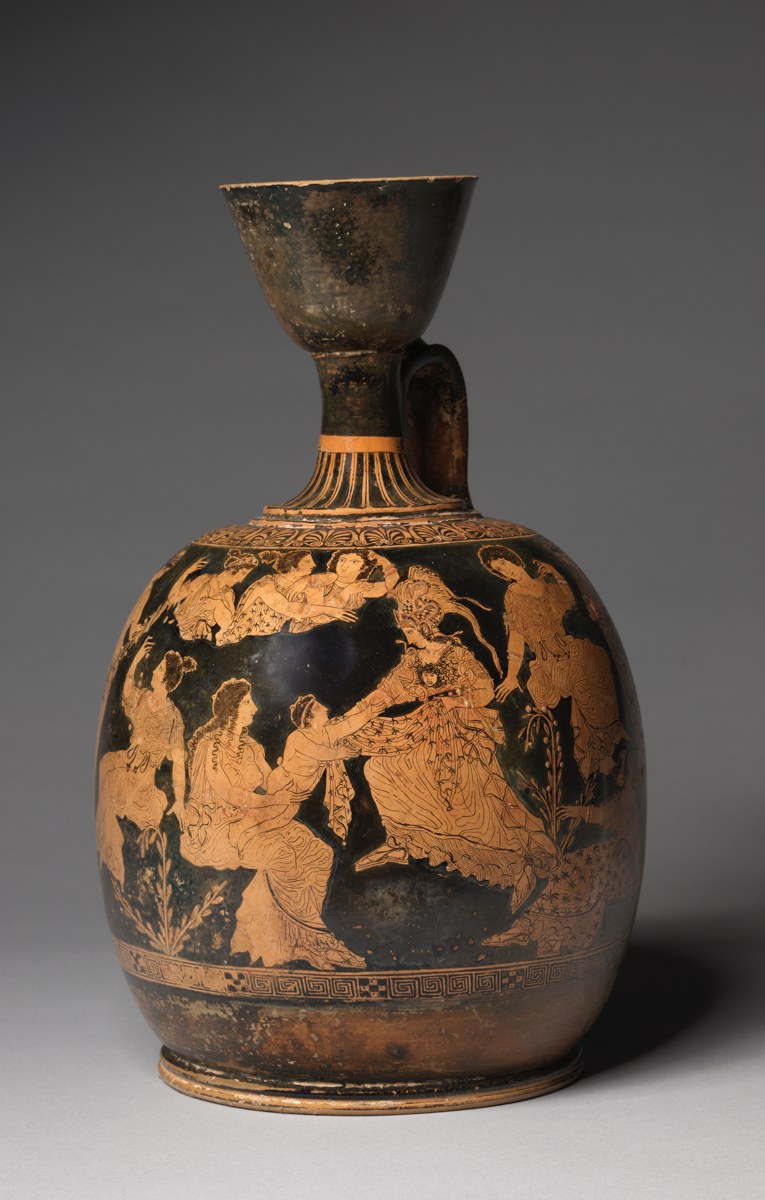
Gaia Entrusts Erichthonius to Athena. Attic red-figure lekythos with gilded details, attributed to the Meidias Painter, c. 420–410 BCE. Gaia, the Earth goddess, is shown handing the infant Erichthonius to Athena, surrounded by other female figures. According to Athenian tradition, Erichthonius was born from the earth following an episode involving Hephaestus. The scene does not illustrate Hesiod’s cosmogony, but it presents Gaia as a divine source of life. Cleveland Museum of Art, inv. 1982.142, Leonard C. Hanna Jr. Fund. Museum photograph, CC0. Original museum record and photograph.
The relationships among these early divine generations are not peaceful, however. Uranus hides his children inside Gaia as soon as they are born, preventing them from emerging into the light. Burdened by the offspring imprisoned within her, Gaia devises a plan to put an end to her suffering and punish Uranus for his actions. Cronus, the youngest Titan, is the only one who dares to act against his father, castrating him with a sickle fashioned by Gaia (Theogony, 154–210)).
From Cronus to Zeus
Sección titulada «From Cronus to Zeus»The fall of Uranus does not bring the conflicts between divine generations to an end. Cronus unites with his sister Rhea, but, having learned that one of his children is destined to overthrow him, he swallows each child as it is born. Rhea manages to save the youngest, Zeus, by hiding him and giving Cronus a stone wrapped in swaddling clothes. Zeus grows up far from his father and eventually succeeds in forcing Cronus to release the children he had swallowed, with Gaia’s counsel also playing a part (Theogony, 453–506).
A new struggle for power then begins. Zeus and his allies confront the Titans in a battle of cosmic proportions. After defeating them, Zeus must still face Typhoeus, a monstrous adversary born of Gaia and Tartarus. With Typhoeus defeated, Zeus’ supremacy is secured (Theogony, 617–735; 820–868).
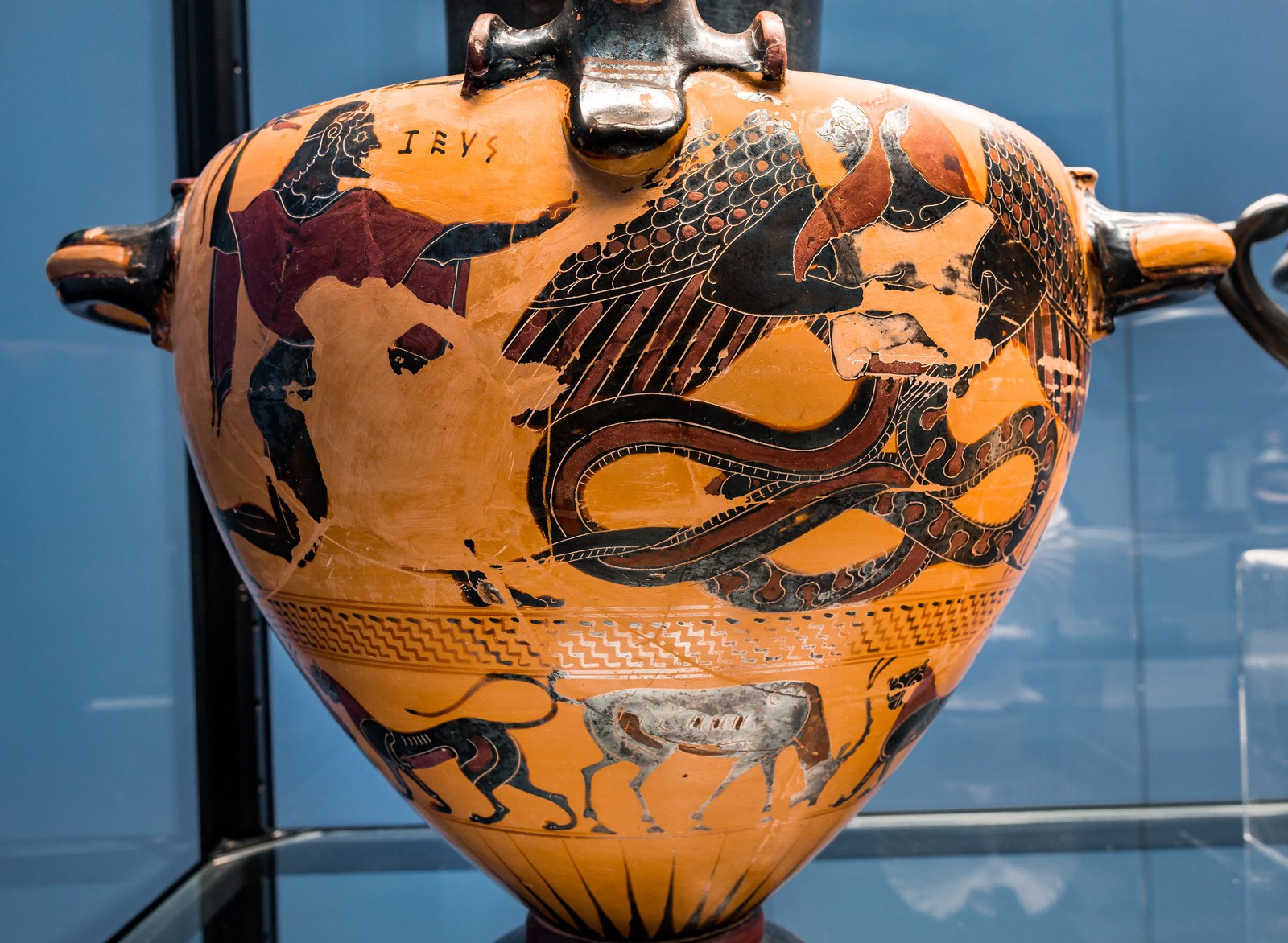
Zeus Confronting Typhoeus. Detail of a Chalcidian black-figure hydria, c. 550–530 BCE, found at Vulci (Italy). Zeus is depicted attacking Typhoeus with his thunderbolt. The monstrous adversary’s defeat secures Zeus’ supremacy over the gods, as recounted by Hesiod in the Theogony (820–868). Staatliche Antikensammlungen, Munich, inv. 596. Photograph by Bibi Saint-Pol, Wikimedia Commons, public domain. Original photograph and licence.
The succession of these confrontations is one of the central threads of the Theogony. Hesiod does not merely enumerate births and family relationships: he explains how a universe inhabited by opposing powers comes to acquire order. Once the struggles are over, the gods, following Gaia’s advice, call upon Zeus to rule over them. He then distributes their honours and spheres of authority (Theogony, 881–885). His reign establishes a new divine order intended to endure.17
The Theogony brings together and poetically organises different mythological traditions and motifs, but it is not a record of a single religious doctrine shared throughout Greece. Nor does its account necessarily agree with the traditions preserved in Homer, although the two works share many gods, stories and mythological elements.
Eurynome Once Again
Sección titulada «Eurynome Once Again»When Hesiod describes Zeus’ unions, Eurynome reappears. He identifies her as a daughter of Oceanus and relates that her union with Zeus produced the three Charites: Aglaea, Euphrosyne and Thalia (Theogony, 907–911). The goddess who protected Hephaestus in a sea cave in Homer now appears in a different role, as the mother of three of Zeus’ daughters.
We therefore have two ancient testimonies that identify Eurynome as a daughter of Oceanus, but present her in different roles: Hephaestus’ protector in Homer and the mother of the Charites in Hesiod. Neither poet claims that Eurynome emerged from Chaos or created the universe, or presents her as a deity specifically associated with the Pelasgians.
We do not know whether other versions once existed that have not survived. Several centuries later, Apollonius of Rhodes preserves a tradition in which Eurynome once ruled alongside Ophion. But we must keep in mind the distinction between a tradition genuinely attested in ancient sources and the reconstruction of an entire cosmogony.
Eurynome in Arcadia: A Goddess Who Received Worship
Sección titulada «Eurynome in Arcadia: A Goddess Who Received Worship»Alongside the mythological accounts, we also have evidence that Eurynome received worship. In the second century CE, Pausanias describes a sanctuary dedicated to her near Phigalia in Arcadia, at the confluence of the rivers Lymax and Neda. The sanctuary was surrounded by cypress trees and was difficult to reach because of the rugged terrain.
According to Pausanias, the sanctuary was opened only one day each year, when sacrifices were offered both publicly and by private individuals. The inhabitants of Phigalia did not all agree about the goddess’s identity. Some regarded Eurynome as an epithet of Artemis; others, who preserved ancient traditions, identified her as the daughter of Oceanus mentioned by Homer—the goddess who had sheltered Hephaestus alongside Thetis.
The cult image was particularly unusual. Pausanias reports that it was a wooden figure bound with golden chains, representing a woman down to the hips, with the lower part of her body in the form of a fish. He acknowledges that he did not see it himself, because he had not arrived during the annual festival. His description therefore comes from what the people of Phigalia told him.
Pausanias suggests that the figure’s fish-like form might be explained by the marine associations of Oceanus’ daughter, but finds it difficult to reconcile with the identification of Eurynome as Artemis (Description of Greece, 8.41.4–6).
This testimony matters because it shows that Eurynome was more than a name preserved in poetry. In the Arcadia described by Pausanias, a sanctuary was dedicated to a goddess of that name, although the local inhabitants preserved different explanations of her identity. We do not know when the cult began, nor can we confidently connect it with a religion predating the Greeks. Nor does this evidence show that Eurynome was regarded as the creator of the universe.
But we now know a little more about her: alongside the poetic traditions we have examined, we have the testimony of a community that maintained a sanctuary in her honour and offered her sacrifices.18
What We Have Found—and What We Still Do Not Know
Sección titulada «What We Have Found—and What We Still Do Not Know»We began our investigation by searching for the origins of the Greek gods in a past before Olympus. Along the way, we encountered the name of the Pelasgians, the traditions preserved about them by ancient writers, and different accounts of the birth and earliest generations of the gods. But we have not found a Pelasgian religion that we can reliably reconstruct, or evidence that these populations worshipped a creator goddess called Eurynome.
Robert Graves attempted to recover that vanished world by bringing together testimonies from different periods and traditions. His story of Eurynome and Ophion contains elements that can be identified in ancient sources, but the complete narrative he constructed is not preserved in any of them. We have been able to trace some of its components and, at the same time, to see how extensively the reconstruction depends on Graves’ own interpretations.
Ancient poetry offers a different picture. In Homer, we encounter a divine world already in existence, with its gods, family relationships and conflicts. Yet some allusions offer glimpses of other explanations of its origins: Hera presents Oceanus as the origin of the gods, while Sleep calls him the origin of all, and Tethys occupies a primordial place beside him. Hesiod, by contrast, begins his account of the origins with Chaos and Gaia, organising successive divine generations until Zeus’ rule is established. Eurynome, who protects Hephaestus in Homer, appears in the Theogony as the daughter of Oceanus and mother of the Charites. Apollonius of Rhodes preserves yet another tradition, in which Eurynome once ruled Olympus alongside Ophion. Several centuries later, Pausanias also documents a local cult of Eurynome in Arcadia, although the inhabitants did not agree about her identity.
These differences do not oblige us to choose one true version and reject the others as false. Nor do they demonstrate that any one of them preserves intact a religion that existed before the arrival of the Greeks. Rather, they show that the origins of the gods could be told in different ways, and that poets organised the traditions they inherited according to the purposes of their works.
There is, moreover, a question that we must not confuse with mythological genealogies. Certain divine names already appear in Mycenaean tablets written in Linear B, many centuries before Homer and Hesiod. Some of these tablets also record offerings to the gods. We therefore know that particular divinities received worship before the poems familiar to us were composed. Yet these documents do not tell us when their worship began or what stories were told at the time about their birth.
A god’s mythological birth is not the same as the historical beginning of that god’s cult. We can study the former through the narratives that have survived; to investigate the latter, we also need the evidence left by the people who worshipped those gods: their sanctuaries, offerings, images, inscriptions and ceremonies.
The origins of the Greek gods were not explained by a single, universally accepted story, just as their cults would not all disappear in the same way or at the same time. Between those two extremes lies a long religious history that we still have to explore: the life of the communities that worshipped the gods, built temples in their honour, celebrated their festivals and turned to them to understand the world and their own existence.