Living with the Gods
From Sanctuary to Home: Religion in the Lives of the Ancient Greeks
I · The Places of the Gods: Great Temples and Small Sanctuaries
Sección titulada «I · The Places of the Gods: Great Temples and Small Sanctuaries»Visiting a Sanctuary
Sección titulada «Visiting a Sanctuary»Anyone wishing to honour a deity could visit a great sanctuary renowned throughout the Greek world or a much more modest sacred place, perhaps beside a road, near a spring or in a grove. In either case, there was a space recognised as sacred to a deity, where prayers could be offered, offerings deposited or sacrifices performed. Some sanctuaries, such as Delphi, Olympia, Dodona and the Heraion on Samos, attracted visitors from distant places. Others, far smaller, were primarily associated with the communities around them.
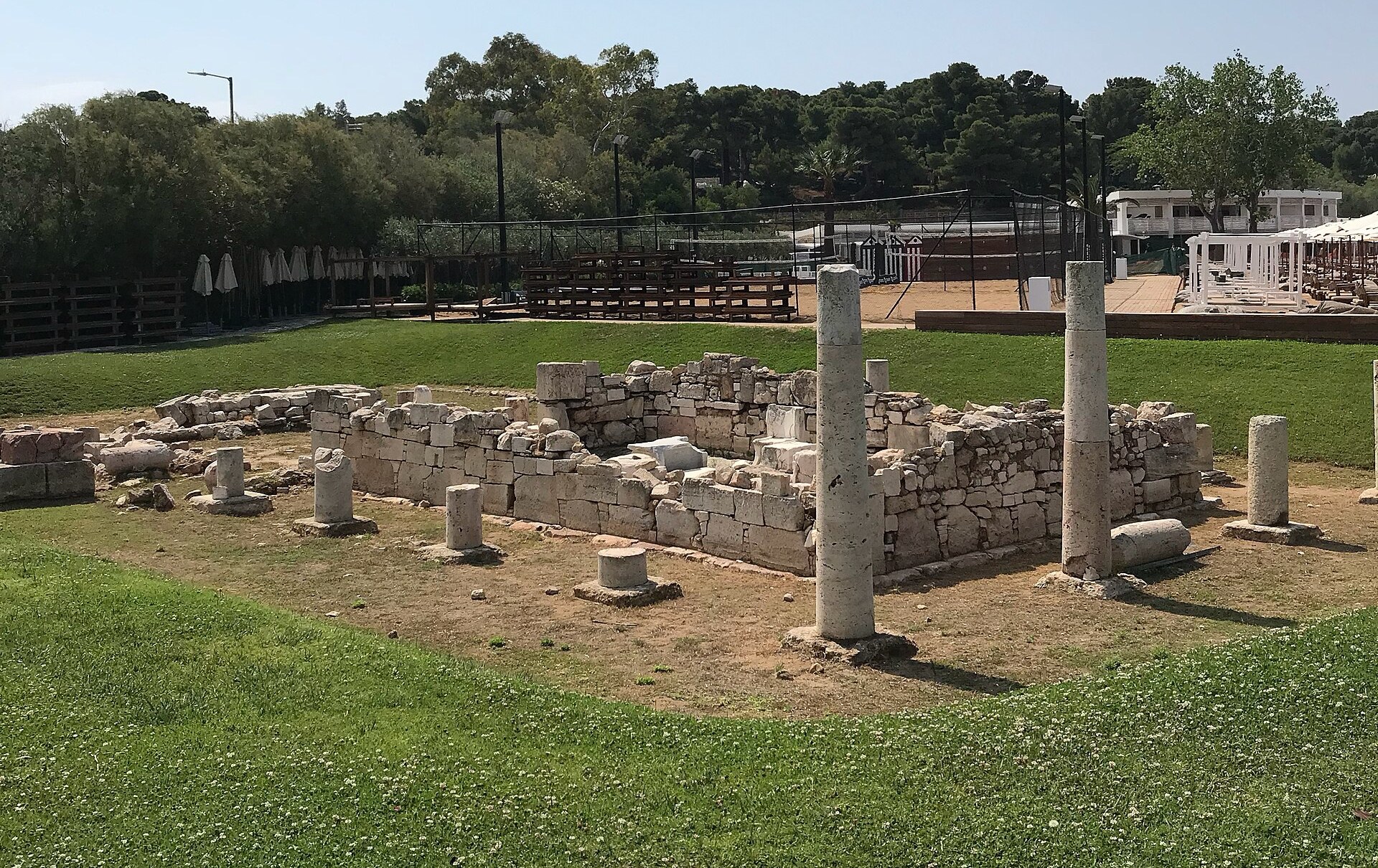
Temple of Apollo Zoster. Remains of a small temple built in the late sixth century BCE at Vouliagmeni, Attica. It served as a cult centre for the deme of Halai Aixonides, where Apollo was worshipped alongside Artemis and Leto. Its main chamber (cella) measured 10.8 × 6 metres. Photograph by Vouliagmeni, Wikimedia Commons, 2018. CC BY-SA 4.0. Cropped from the original. Original photograph and licence.
It is important to distinguish between the sanctuary (hieron) and the temple (naos). The sanctuary was the sacred space as a whole: it might contain altars, images, offerings and other buildings, but it could also exist without a temple. Where a temple stood, it usually housed the cult image and certain objects dedicated to the deity. Sacrifices and communal ceremonies generally took place outdoors, around the altar. Visitors to a sanctuary would also encounter offerings left there over time by others, reminders of the generations who had worshipped the deity before them.
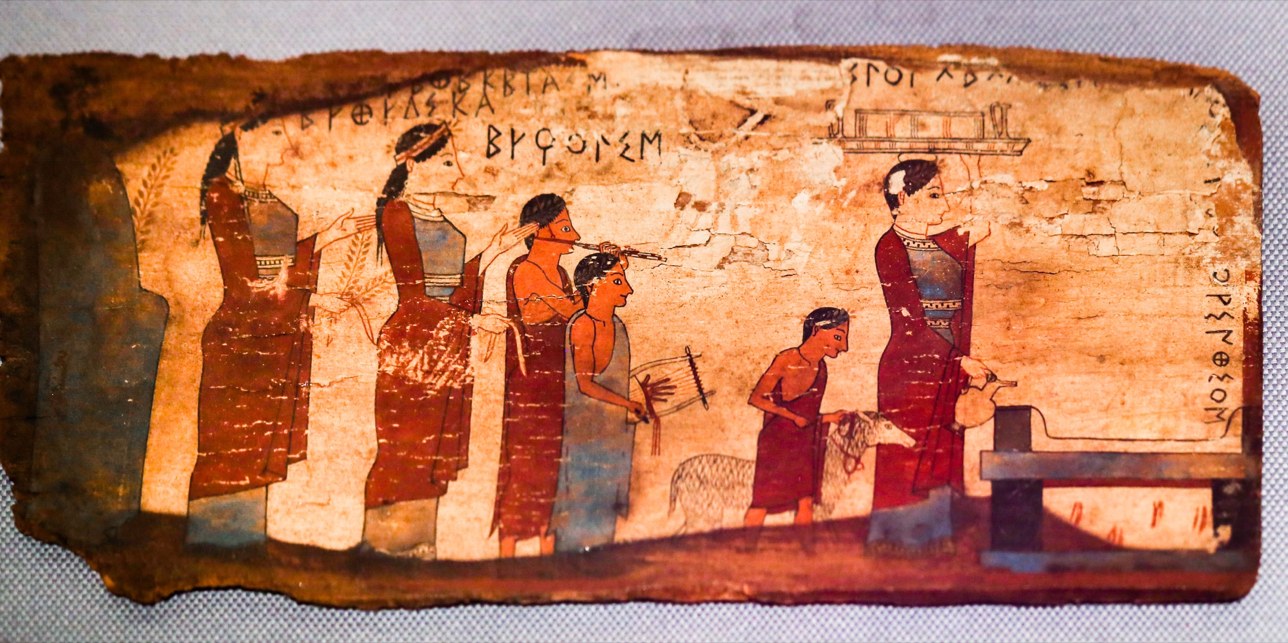
Sacrificial Procession with a Lamb. Painted wooden panel from a cult cave at Pitsa, Corinthia, c. 540–530 BCE. The scene depicts a sacrificial procession accompanied by musicians playing the aulos and lyre. Inscriptions preserve the names of participants and a dedication to the Charites (Graces). National Archaeological Museum, Athens, inv. 16464. Photograph by ArchaiOptix, Wikimedia Commons, CC BY-SA 4.0. Original photograph and licence.
Sometimes a natural place could be developed as a sanctuary through the efforts of individual worshippers. In the late fifth century BCE, a man named Archedemus, originally from Thera, adapted a cave near Vari in Attica for the worship of the nymphs. He worked the rock to create and improve spaces within the cave and left inscriptions describing his activities. In one of them, he states that he had carried out the work at the direction of the nymphs themselves. His name can still be read there. This was not a great temple built by a city, but a place of worship where personal religious devotion left material traces that have survived to the present day. The cave had already been used for worship before Archedemus made his alterations (IG I³ 977–980).
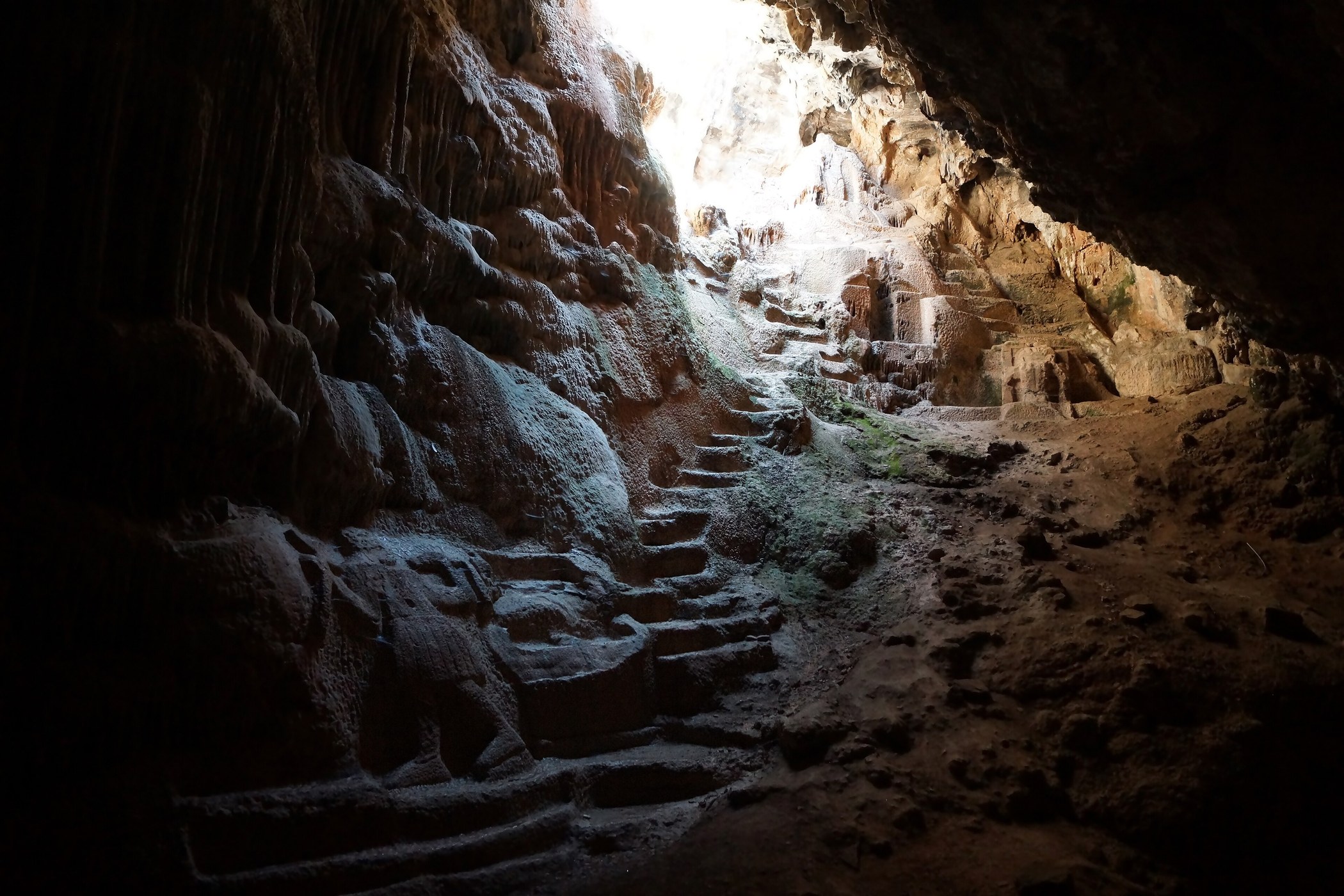
Archedemus in the Cave at Vari (Attica). Relief carved into the rock, interpreted as a representation of Archedemus, a man from Thera who adapted the sanctuary of the nymphs in the late fifth century BCE. Surviving inscriptions record that he cultivated a garden and prepared a space for dancing in honour of the nymphs (IG I³ 977). In another inscription, he describes himself as nympholēptos, “inspired by the nymphs”, and states that he worked on the cave following their instructions (IG I³ 980). Photograph by 5telios, January 2006. Wikimedia Commons, CC BY 3.0. Original photograph and licence. Inscription IG I³ 977 · Inscription IG I³ 980.
One Deity, Many Places and Names
Sección titulada «One Deity, Many Places and Names»The same deity could be worshipped in different places and under different names or epithets, emphasising particular functions or connections with a place or community. In Athens itself, for example, Athena was worshipped as Athena Polias, protector of the city, and as Athena Nike, associated with victory. Both had their own places of worship on the Acropolis. Apollo was called Pythian because of his connection with Delphi, Delian because of Delos, and Didymaean because of the sanctuary near Miletus. These were not different gods, but different ways of invoking and worshipping the same deity. Such names could also be used in places other than those to which they originally referred.
The Greeks shared many names and stories about their gods, but they did not all worship them in the same way. Ceremonies, priesthoods and religious calendars could vary from one city to another. To understand a particular cult, therefore, we need to consider the place, period and community in which it was practised.
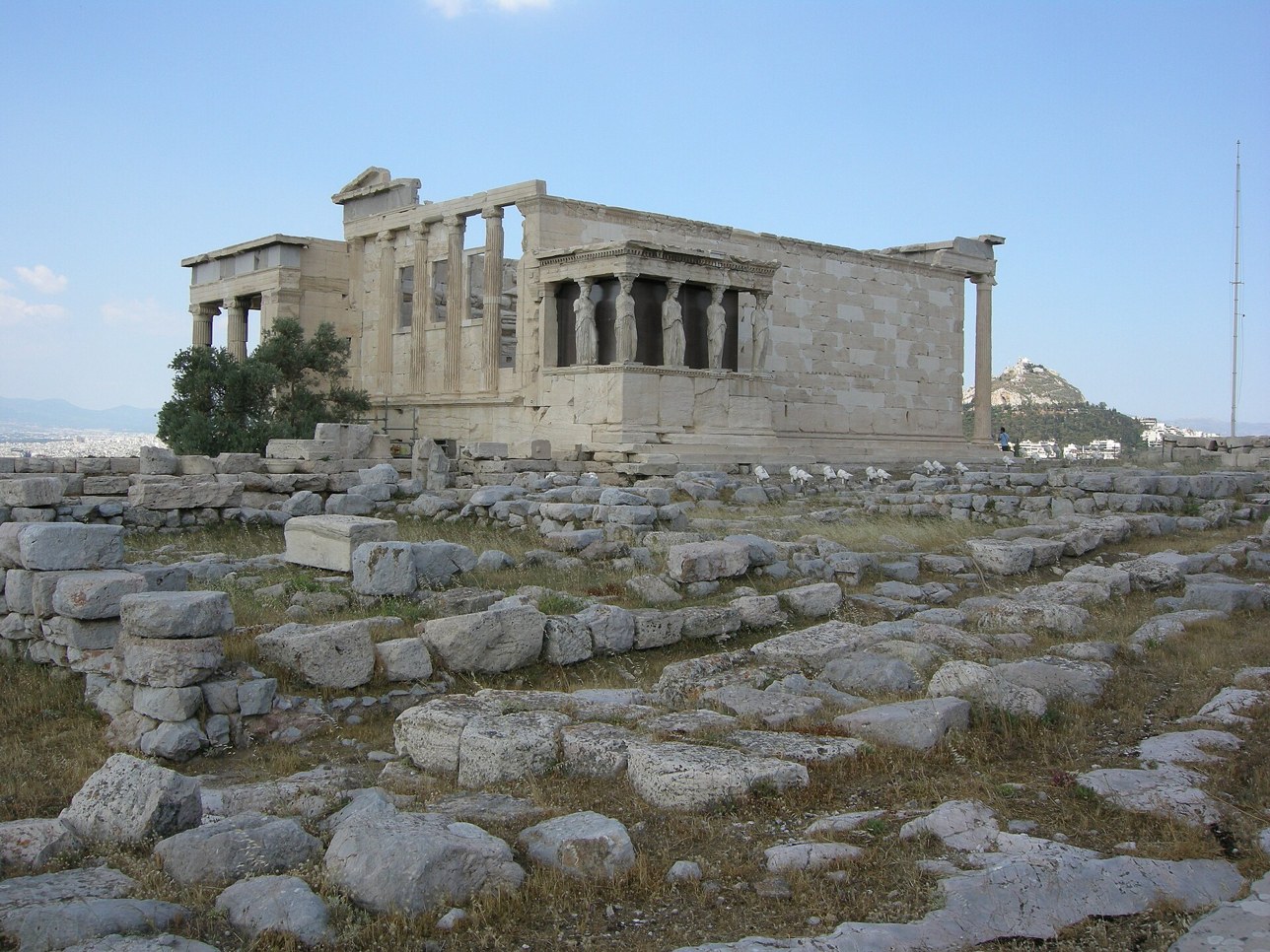
The Erechtheion, Acropolis of Athens. Ionic temple built between 421 and 406 BCE, accommodating several cults, particularly those of Athena Polias, protector of the city, and Poseidon-Erechtheus. The eastern part of the building housed the ancient wooden cult statue of Athena, to which the Athenians offered a peplos during the Panathenaic festival. Other figures from Athenian religious tradition, including Hephaestus and the hero Boutes, were also worshipped there. Photograph by Sailko, Wikimedia Commons, 2008, CC BY-SA 3.0. Original photograph and licence.
Seeking an Answer: Oracles and Signs
Sección titulada «Seeking an Answer: Oracles and Signs»At some sanctuaries, people could consult the gods. Individuals and communities travelled to Delphi and Dodona seeking guidance on important problems or decisions. Evidence of these consultations has survived, although we do not always know what answers were given. Even when an answer was received, it could be difficult to interpret: consulting a god did not guarantee a clear solution or relieve anyone of the responsibility of making a decision.
The lead tablets found at Dodona reveal some of the concerns of those who consulted the oracle. One fourth-century BCE inscription contains an extraordinarily brief question: “Shall I seek another?” Researchers associate it with consultations about choosing a wife. We do not know the answer, but those few words bring us close to a very personal dimension of Greek religion: people also consulted the gods about the uncertainties of everyday life.
Source: Greek text, English translation and commentary in I.Dodone Online, inscription 1.
Dreams could also be interpreted as messages from the gods, although understanding them was not always straightforward. In the Odyssey, Penelope explains that dreams pass through two gates: those that come through the gate of ivory deceive mortals, while those that pass through the gate of horn foretell events that will come true (Odyssey, 19.560–569). But how could anyone distinguish one kind from the other? Seeking a divine answer did not guarantee that one had understood it correctly.
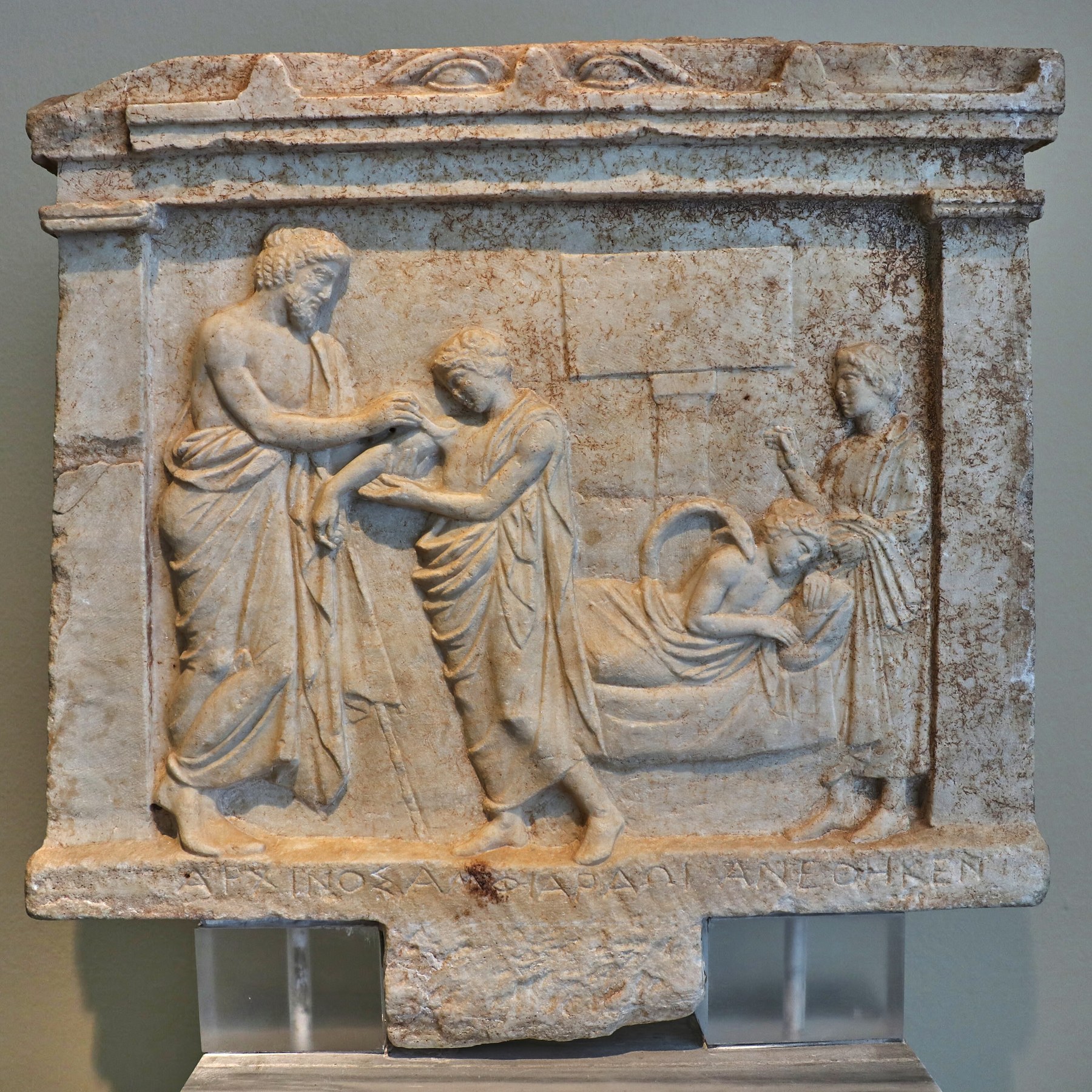
Archinus Gives Thanks to Amphiaraus for His Cure. Marble votive relief from the sanctuary of Amphiaraus at Oropos, first half of the fourth century BCE. Archinus, whose name appears in the inscription on the relief, sought healing at the sanctuary. He is depicted in three scenes: receiving treatment from Amphiaraus for an injury to his shoulder; undergoing ritual sleep, during which a sacred snake intervenes in his healing; and approaching the god in prayer. The relief was dedicated by Archinus in gratitude for his cure. National Archaeological Museum, Athens, inv. 3369. Photograph by George E. Koronaios, Wikimedia Commons, 2018, CC BY-SA 4.0. Original photograph and licence.
A City Turns to Its Goddess
Sección titulada «A City Turns to Its Goddess»A scene from the Iliad shows how a community might turn to its gods for protection. Faced with the danger threatening Troy, Hector asks his mother Hecuba to gather the older women of the city and take an offering to Athena’s temple. Hecuba chooses a magnificent robe and goes to the sanctuary accompanied by the women. There, the priestess Theano places the robe on the knees of the goddess’s image and prays for Athena to protect Troy and its inhabitants from Diomedes. She promises to sacrifice twelve heifers if the goddess grants her request. But Athena rejects the prayer (Iliad, 6.269–311).
Although this is an epic scene, rather than a description of a documented historical ceremony, it helps us understand what visiting a sanctuary could mean: offering something valuable, asking for help and awaiting an answer that was not always favourable.
It is significant that the Trojans seek protection from Athena, a goddess who favours their enemies in the Iliad. Both sides could worship the same deities, even though divine assistance was not granted equally. Nor was divine favour unconditional. In traditions concerning the fall of Troy, Ajax son of Oileus assaults Cassandra when she takes refuge beside Athena’s image. The goddess is outraged by the desecration of her sanctuary and, as Euripides recounts in The Trojan Women (65–85), by the Achaeans’ failure to punish the offender. She therefore resolves to turn against them and make them suffer on their journey home.
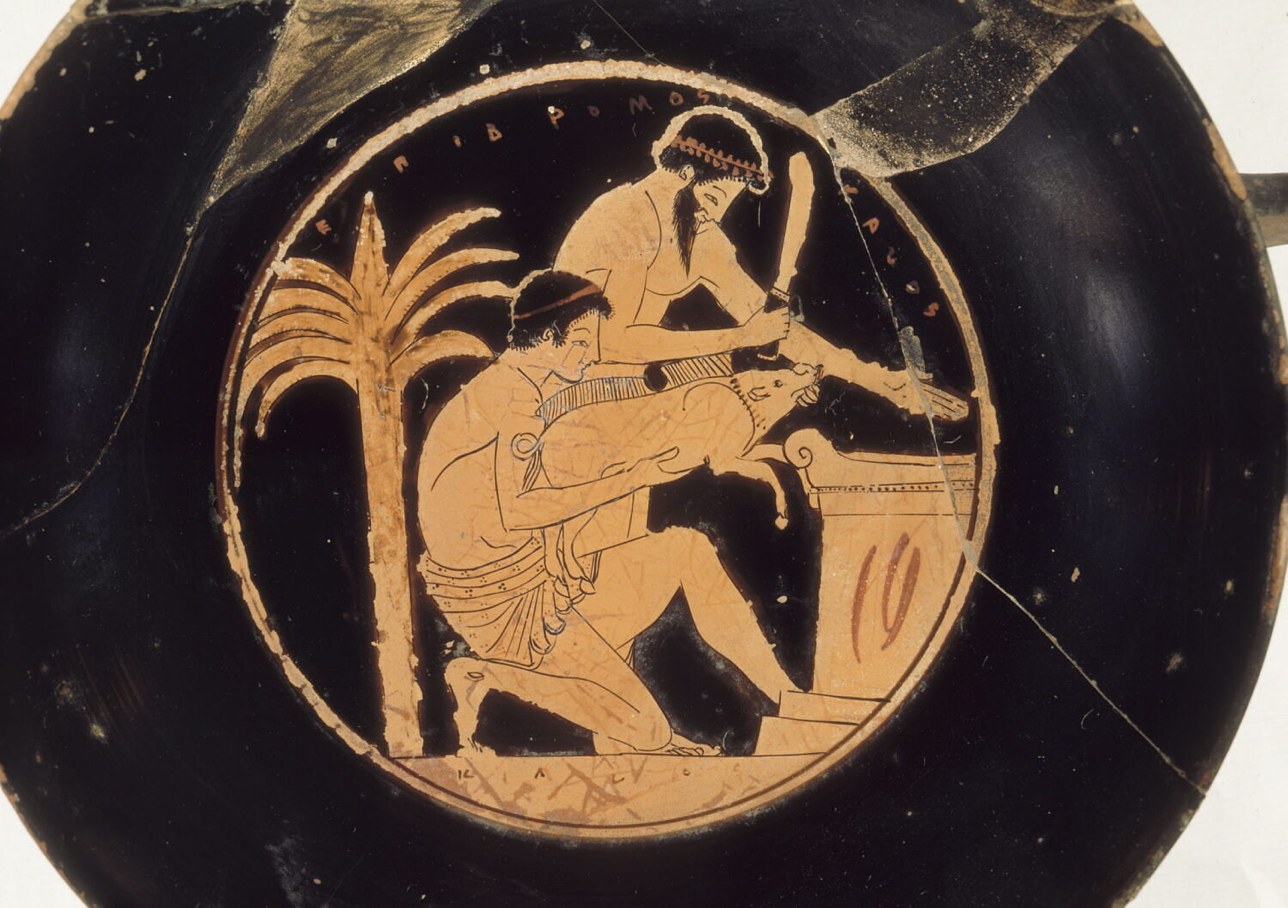
Preparing a Sacrifice at an Altar. Interior of an Attic red-figure cup attributed to the Epidromos Painter, c. 510–500 BCE. A young man holds a pig beside an altar, while a bearded man with a knife prepares to perform the sacrifice. Musée du Louvre, Paris, inv. Cp Suppl 582 (G 112). Original museum record and photographs.
II · The City: Protection, Organisation and Commitments before the Gods
Sección titulada «II · The City: Protection, Organisation and Commitments before the Gods»The Gods of the Community
Sección titulada «The Gods of the Community»Religious cults formed part of the public life of Greek cities. Athena was closely associated with Athens, Hera with Argos, and Poseidon with the great sanctuary on the Isthmus near Corinth. This did not mean that each city had only one patron deity. Its inhabitants worshipped different gods, building temples and sanctuaries in their honour and organising festivals and ceremonies.
Organising these cults required setting dates, allocating resources and assigning responsibilities. One of the sources that illustrates this is the sacrificial calendar of Thorikos, a community in Attica. The inscription specified which sacrifices were to be performed throughout the year, the gods and heroes to whom they were dedicated, the places where they were to take place and the animals to be offered. It also included provisions concerning oaths and the auditing of public officials’ accounts. Honouring the gods was therefore part of the community’s public obligations and administration.
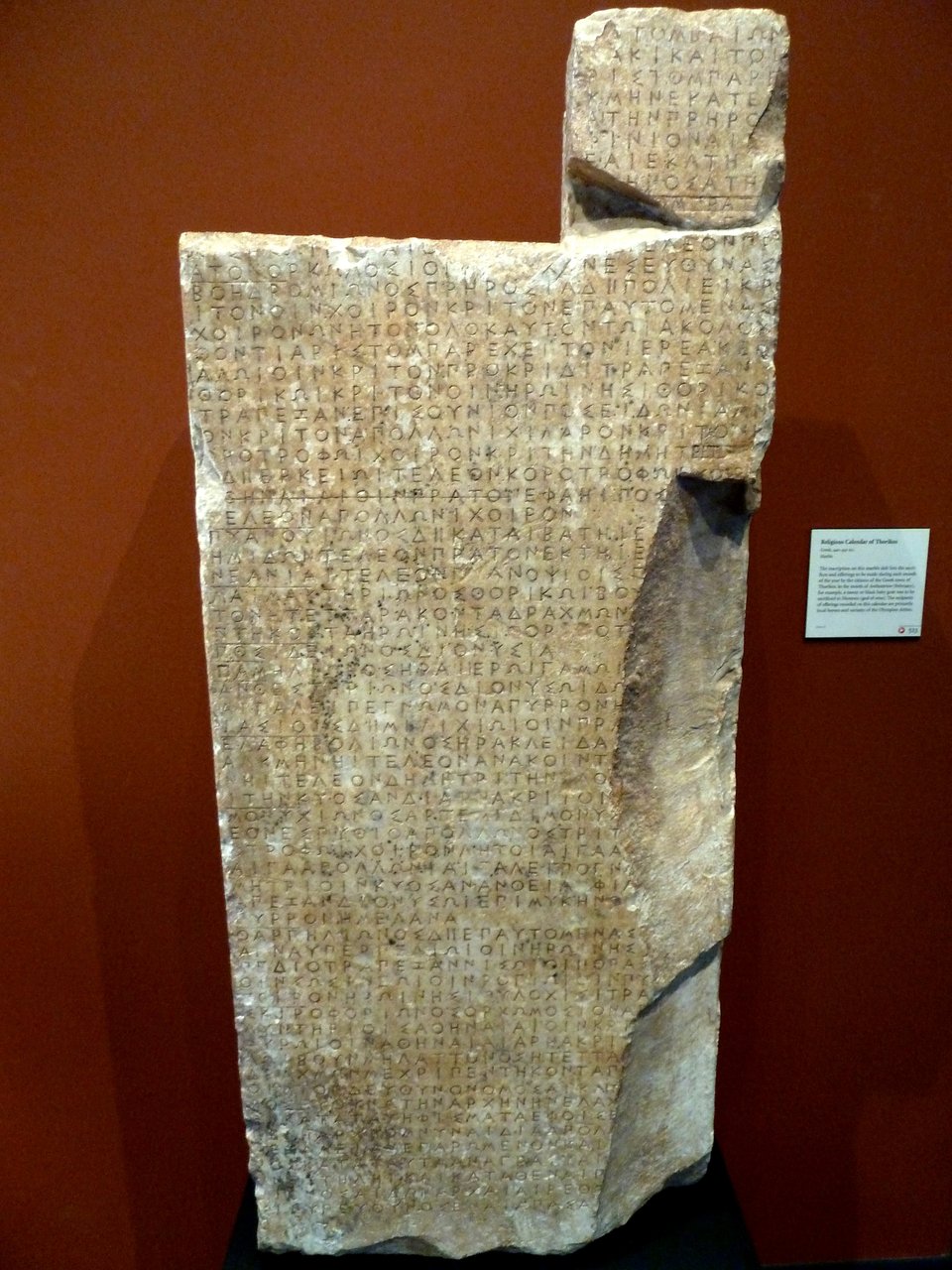
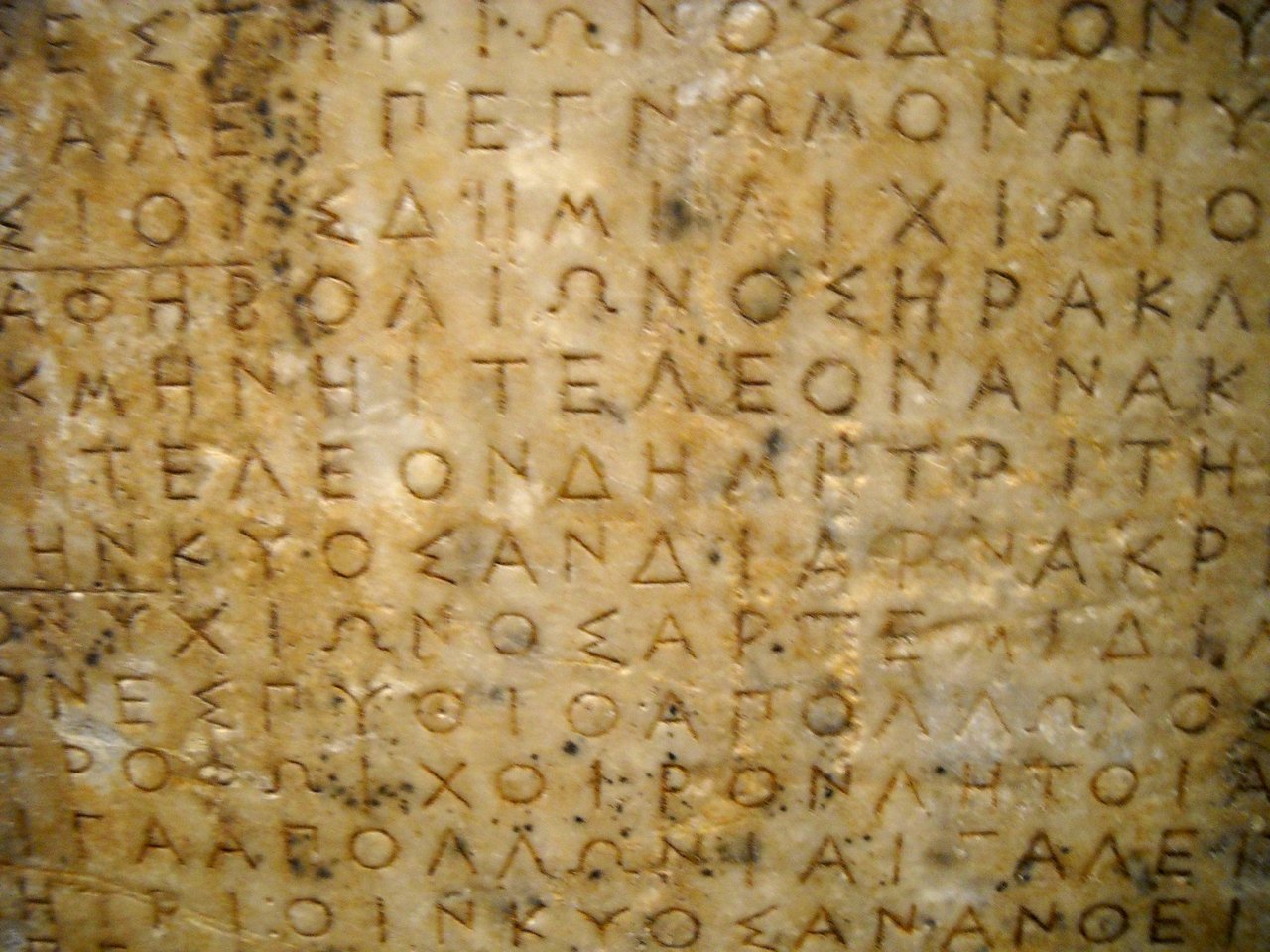
Reading the Sacrificial Calendar of Thorikos in English
Sección titulada «Reading the Sacrificial Calendar of Thorikos in English»Attica, late fifth or early fourth century BCE (date disputed).
The inscription records the sacrifices that the community of Thorikos was required to perform throughout the year. It identifies the recipient deities, the animals to be offered and, in some cases, the places of celebration and the associated costs. It also establishes obligations for public officials, including oaths connected with the auditing of their accounts.
Read the Greek inscription, complete English translation and scholarly commentary: Attic Inscriptions Online, AIO 847.
The maintenance of sanctuaries and the organisation of processions, sacrifices and religious festivals required the involvement of magistrates, priests, priestesses and others entrusted with specific duties. These celebrations formed part of public life: they brought communities together, expressed their relationships with the gods and helped define who belonged to them and how people participated in their ceremonies. They also provided an opportunity for communities to display their traditions and identity to other cities.
Promises, Protection and Shared Rules
Sección titulada «Promises, Protection and Shared Rules»The Greeks had no single sacred book or common religious authority that imposed the same beliefs and obligations on every city. Nor was there a set of revealed commandments binding on everyone. That did not mean that human behaviour was a matter of indifference to the gods. Keeping oaths, protecting suppliants, honouring the dead and respecting the rules of sanctuaries were duties whose neglect could have both religious and human consequences.
In the Iliad, the Achaeans and Trojans seal an agreement before the duel between Paris and Menelaus. Agamemnon calls upon Zeus, Helios (the Sun), the rivers, the Earth and the powers of the underworld who punish false oaths to witness their agreement. The oath is accompanied by sacrifices and a curse upon those who break it (Iliad, 3.276–301). A promise made between human beings was thus also placed under the watchful eyes of the gods.
The presence of the gods in public commitments is also evident in inscriptions. An Athenian stele inscribed in 403/2 BCE records decrees honouring the Samians. Above the inscription, Athena and Hera are depicted shaking hands. The two goddesses, associated respectively with Athens and Samos, symbolise the agreement between the communities through this gesture.
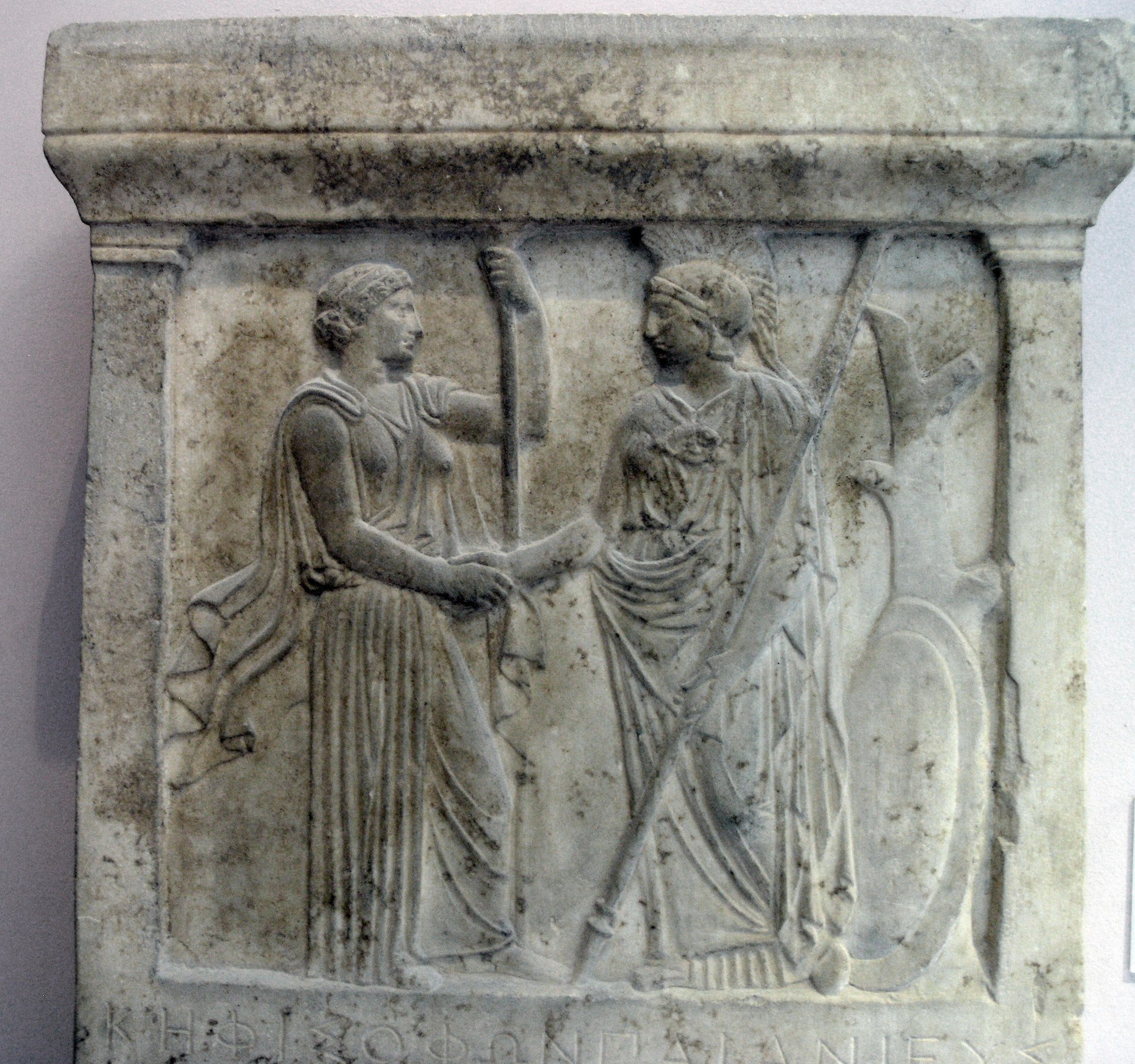
Athena and Hera, Protectors of Athens and Samos. Relief on a marble stele bearing Athenian decrees dated to 405/4 and 403/2 BCE, all inscribed in 403/2 BCE. The two goddesses are shown shaking hands, symbolising the agreement between their cities. The inscription records honours and privileges granted to the Samians in recognition of their loyalty to Athens. Acropolis Museum, Athens, inv. 1333. Photograph by Marsyas, Wikimedia Commons, 2007, CC BY-SA 2.5. Original photograph and licence.
The relationship between religion and public obligations also appears in the sacrificial calendar of Thorikos. At the end of the inscription, those responsible for auditing the magistrates’ accounts are required to swear an oath invoking Zeus, Apollo and Demeter. They undertake to carry out their duties in accordance with the community’s decrees and call down utter destruction upon themselves if they break their oath. A responsibility towards the community thus becomes a commitment before the gods as well.
The gods did not replace the laws of the cities or prevent conflicts among their inhabitants. But they could be invoked as witnesses to human commitments and as guarantors of their fulfilment. Breaking an oath or failing to fulfil a public obligation could also mean failing to show the gods the respect owed to them.
Work and the Risks of Everyday Life
Sección titulada «Work and the Risks of Everyday Life»The Greeks also turned to the gods with the concerns of everyday life. A farmer depended on rainfall and the success of his crops; a sailor on the winds and the hope of returning home safely; a family sought protection for its children. There was not necessarily a particular god assigned exclusively to each trade or activity, but prayers and offerings show that people sought divine help with specific needs.
The dangers of seafaring provide a good example. Sailors could invoke the Dioscuri, Castor and Polydeuces, who were regarded as protectors of those who travelled by sea. A votive relief found in Piraeus depicts a sailor standing on the prow of his vessel, addressing the two gods. We do not know whether he was giving thanks for a safe return or asking for protection on a new voyage. In either case, the image shows a man turning to the gods for help in facing the dangers of his occupation.
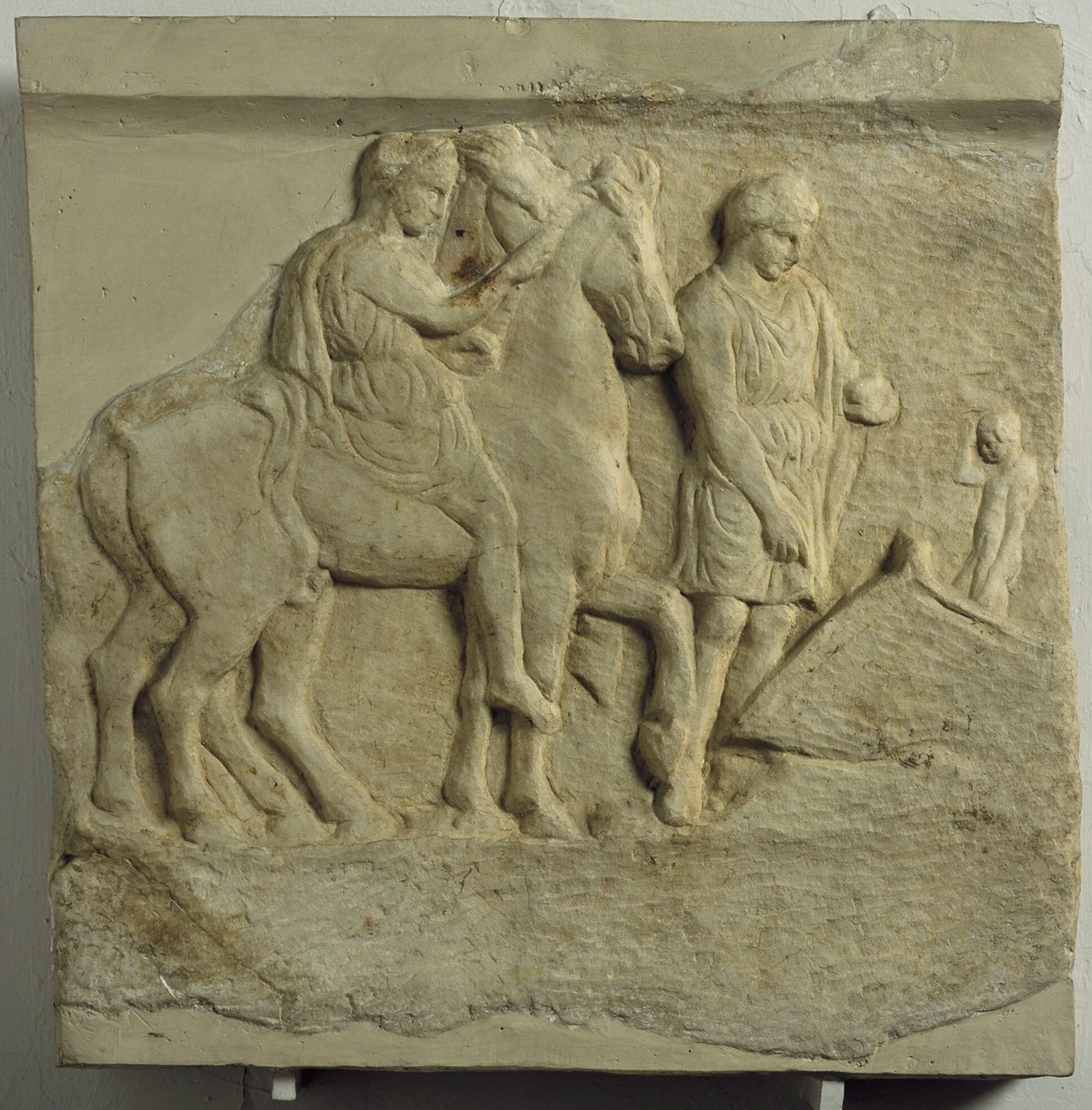
A Sailor before the Dioscuri. Marble votive relief found in Piraeus. A sailor standing on the prow of a ship addresses the Dioscuri, protectors of seafarers. One of the brothers is depicted on horseback, while the other stands beside his horse. The scene may represent either a request for protection on a voyage or an offering of thanks for a safe return. National Archaeological Museum, Athens, inv. 1409. Image: © National Archive of Monuments — Greek Ministry of Culture. SearchCulture, CC BY-NC 4.0. Original record and image.
In the Odyssey, Penelope asks Athena to remember the sacrifices Odysseus had offered her in the past and to protect Telemachus from the suitors (Odyssey, 4.762–766). Past offerings thus become part of a new appeal for divine help. This relationship between mortals and gods can be understood through the idea of charis, a Greek word encompassing favour, gratitude and reciprocity. Those who honoured a deity hoped to receive divine goodwill in return, but this did not mean that they could demand the fulfilment of their wishes.
III · Celebrating Together: Sacrifices, Festivals and Competitions
Sección titulada «III · Celebrating Together: Sacrifices, Festivals and Competitions»A Day Marked on the Calendar
Sección titulada «A Day Marked on the Calendar»The Greeks did not turn to their gods only in times of illness, during dangerous voyages or when faced with military threats. Cities and other communities also set aside days each year to honour them through festivals. Depending on the occasion, these celebrations might include processions, sacrifices, singing, dancing, competitions and communal meals. They were opportunities for people to gather, take part in their community’s traditions and celebrate together. Festive enjoyment and religious ceremonies were not separate activities, but part of the same celebration.
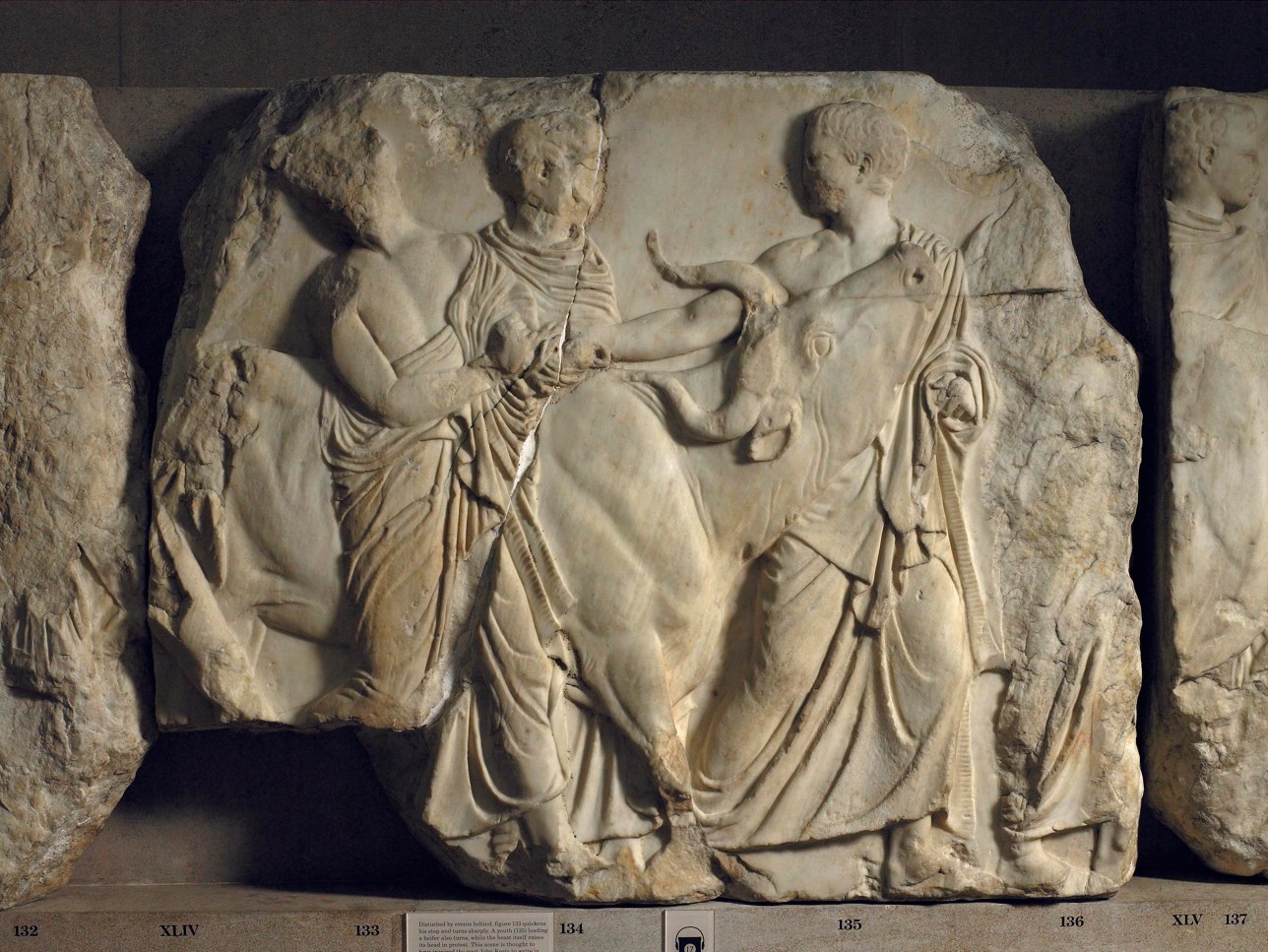
A Heifer Led to Sacrifice during the Panathenaea. Marble relief from the south frieze of the Parthenon in Athens, carved between 438 and 432 BCE. Several young men lead a heifer intended for sacrifice in honour of Athena. The animal raises its head and resists as one of the youths attempts to restrain it. The scene forms part of the Panathenaic procession, one of Athens’ principal religious festivals. British Museum, London, south frieze, block XLIV, inv. 1816,0610.86, image no. 190171001. Photograph: © The Trustees of the British Museum, CC BY-NC-SA 4.0. British Museum collection guide · Original image and collection record.
The opening scene of Book 3 of the Odyssey offers a good example. Telemachus arrives at Pylos to find a large crowd gathered on the seashore, sacrificing bulls to Poseidon. The poem describes nine groups of five hundred people, each offering nine bulls (Odyssey, 3.5–9). These figures belong to the epic narrative and are not historically verified numbers, but they convey the scale of the celebration: a community gathered to honour its god and share in a religious festival.
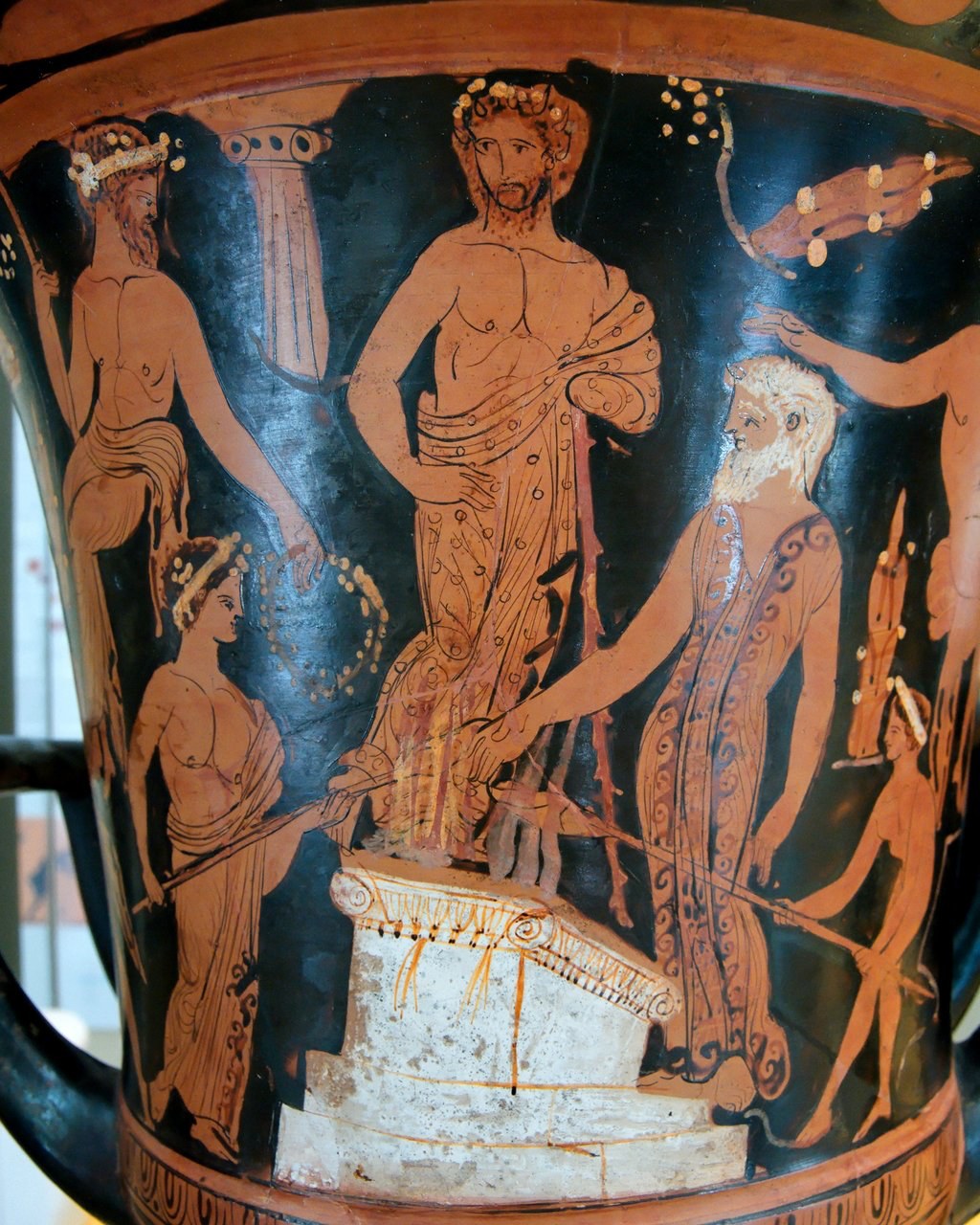
Nestor and His Sons Sacrificing to Poseidon at Pylos. Side A of an Attic red-figure calyx-krater attributed to the Meleager Painter, c. 400–380 BCE. The scene offers a later artistic representation of the sacrifice to Poseidon that Telemachus witnesses on arriving at Pylos (Odyssey, 3.5–9), distinct from the sacrifice to Athena described later in the same book. National Archaeological Museum, Madrid, inv. 2007/86/1. Photograph by Marie-Lan Nguyen, Wikimedia Commons, 2008, CC BY 2.5. Original photograph and licence.
On Ithaca, the day on which Odysseus confronts the suitors coincides with a festival dedicated to Apollo. The poem describes a celebration involving the whole community and a hecatomb, a large-scale animal sacrifice, in a grove sacred to the god (Odyssey, 20.156 and 20.276–280). We do not know the name of this festival, but the scene reminds us that religious celebrations formed part of the calendar and communal life of the Greeks.
Sacrifice and the Shared Table
Sección titulada «Sacrifice and the Shared Table»Not every offering to the gods involved the sacrifice of an animal. Wine, grain, fruit and objects deposited in sanctuaries could also be offered. When an animal was sacrificed and its meat was intended for a communal meal, the ceremony involved various preparations, prayers, portions burned on the altar and the distribution of meat among the participants. The allocation of portions could also reflect differences in social standing and the honours accorded to particular individuals.
Later in the same book of the Odyssey, another sacrifice is described in detail, performed before Nestor’s palace at Pylos in honour of Athena. A goldsmith gilds the heifer’s horns, and water, barley and the necessary implements are prepared. Nestor leads the prayer, cuts hairs from the animal’s head and throws them into the fire. The heifer is then sacrificed, certain portions are burned for the goddess, and the meat intended for the participants is roasted (Odyssey, 3.418–463).
Not all sacrifices took the same form. The sacrificial calendar of Thorikos, discussed earlier, and that of Erchia, another community in Attica, show how different localities organised their religious obligations. The recipient deities, animals offered, dates, places of celebration and expected expenses could vary. The fourth-century BCE calendar of Erchia even specifies, for certain sacrifices, who was to receive the animal’s hide and whether its meat could be taken away from the place of sacrifice.
Hesiod offers a different kind of explanation, this time a mythological one. In the Theogony, Prometheus divides an ox into two portions: he conceals the meat and entrails beneath the animal’s stomach, while covering the bones with gleaming fat. Zeus, aware of the deception, nevertheless takes the portion containing the bones (Theogony, 535–557). The story explains why humans kept the meat while offering certain parts of the animal to the gods. But it is a myth about the origin of this custom, not a description of how every sacrifice was performed.
A religious festival could also provide an opportunity to eat together. Sacrifices brought together those who supplied the animals, conducted the ceremonies, prepared the meat and participated in its distribution. Not everyone held the same position or necessarily received the same portions, and some people could be excluded from particular celebrations. Sacrifice therefore expressed not only the relationship between humans and gods, but also the relationships among members of the community.
Competing in Honour of a God
Sección titulada «Competing in Honour of a God»For the Greeks, honouring a deity could also mean taking part in a race, competing in a musical contest or performing in a play. Many religious festivals included competitions in which participants sought victory and public recognition. Success brought prestige to the winner, their family and sometimes their home city.
The four major Panhellenic games attracted participants from different Greek communities. The Olympic Games were held at Olympia in honour of Zeus; the Pythian Games, at Delphi, were dedicated to Apollo and placed particular emphasis on musical competitions. The Nemean and Isthmian Games honoured Zeus and Poseidon respectively. Over time, the events, rules and ceremonies associated with these festivals changed.
Cities also organised their own religious competitions. In Athens, the Panathenaea were celebrated in honour of Athena. Every four years, the Great Panathenaea included an extensive programme of athletic, musical and equestrian contests, alongside processions and sacrifices. At the Great Dionysia, dedicated to Dionysus, dramatic competitions featured performances of tragedies and comedies. These plays could entertain, move or provoke thought among spectators, but theatre was also part of a religious festival celebrated by the city.
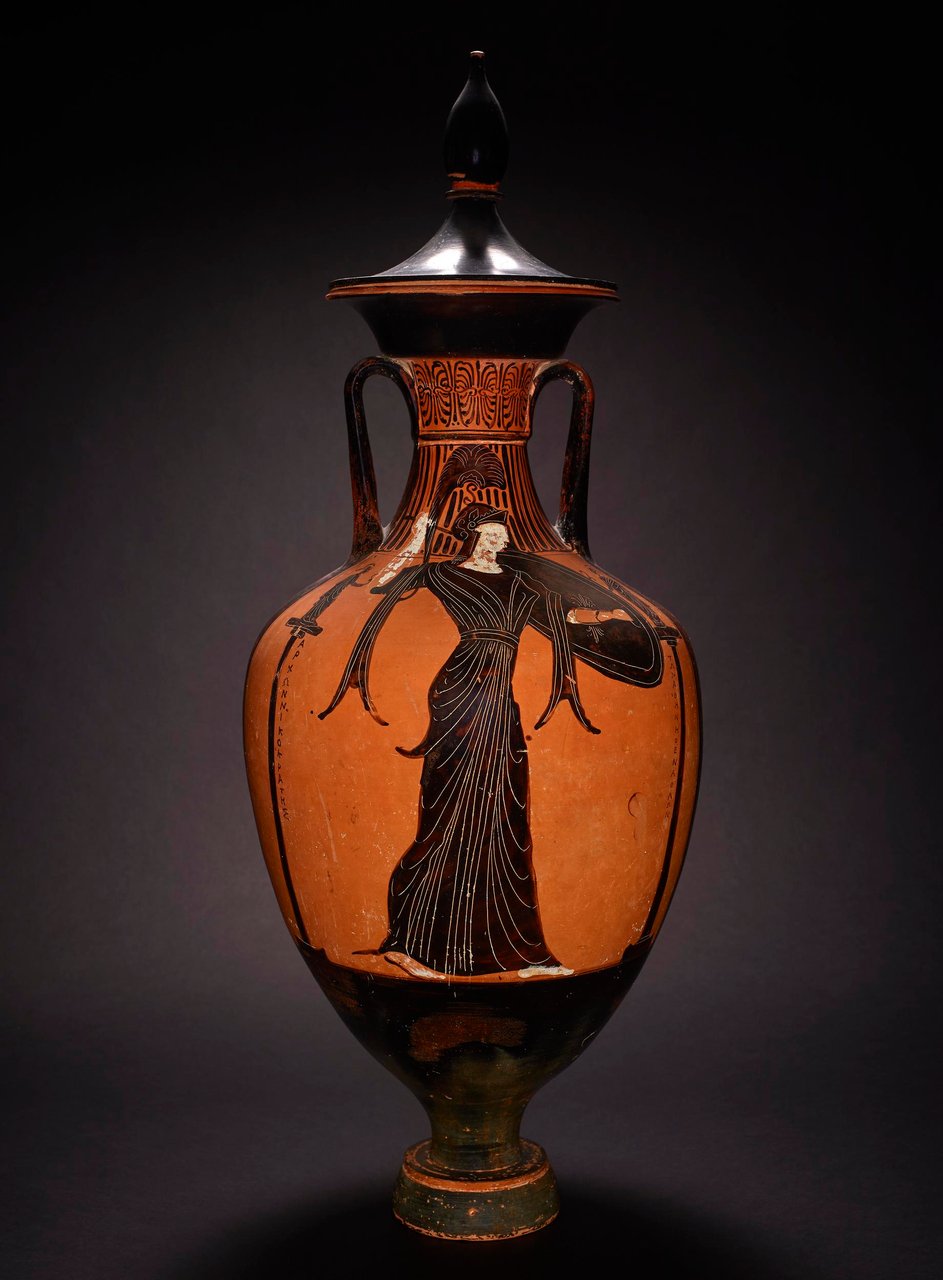
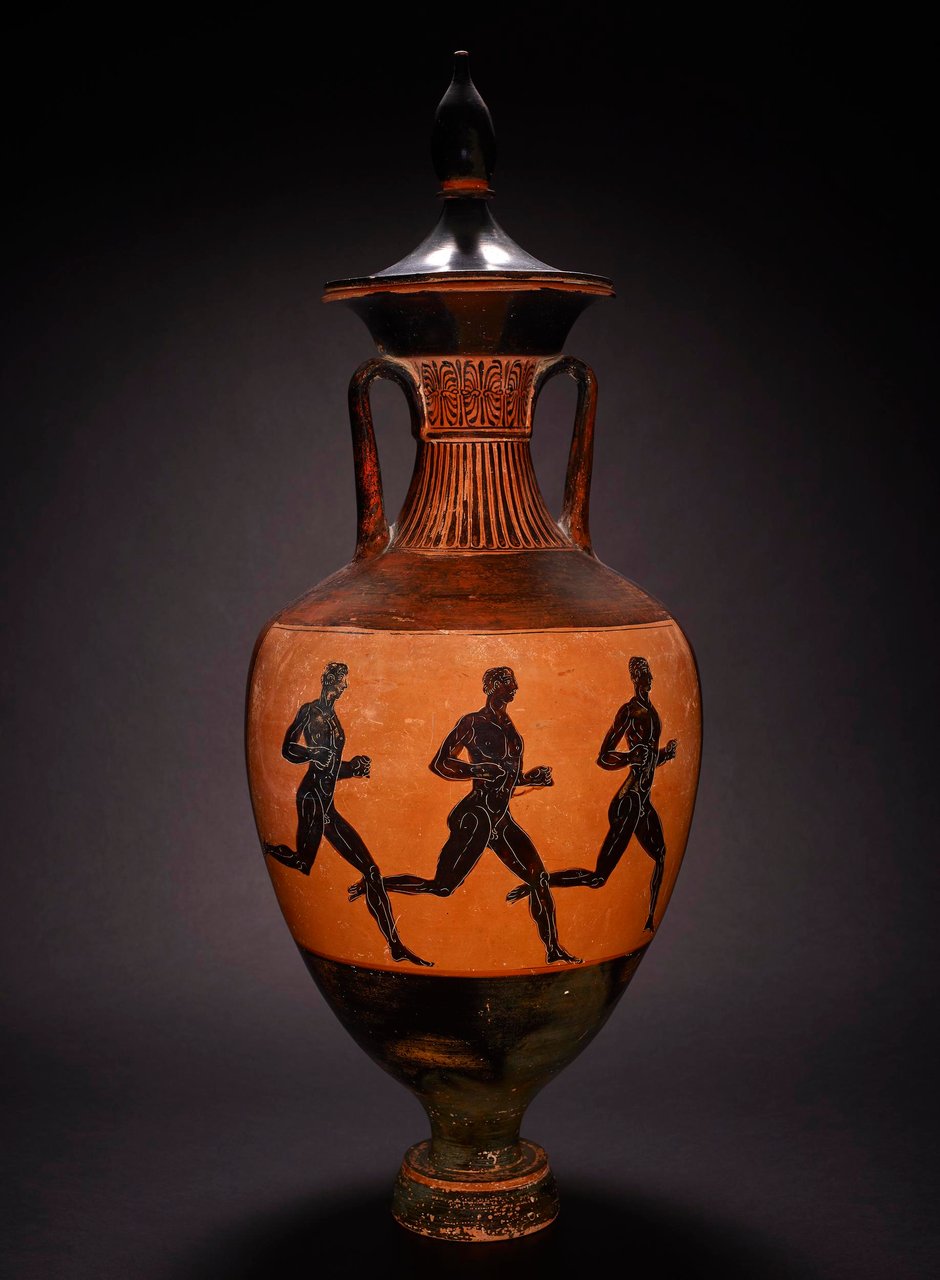
The Homeric poems also describe competitions, although these are not always associated with festivals held in honour of the gods. Achilles organises funeral games for Patroclus, including chariot races, wrestling and other contests (Iliad, 23.257–897). In the Odyssey, the Phaeacians hold athletic competitions and entertain Odysseus with singing and dancing (Odyssey, Book 8). In the first case, the games form part of the honours paid to the dead; in the second, they are part of the hospitality extended to a guest. Neither scene depicts the great religious festivals of historical Greece, but both reveal the importance of competition, music and public recognition in the Homeric world.
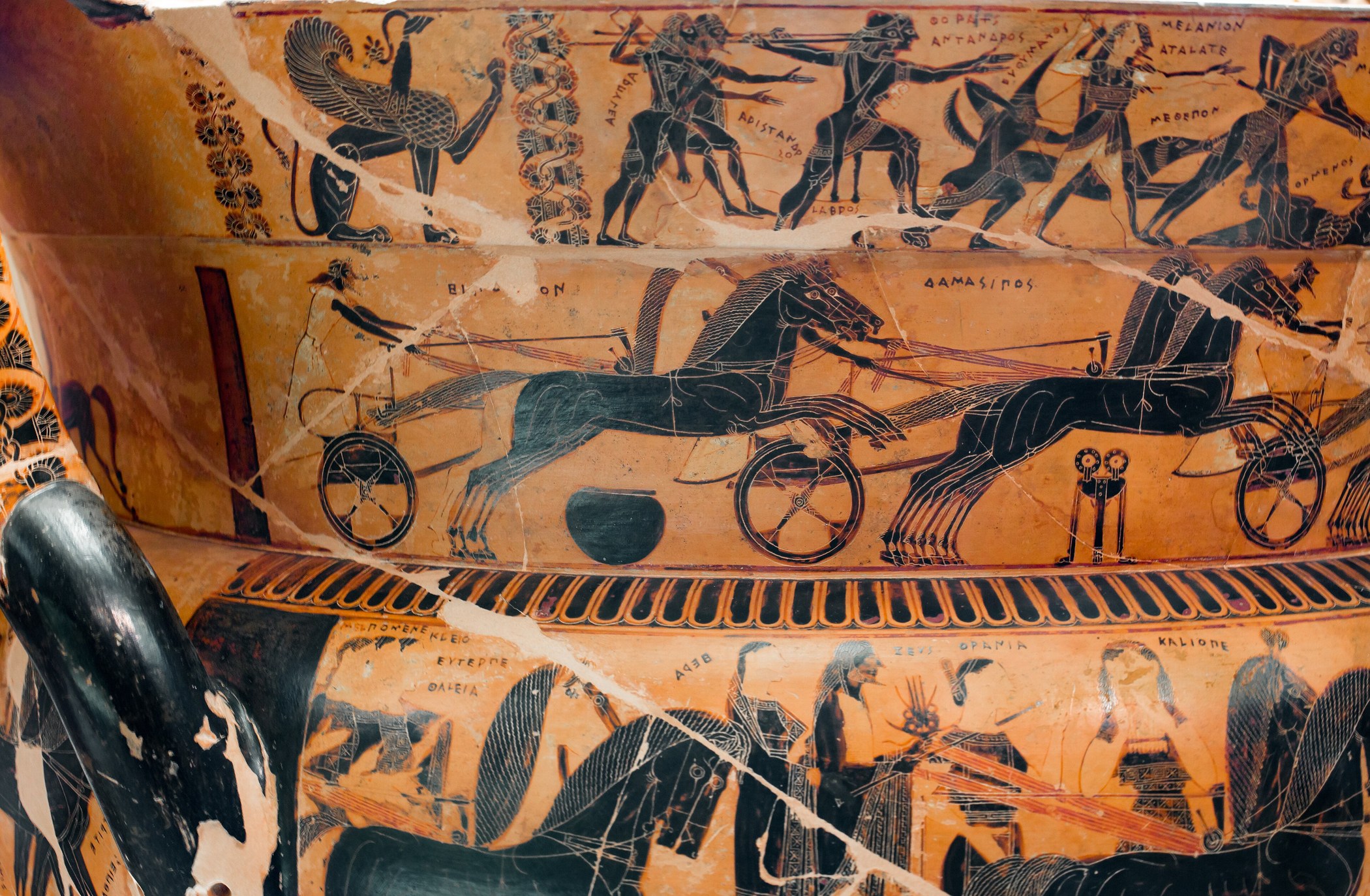
The Funeral Games of Patroclus. Detail of the frieze on the neck of the François Vase, an Attic black-figure volute-krater made c. 575–565 BCE and signed by the potter Ergotimos and the painter Kleitias. The scene depicts a chariot race associated with the funeral games organised by Achilles in honour of Patroclus (Iliad, 23.257–652). Found at Chiusi (Italy). National Archaeological Museum, Florence, inv. 4209. Photograph by ArchaiOptix, Wikimedia Commons, 2016, CC BY-SA 4.0. Original photograph and licence.
Not Everyone Participated in the Same Way
Sección titulada «Not Everyone Participated in the Same Way»Festivals brought communities together, but did not erase their differences. Men and women, citizens, foreigners and enslaved people did not always participate in the same ceremonies or perform the same roles. Some priestesses presided over important rites, and certain festivals gave women a prominent role. Forms of participation varied according to the cult and the community. Moreover, the surviving evidence tells us more about major public celebrations than about the experiences of those who visited a sanctuary with a modest offering.
Inscriptions reveal some of these differences. Fourth-century BCE inventories of offerings to Artemis at Brauron, preserved in copies from her sanctuary on the Athenian Acropolis, record garments, jewellery and other objects dedicated by women. Women were not merely spectators at religious ceremonies: they could make offerings, hold priestly offices and participate in festivals such as the Thesmophoria, celebrated in honour of Demeter. In Athens, participation in this festival was reserved for the wives of citizens.
The position of enslaved people also varied. Athenaeus preserves accounts of celebrations in Crete and Troezen at which masters served meals to enslaved people. By contrast, he reports that enslaved people were excluded from a sacrificial meal in honour of Hera on Cos (Deipnosophistae, 14.639b–d). These accounts preserve earlier traditions transmitted by an author writing in the Roman period, but they illustrate how different the conditions of participation could be. Religious celebrations brought communities together without removing the inequalities within them.
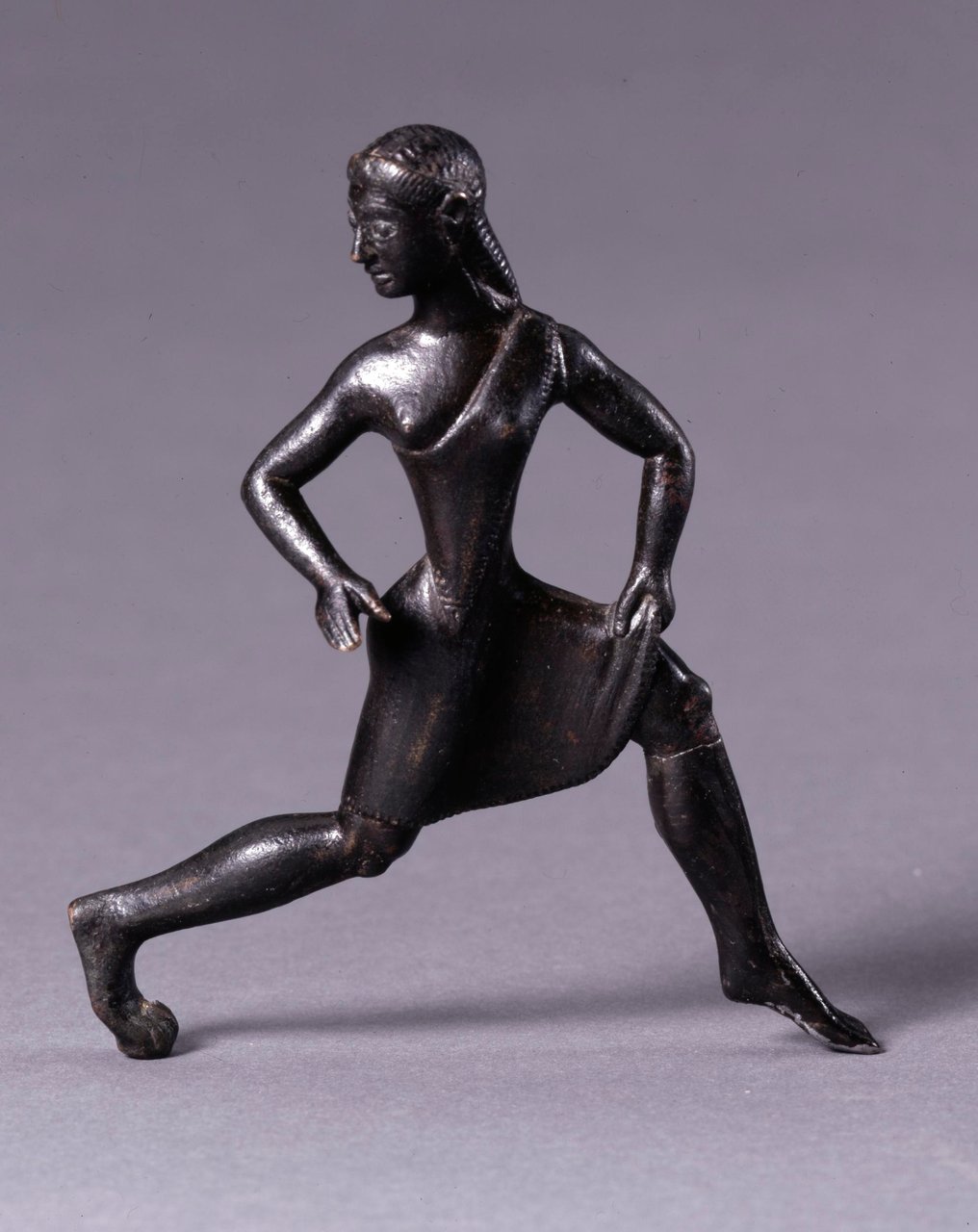
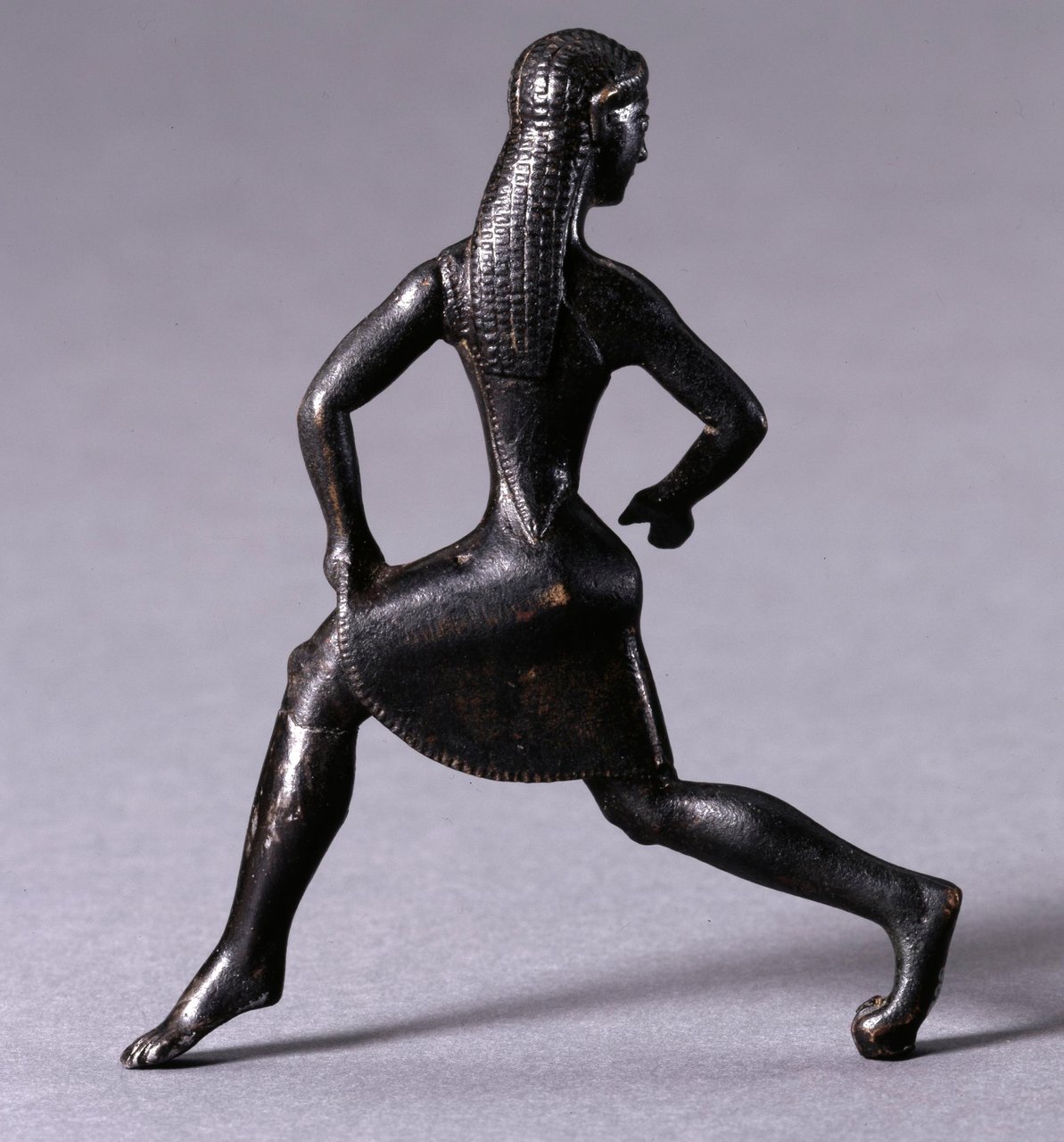
IV · Everyday Life: Household, Hospitality and Family
Sección titulada «IV · Everyday Life: Household, Hospitality and Family»Hestia and the Protectors of the Home
Sección titulada «Hestia and the Protectors of the Home»Relations with the gods did not begin or end at sanctuaries. Within the home, too, people sought protection for its inhabitants, possessions and the continuity of the family. Zeus was worshipped under different titles: as Ktesios, protector of household possessions and stores, and as Herkeios, protector of the domestic enclosure. Hestia, meanwhile, was the goddess of the hearth, where the fire used for cooking and warmth burned.
The hearth also had religious significance. Small offerings of food could be placed beside the fire, and libations made there. Some family rites took place around it as well. In Athens, for example, the Amphidromia marked the acceptance of a newborn child into the household. According to some ancient accounts, the ceremony involved carrying the child around the hearth. A place used every day to prepare meals thus also played a part in welcoming new members of the family.
Archaeology has also preserved evidence of domestic worship. Objects associated with religious practices have been found in houses at Olynthus, a Greek city in Chalcidice. Among them are three bronze incense burners and a phiale, a vessel used for libations, identified through research at the Archaeological Museum of Thessaloniki among finds dating from the fifth and fourth centuries BCE. These objects show that domestic offerings and rites were not merely customs described by ancient writers: they also formed part of the material life of some Greek households. Practices could vary from one family to another and did not necessarily require a space reserved exclusively for worship.
Hestia also had a place in public life. Some cities maintained a communal hearth in the prytaneion, a building associated with civic authorities and public ceremonies. The family hearth and the city’s hearth expressed, on different scales, a shared idea: belonging to a community that acknowledged its gods and honoured them through common practices.
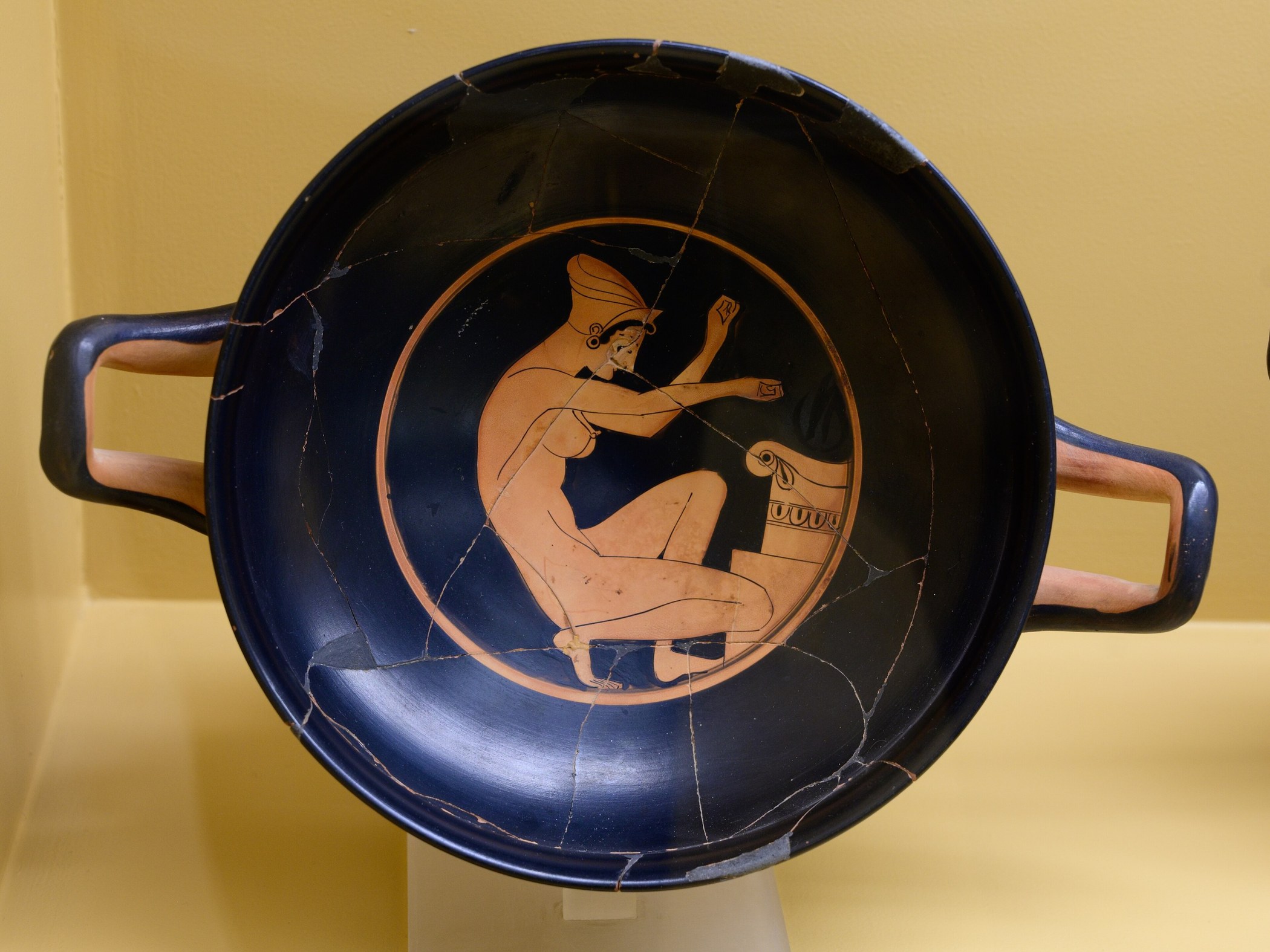
A Woman before an Altar. Interior of an Attic red-figure cup attributed to the Painter of the Agora Chairias Cups, c. 510–500 BCE. A kneeling woman holds a wreath above the flames of an altar. We do not know which deity she addresses or the circumstances of the ceremony depicted. Ancient Agora Museum, Athens, inv. P 24102. Photograph by Zde, Wikimedia Commons, 2022, CC BY-SA 4.0. Original photograph and licence.
Before Asking Who the Visitor Is
Sección titulada «Before Asking Who the Visitor Is»A scene in the Odyssey illustrates the importance of hospitality in the Homeric world. When Telemachus and Pisistratus arrive in Sparta, Menelaus orders that they be welcomed before he knows who they are. He recalls that during his own travels he too had depended on the hospitality of others. The young men are received, bathed and invited to eat. Menelaus offers them food and says that he will ask who they are afterwards. Later, Helen notices Telemachus’ resemblance to Odysseus, and Pisistratus confirms that he is his son (Odyssey, 4.20–162).
Hospitality was more than a gesture of courtesy. It was regarded as a duty under the protection of Zeus Xenios, Zeus in his role as guardian of guests and strangers. In the Odyssey, when Eumaeus welcomes Odysseus disguised as a beggar, he says that it would be wrong to dishonour a stranger, however poor, because all strangers and beggars come from Zeus (Odyssey, 14.56–59). Eumaeus himself has little to offer, yet he treats the stranger with respect.
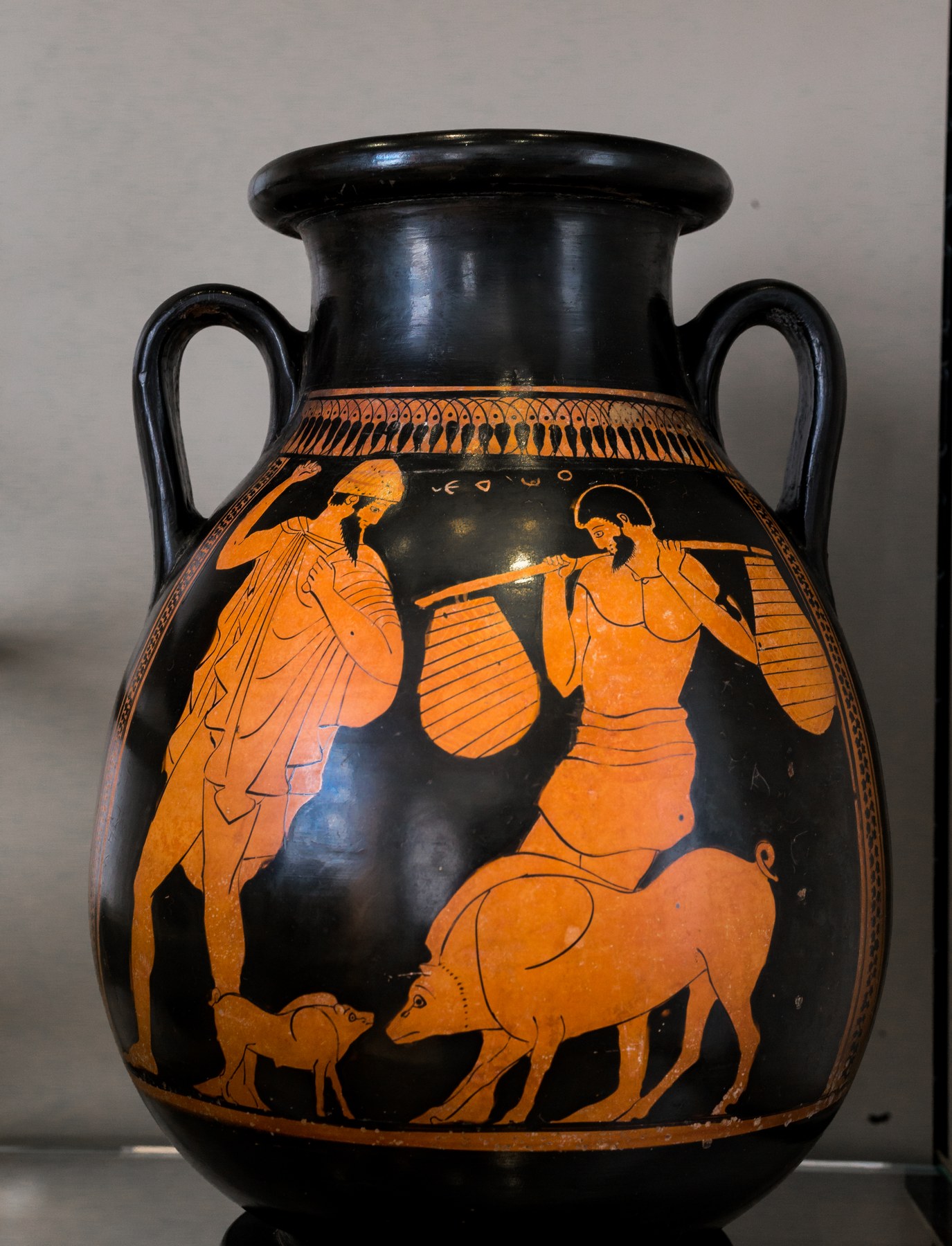
Two Men with Pigs, Possibly Odysseus and Eumaeus. Scene on an Attic red-figure pelike attributed to the Pig Painter, c. 470–460 BCE. Two men stand beside pigs; one carries two baskets suspended from a pole across his shoulder. The scene has sometimes been interpreted as an encounter between Odysseus and the swineherd Eumaeus, who welcomes him without recognising him when he returns to Ithaca disguised as a beggar (Odyssey, Book 14). Fitzwilliam Museum, Cambridge, inv. GR.9.1917. Photograph by ArchaiOptix, Wikimedia Commons, 2018, CC BY-SA 4.0. Original photograph and licence · Fitzwilliam Museum collection record.
Menelaus welcomes two strangers into his palace and offers them generous hospitality; Eumaeus receives a stranger in his humble hut and shares his food with him. Their circumstances could hardly be more different, yet both observe the same principle: a visitor deserves hospitality before his identity is known.
Birth, Belonging and Starting a Family
Sección titulada «Birth, Belonging and Starting a Family»Important events in family life, including births, marriages and deaths, were accompanied by religious ceremonies. Some rites also served to acknowledge a person’s membership of a family or kinship group.
The phratries (phratriai) were kinship-based associations with shared traditions, religious practices and obligations. In Athens, where they are best documented, they played an important role in recognising family membership and descent. During the Apaturia, members gathered for sacrifices and communal meals, and fathers presented their children, particularly their sons, for recognition by the phratry. These ceremonies were especially important for boys, whose admission could later serve as evidence of legitimate parentage and eligibility for citizenship. Zeus Phratrios and Athena Phratria were the deities associated with these rites. The presentation of a child was therefore a family, social and religious event at the same time.
Conclusion · From Great Sanctuaries to the Family Hearth
Sección titulada «Conclusion · From Great Sanctuaries to the Family Hearth»Our journey began in great sanctuaries and small sacred places, passed through cities and their celebrations, and ended inside a home, beside the hearth and the shared table. These were not greater and lesser forms of religion, but different ways of relating to the gods. A ceremony bringing an entire city together and a modest family offering could answer the same need: to honour the deities and seek their favour.
The Greeks turned to their gods when organising festivals, setting out on journeys, swearing oaths or welcoming strangers. They did so when a child was born, when they feared for their crops or when they needed guidance in making a difficult decision. Religion was not separate from everyday life: it formed part of the celebrations, obligations and hopes of those who practised it.
Yet not all Greeks experienced this relationship in the same way. Customs varied between cities, periods and social groups. The Homeric poems offer literary representations of the world; inscriptions, objects and the remains of sanctuaries provide different kinds of evidence for the practices of historical communities. None of these sources tells the whole story. Together, however, they help us understand a society in which the gods shaped how people understood the world and faced the challenges of life.
In the first article, we asked how the Greeks imagined the birth of their gods. Here, we have tried to come closer to the people who lived with them: those who offered sacrifices, sought their help and organised their communities in a world where the gods were constantly present.
But this religious world did not remain unchanged. Over the centuries, some cults lost their place in public life, while others continued to be practised for much longer. The ancient gods also remained present in poems, images and books, even in places where sacrifices were no longer offered to them.
How did these changes come about? Why did some cults disappear before others, and what remained of those gods afterwards? These are the questions we shall explore in the final article of the trilogy.