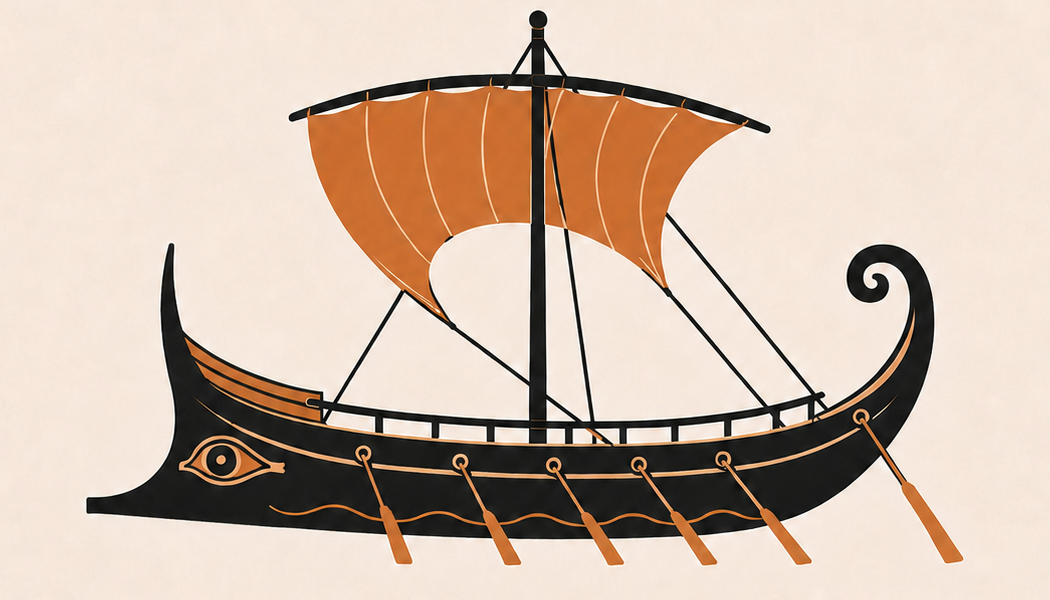
What Killed the Greek Gods?
The Twilight of the Greek Gods
In the early seventh century CE, in Aphrodisias, a city in Asia Minor within the Eastern Roman Empire, some people were still worshipping the ancient gods. Beneath a large private residence, known today as the House of Kybele, lay an extensive religious complex with rooms and passageways, ritual objects and marble figures of Cybele, Athena, Aphrodite, Asclepius and Apollo. The house was destroyed by fire, almost certainly in 617 CE, when the complex was still being used for worship.
By then, more than three centuries had passed since Constantine began to favour Christianity, and more than two centuries since imperial legislation had imposed sweeping prohibitions on traditional sacrifices. How had worship of the ancient gods survived so many political and religious changes?
To answer this question, we need to distinguish three processes: the suppression and decline of public cults, the survival and adaptation of certain religious communities, and the continued presence of the ancient gods in poetry, images and books. These processes did not unfold at the same time or in the same way everywhere.
The Gods Who Were Still Alive
Sección titulada «The Gods Who Were Still Alive»Excavations carried out in 2024 and 2025 at the House of Kybele in Aphrodisias have revealed more about this remarkable place of worship. Beneath the residence lay a large hall, approximately eighteen metres long and four and a half metres wide, with niches that probably held images of the gods. Some adjoining rooms and an underground tunnel were designed to resemble a natural cave. An ingenious water system allowed water to seep through the tunnel’s vaulted ceiling and trickle down its walls, creating the impression of an underground cavern. The finds included oil lamps, incense burners, vessels and small marble figures of the gods.
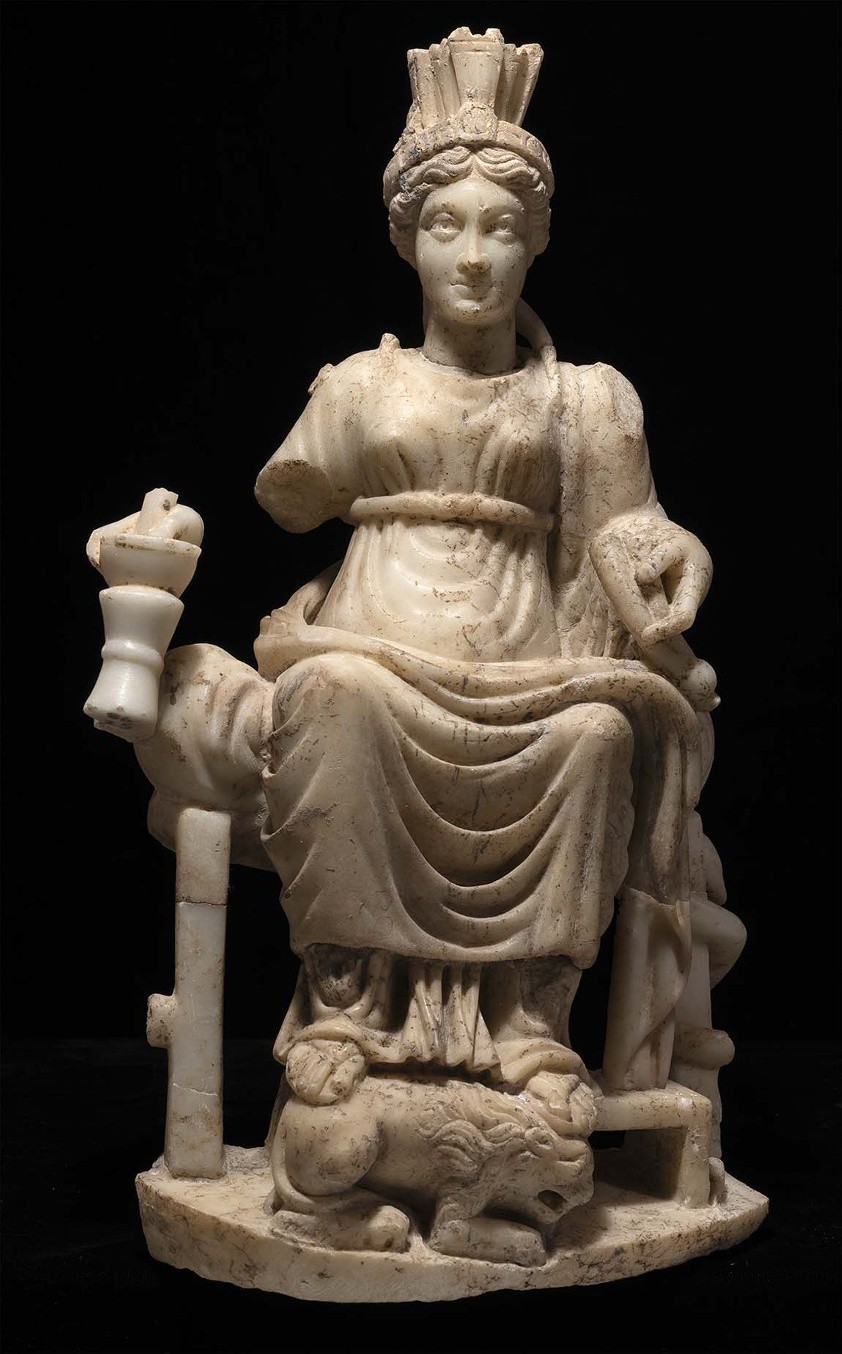
Kybele A, House of Kybele, Aphrodisias. Late Antique marble statuette, probably dating from the fifth century CE, discovered in the underground religious complex of a private residence at Aphrodisias (present-day Türkiye). Height: 34 cm. The goddess sits on a chair, wearing a mural crown and an imperial-style diadem with traces of gilding. Her feet rest on a crouching lion, while a snake coils around the right-hand leg of her seat. She holds a deep libation bowl in her right hand; her other attributes included a double cornucopia and a tall sceptre, both now partly lost. Archaeological inventory nos. 86-25 and 24-115. Photograph published in Ine Jacobs and R. R. R. Smith, “The House of Kybele and the Last Pagans of Aphrodisias”, The Journal of Roman Studies (2026), fig. 35. The article is published under CC BY-NC-ND 4.0. Original article and image.
The sculptures found in the complex show how representations of the ancient gods continued to evolve. One of the figures of Cybele retains traditional attributes such as the lion, the snake and the mural crown, but also wears an imperial-style diadem of a kind used from the middle of the fourth century CE onwards. The researchers interpret this detail as a symbol of universal divine power, expressed through the imperial imagery of the period. Those who continued to worship Cybele were not simply preserving an ancient tradition: they were also representing their goddess through symbols drawn from the world in which they lived.
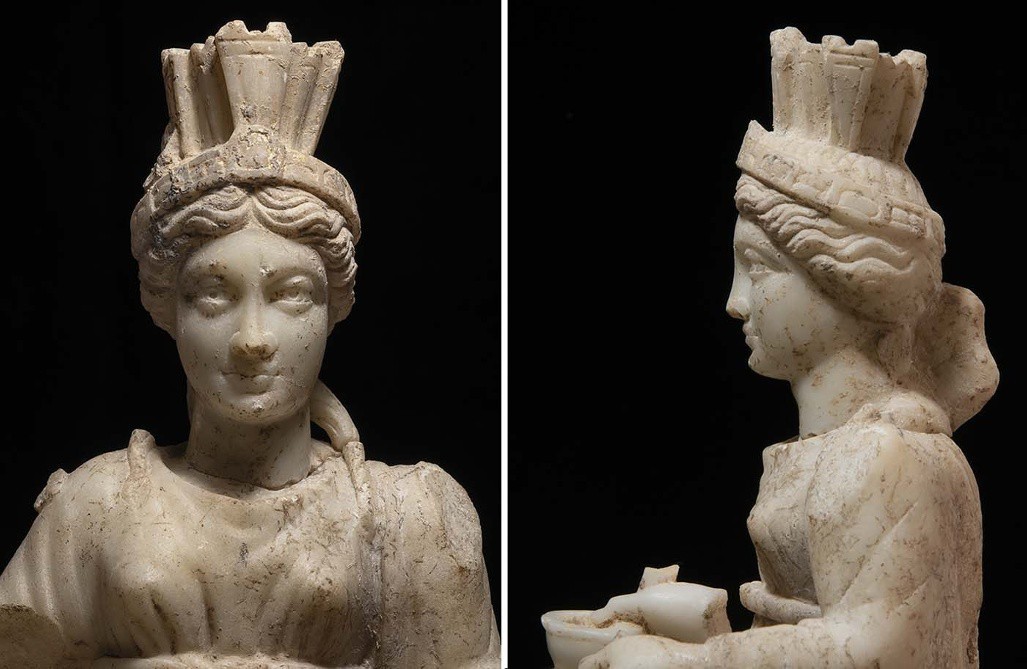
Kybele’s Imperial Diadem. Two details of the marble statuette known as Kybele A, found in the House of Kybele at Aphrodisias. Left: frontal view of the head; right: profile view. Beneath the goddess’s mural crown is an imperial-style diadem, decorated with linked jewel-like motifs and a raised central ornament, and retaining traces of gilding. Diadems of this kind were worn by imperial figures from the middle of the fourth century CE onwards. The researchers interpret the diadem as a symbol of universal divine power expressed through contemporary imperial imagery. Photographs published in Ine Jacobs and R. R. R. Smith, “The House of Kybele and the Last Pagans of Aphrodisias”, The Journal of Roman Studies (2026), fig. 36a–b. The article is published under CC BY-NC-ND 4.0. Original article and images.
Cybele was not the only deity worshipped in the house. Alongside her images were small marble figures of Athena, Aphrodite, Apollo and Asclepius, among others. These were gods who had received worship for centuries and who still had devotees in this Late Antique city.
According to the archaeological reconstruction by Ine Jacobs and R. R. R. Smith, the complex underwent several phases of construction and alteration between the fourth and seventh centuries CE. It was considerably enlarged in the early fifth century, when traditional cults were already facing serious restrictions. Following further rebuilding in the late fifth century, later modifications made access to the religious spaces increasingly restricted and concealed. The researchers interpret these changes as evidence of a growing need for secrecy. In its final phase, ritual activity appears to have diminished, but the complex was still in use when the house was destroyed by fire, almost certainly in 617 CE.
The discovery cannot tell us how many people continued to practise the ancient cults throughout the Empire, or exactly how their ceremonies were performed. It does, however, demonstrate something important: imperial prohibitions had not succeeded in bringing all such practices to an end. At Aphrodisias, worship of the ancient gods persisted in a private setting well into the seventh century. To understand why this discovery is so remarkable, we need to go back several centuries.
When the Gods Ruled the Cities
Sección titulada «When the Gods Ruled the Cities»In the second and third centuries CE, the ancient Greek gods continued to occupy an important place in the religious life of many cities of the Roman Empire, particularly in its Greek-speaking eastern provinces. Temples, priests, sacrifices, processions and festivals remained part of public life. Worship was not separate from society: it formed part of civic calendars, public celebrations and the relationships between communities and their protective deities. The cult of the Roman emperors also had its place within these religious traditions.
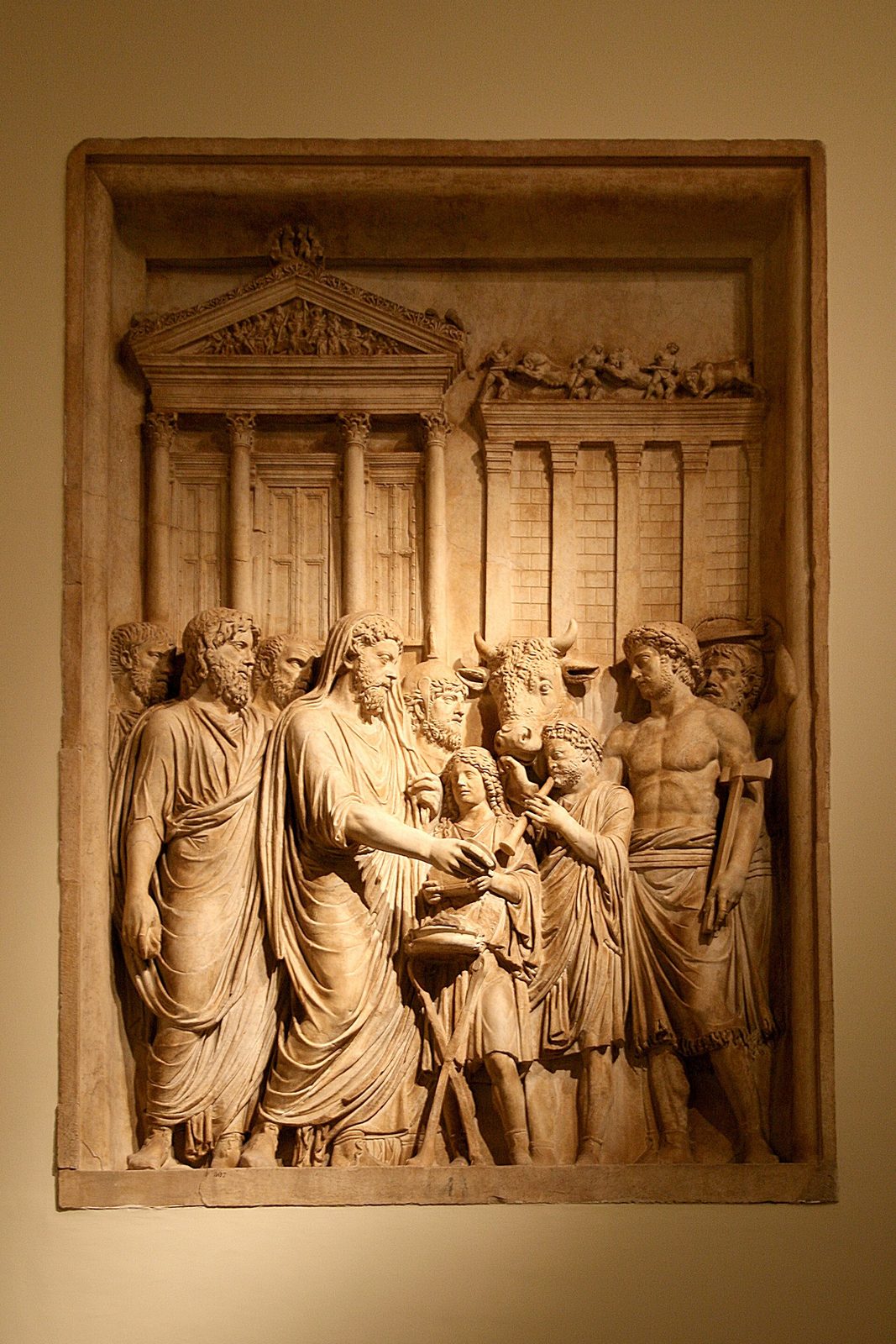
Marcus Aurelius Sacrificing to Jupiter Capitolinus. Marble relief dating from 176–180 CE, originally part of an honorary monument dedicated to the emperor. Marcus Aurelius is depicted performing a sacrifice at a portable altar, accompanied by priests and attendants. Behind them stands the Temple of Jupiter Capitolinus on Rome’s Capitoline Hill, with the Capitoline Triad — Jupiter, Juno and Minerva — represented in its pediment. The scene illustrates the close relationship between traditional religious worship, public ceremonies and imperial authority. Capitoline Museums, Rome, inv. MC0807. Photograph by Jean-Pol Grandmont, 2011, Wikimedia Commons, CC BY-SA 3.0. Original photograph and licence · Capitoline Museums collection record.
Traditional religion had no single governing authority comparable to the ecclesiastical hierarchy of the Christian Church. Each community maintained its own customs; households could perform their own rites; and local cults and religious associations followed different traditions. The term “paganism”, although convenient, therefore encompasses a wide variety of practices and beliefs. There was no single institution whose closure could bring them all to an end.
Temples required resources for their maintenance, as well as priests and others responsible for religious ceremonies. Festivals needed organisers and funding. Civic authorities and wealthy individuals or families often helped sustain these activities, motivated by religious devotion, public responsibility and prestige. The religious life of a city therefore also depended on material resources and social relationships.
Philosophers had long questioned the nature of the gods and the stories told about them by Homer and other poets. Xenophanes criticised the attribution of human characteristics and morally reprehensible behaviour to the gods. Plato also challenged certain traditional narratives, particularly those depicting the gods committing injustices or fighting among themselves. But questioning the stories told about the gods was not necessarily the same as rejecting their worship. A person could criticise the behaviour attributed to Zeus in poetry while continuing to participate in religious ceremonies.
The traditional cults had never remained entirely unchanged. Some lost importance, others were transformed, and new forms of worship emerged. There is no reason to assume that, before Christianity gained imperial support, this diverse religious world was inevitably destined to disappear. Changes in the relationships between imperial authority, cities and religious communities would profoundly alter the conditions under which these cults could survive.
An Empire Changing Its Religion
Sección titulada «An Empire Changing Its Religion»Christianity had been growing within the Roman Empire for generations, developing urban communities, networks of mutual support and authorities of its own. Its expansion did not begin with Constantine. What changed in the fourth century was the support it began to receive from imperial power.
In 311, the emperor Galerius had already permitted Christians to practise their religion and hold assemblies, subject to certain conditions. Two years later, in 313, Constantine and Licinius met in Milan and agreed to grant freedom of worship to Christians and followers of other religions. Their agreement is traditionally known as the “Edict of Milan”, although no edict promulgated at Milan has survived. What we possess is a document published by Licinius at Nicomedia on 13 June 313, reflecting the decisions reached by the two emperors. Lactantius preserves its Latin text, while Eusebius of Caesarea transmits a Greek version of the imperial provisions. These measures guaranteed freedom of religious observance and ordered the restoration of property confiscated from Christian communities.
Constantine’s association with Christianity became increasingly apparent around the time of his victory over Maxentius in 312, although the development of his personal religious beliefs is difficult to reconstruct with certainty. For some years, traditional Roman religious imagery continued to appear in his public representations, even as he increasingly favoured Christian communities and institutions. He was not baptised until shortly before his death in 337. His reign illustrates the complex and gradual changes in the relationship between traditional religion, Christianity and imperial power.
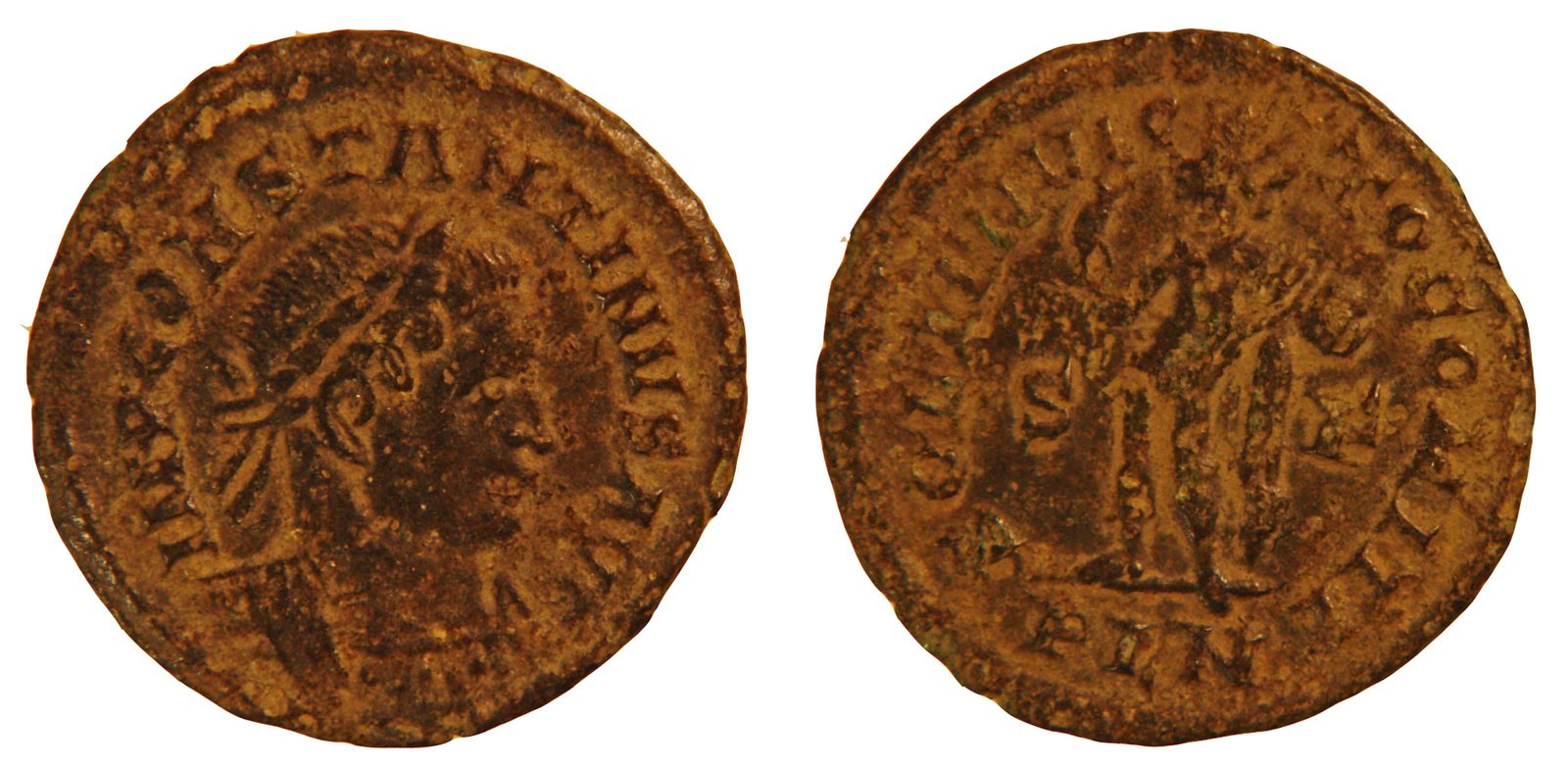
Constantine and Sol Invictus. Obverse and reverse of a copper-alloy nummus minted in London in 313–314 CE. The obverse bears a portrait of Emperor Constantine, wearing a laurel wreath; the reverse depicts Sol, the Roman sun god, with his right hand raised and the inscription SOLI INVICTO COMITI (“To the Unconquered Sun, the emperor’s companion”). The coin illustrates the continued use of traditional religious imagery in imperial coinage after Constantine had begun to favour Christianity. Found in Lincolnshire, England. Portable Antiquities Scheme, FindID 621569 (former reference NLM-719895). Photograph by Martin Foreman / North Lincolnshire Museum, 2014. Image credit: Portable Antiquities Scheme / The Trustees of the British Museum, Wikimedia Commons, CC BY-SA 2.0. Original photograph, archaeological record and licence.
What did change was the distribution of imperial privileges and recognition. Constantine and his successors supported Christian institutions through donations, church construction, exemptions from certain public obligations and other forms of official backing. Bishops acquired a greater public role, and some wealthy individuals and families began to direct their patronage towards churches and Christian communities. The process involved personal conversions and social change, but also decisions made by those in power.
This did not mean that ancient sanctuaries lost their resources overnight. Some cities and families continued to support them. Nevertheless, imperial support increasingly favoured Christian institutions, altering the position that traditional cults had long occupied in public life.
The reign of Julian, from 361 to 363, demonstrates that the ancient cults still had a significant presence. The emperor sought to restore temples, priesthoods and sacrifices to public prominence. He also attempted to reorganise religious institutions and encourage priests to undertake charitable activities. His project came to an end with his death, but it would be misleading to describe it as an attempt to revive a religion that had already disappeared.
In 380, the decree known as Cunctos populos, issued in the names of Gratian, Valentinian II and Theodosius I, established Nicene Christianity as the religious doctrine favoured by imperial law. It also sought to impose doctrinal unity upon Christian communities that held different beliefs. The decree did not immediately convert the entire population, nor did it itself prohibit every traditional religious practice. More direct restrictions followed.
Laws issued in 391 and 392 prohibited sacrifices and acts of worship in temples, while extending restrictions to private religious practices. The law of 392 expressly prohibited offerings to the Lares, the Genius and the Penates, divinities associated with domestic and family life. These measures provided legal grounds for punishing traditional religious activities, although their enforcement depended on imperial officials and local circumstances.
We must not confuse a law with its enforcement. The fact that an emperor prohibited sacrifice demonstrates an intention to suppress it, not that every community abandoned the practice the following day. Repeated prohibitions also show that the authorities continued to regard these practices as a matter requiring intervention, although legislation alone cannot tell us how frequently the bans were disregarded.
Christianity gained a central position through its social growth, imperial support and institutional development. Legislation accelerated the marginalisation of traditional cults, but there was no single date on which they all disappeared.
Not All the Gods Disappeared in the Same Way
Sección titulada «Not All the Gods Disappeared in the Same Way»Temples met very different fates. Some were abandoned, others acquired new uses, and still others were converted into churches. Some buildings were preserved as monuments, while certain sanctuaries were damaged or destroyed during episodes of violence. The disappearance of a statue does not prove that every form of devotion within a community came to an end, just as a temple still standing does not prove that sacrifices continued to be offered there.
The Serapeum of Alexandria, a great sanctuary dedicated to Serapis, was the scene of violent conflict and the destruction of its principal temple in 391. Christian writers such as Socrates Scholasticus and Sozomen describe confrontations involving followers of traditional cults, Christians and imperial authorities. Their accounts must be read with attention to their religious perspectives. Archaeological evidence also helps us reconstruct the subsequent transformation of the site and the reuse of parts of the complex. Alexandria offers an important example, but not a universal model for what happened to every sanctuary.
Nor do we always know when the last ceremony took place at a particular site. In the Passion of Artemius, a response supposedly brought from the oracle at Delphi to Emperor Julian by his physician Oribasius announces that Apollo no longer has a dwelling, a prophetic laurel or a speaking spring. Yet the story survives in a Christian work composed in the seventh century, long after the supposed events, and the authenticity of the oracle is disputed. We cannot treat it as reliable testimony to the date of Delphi’s final consultation.
The end of the Eleusinian Mysteries is also associated with the religious and political crisis of the late fourth century. The sanctuary suffered severe damage during the upheavals traditionally linked to the invasion of Greece by Alaric’s Goths. Eunapius, who had himself been initiated at Eleusis, associated these events with the end of the worship of Demeter and Persephone. But neither his account nor the archaeological evidence allows us to establish the exact year of the last initiation. The destruction of the sanctuary and the definitive abandonment of its ceremonies need not have occurred on the same date.
Something similar applies to the Olympic Games. It is often repeated that Theodosius I banned them in 393, although no surviving imperial decree expressly orders the abolition of the competitions. Their disappearance is better understood as part of a prolonged transformation of civic institutions, financial resources and religious life during the fourth and fifth centuries. We cannot reduce the end of the ancient Games to a single imperial decision.
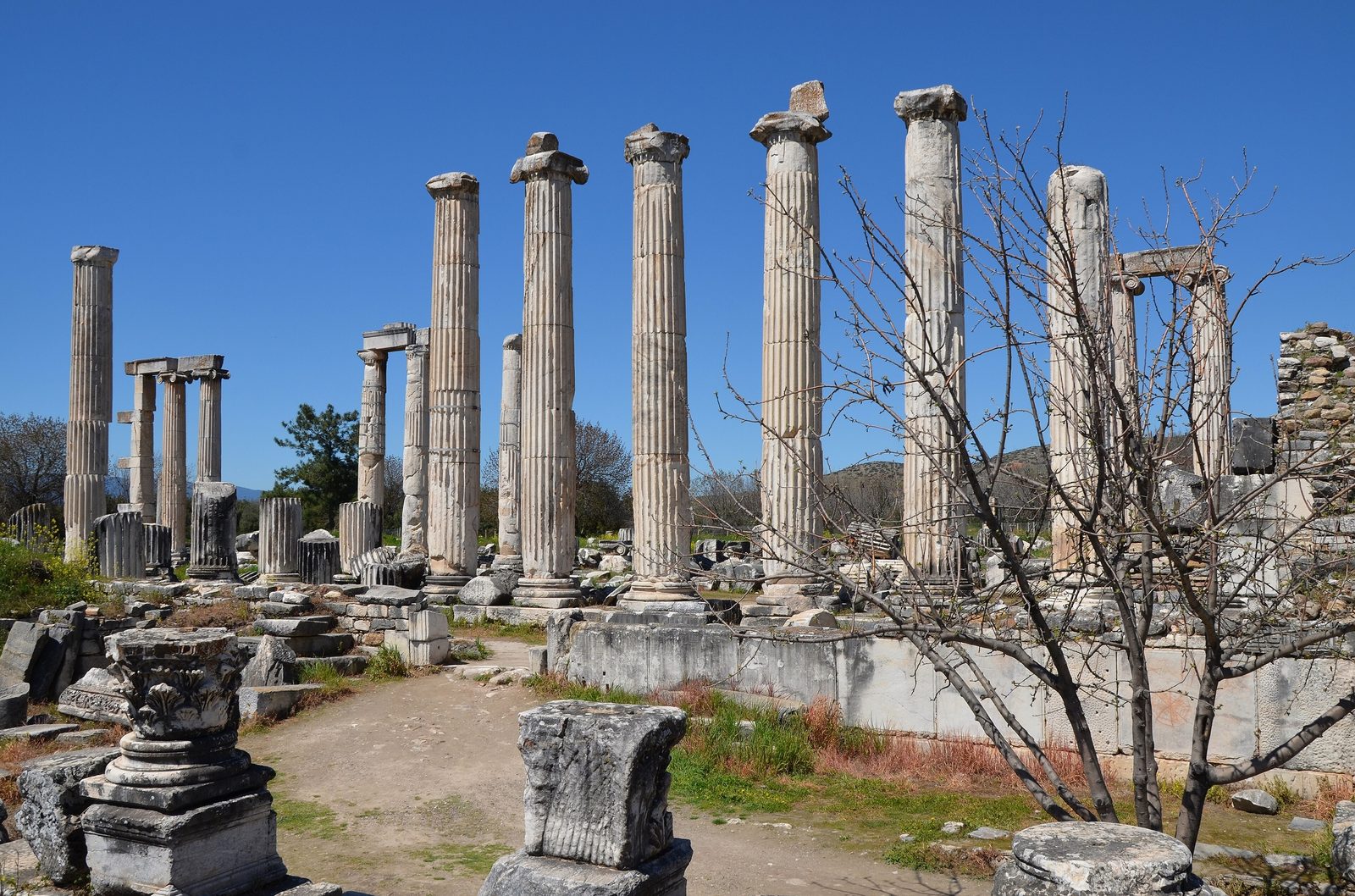
From the Temple of Aphrodite to a Christian Church. Remains of the ancient Temple of Aphrodite at Aphrodisias (present-day Türkiye), converted into a Christian basilica in the late fifth century CE. The transformation was extensive: the temple’s inner walls were dismantled and reused, columns were rearranged, and a new apse was constructed at the eastern end. The building became the city’s cathedral, dedicated to St Michael. Fourteen columns, sections of the exterior walls and the apse still survive. This transformation illustrates how a sanctuary once dedicated to an ancient goddess could acquire a new religious function while retaining much of its earlier architecture. Photograph by Carole Raddato, 2015. Wikimedia Commons, CC BY-SA 2.0. · Original image / source
The year 529 is often presented as another symbolic ending. Under Justinian, measures were taken against traditional religious practices, and an imperial order concerning the teaching of philosophy in Athens is recorded by the chronicler John Malalas. The activities of the city’s Neoplatonic school were affected, although the precise consequences remain debated. Some philosophers, including Damascius and Simplicius, later travelled to the court of the Persian king Chosroes I, returning to Roman territory after a relatively short stay. The Athenian school of this period was not Plato’s Academy preserved unchanged since the fourth century BCE. Nor did these events bring philosophy or traditional religious beliefs throughout the Empire to an end.
Traditional religious practices continued to exist in some communities during the sixth century. John of Ephesus, a Christian missionary active under Justinian, described his efforts to convert people who still followed traditional cults in parts of western Asia Minor. His account offers evidence of their persistence, although it must be read in the light of his religious commitments and missionary aims. Elsewhere, the evidence is often fragmentary, and the history of many local communities remains difficult to reconstruct. We should therefore not turn the absence of evidence into a definite date of disappearance.
The surviving evidence reveals different local histories, shaped by imperial legislation, religious conflict and social change, rather than a simultaneous disappearance of the ancient cults ordered from the imperial capital. We should also remember that the survival of a custom — a festival, a ritual gesture or a funerary practice — does not necessarily mean that it retained the same religious meaning it had held centuries earlier.
The Gods in Homes and Books
Sección titulada «The Gods in Homes and Books»Seen against this background, the discovery at Aphrodisias takes on a different significance. In a city where imperial power favoured Christianity and laws increasingly restricted ancient rites, the owners of a prosperous residence maintained an extensive complex devoted to the worship of traditional divinities. It was not a small improvised chapel for household use alone, but a religious complex built and altered over generations, apparently intended to accommodate a wider circle of participants.
As we have seen, the archaeologists uncovered a large hall with niches for cult images, ancillary rooms and underground spaces in which rock-like surfaces and flowing water helped create a distinctive atmosphere. Images of the gods were found alongside lamps, vessels and other objects associated with religious ceremonies. The researchers suggest that gatherings, ritual meals and acts of veneration took place there. Some of these activities are supported by the archaeological finds, while the details of particular ceremonies remain hypotheses.
Most strikingly, substantial work was undertaken to enlarge the complex during the fifth century, when imperial laws prohibiting traditional sacrifices were already in force. The owners and their associates still had the resources and the commitment to invest in their cults. Later, access routes were modified and the religious spaces became more concealed, changes the archaeologists associate with an increased need for discretion. When fire destroyed the residence, probably in 617, the religious area still showed evidence of ritual activity.
Aphrodisias was not representative of every city in the Empire. The owners belonged to a prosperous milieu, and the complex is exceptional in the extent of its preservation. Nevertheless, it demonstrates that the loss of public support did not immediately bring every form of devotion to an end. Some people continued to worship the ancient gods even after those gods had ceased to occupy the place they had held for centuries in the official life of cities.
Meanwhile, the gods endured in another setting: books. Zeus, Athena, Apollo, Aphrodite and Hermes continued to appear in poems, commentaries and school texts. Christian readers did not need to worship them in order to study Homer. The stories of the ancient gods formed part of a literary heritage that could be preserved without sharing the religious beliefs of those who first told them.
The transmission of Greek literature during Late Antiquity and the Byzantine period was selective and involved considerable losses. Many works disappeared; others were copied, commented upon and reinterpreted. A tenth-century manuscript of the Iliad, known as Venetus A, preserves the poem together with extensive scholarly annotations. In the twelfth century, Eustathius, Archbishop of Thessalonica, composed detailed commentaries on Homer. Through the work of generations of readers, teachers and scribes, many of them Christian, stories in which the ancient gods constantly intervened continued to circulate.
We must therefore distinguish the survival of a cultural tradition from the continuation of a religion. An image of Athena in a medieval manuscript does not demonstrate that anyone was still offering her sacrifices. By contrast, the ritual objects from the House of Kybele provide material evidence that, in certain places, people continued to honour the ancient gods through religious practices, long after their public cults had lost much of their former position.
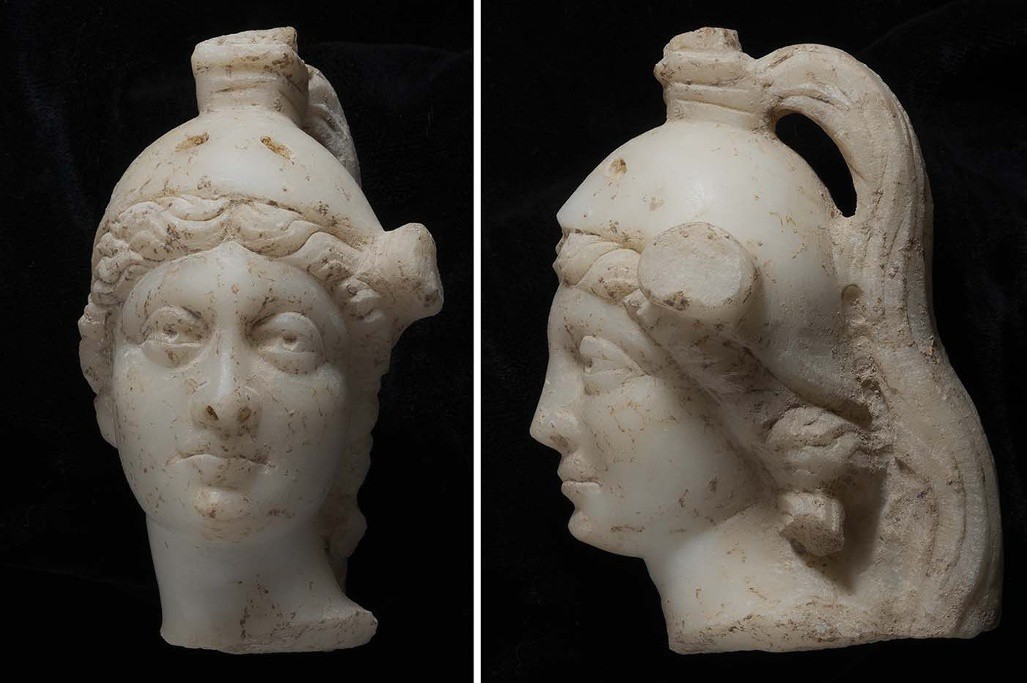
Athena in the House of Kybele at Aphrodisias. Two views of a marble head belonging to a statuette of the goddess, discovered in the religious complex at Aphrodisias (present-day Türkiye). Athena wears a highly stylised Corinthian-type helmet pushed back on her head, with two vestigial eye-holes and a crest descending behind her neck. Her facial features, particularly the drilled pupils and pronounced upper eyelids, are characteristic of Late Antique sculpture. In the fifth and sixth centuries, Athena was closely associated with Athens and its philosophical traditions. As the excavators suggest, these associations may have held particular significance for those who worshipped her in the House of Kybele. Photographs published in Ine Jacobs and R. R. R. Smith, “The House of Kybele and the Last Pagans of Aphrodisias”, Journal of Roman Studies (2026), fig. 40a–b. Article published under CC BY-NC-ND 4.0. · Original article and figure.
What, then, killed the Greek gods? Not a single cause, and not on a single date. Their public worship gradually lost legal protection, resources and prestige as Christianity gained social and institutional influence. Prohibitions, conversions and changes in urban life accelerated the process. Some cults ceased to be practised, while others survived in altered forms. A few have left material traces as revealing as those discovered at Aphrodisias.
We do not know when the last sacrifice was offered to Zeus. We can, however, say that the world which had sustained the ancient cults changed until the gods no longer occupied their former place in the public life of cities. Their worship eventually disappeared, but their stories survived.
Ancient Sources Examined
Greek gods and philosophical criticism. Xenophanes, fragments DK B11 and B14–16 (criticism of the traditional representations of the gods); Plato, Republic, 377e–379a (criticism of certain mythical narratives and their educational implications).
Legislation, toleration and imperial support for Christianity. Lactantius, De mortibus persecutorum, 34 and 48 (Galerius' toleration of Christianity in 311 and the measures agreed by Constantine and Licinius in 313); Eusebius of Caesarea, Ecclesiastical History, 8.17 and 10.5–7 (imperial measures concerning Christianity, grants to Christian communities and exemptions granted to the clergy); Eusebius, Life of Constantine, 4.61–63 (Constantine's baptism); Theodosian Code, 16.1.2 (the decree Cunctos populos of 380) and 16.10.10–12 (restrictions on traditional religious practices in 391–392).
Traditional religion and the transformation of sanctuaries. Julian, letter to Arsacius, high priest of Galatia (letter 22 in W. C. Wright's edition; priesthood, charitable assistance and the Homeric ideal of hospitality); Socrates Scholasticus, Ecclesiastical History, 5.16–17, and Sozomen, Ecclesiastical History, 7.15 (religious conflict and the destruction of the Serapeum at Alexandria); Eunapius, Lives of the Sophists, Life of Maximus, 7.3.4 (traditions concerning the final hierophants of Eleusis); Passion of Artemius, 35 (the late Christian tradition of Apollo's supposed final response at Delphi).
Traditional beliefs and philosophical teaching in the sixth century. John Malalas, Chronicle, 18.47 (Justinian's order concerning philosophical teaching in Athens); Agathias, Histories, 2.30–31 (the journey of seven philosophers to Persia and their return, compared with the related passage preserved in the Suda, π 2251); John of Ephesus, Ecclesiastical History, Part III, Book 3, chapter 36 (missionary activity among followers of traditional cults in western Asia Minor).
Archaeological and Historical Studies Consulted
Jacobs, Ine, and R. R. R. Smith (2026). “The House of Kybele and the Last Pagans of Aphrodisias”, Journal of Roman Studies, First View, pp. 1–57. https://doi.org/10.1017/S0075435826101853.
This is the principal archaeological study used in the article. We examined its descriptions of the underground complex, chronological development, cult sculptures, ritual equipment and religious activities, together with the authors' discussion of the traditional religious milieu of Late Antique Aphrodisias. Particular attention was given to the architectural phases, cult figures and interpretation of the complex's continued use into the early seventh century.
Roueché, Charlotte (2004). Aphrodisias in Late Antiquity: The Late Roman and Byzantine Inscriptions, revised second edition, King's College London. https://insaph.kcl.ac.uk/ala2004/.
The historical commentary in Section VI, concerning the period from Justinian to Heraclius (527–641), was consulted for the city's religious and civic transformations and the difficulties of dating the surviving evidence.
Archaeological and Manuscript Documentation
Aphrodisias Excavations, University of Oxford. “Temple of Aphrodite and Church”. https://aphrodisias.classics.ox.ac.uk/templeofaphrodite.html. Consulted for the architectural transformation of the Temple of Aphrodite into the Christian cathedral of St Michael.
The Homer Multitext Project. “The Venetus A (Marciana 454 = 822)”. https://www.homermultitext.org/manuscripts/venetusA/. Consulted for the tenth-century manuscript of the Iliad and its accompanying ancient scholarly annotations, as evidence for the transmission of Homer in the Byzantine period.
Method and Limits of the Evidence
The references above identify ancient passages, archaeological studies and documentary resources examined in preparing this article. They do not imply that every ancient work has been read in its entirety. Ancient evidence was examined in the relevant passages, using accessible texts and translations; in the case of Agathias, the cited chapters were also checked through a historical Latin translation.
These sources have different evidential value. Imperial legislation records legal intentions and prohibitions but does not demonstrate uniform enforcement. Christian historians and missionaries describe events from particular religious perspectives, while accounts such as the Passion of Artemius preserve later traditions whose historicity remains disputed. The authenticity of Julian's letter to Arsacius has also been questioned.
Archaeological evidence provides an independent means of examining religious practice, but the interpretation of objects, architectural changes and ritual activities requires caution. In particular, the House of Kybele supplies unusually detailed evidence for one community at Aphrodisias; it cannot establish how widespread similar practices were throughout the Empire.
The survival of ancient gods in literary and manuscript traditions must also be distinguished from the continuation of their worship. These different forms of evidence have been considered together without treating the disappearance of temples, the prohibition of sacrifices or the preservation of mythical narratives as equivalent historical events.