Demeter and Persephone Stories and Mysteries
The story of Persephone has come down to us through many voices. Some poets barely mentioned her abduction; others recounted her mother's desperate search; still others portrayed Pluto consumed by desire or Persephone exercising her power over the souls of the dead.
The following sources offer different accounts of her story. We shall explore them one by one.
| Source | Approximate date | Main contribution |
|---|---|---|
| Homer, Iliad and Odyssey | c. 8th century BC | Hades and Persephone are already powers of the world of the dead |
| Hesiod, Theogony | late 8th–early 7th century BC | Genealogy, Zeus’s consent to the abduction and the shared dwelling |
| Homeric Hymn to Demeter | 7th–6th centuries BC | Abduction, search, Eleusis, famine, pomegranate and return |
| Pindar, fragment 133 | 5th century BC | Persephone’s power over the return of certain souls |
| Diodorus Siculus, 5.2–5.4 | 1st century BC | Enna, Syracuse, the spring of Cyane and Sicilian traditions |
| Virgil, Aeneid 6 | 1st century BC | The golden bough belongs to the queen of the underworld |
| Ovid, Metamorphoses 5 | early 1st century AD | Cupid, Cyane, Arethusa, Ascalaphus, seven seeds and half the year |
| Ovid, Fasti 4 | early 1st century AD; unfinished work | Ceres’ search and a distinctive version of Eleusis |
| Pseudo-Hyginus, Fabulae 146–147 | complex dating | Abduction with three goddesses, half the year and Triptolemus |
| Pseudo-Apollodorus, Library 1.5 | Imperial period | Greek synthesis, Ascalaphus and one third of the year |
| Pausanias, Description of Greece | 2nd century AD | Local versions from Argos, Eleusis and Arcadia |
| Orphic Hymns, 29 | Imperial period | Invocation to Persephone as queen: life, fruits and death |
| Claudian, De raptu Proserpinae | late 4th century AD | Great epic with Hades as protagonist, without a surviving ending |
We shall explore these sources one by one. Each offers a different perspective, preserving aspects of the myth that deserve our attention.
The story of Hades, Persephone and Demeter, passed down from Homer to the late Latin poets, brings together a remarkable variety of traditions and beliefs. After examining these accounts, we shall return to the myth as a whole and consider what they reveal about its meaning.
Greek and Roman Names of the Gods
Sección titulada «Greek and Roman Names of the Gods»Greek and Roman Names of the Gods
Throughout this article, we shall encounter Greek and Latin names for the same deities. Wherever possible, we have retained the names used by each ancient author. The following table shows their principal equivalents.
| Greek name | Roman or Latin name |
|---|---|
| Hades, also called Pluto or Aidoneus | Pluto, Dis (Dis Pater, “Rich Father”) |
| Persephone, also called Kore (“the maiden”) | Proserpina |
| Demeter | Ceres |
| Zeus | Jupiter |
| Hera | Juno |
| Poseidon | Neptune |
| Cronus | Saturn |
| Artemis | Diana |
| Athena | Minerva |
| Aphrodite | Venus |
| Ares | Mars |
| Hermes | Mercury |
| Apollo | Apollo |
| Hephaestus | Vulcan |
| Helios | Sol |
| Eos | Aurora |
| Gaia | Earth (Terra, Tellus) |
| Hecate | Hecate, also Trivia |
| Erinyes | Furies |
| Moirai | Fates |
One point deserves clarification: Pluto is not exclusively a Roman name. The Greeks also called the ruler of the dead Plouton (Πλούτων). This explains why Diodorus Siculus uses the name, even though he wrote in Greek.
These equivalences reflect identifications established between Greek and Roman traditions. They do not mean that the deities' cults, attributes and stories were identical in every place or period.
1. Homer — The Iliad and The Odyssey
Sección titulada «1. Homer — The Iliad and The Odyssey»1. Homer — The Iliad and The Odyssey
The Iliad
During the Trojan War, Achilles has withdrawn from battle, furious with Agamemnon. The Achaeans need his help and send an embassy to persuade him to return. Among the envoys is Phoenix, the elderly man who had cared for Achilles since childhood.
Phoenix tries to move Achilles by recalling his own youth. His father, Amyntor, kept a concubine and neglected his wife in favour of the other woman. His mother asked Phoenix to sleep with the concubine in order to turn her away from her husband. The young man eventually agreed, but his father discovered what had happened and pronounced a terrible curse upon him: he would never have a son to sit upon his knees. Amyntor invoked the Erinyes, and Zeus beneath the earth and dread Persephone brought his wish to fulfilment.
Phoenix even considered killing his father, but eventually left his home and fled to Phthia, where he was welcomed by Peleus, the father of Achilles.
Later, the old man recalls another story: that of Meleager, the hero who defended Calydon against its enemies.
The conflict began when Artemis, angered because King Oeneus had failed to offer her the sacrifices she was owed, sent a huge boar to ravage his fields. Meleager managed to kill it, but a dispute over the animal's head and hide set the Aetolians and the Curetes against one another. The two peoples eventually found themselves fighting around Calydon.
Meleager had killed his maternal uncle, and his mother, Althaea, distraught at the loss of her brother, turned against her own son.
Kneeling, she struck the ground again and again with her hands. Her tears soaked her clothes as she called upon Hades and dread Persephone, begging for death to claim Meleager. From the depths of Erebus, a relentless Erinys heard her curse.
Angry with his mother, Meleager withdrew from the fighting and remained with his wife Cleopatra while the enemy advanced towards Calydon. Neither the pleas of the elders and his family nor the rewards they offered could persuade him to return. At last, when the Curetes reached the walls and began setting the city alight, Cleopatra described the disasters awaiting its inhabitants. Meleager took up his weapons and went out to fight.
He had saved his city, but it was too late to receive the rewards previously offered to him. That was precisely what Phoenix wished to prevent from happening to Achilles.
Elsewhere in the Iliad, Homer introduces Hades himself.
Poseidon recalls how, when the three brothers divided the universe by lot, Zeus received the sky, Poseidon the sea, and Hades the dark depths below. The earth and Olympus remained their common domains.
And when the gods go to war and Poseidon makes the earth tremble, Hades springs from his throne in terror. He fears that the ground will split open above him and expose his dark, damp abode, a place so dreadful that even the immortals recoil from it.
The Odyssey
After spending a year at Circe's home, Odysseus and his companions prepare to leave the island of Aeaea. But the goddess tells Odysseus that another journey still lies ahead: he must travel to the realm of Hades and dread Persephone to consult the spirit of Tiresias, the Theban seer.
Circe explains that Tiresias enjoys an extraordinary privilege among the dead. Persephone has allowed him to retain his understanding even after death, while the other souls wander like shadows.
Odysseus follows the goddess's instructions and sails to the farthest reaches of Ocean. There he prepares a sacrifice to summon the dead. He digs a trench, pours offerings into it and slaughters two animals over it. Drawn by the blood, numerous souls emerge from Erebus.
The first to appear is Elpenor, one of his companions, who died after falling from the roof of Circe's house. His body was left behind without burial. Odysseus is startled to find him among the dead, and the young man begs him to give his body a proper burial when he returns to the island.
Next comes the soul of Anticleia, his mother, who died during his absence. Odysseus is deeply moved, but will not allow her to approach the blood until he has consulted Tiresias.
At last the seer arrives and foretells the difficulties Odysseus must still face before returning home. He warns him of the dangers ahead and tells him what he must do to reach Ithaca.
When Tiresias has finished speaking, Odysseus allows his mother to approach the blood. Anticleia recognises her son and they begin to talk. He learns how she died, asks about his father and wife, and listens to news of the family he left behind.
Overcome with emotion, he tries to embrace her. Three times he reaches out to hold her, and three times her shade slips through his arms.
Bewildered, he asks whether Persephone has sent this phantom to deepen his sorrow. Anticleia replies that the goddess is not deceiving him: this is the nature of the dead, whose souls separate from their bodies and flutter away like dreams.
When their meeting ends, Persephone summons the souls of women from long ago, wives and daughters of great heroes. They gather around the blood, and Odysseus questions them one after another.
Among them he recognises Tyro, Antiope, Alcmene, the mother of Heracles, and Epicaste, the mother of Oedipus, who took her own life after discovering that she had married her son.
When Persephone disperses the souls of these women, the shades of great warriors begin to arrive.
First comes Agamemnon, murdered on his return from Troy; then Achilles, who hears news of his father and son; and Ajax, who still bears a grudge against Odysseus over the contest for Achilles' armour.
Odysseus also witnesses the terrible punishments suffered by certain figures.
He sees the giant Tityos stretched upon the ground, while two vultures devour his liver and he is powerless to stop them. Then he encounters Tantalus, standing in a lake whose waters retreat whenever he tries to drink. Above his head hang branches laden with fruit, but whenever he reaches for them, the wind blows them away.
He also sees Sisyphus, condemned to push a huge stone to the top of a hill. Whenever he is about to reach the summit, the rock rolls down again and he must begin his labour anew.
Finally, he encounters the shade of Heracles, carrying a bow ready to shoot and a splendid shoulder-belt decorated with scenes of wild beasts, battles and death. The hero himself, however, enjoys the company of the immortals, while his image remains among the dead.
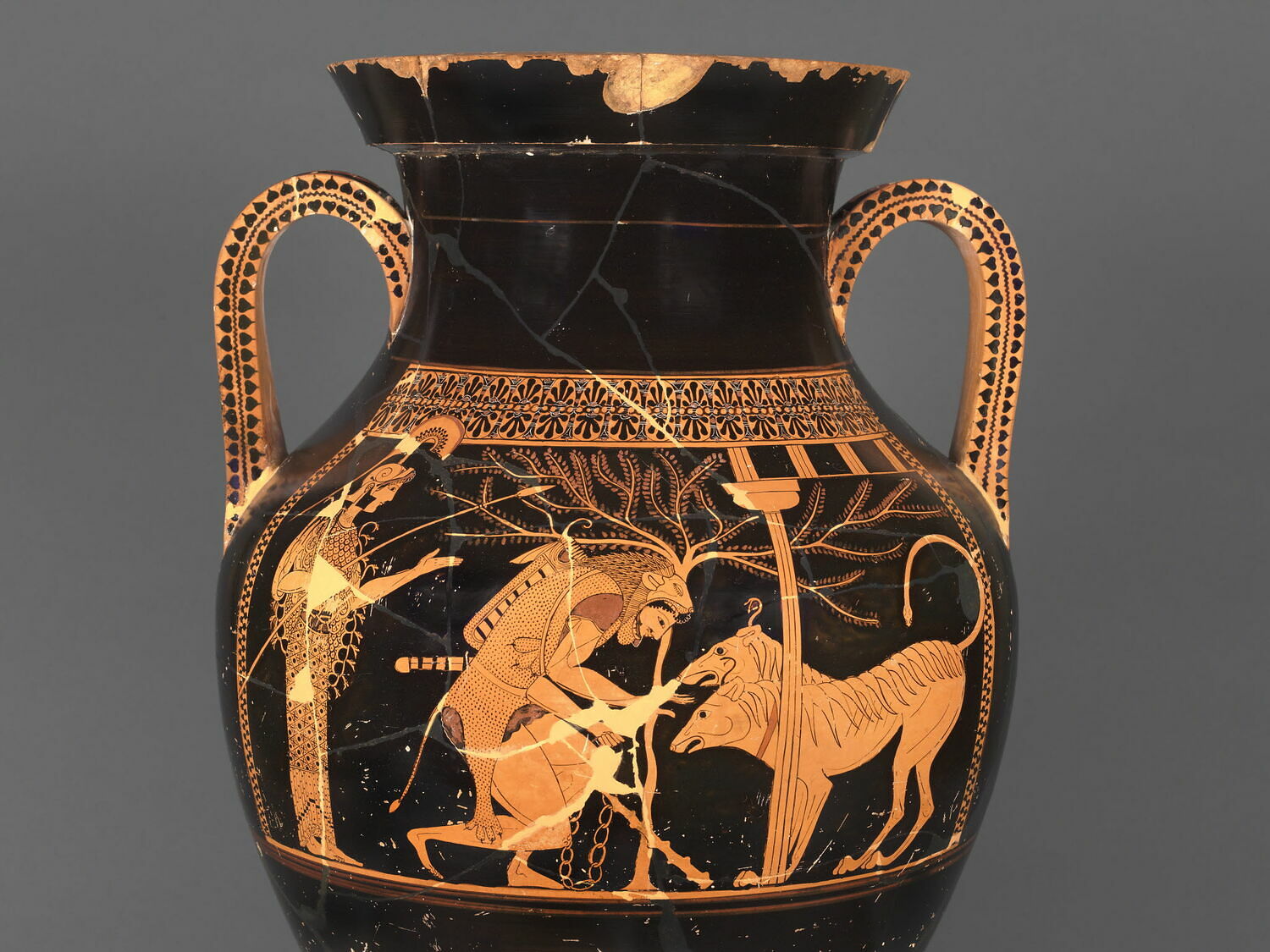
Heracles recognises Odysseus and recalls the terrible trials he endured during his lifetime, including the time he descended to the underworld to carry off Cerberus, the monstrous dog that guarded its gates.
But the souls continue to gather around Odysseus. Their voices rise in a dreadful clamour, and fear seizes him. He fears that Persephone may send the head of the monstrous Gorgon up from the depths of the underworld.
Odysseus does not wait to find out. He rushes back to his ship, orders his companions aboard and sails away.
2. Hesiod — The Theogony
Sección titulada «2. Hesiod — The Theogony»2. Hesiod — The Theogony
In Homer's poems, the gods take part in events alongside mortals. They intervene in human lives, fight, quarrel and determine their destinies, without the poet needing to explain who they are.
Hesiod, by contrast, traces the origins and genealogies of the gods in his Theogony, recounting their struggles for power and the order that eventually emerged. His account helps us understand who Hades and Persephone were.
Hades belonged to an ancient generation of gods. He was the son of Cronus and Rhea, and the brother of Hestia, Demeter, Hera, Poseidon and Zeus. His father, Cronus, ruled over the gods but lived in fear of a prophecy. Gaia, the Earth, and Uranus, the Sky, had warned him that one of his children would eventually overthrow him.
To prevent this, Cronus swallowed each of his children as soon as they were born. Hestia, Demeter, Hera, Hades and Poseidon disappeared in turn, while Rhea watched helplessly as her husband devoured each newborn child.
When the time came to give birth to Zeus, Rhea resolved to save him. With the help of Gaia and Uranus, she travelled to Crete and hid the baby in a cave. She then wrapped a large stone in swaddling clothes and handed it to Cronus, who swallowed it, believing it to be his newborn son.
Zeus grew up far from his father and, when he reached maturity, succeeded in overcoming him through strength and cunning. Cronus eventually disgorged the children he had swallowed, beginning with the stone he had consumed last. Hades and his siblings were thus released from the imprisonment imposed upon them by their father.
Then came the great war against the Titans. For ten years, the gods fought for mastery of the universe, until Zeus prevailed with the help of his allies. The defeated Titans were imprisoned in Tartarus, a dreadful region deep beneath the earth.
Zeus still had to confront Typhoeus, a monstrous son of Gaia and Tartarus who threatened his rule. After defeating him with his thunderbolts, Zeus consolidated his power and became ruler of the immortals.
Hades, meanwhile, appears in the poem as a powerful god, unyielding of heart, who dwells beneath the earth. With the establishment of the new divine order came Zeus's unions and the birth of numerous other gods.
From Zeus's union with Demeter, the goddess who nourished the earth and made its fruits grow, was born white-armed Persephone. But she would not remain beside her mother.
Hades, whom Hesiod also calls Aidoneus, carried Persephone away from Demeter. Zeus, the young goddess's father and Hades' brother, had consented to the union and given her to the ruler of the underworld.
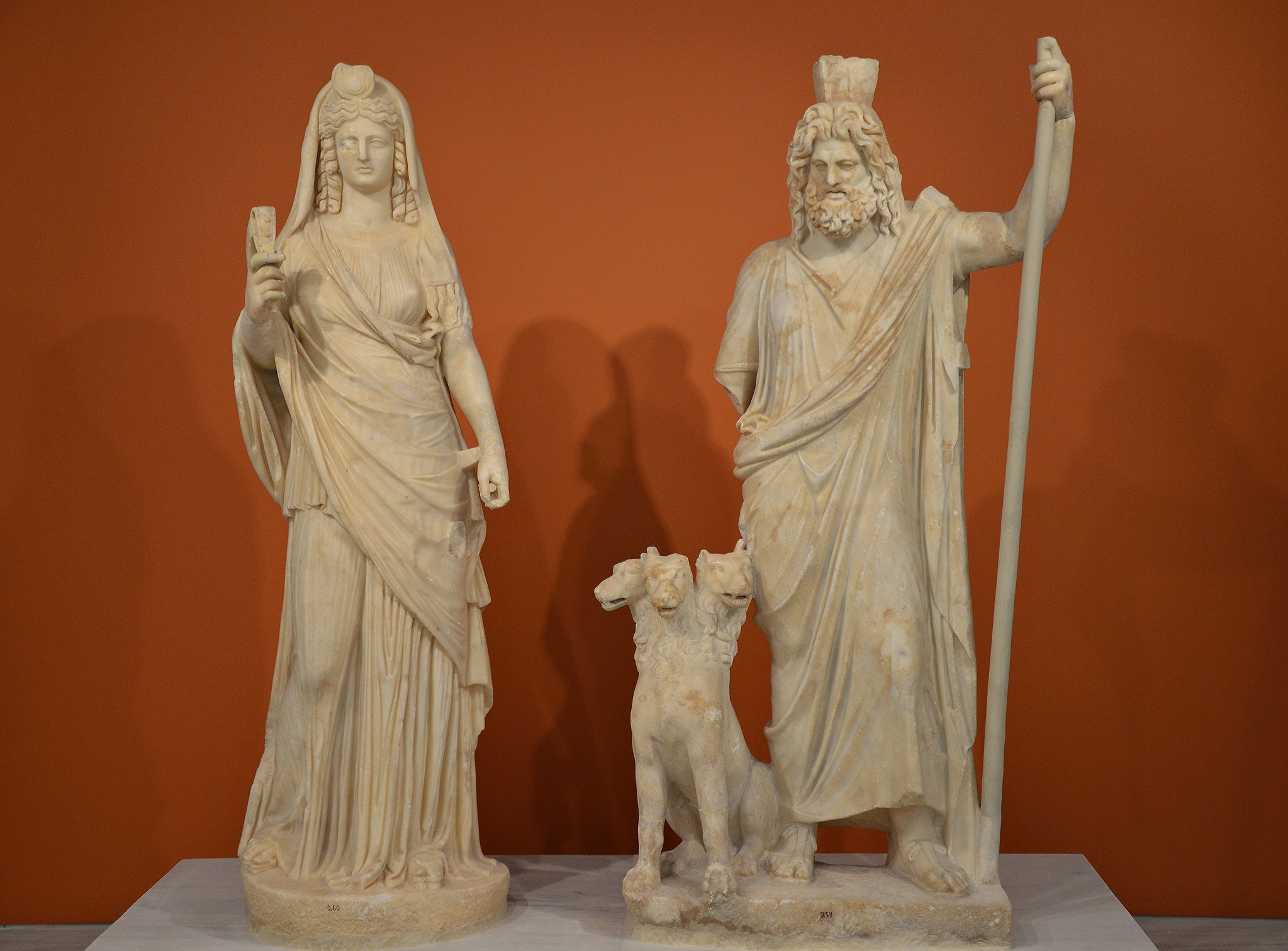
Deep beneath the earth, among dark and terrible places, stand the echoing halls of Hades and dread Persephone. Before their gates stands a monstrous dog, guarding the entrance. He is a watchful guardian, possessed of a peculiar cunning. When someone enters the house of the dead, the animal greets the newcomer, wagging his tail and moving his ears as though offering a friendly welcome. But he allows no one to leave. He watches the gates ceaselessly and devours anyone who tries to escape.
This is Cerberus, the dog of Hades, whom Hesiod has already described among the offspring of the monstrous Echidna and Typhon. He has a voice of bronze, fifty heads and a taste for raw flesh.
Perséphone, daughter of Zeus and Demeter, had been carried off by Hades with her father's consent. Now she shared those dark halls with him, their gates guarded by a monstrous creature that welcomed the newly arrived but never allowed them to return.
3. Homeric Hymn to Demeter
Sección titulada «3. Homeric Hymn to Demeter»3. Homeric Hymn to Demeter
Persephone, daughter of Zeus and Demeter, was playing in a vast meadow with the daughters of Oceanus. As she gathered roses, crocuses, violets and hyacinths, she came upon an extraordinary flower.
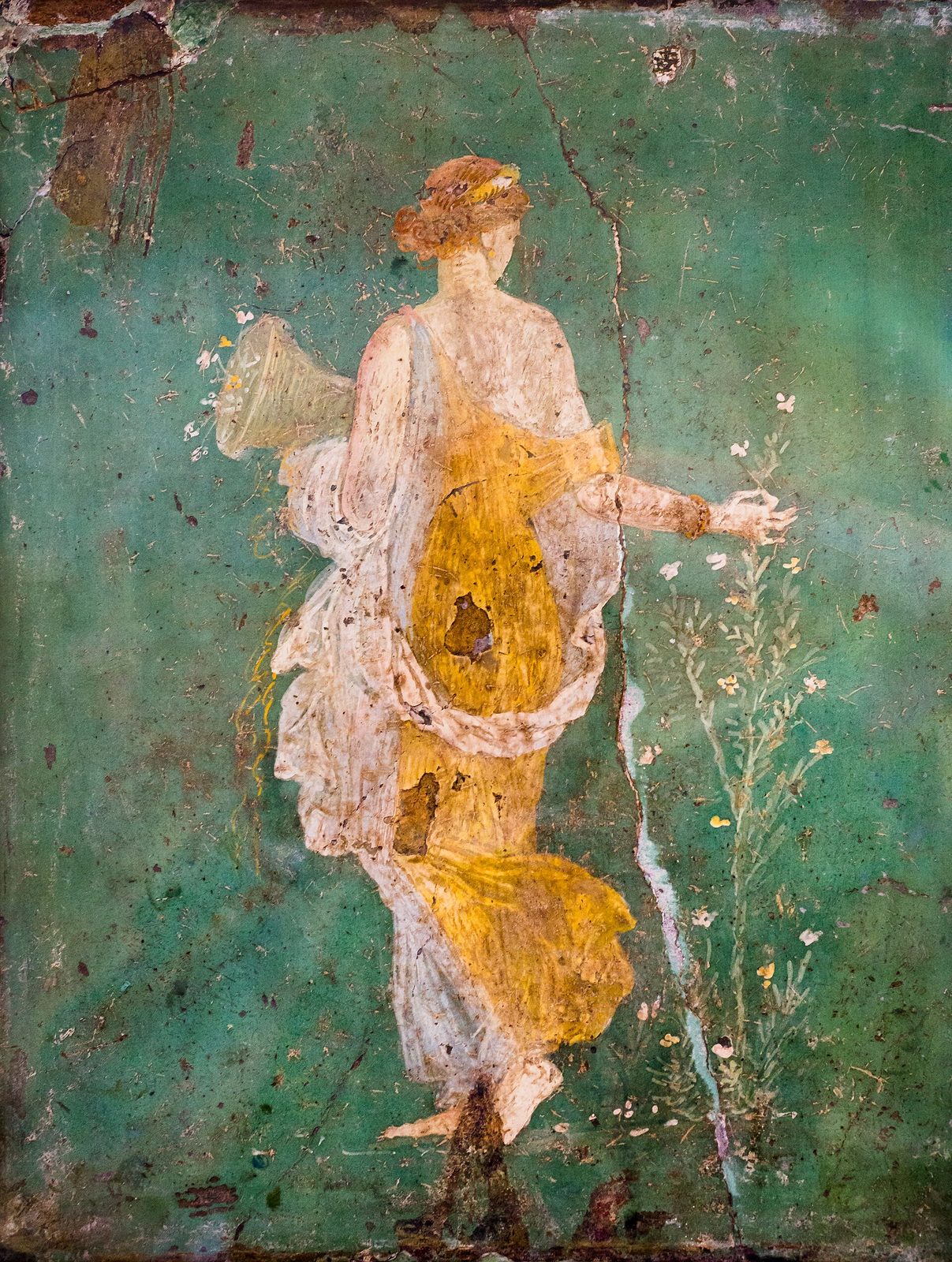
It was a narcissus that Earth herself had caused to grow in accordance with Zeus' plan, to please Hades, the ruler of the underworld. A hundred blossoms sprang from a single root, their fragrance spreading across the sky and sea. Even the gods marvelled at their beauty.
Fascinated, Persephone drew near and reached out with both hands to pick the flower. At that moment, the earth opened before her, and Hades, son of Cronus and brother of Zeus, emerged in a golden chariot drawn by immortal horses. He seized the young goddess, carried her into the chariot against her will and drove away towards the depths of the underworld.
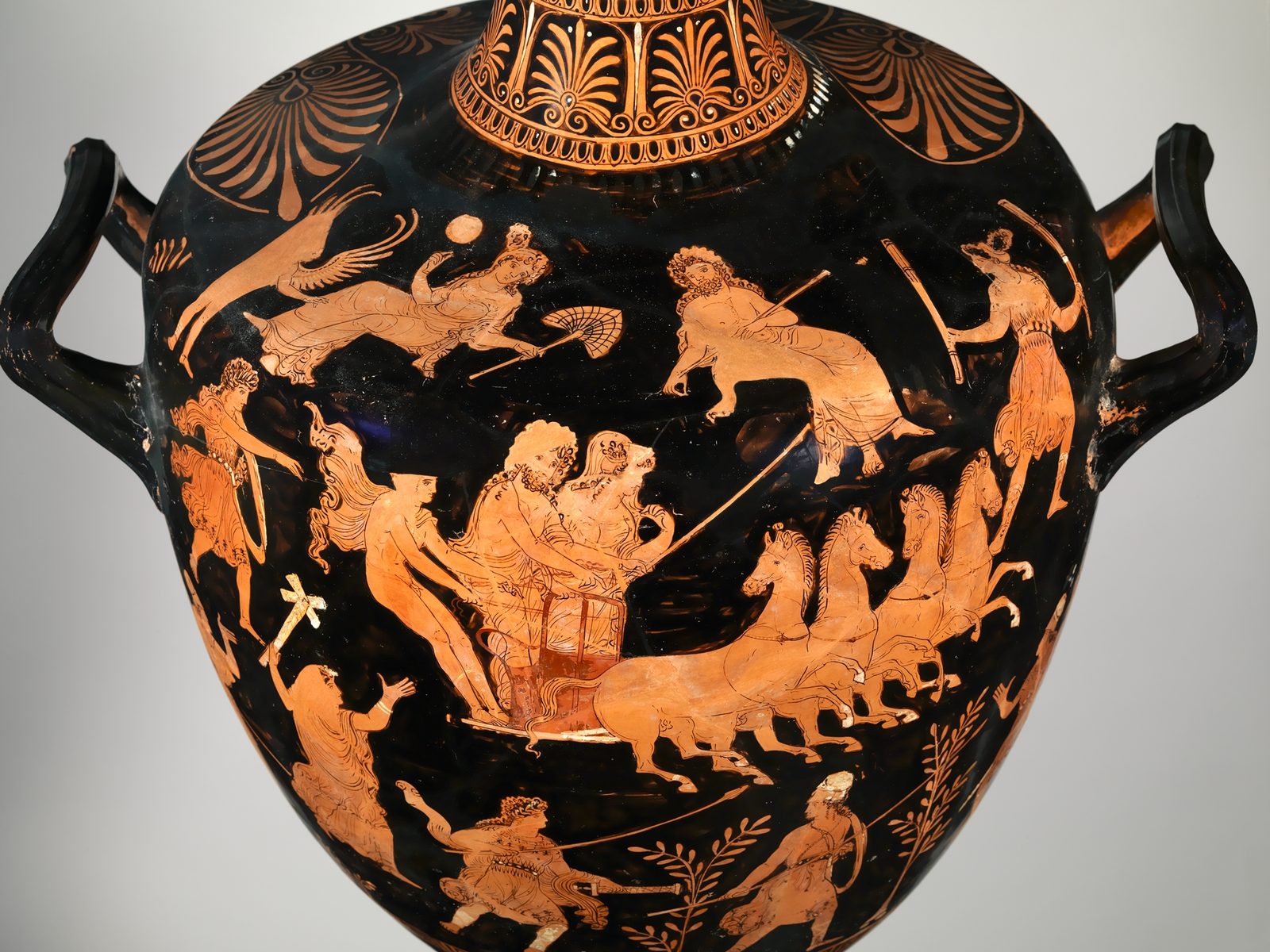
Persephone wept and cried out to her father. But Zeus, who had consented to the abduction, remained apart from the other gods, receiving sacrifices at a sanctuary. Only two deities heard her cries: Hecate, an ancient and powerful goddess, daughter of Perses and Asteria, who heard them from her cave; and Helios, the Sun, who travelled across the heavens and saw everything that happened upon the earth.
As the chariot sped away, Persephone could still see the sunlight, the starry sky and the waters of the sea. She still hoped to see her mother again. But Hades pressed on, carrying her into his realm beneath the earth. Persephone's cries echoed through the mountains and the depths of the sea. At last, they reached Demeter's ears.
Terrible anguish pierced the goddess's heart. She tore the ornaments from her hair, wrapped herself in a dark cloak and immediately set out in search of her daughter.
For nine days, Demeter wandered across the earth with burning torches, desperately searching for her daughter. She tasted neither ambrosia nor nectar, the food and drink of the immortals, and did not even bathe. Her grief was so profound that she had ceased to care for herself. She questioned gods and mortals, but no one would reveal what had happened.
At dawn on the tenth day, Hecate appeared, also carrying a burning torch. She explained that she had heard Persephone's cries but had not seen who had taken her away. The two goddesses then went to Helios, whose rays illuminated the whole face of the earth.
Demeter begged him to reveal all he knew, and Helios did not conceal the truth. He told her that Hades had taken Persephone and that Zeus, her own father, had given her to him as his wife. He added that Hades was no unworthy husband: he belonged to the same family as Zeus and Poseidon, had received a third of the universe when the divine domains were divided, and ruled over the dead in his own right.
Far from comforting Demeter, these words deepened her pain. Her grief turned to anger against Zeus. She left Olympus, withdrew from the other immortals and began wandering among mortals, concealing her true appearance. For a long time, no one could recognise her.
At last, she reached Eleusis, a city in Attica near Athens, ruled by Celeus, son of Eleusinus, who lived there with his wife Metaneira and their children. Taking the form of an old woman, Demeter sat down beside a well in the shade of an olive tree.
Soon, four young women arrived carrying bronze water jars. They were the king's daughters, come to fetch water for their household. The girls approached the stranger and asked who she was and why she sat alone, so far from the town.
Demeter replied that her name was Doso and that she came from Crete. She told them that pirates had captured her and brought her by sea to the coast of Attica. When the men landed near Thoricus to prepare a meal, she had managed to escape and had been wandering ever since, unfamiliar with the country. She was now looking for a household in which to work. She could care for a small child, look after the rooms and perform the tasks expected of a woman of her age.
One of the girls, Callidice, told her about the leading families of Eleusis and suggested that she come to her father's palace. Her mother, Metaneira, had a young son, born after many years of waiting, and might be willing to entrust him to the old woman's care. Demeter agreed.
The girls filled their jars and returned to the palace. When they told Metaneira about the stranger they had found beside the well, she immediately sent them back to offer her whatever was necessary to persuade her to enter their service. And so Demeter came to the house of King Celeus.
Metaneira was sitting with her little son upon her knees when the old woman appeared in the doorway. For a moment, the goddess seemed to rise towards the ceiling, and a divine radiance filled the room. The queen was overcome with fear and rose to offer her seat.
Demeter, however, remained standing, silent and with her eyes lowered. She would not sit in Metaneira's magnificent chair. A woman named Iambe brought her a simple seat covered with a skin. The goddess sat down and remained motionless for a long time, her face hidden behind her veil.
She spoke to no one, did not smile and refused food and drink. Her thoughts remained with her missing daughter. It was Iambe who finally managed to ease her sorrow for a moment. She began making jokes and amusing remarks until Demeter, for the first time since the abduction, smiled and at last laughed.
Metaneira then offered her a cup of sweet wine, but the goddess refused it. Instead, she asked for a mixture of water, barley meal and pennyroyal, a drink called kykeon. They prepared it for her, and she drank.
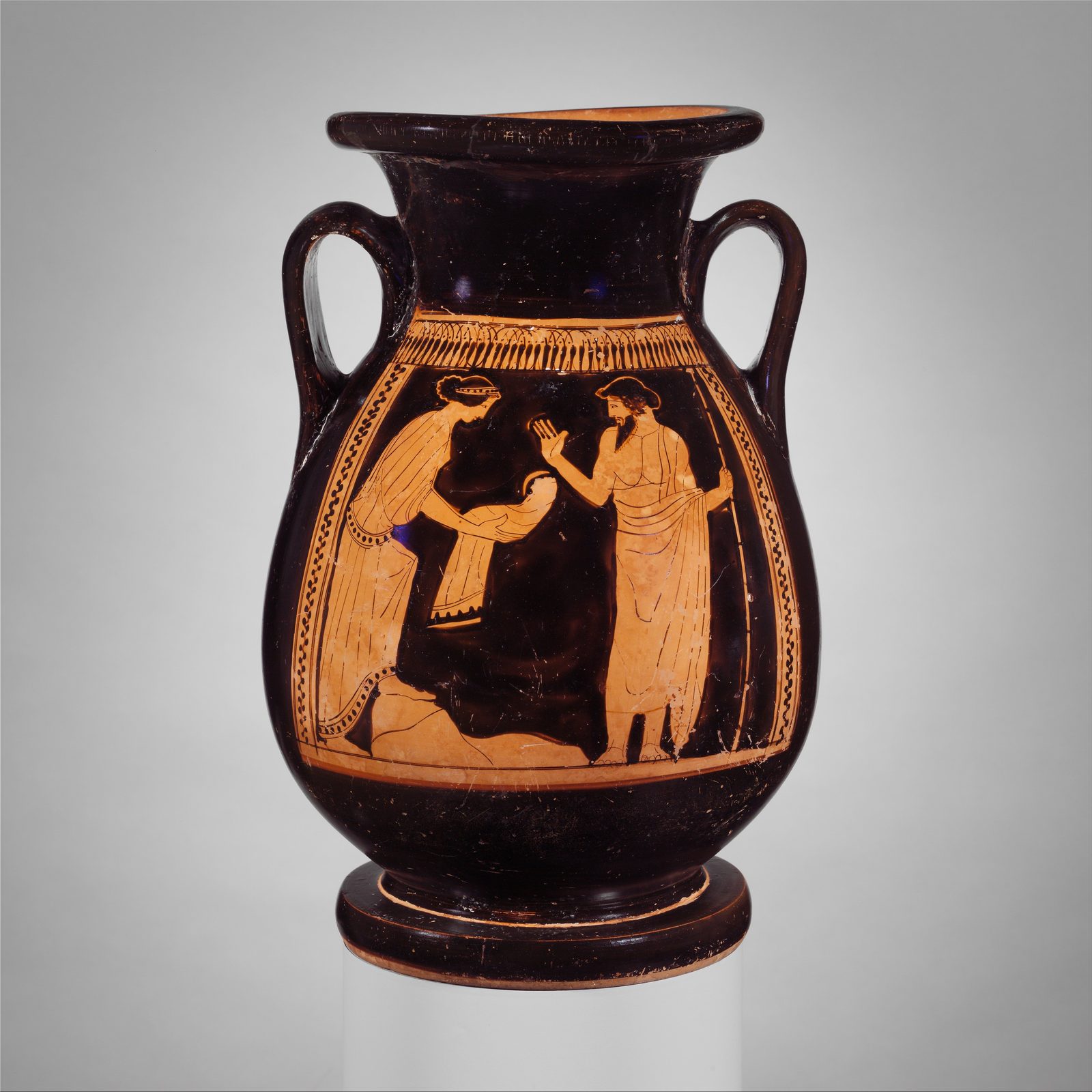
Metaneira then entrusted her son Demophon to Demeter. He was the long-awaited child whom the gods had granted her after many prayers. The goddess took him in her arms and began to care for him. Under her care, Demophon flourished in an extraordinary way. He did not need to be fed like other children. Demeter anointed him with ambrosia and held him close to her breast, breathing her immortal breath upon him. But his parents knew nothing of what else she was doing.
At night, Demeter placed the child among the flames of the hearth, as though he were a burning log. In this way, she was preparing him to escape old age and death. The boy would have become immortal if his mother had not discovered what was happening.
One night, Metaneira left her chambers and found the old woman holding Demophon in the fire. Terrified, she cried out, convinced that the woman was killing her son. Demeter was furious.
She lifted the boy from the flames and laid him on the floor. She reproached Metaneira for the inability of mortals to recognise the blessings the gods might grant them. Because of her intervention, Demophon had lost his chance of immortality.
The goddess swore by the waters of the Styx that, had she not been interrupted, she would have made the child free from old age and death. Now Demophon would share the fate of all mortals. Yet he would receive an everlasting honour because he had rested in the goddess's arms and upon her knees. Demeter also foretold that the young men of Eleusis would hold contests in his honour.
Demeter then revealed who she was. Before Metaneira's eyes, the old woman lost her mortal appearance. Her body took on extraordinary beauty, golden hair fell over her shoulders and a marvellous fragrance rose from her garments. The whole room was filled with the goddess's radiance.
At the sight of the goddess, Metaneira's knees gave way. She stood motionless and speechless, so overwhelmed that she forgot even to pick up her son, who was crying on the floor. Her daughters came when they heard the child's cries. One took him into her arms, while another supported their mother, who could scarcely stand, still dazed by what she had witnessed.
Demeter commanded the people of Eleusis to build a temple and an altar in her honour on a hill beside Callichoron, the well of beautiful dances. When the temple was finished, she herself would teach them the rites with which they were to worship her. Then she left the palace.
The next day, Celeus assembled the people of Eleusis and conveyed the goddess's orders. Everyone set to work building the sanctuary. When it was complete, Demeter took up residence there, apart from gods and mortals alike. Still consumed by grief at the loss of Persephone, she decided to prevent the earth from yielding its crops.
That year was terrible for mortals. People ploughed their fields with oxen and sowed seeds in the furrows, but nothing germinated. Demeter kept the grain hidden beneath the earth. No wheat grew, the harvests failed and famine began to spread throughout the world.
Humanity faced extinction, and with its disappearance the sacrifices and offerings that mortals made to the immortal gods would also cease. Zeus finally realised the gravity of the situation.
First, he sent Iris, his messenger, to summon Demeter back to Olympus. The goddess refused.
Then the other immortals came to her, one after another. They offered her magnificent gifts and all the honours she might desire among the gods. But Demeter rejected every offer.
She would neither return to Olympus nor allow the earth to bear fruit again until she had seen her daughter. Zeus was forced to change his plans. He summoned Hermes, the messenger of the gods, and ordered him to descend into the realm of Hades. He was to persuade the ruler of the underworld to allow Persephone to return, so that Demeter might be reunited with her daughter, relinquish her anger and bring an end to the catastrophe.
Hermes immediately set off for the depths of the earth. He found Hades in his palace, sitting beside Persephone. The young goddess remained sorrowful, longing for her mother and grieving over their separation.
Hermes approached Hades and delivered Zeus' command. He explained that Demeter was preventing the crops from growing and that, if she continued, humanity would perish and the gods would lose the honours they received from mortals.
Hades listened to the message and smiled. He had no wish to disobey his brother. Turning to Persephone, he told her that she could return to her mother.
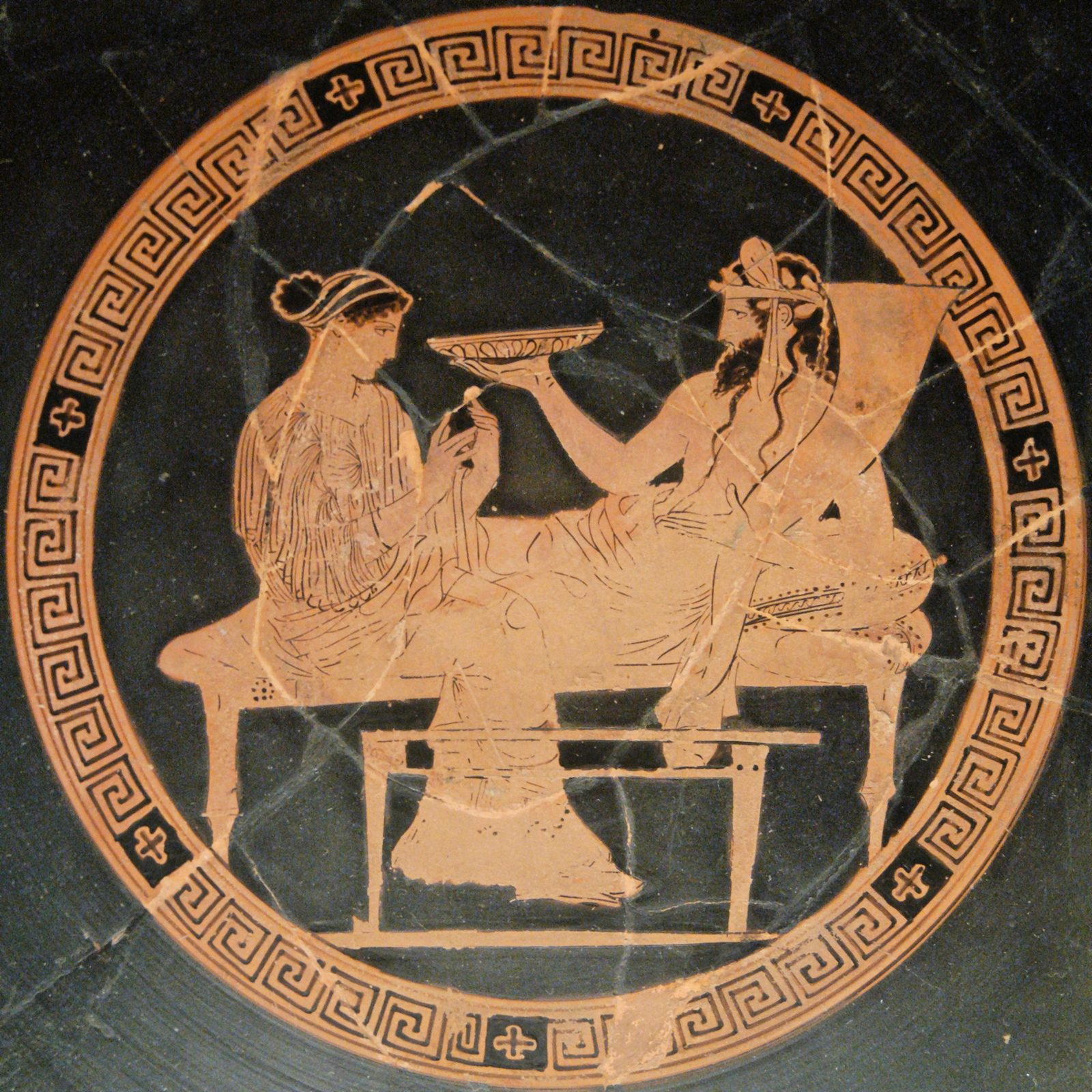
He asked her not to surrender to excessive grief and reminded her that he was the brother of Zeus and ruler of part of the universe. At his side, Persephone would enjoy an extraordinary position: she would be queen over all that lived and moved, receive great honours among the immortals and be entitled to the sacrifices mortals owed her. Those who failed to honour her or offer the sacrifices due to her would face her punishment.
Persephone listened to his words. Delighted at the prospect of seeing her mother again, she immediately prepared to leave. But Hades did not want her to remain away from him forever. Before allowing her to depart, he secretly made her eat a pomegranate seed, sweet as honey, hoping to prevent her from remaining permanently with Demeter.
He then prepared the immortal horses and the golden chariot. Persephone climbed in beside Hermes, who took the reins and set off towards the world above. The horses travelled with extraordinary speed. Neither rivers nor seas, valleys nor mountains could stop them. At last, they reached the sanctuary at Eleusis.
When Demeter saw her daughter approaching, she rushed towards her, overcome with joy. Mother and daughter were reunited after so long apart. But Demeter knew that one obstacle might still prevent their permanent reunion. She asked Persephone whether she had eaten anything while in the underworld.
The young goddess replied that, when Hermes had arrived with Zeus' command, she had risen full of joy. Hades had then secretly placed a pomegranate seed in her hand and forced her to eat it.
She went on to tell her mother everything that had happened since the abduction. She recalled the meadow where she had played with the daughters of Oceanus, together with Athena and Artemis. She remembered the flowers they had gathered, the beautiful narcissus that had attracted her attention and the earth suddenly opening beneath her feet. She told how Hades had appeared in his chariot, seized her against her will and carried her away despite her cries. Demeter listened closely and understood that Persephone remained bound to the realm of the dead.
The two spent the day together, embracing and enjoying a happiness that had seemed lost to them forever. Hecate, too, came to greet Persephone and embraced her affectionately. From then on, she became her companion.
But the matter was not yet settled, and an agreement among the gods was needed. Zeus sent Rhea, mother of Demeter and Hades, to persuade her daughter to return to Olympus. Rhea came to Eleusis and conveyed Zeus' decision: Persephone would spend one third of the year in the underworld and the remaining two thirds with Demeter and the other immortals. This was the arrangement proposed by the ruler of the gods.
Rhea urged Demeter to set aside her anger and allow the earth to yield its fruits once more. The goddess finally agreed, and wheat began to grow again in the fields. The furrows filled with ears of grain, and the harvests returned. The famine was over.
Before leaving Eleusis, Demeter fulfilled the promise she had made to its people. She revealed to Triptolemus, Diocles, Eumolpus and Celeus the sacred rites with which she was to be worshipped. She taught them how to perform the ceremonies and commanded them to keep their content secret.
These ceremonies, which would become known as the Eleusinian Mysteries, offered mortals something extraordinary: the hope of a different fate after death. Those who took part were forbidden to reveal what they had witnessed, for the sacred rites were not to be disclosed.
The poet calls those who have witnessed the mysteries blessed. When death came and they descended into the dark depths, they would not share the same fate as those who had never been initiated.
With the rites at Eleusis established, Demeter and Persephone returned to Olympus and took their places among the immortals. Thereafter, both goddesses received the honours due to them. To mortals who enjoyed their favour, they could send Plutus, the personification of wealth, who brought abundance to their homes.
Persephone, however, would no longer remain always beside her mother. For part of each year, she would return to the underworld, where Hades had made her his wife and promised her great honours as queen. When the time came to leave that realm, she would return to the light and be reunited with Demeter.
Thus her fate was established between the two worlds.
4. Pindar
Sección titulada «4. Pindar»4. Pindar
Persephone and the Return of Souls
Persephone, queen of the realm of the dead, possessed a power that went beyond receiving those who had died. She could also allow certain souls to return to the world of the living.
Pindar speaks of an ancient suffering endured by the goddess, for which she was owed reparation. He does not, however, explain what caused her suffering or who was required to make amends.
When Persephone accepted that reparation, she allowed certain souls to leave the realm of the dead. In the ninth year, she sent them back into the sunlight to be born again among mortals.
From among them would emerge illustrious kings, men of exceptional strength and others renowned for their wisdom. Future generations would honour them as sacred heroes.
Persephone did not merely rule over the dead. She also possessed the power to allow certain souls to return to the world of the living, where they could attain an extraordinary destiny.
The Island of the Blessed
In another poem, composed to celebrate Theron of Acragas' victory at the Olympic Games, Pindar describes the fate awaiting mortals after death. He does not explicitly mention Persephone, Hades or Demeter, but speaks instead of honoured gods, παρὰ μὲν τιμίοις θεῶν (Olympian 2.64–65).
The souls of those who have committed injustices must answer for their actions. Beneath the earth, a judge pronounces judgement and imposes the appropriate punishments.
But not all the dead share that fate.
The righteous enjoy an existence free from suffering. There, the sun shines for them both day and night. They need neither work the land nor sail the seas to obtain food. They live without tears, in the presence of the honoured gods, while the guilty endure terrible torments.
There is an even more extraordinary destiny, reserved for those who have kept their souls free from wrongdoing three times in each of the two worlds.
They follow the path of Zeus until they reach the stronghold of Cronus, on the Island of the Blessed.
There, breezes from Ocean blow and golden flowers gleam. Some grow upon radiant trees; others spring from the waters. The island's inhabitants adorn their hands with them and weave garlands for their heads.
Cronus rules there, accompanied by Rhadamanthys, renowned for his justice, who serves as his counsellor. Cadmus and Peleus are among those who enjoy this blessed existence.
Achilles is there too. His mother Thetis secured him a place on the Island of the Blessed after moving Zeus with her pleas. Pindar recalls his great deeds: he killed Hector, defender of Troy, Cycnus and Memnon, son of the Dawn.
Achilles, whose shade we encounter among the dead in the Odyssey, now appears among the blessed, far from mortal suffering.
5. Diodorus Siculus — The Abduction of Persephone in Sicily
Sección titulada «5. Diodorus Siculus — The Abduction of Persephone in Sicily»5. Diodorus Siculus — The Abduction of Persephone in Sicily
The people of Sicily believed that their island had been sacred to Demeter and her daughter Persephone since ancient times. Some poets even claimed that Zeus had given Sicily to the young goddess as a wedding gift when she married Pluto.
In the heart of the island, near the city of Enna, lay meadows of extraordinary beauty. The land was flat at its centre, abundantly watered and surrounded by steep hills. Some called the place the navel of Sicily, because it seemed to lie at the very centre of the island.
Among the sacred groves and marshes grew violets and flowers of every kind, their fragrance so intense that hunting dogs lost the trail of their prey, unable to distinguish one scent from another. The flowers remained in bloom throughout the year, filling the landscape with colour and fragrance. This was one of Persephone's favourite places.
The young goddess had grown up alongside Athena and Artemis, and all three had chosen to remain virgins. They often gathered flowers together and wove a cloak intended for their father Zeus.
But the meadows concealed an entrance to the underworld. Near the woods stood an enormous cave, opening towards the north, with a deep fissure inside that descended into the depths of the earth.
According to the tradition preserved by the inhabitants of Enna, Pluto emerged through that opening in his chariot. There he seized Persephone and carried her away. Her disappearance was forever associated with those meadows.
Athena and Artemis also received sacred places in Sicily, in memory of the time they had spent with their companion. Athena was given a region near Himera, where nymphs caused hot springs to emerge during a visit by Heracles. Artemis received the island of Ortygia, beside Syracuse, where the same nymphs brought forth the spring of Arethusa.
The waters of Arethusa were home to numerous fish regarded as sacred by the inhabitants. No one was allowed to catch or eat them, and it was said that those who committed this sacrilege during times of war had suffered terrible misfortunes.
Persephone retained the meadows of Enna, but was also given another sacred spring near Syracuse, called Cyane, a name meaning 'blue'.
A different tradition concerning the location of the abduction survived in that region. According to this account, Pluto had seized Persephone near Syracuse and carried her away in his chariot. He then opened the earth and descended with her into the realm of the dead. At that very spot, he caused the spring of Cyane to emerge.
The inhabitants of Syracuse held a great festival beside its waters each year, offering sacrifices to Persephone. Small animals were sacrificed in private ceremonies, while during public celebrations bulls were submerged in the spring.
They attributed this custom to Heracles, who had crossed Sicily driving the cattle he had taken from the giant Geryon and had established the manner in which the sacrifices were to be performed.
When Demeter discovered that Persephone had vanished, she searched desperately for her daughter. She went to Mount Etna and lit her torches in the volcano's craters. Carrying them, she embarked on a long journey through the world, visiting many lands and communities. Those who welcomed her hospitably were rewarded by the goddess, who gave them wheat, a food that would transform their lives.
The Sicilians maintained that they had been the first to receive this gift, for their island was particularly dear to Demeter and Persephone.
The Athenians received it afterwards, having shown the goddess greater hospitality than other peoples. In gratitude, the inhabitants of Athens established great sacrifices in Demeter's honour and the sacred rites of Eleusis, whose antiquity and sanctity made them famous throughout the Greek world.
From there, knowledge of agriculture spread to other communities, which shared the seeds with their neighbours until the practice reached the whole inhabited world.
Elsewhere in his work, Diodorus preserves a different account of how wheat first came to mortals. According to this tradition, Demeter had discovered the grain even before Persephone was born. She had learnt how to gather it while it still grew wild, how to preserve it and prepare it as food, and had taught mortals to cultivate it.
But after the abduction, furious with Zeus and consumed by grief, she burned the grain and deprived humanity of that food.
A tragic poet named Carcinus, who had visited Syracuse and witnessed celebrations dedicated to the two goddesses, recalled in his verses the misfortunes that accompanied Persephone's disappearance. He spoke of Demeter's daughter as a goddess whose name must not be spoken. He told how Pluto had seized her through a secret conspiracy and descended with her into the depths, where darkness took the place of light.
While Demeter wandered through the lands in search of her daughter, Sicily trembled beneath the fires of Etna and its inhabitants suffered from the absence of wheat. Finally, according to the account Diodorus gives later, Demeter found Persephone and was reconciled with Zeus.
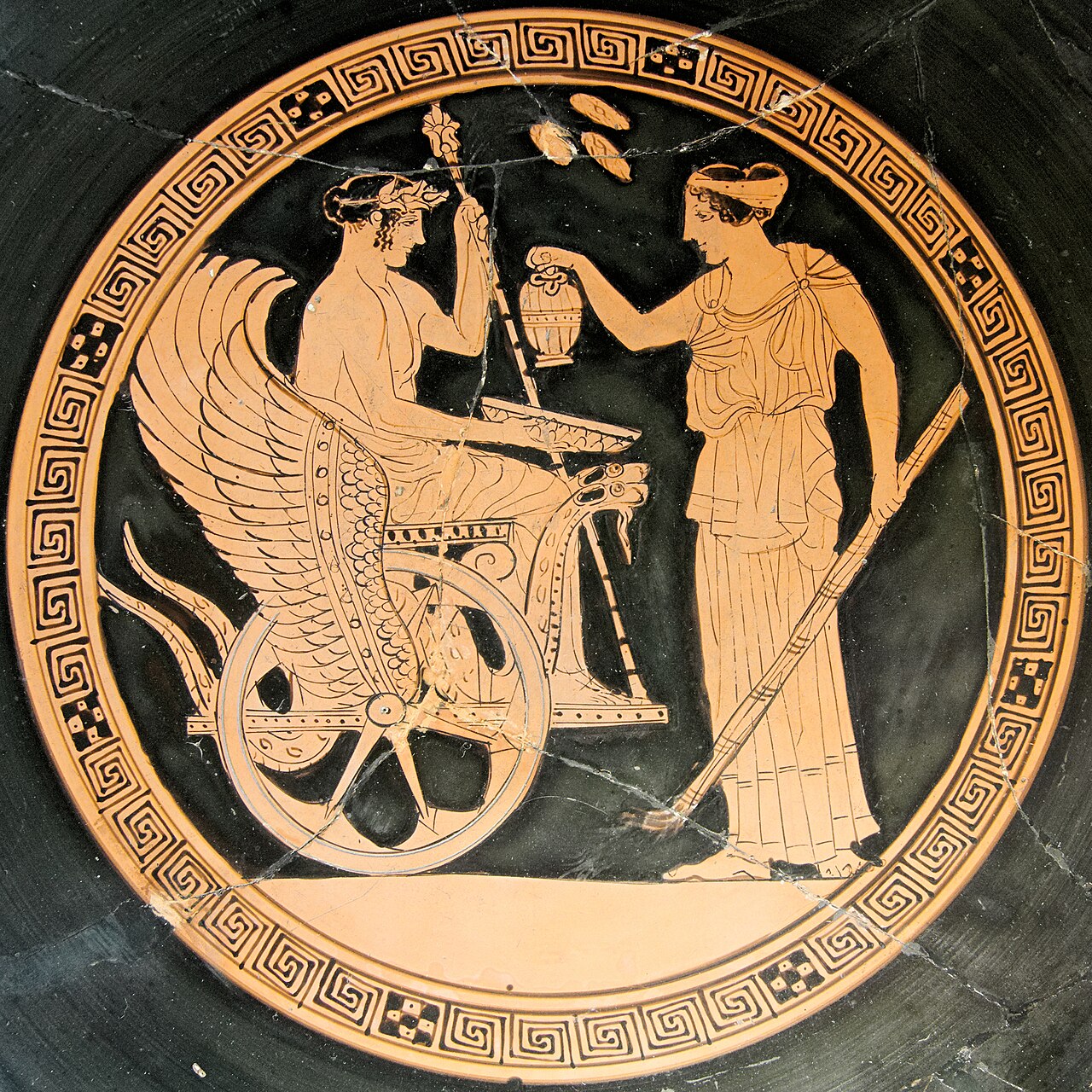
She then decided once more to share the knowledge of agriculture with mortals. She gave wheat to Triptolemus and entrusted him with teaching people how to sow and cultivate it, so that the gift might spread throughout the inhabited world.
But the different peoples did not agree on who had first received the grain. The Egyptians maintained that Demeter and Isis were the same goddess and that Egypt had been the first land to benefit from her discovery. The Athenians likewise claimed that this knowledge had first been given to their own land.
The Sicilians, for their part, argued that Demeter could hardly have chosen their island as her favourite dwelling place without first granting its inhabitants the gift of wheat. They pointed to the extraordinary fertility of their fields and to the belief that Persephone's abduction had taken place there.
In Sicily, where the two goddesses were believed to have lived since the most ancient times, the inhabitants preserved festivals of their own.
The festival celebrating Persephone's return was held when the wheat began to ripen. It was a solemn occasion, observed with particular care and reverence, recalling the young goddess's return and the extraordinary gift the two goddesses had bestowed upon humankind.
Demeter received her honours at another time of year, when sowing began. Great celebrations were held in her name for ten days. Participants observed ancient customs and exchanged coarse remarks and obscene jokes.
This practice recalled an episode from the search for Persephone: when Demeter was overwhelmed by sorrow, indecent remarks had succeeded in making her laugh.
Diodorus attributed an even greater benefit to the goddess. Besides discovering wheat and teaching people to use it as food, she was said to have introduced laws that enabled them to live together more justly. For this reason, she was also called Thesmophoros, the giver of laws.
Thus, the inhabitants of Sicily continued to remember Persephone's abduction, her mother's sorrow and the young goddess's return from the realm of the dead.
And in the fields of Enna, where flowers bloomed throughout the year, they still located the place where Hades had appeared in his chariot to carry away Demeter's daughter.
6. Virgil — The Queen of the Realm of the Dead
Sección titulada «6. Virgil — The Queen of the Realm of the Dead»6. Virgil — The Queen of the Realm of the Dead
Georgics — Orpheus and Eurydice
Orpheus had lost his wife Eurydice when their life together had barely begun.
The young woman died after being bitten by a snake while fleeing from Aristaeus, who was pursuing her along a riverbank. Hidden in the grass, the snake had sunk its fangs into her foot.
The mountain nymphs mourned her death, and their lamentations echoed throughout Thrace.
Overcome with grief, Orpheus took up his lyre and began to sing. His music was so extraordinary that it could charm wild beasts and make trees bend towards him to listen. But none of this could bring Eurydice back.
Unable to bear his loss, he resolved to seek her in the world of the dead. He travelled to Cape Taenarum, at the southern tip of the Peloponnese, where one of the entrances to the underworld was believed to lie. He descended along its dark paths into the depths, until he came before the ruler of the dead.
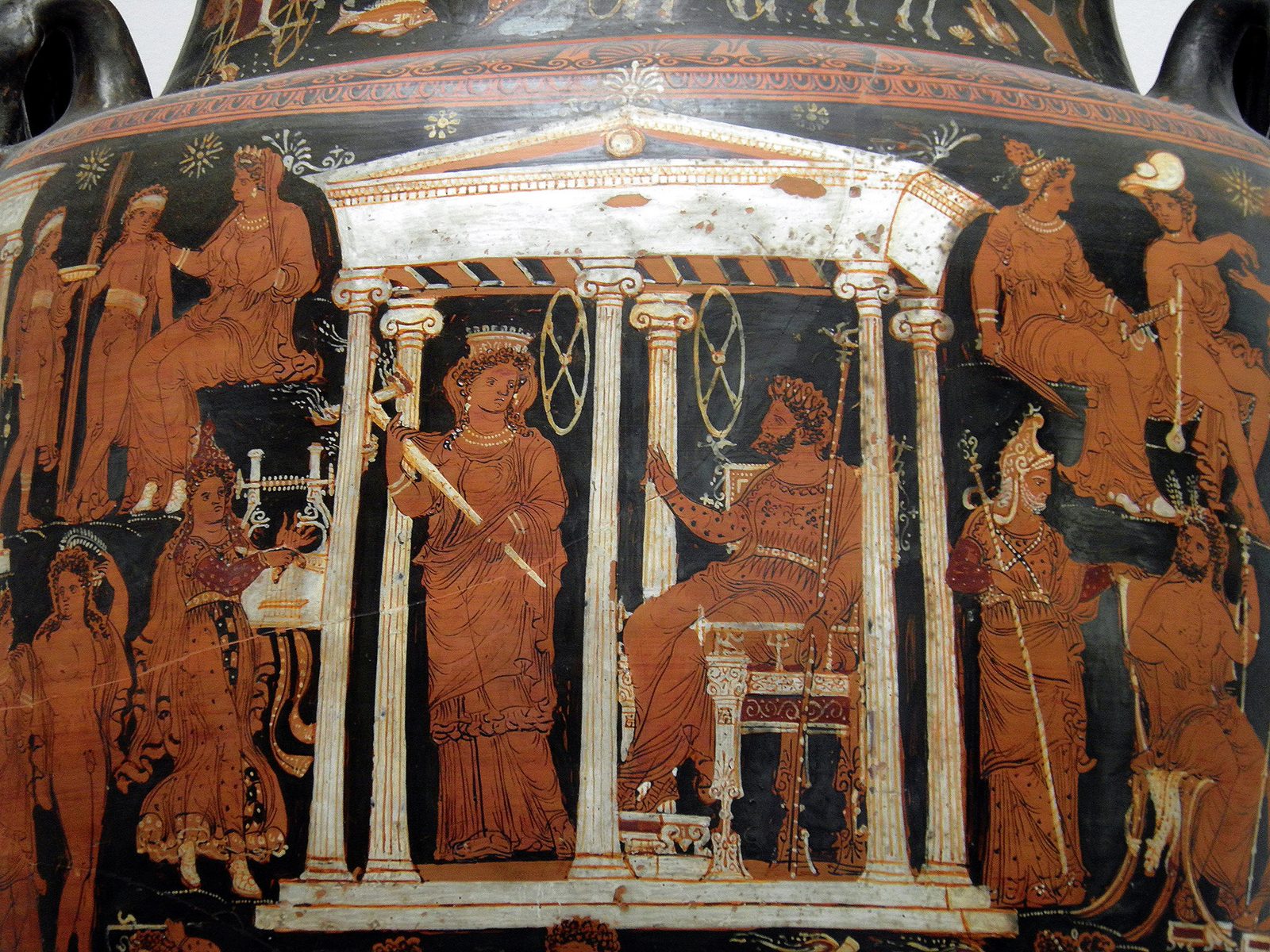
There he took up his lyre once more and began to sing. His music moved the souls that inhabited that realm. Countless shades emerged from the deepest regions of Erebus, as numerous as the birds that seek shelter among the leaves when night falls or winter storms drive them from the mountains. Among them were mothers and men of every age, great heroes, children, young women who had died before marriage and young men whose parents had watched their bodies laid upon funeral pyres.
They gathered to hear him, surrounded by the dark waters of Cocytus and Styx. Even the halls of death seemed astonished by his song.
The Erinyes, with snakes entwined in their hair, stood motionless. Cerberus remained still, his three jaws open, and the wheel upon which Ixion suffered his punishment stopped turning.
Orpheus had succeeded in moving the inhabitants of a realm whose rulers were unaccustomed to answering human pleas. At last, the rulers of the underworld agreed to return Eurydice to him.
But Proserpina imposed one condition: Eurydice would walk behind her husband on their return, and Orpheus must not turn to look at her before they reached the world above.
Together, they began the journey towards the light. Orpheus walked ahead, while Eurydice followed along the dark paths. They had overcome the greatest dangers and were nearing the exit when Orpheus, overcome by a sudden longing to see his wife again, stopped and turned towards her.
In that instant, the agreement imposed by the rulers of the dead was broken. A terrible sound echoed three times across the waters of Avernus, and Eurydice realised that she must return to the depths.
Eurydice reproached him for the rashness that had destroyed them both. Cruel fate claimed her once more, and her eyes began to close in death. She said farewell to Orpheus as an immense darkness enveloped her, stretching out her weakening hands towards him, though she could no longer reach him.
She had scarcely finished speaking when she vanished from his sight, like smoke dissolving into the air. She drifted away while Orpheus tried in vain to embrace her shade, with so much still left unsaid.
He tried to return to the underworld, but the ferryman would not let him cross the waters a second time. Eurydice had been taken from him again.
For seven months, Orpheus remained beside the waters of the Strymon, mourning his loss. Beneath a towering cliff and in the cold caves, he sang of his sorrow, moving wild beasts and trees with his music. He found no comfort in another woman's love.
At last, during the nocturnal rites of Bacchus, Thracian women whose love he had rejected tore him apart and scattered his remains across the fields.
His severed head was carried away by the waters of the River Hebrus. Even then, as life ebbed away, his lips continued to call Eurydice's name.
And all along the river, the banks echoed that name again and again.
Aeneid — The Death of Dido
Dido, queen of Carthage, had welcomed the Trojan prince Aeneas when he reached her shores after escaping the destruction of Troy. They had fallen in love, but Aeneas was bound to fulfil a destiny ordained by the gods: he had to leave Carthage and sail to Italy, where his descendants would establish a new people.
When Aeneas departed, Dido could not bear his abandonment. She ordered a funeral pyre to be built within the palace and placed upon it the possessions she had kept as reminders of the Trojan prince. Then she climbed onto the pyre and plunged a sword into her breast.
Her sister Anna rushed to her in despair when she heard the cries, but it was too late. Dido lay mortally wounded. She struggled to raise herself but fell back onto the couch as her life slowly ebbed away. Three times she tried to rise, and three times she collapsed.
Juno, witnessing her suffering, took pity on her and decided to bring her prolonged agony to an end.
Dido was not dying at the time appointed by fate. Her death had come prematurely, brought about by despair. For this reason, Proserpina had not yet cut the lock of hair from her head that would consign her to the realm of the dead.
Juno therefore sent Iris, the messenger of the gods. She descended from Olympus, spreading her dew-covered wings across the sky, their colours gleaming in the sunlight.
She approached Dido and hovered above her head. She announced that, in obedience to the command she had received, she would dedicate the lock of hair to Dis, ruler of the dead, and release the queen's soul from her body.
Then, with her right hand, she cut the lock. At that instant, the last warmth left Dido's body, and her life dissolved into the air.
Aeneid — Proserpina's Golden Bough
After many adventures, Aeneas reached the coast of Italy and landed near Cumae. There he went to the sanctuary of Apollo to consult the Sibyl, a priestess endowed with the gift of prophecy.
Aeneas wished to descend into the world of the dead to meet his father Anchises, who had died during their journey from Troy. The Sibyl warned him that entering the realm of Dis was relatively easy, for its gates stood open day and night. But returning from that place was an extraordinary undertaking, granted to very few mortals.
Before making the descent, Aeneas had to find a golden bough hidden among the trees of a dark wood. The bough was sacred to Proserpina, whom Virgil also calls the Juno of the underworld.
The goddess had decreed that anyone wishing to enter the depths of the underworld must bring her this offering. The bough was extraordinary: its leaves and supple stem shone with gold, and whenever it was plucked, another grew in its place. But not everyone could obtain it.
The Sibyl explained that, if fate permitted his journey, the bough would yield easily to his hand. If he was not destined to enter the underworld, no human strength, not even an iron sword, could tear it free.
Aeneas set off to find it. As he searched the woods, two doves sent by Venus, his mother, appeared before him. The birds guided him through the trees to the place where the bough grew. There he found it gleaming among the dark foliage.
Aeneas grasped the bough and broke it from the tree, though it resisted his pull, then carried it back to the Sibyl. After the necessary sacrifices had been performed, they entered the world of the dead. They passed through regions inhabited by shades, monsters and spirits until they reached the shores of the Stygian waters.
There they encountered Charon, the ferryman who carried the souls of the dead. When he saw a living man approaching, armed and accompanied by the Sibyl, he became furious. He ordered them to halt and reminded them that this place belonged to the shades. No living body had the right to cross its waters.
Charon had suffered unpleasant experiences with earlier visitors. He remembered Heracles, who had descended into the underworld and carried off Cerberus, the monstrous dog guarding its gates. He also remembered Theseus and Pirithous, who had attempted an even bolder undertaking: to abduct Proserpina from the very bedchamber of Dis.
The Sibyl reassured the ferryman. She explained that Aeneas had no intention of carrying off Cerberus or stealing Proserpina from her husband. He merely wished to find his father. To demonstrate that his journey had divine sanction, the priestess showed him the golden bough concealed within her robes.
Charon immediately recognised the sacred offering. His anger subsided, and he allowed them aboard. The vessel sank dangerously low beneath the weight of Aeneas' living body, but managed to cross the waters and reach the opposite shore.
There they found Cerberus, guarding the entrance with his three heads and terrible barking. The Sibyl threw him a cake made with honey and herbs that would send him to sleep. The monster swallowed it and fell asleep.
Aeneas and his companion continued their journey. They passed through the places inhabited by the souls of those who had died prematurely, those who had suffered for love and the great warriors of the past.
There Aeneas met Dido again. Her shade wandered among those who had died because of unhappy love. The Trojan tried to speak to her and explain why he had been forced to leave Carthage, but the queen remained silent and eventually turned away.
Farther on, the Sibyl showed him the dreadful regions where those guilty of great crimes suffered punishment.
Then they came to immense walls and gates forged by the Cyclopes. Here stood the entrance to the palace of Dis. The moment had come to present Proserpina with her offering.
Aeneas approached the threshold, sprinkled himself with fresh water and placed the golden bough at the entrance. His obligation fulfilled, he could continue his journey into the regions inhabited by the blessed.
At last, he found his father Anchises, who revealed the destiny awaiting his descendants and the future greatness of Rome.
After their meeting, Aeneas returned to the world of the living to continue his journey.
7. Ovid — Metamorphoses
Sección titulada «7. Ovid — Metamorphoses»7. Ovid — Metamorphoses
Venus Intervenes and Pluto Falls in Love with Proserpina
Buried beneath the mountains and lands of Sicily lay the monstrous Typhoeus, who had once dared to challenge the power of the gods and seize dominion over heaven. His gigantic body bore the weight of the entire island: his right hand was trapped beneath Cape Pelorus, his left beneath Cape Pachynus and his legs beneath the lands of Lilybaeum. Above his head rose Mount Etna, from whose depths he hurled sand and flames.
Typhoeus often struggled to free himself from his immense prison. He tried to lift the mountains and shake the cities resting upon his body. Then the earth trembled and threatened to split open into enormous fissures.
Alarmed by the earthquakes, Pluto left his subterranean home and, in his chariot drawn by black horses, carefully inspected the foundations of Sicily. He feared that Typhoeus' movements might have opened great cracks in the earth, exposing his kingdom and allowing daylight to reach the shades of the dead. Once he had satisfied himself that the ground was firm and his realm secure, his fears subsided.
As he travelled across the island, Venus caught sight of him from the heights of Mount Eryx. The goddess of love stood beside her son Cupid, the young archer whose arrows could awaken desire even among the immortals. Venus took pride in the power they wielded: their arrows had subdued the inhabitants of Olympus and the rulers of the sea. Yet one kingdom remained beyond their influence: the underworld. She was determined that this should change.
She was also troubled by the goddesses who rejected love and preferred to remain virgins. Athena and Artemis had already chosen that path, and Proserpina, daughter of Ceres, seemed ready to follow their example. Venus therefore asked Cupid to aim one of his arrows at Pluto. In this way, the ruler of the dead would fall under the power of love, and Proserpina would be united with him.
Cupid opened his quiver and chose, from a thousand arrows, the sharpest and surest. He braced his bow against his knee, drew the string taut and released the arrow. It struck Pluto in the heart.
Not far from Enna, in the heart of Sicily, lay a lake called Pergus. Its waters were surrounded by woods so dense that the branches scarcely allowed the sun's rays to penetrate. Swans glided across its surface, and flowers covered its shores. Perpetual spring seemed to reign there.
Proserpina was there with other young women. She gathered violets and lilies, filling her baskets and the folds of her dress with flowers. Laughing, she tried to gather more than her companions. That was when Pluto saw her.
The god fell in love the instant he caught sight of her. Without a word, he approached, seized her and lifted her into his chariot. It all happened with extraordinary speed. Proserpina cried out for her mother and the young women who accompanied her. As she struggled in her abductor's arms, the upper part of her dress tore, and the flowers she had gathered scattered across the ground.
The young goddess even wept for the flowers she had lost, a detail on which Ovid dwells to convey her innocence.
Pluto shook the rust-coloured reins across the necks and manes of his horses, calling each by name, and urged them into a gallop. The chariot crossed Sicily, passing places where sulphurous waters rose from the earth, and headed towards Syracuse. There, beside the city, lay a spring inhabited by the nymph Cyane.
As the chariot approached her waters, the nymph rose from the spring, her body visible as far as the waist. She recognised Proserpina and immediately understood what was happening. She stood in Pluto's path and ordered him to stop.
Cyane had herself known the love of the river god Anapis, whom she had willingly married. She therefore rebuked Pluto for attempting to obtain Proserpina by force. He should have sought the young goddess's hand in marriage rather than seizing her against her will.
The nymph spread her arms to block the horses' advance, but Pluto became enraged. Grasping his sceptre, he drove it with all his strength into the depths of the spring. The earth opened, revealing a passage that led down to Tartarus. The chariot, horses and captive goddess vanished through the opening.
Cyane was left alone. She could not bear what she had witnessed or the violation of her sacred spring. Her sorrow was so profound that she slowly began to dissolve. First her hair, fingers and feet softened. Then her arms, shoulders and the rest of her body lost their substance. At last, even the blood in her veins turned to water. Cyane disappeared entirely, becoming part of the spring she had tried to protect.
Meanwhile, Ceres searched desperately for her daughter. She travelled across lands and seas without allowing herself to rest. Neither the coming of dawn nor the appearance of the evening stars could stop her. On Mount Etna, she lit two pine torches and continued her search through the night, carrying one in each hand.
One day, exhausted and thirsty, she came to a humble cottage with a thatched roof. She knocked at the door, and an old woman came out to greet her. When Ceres asked for water, the woman offered her a sweet drink made with roasted barley meal. The goddess began to drink, but a boy who was watching her started to mock her, insolently calling her greedy.
Angered, Ceres threw the remaining drink into his face. The transformation was immediate: spots appeared on the boy's skin, his arms became legs and a tail grew from his body. He shrank until he became a tiny, speckled lizard. The old woman watched in terror and tried to approach the creature, but it ran away to hide.
Ceres continued her journey. Having travelled through countless places without finding Proserpina, she returned to Sicily and came once more to Cyane's spring. The nymph could have told her what she had witnessed, but she no longer had a mouth or voice.
She did, however, manage to give her a sign. A girdle that Proserpina had lost during the abduction lay floating on the surface of the sacred waters, and Ceres recognised it at once. She tore at her hair and beat her breast, realising that some terrible misfortune had befallen her daughter.
She still did not know where her daughter was, but her sorrow turned to fury against the lands that had failed to protect her, above all Sicily, where she had found evidence of her disappearance. Ceres therefore broke the ploughs, destroyed the seeds and deprived the fields of their fertility. Plants withered soon after sprouting. Sometimes the sun scorched them; sometimes rain destroyed them, while winds, birds and weeds ruined what little managed to grow. Lands once famous for their abundant harvests ceased to produce food.
Then Arethusa appeared, a nymph originally from the Peloponnese who had been transformed into a spring on the island of Ortygia, near Syracuse. Her waters had travelled beneath the earth to Sicily, and during that journey she had seen the realm of the dead. Arethusa rose from her spring and begged Ceres to stop punishing Sicily's fields. The island was not responsible for Proserpina's disappearance. She could testify to this, for she had seen the young goddess in Pluto's kingdom.
Proserpina was still alive. Her face still bore the signs of sorrow and fear, but she now held an extraordinary position: she was queen of the shades and shared the authority of the ruler below.
Ceres stood motionless on hearing these words. For a moment, she was so astonished that she seemed unable to react. Then her grief turned to indignation.
She mounted her chariot and travelled to Olympus to confront Jupiter. She demanded that the ruler of the gods return her daughter. She reminded him that Proserpina was his daughter too and that he had a duty to protect her. Ceres was prepared to endure the wrong she herself had suffered if only she could recover the young goddess. But she refused to accept the man who had abducted her daughter as a son-in-law.
Jupiter tried to reassure her. He replied that Pluto was his own brother, a powerful god who had rightfully received part of the universe. His union with Proserpina should not be regarded as dishonourable and, according to Jupiter, what had happened could be attributed to love.
But Ceres would not yield. At last, Jupiter agreed that Proserpina could return, on one condition: she must not have eaten anything during her stay in the underworld. This was a law established by the Fates, which not even the ruler of the gods could set aside.
For a moment, it seemed that everything might be resolved. But Proserpina had done something that would change her destiny. While wandering innocently through a garden in the underworld, she had found a pomegranate tree laden with fruit. She plucked a pomegranate and ate seven of its seeds. No one seemed to have noticed. Yet Ascalaphus, son of the river god Acheron and the nymph Orphne, had witnessed the scene.
When Proserpina's return was being considered, Ascalaphus revealed what had happened. His disclosure prevented the young goddess from leaving Pluto's realm permanently.
Proserpina was furious with the informer. She took water from Phlegethon, one of the rivers of the underworld, and sprinkled it over his head. Ascalaphus began to change: his face developed a beak, feathers appeared on his body and his eyes grew enormously. His arms became wings, and long, curved talons grew from his fingers. He was transformed into an owl, a nocturnal bird regarded by mortals as an omen of misfortune.
Ovid then recalls other creatures whose appearance had changed: the Sirens. These young women, daughters of the river god Achelous, had been Proserpina's companions when she gathered flowers.
The poet suggests that, after her disappearance, they searched everywhere for her. Unable to find her on land, they wished for wings so that they could continue their search across the sea. The gods granted their wish: feathers covered their bodies and they acquired the feet of birds, while retaining their youthful faces and beautiful voices.
Meanwhile, Jupiter had to resolve the conflict between Ceres and Pluto. He finally divided the year into two equal parts: Proserpina would spend six months with her mother and the other six with her husband in the underworld. In this way, the young goddess would divide her time between the two realms.
Ovid then describes the transformation in her expression. The sorrow that had clouded her face gave way to joy. Her happiness was as sudden as the sun emerging when the clouds part after a storm.
Relieved at her daughter's return, Ceres remembered Arethusa's promise and asked why she had left Greece and how she had come to be transformed into a Sicilian spring.
The nymph rose from the water, brushed the wet hair from her brow and began her story. She had once been a young huntress in the woods of Achaea.
One day, while bathing in a clear river, she heard the voice of the river god Alpheus, who had seen her and began to pursue her. Arethusa fled in terror and, when her strength was almost exhausted, called upon Artemis for help.
The goddess concealed her within a cloud, but Alpheus continued searching. Overcome with fear, Arethusa began to sweat until her entire body turned to water. Alpheus then resumed his own watery form and mingled his waters with hers.
Artemis opened a fissure in the earth to allow Arethusa to escape. The nymph plunged through it and travelled along deep underground passages until she reached the island of Ortygia, near Syracuse, where her waters rose once more to the surface.
Ceres then turned her attention once more to humankind. She gave seeds to Triptolemus and entrusted him with her chariot, drawn by two dragons, so that he could travel the world spreading the knowledge of agriculture.
He journeyed through the skies above Europe and Asia until he reached Scythia, a vast region of steppe north of the Black Sea, ruled by King Lyncus.
When the king discovered that his guest carried such a valuable gift for humanity, he decided to murder him in his sleep and claim the discovery of agriculture as his own. But Ceres intervened before he could carry out his plan. She transformed Lyncus into a lynx and ordered Triptolemus to continue his journey, carrying seeds and agricultural knowledge to other lands.
8. Ovid — Fasti
Sección titulada «8. Ovid — Fasti»8. Ovid — Fasti
Ceres' Search across Sicily
The earliest human beings knew nothing of growing grain. They lived on grasses, tender leaves and acorns, gathering whatever the earth produced naturally. It was Ceres who transformed their lives.
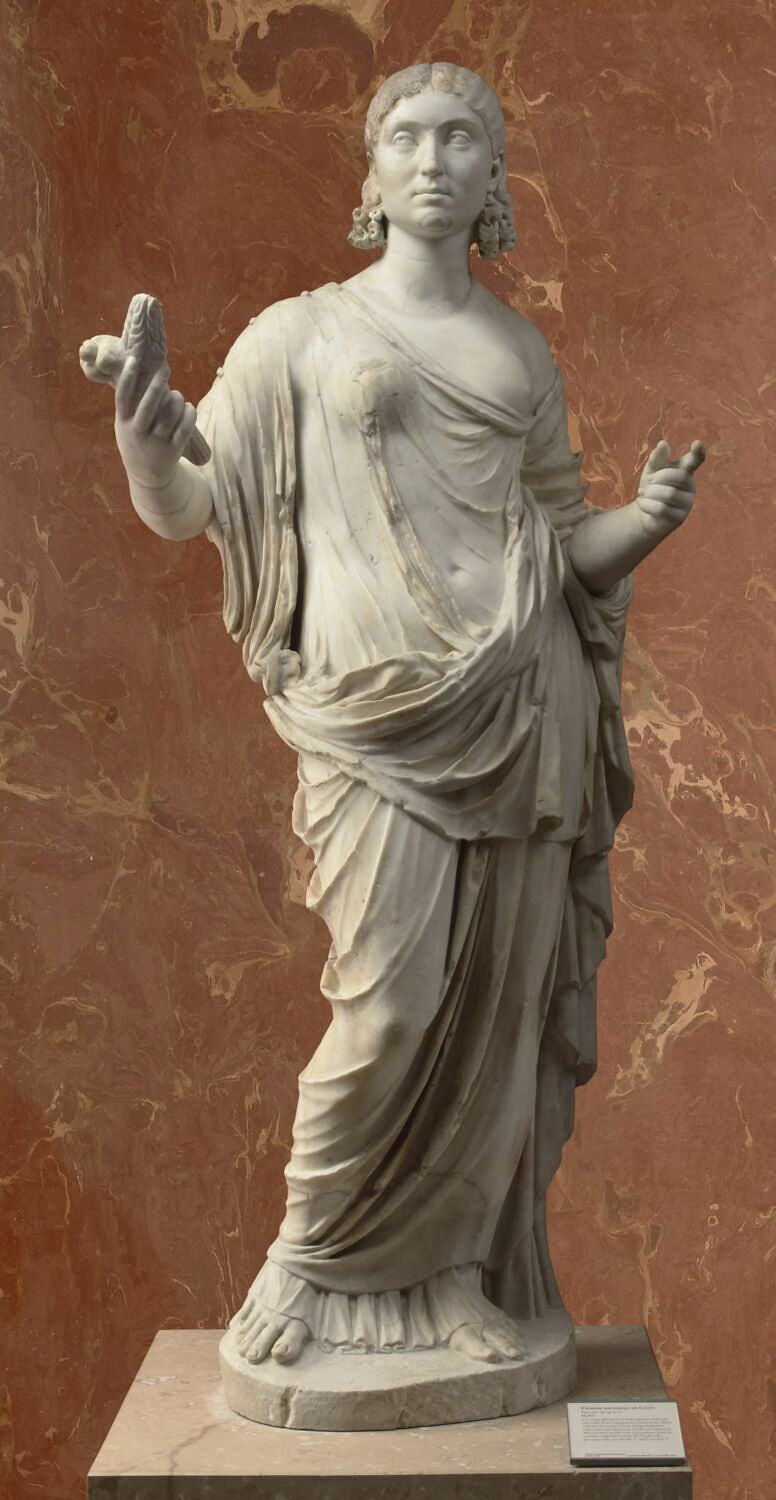
The goddess taught them how to grow wheat, prepare the fields and use oxen to draw the plough. Thanks to her, humanity no longer depended solely on wild plants and learnt to obtain food by cultivating the soil.
Ceres was particularly fond of Sicily, a fertile island stretching into the sea through three great promontories. Her daughter Proserpina lived there, near Enna.
One day, while Ceres attended a banquet at the invitation of Arethusa, the young goddess went walking with her companions. They wandered barefoot through the meadows, enjoying places they had known since childhood. In a shaded valley, spray from a waterfall kept the ground constantly moist. Flowers grew in abundance, covering the landscape with colour.
Proserpina called to her friends and suggested that they gather flowers. The girls began filling their baskets. Some looked for violets, others for poppies or hyacinths. There were roses, amaranths, thyme, rosemary and countless flowers that did not even have names.
Proserpina was particularly drawn to the crocuses and white lilies. Little by little, absorbed in gathering them, she wandered away from her companions. None of them noticed that she had been left alone. It was then that Pluto, Jupiter's brother and the young goddess's uncle, caught sight of her.
He rushed towards her, seized her and lifted her into his chariot. Proserpina cried out for her mother as the dark horses sped away. In her distress, she tore at her dress. Pluto opened a passage beneath the earth and disappeared with her into the underworld. His horses could scarcely endure the daylight, to which they were unaccustomed.
Meanwhile, Proserpina's companions had finished filling their baskets and called to her to come and see the flowers they had gathered. But there was no answer. They called again and again, until they realised that she had disappeared. They ran about desperately, filling the mountains with their cries.
Ceres had just returned to Enna when she heard their lamentations and immediately understood that something terrible had happened. She began calling for her daughter and ran through the meadows with dishevelled hair, like a mother searching for a child who had been snatched away from her.
On the ground, she discovered small footprints that she recognised as Proserpina's. She followed the trail, but soon found that pigs had crossed the area and obliterated the marks. Her search had to begin anew, and she travelled across Sicily from one end to the other.
She passed Leontini, the banks of numerous rivers and the country around Syracuse. She crossed volcanic regions, pasturelands and places near the sea. She asked shepherds and farmers whether they had seen a young woman pass by, but no one could give her any news.
Night fell, and darkness covered the fields. The dogs fell silent. Ceres went to the slopes of Mount Etna and found two pine trees. She set them alight with fire from the volcano and continued her search for Proserpina, carrying them as torches.
She reached a cave, where she prepared her chariot and harnessed serpents capable of drawing it through the air. Thus she left Sicily and began a journey across the world. She travelled over the sea without becoming wet and eventually reached the coast of Attica.
There, near Eleusis, she found a cold stone and sat down upon it. So great was her grief that she remained motionless for several days, enduring the cold of night and the rain falling upon her.
The people of the region would preserve the memory of that stone, which they called the Sorrowful Stone.
At that time, Eleusis was not yet a place renowned for its great sanctuaries. The land belonged to an old man named Celeus, who lived modestly with his wife Metaneira, a young daughter and an infant son who lay ill in his cradle.
One day, Celeus was returning home with firewood, acorns and wild blackberries. His daughter was coming back from the hills, driving two goats. When the girl saw the woman sitting upon the stone, she approached and asked:
'Mother, what are you doing all alone in this place?'
That single word deeply moved Ceres, who had spent so long searching for her missing daughter.
The old man also stopped and invited her to take shelter in his humble home. Ceres had assumed the appearance of an elderly woman and at first declined. She explained that her daughter had been taken from her and that she had been unable to find her ever since. So deep was her sorrow that a bright drop, like a tear, fell upon her breast, although, as Ovid remarks, the gods cannot weep.
Celeus and his daughter took pity on her. The old man expressed the hope that she would recover her daughter and again urged her to accept their hospitality. At last, Ceres agreed.
As they walked towards the house, Celeus explained that he had a little son who was seriously ill. The boy could not sleep and grew weaker as his illness continued. The goddess listened and, before entering the house, picked a poppy growing beside the path. Without thinking, she tasted a little of it, unwittingly breaking the long fast she had kept throughout her search.
When she entered the house, she found the whole family overwhelmed by grief. Metaneira had almost lost hope of saving her son. Ceres approached the child and kissed him on the lips.
At once, the pallor left his face and strength returned to his body. The family was astonished.
Metaneira, Celeus and their daughter rejoiced at his recovery. Apart from the child, they were the only members of the household, and all had suffered during his illness. They prepared a meal for their guest, but Ceres refused to eat. Instead, she gave the boy warm milk mixed with poppy to help him sleep.
At midnight, when the whole house was silent, the goddess took Triptolemus into her arms. Three times she passed her hand over his body and uttered three sacred incantations that no mortal was permitted to repeat. Then she laid the boy among the glowing embers of the hearth. Her intention was to purge the mortal part of his nature through fire and grant him immortality.
But Metaneira awoke and, seeing her son among the flames, cried out and rushed to pull him from the fire. Ceres interrupted the rite and reproached the mother for allowing her fear to prevent her son from receiving an extraordinary gift.
Triptolemus would remain mortal. Yet the goddess announced a special destiny for him: he would be the first to plough the fields, sow seeds and reap the fruits of cultivated land.
Then Ceres left the house.
A cloud surrounded her as she mounted her serpent-drawn chariot and rose into the sky to continue her search. She left Cape Sounion and the harbour of Piraeus behind. She flew over the islands of the Aegean, crossed the Ionian Sea and passed the Hellespont. Then she travelled over distant lands, looking down upon Arabia, Ethiopia, Libya and the deserts around Meroe. She flew above the great rivers of the West: the Rhine, Rhône, Po and Tiber. No place remained unvisited.
At last, in despair, she decided to seek help from the stars. She addressed the constellations near the celestial pole, which never sank beneath the waters of the sea, and begged them to tell her where Proserpina was.
One of those stars, Helice, replied that she should consult the Sun, for he illuminated the earth by day and might have witnessed what had happened.
Ceres went to the Sun, and the god answered without delay. He revealed that Proserpina had become the wife of Jupiter's brother and now ruled beside him over the third realm of the universe: the underworld.
At last, Ceres understood. Having travelled the whole world, she had discovered that her daughter was not lost: Pluto had abducted her and taken her to his kingdom.
The goddess went before Jupiter, her face marked by sorrow and exhaustion. She reminded him that Proserpina was their daughter and that he must therefore share her concern. She lamented that Pluto could enjoy his marriage in peace after committing such an act of violence. Proserpina did not deserve a husband who had obtained her through abduction. Ceres did not demand that Pluto be punished; she asked only that he return her daughter and make amends for the wrong he had done.
Jupiter tried to reassure her. He explained that Pluto was a powerful god, his own brother and the rightful ruler of one of the great realms of the universe. Once again, he attributed what had happened to love. But Ceres remained determined to recover Proserpina.
At last, Jupiter agreed to attempt to separate them, but imposed one condition: the young goddess must not have eaten anything since entering the underworld. If she had fasted throughout her stay, she could return to her mother. Otherwise, she must remain Pluto's wife.
Jupiter immediately sent Mercury to investigate. The messenger descended into Tartarus and returned with news that shattered Ceres' hopes: Proserpina had eaten three pomegranate seeds.
The goddess felt the same anguish she had experienced when she first learnt of her daughter's disappearance, and remained inconsolable for a long time. She even declared that heaven was no longer a place where she could live and asked to be allowed to descend into Pluto's realm herself, entering through the region of Cape Taenarum.
Jupiter realised that he must find a solution. Eventually, he decreed that Proserpina could spend six months of each year in heaven with her mother. For the other six, she would remain in the underworld with her husband.
Ceres accepted the agreement. Her expression and spirits recovered, and she once more placed a wreath of ears of grain upon her hair. The fields, which had remained barren, yielded abundant harvests again. The grain grew so plentifully that the threshing floors could scarcely contain the gathered sheaves.
Thus ended Ceres' search, with Proserpina's periodic return and the restoration of the earth's fertility.
9. Pseudo-Hyginus — Proserpina’s Abduction and the Story of Triptolemus
Sección titulada «9. Pseudo-Hyginus — Proserpina’s Abduction and the Story of Triptolemus»9. Pseudo-Hyginus — Proserpina's Abduction and the Story of Triptolemus
Proserpina's Abduction on Mount Etna
Pluto, ruler of the dead, wished to marry Proserpina, daughter of Jupiter and Ceres. He therefore approached his brother Jupiter and asked him to grant the young goddess to him in marriage. Jupiter knew that Ceres would never accept such a union. He could hardly expect her to consent to her daughter leaving the world of the living to dwell in the dark depths of Tartarus.
Yet Jupiter did not wish to refuse his brother's request. Instead of trying to persuade Ceres, he advised Pluto to seize Proserpina while she was gathering flowers on Mount Etna in Sicily.
The young goddess was there with three other goddesses: Venus, Diana and Minerva. All four were gathering flowers when Pluto appeared in a chariot drawn by four horses. The ruler of the dead approached Proserpina, seized her and carried her away into the underworld.
When Ceres discovered what had happened, she appealed to Jupiter to secure her daughter's return. Eventually, she obtained an agreement from the ruler of the gods: Proserpina would spend half the year with her mother and the other half with Pluto.
Thus, her time was divided between the world of the living and the realm of the dead.
Ceres and Triptolemus
While searching for her missing daughter, Ceres reached the court of Eleusinus, a king whose wife Cothonea had recently given birth to a boy named Triptolemus. The goddess concealed her true identity and presented herself as a wet nurse.
Cothonea gladly welcomed her and entrusted her son to her care. Ceres began to raise him, but she was not content to let him grow like any other child. She had resolved to bestow upon him a gift reserved for the gods: immortality. By day, she nourished him with divine milk, and at night, while everyone slept, she secretly placed him among the flames of the hearth.
Under this extraordinary care, Triptolemus began to grow in a way no mortal child had grown before. His parents noticed that something unusual was happening: the boy was developing at an astonishing rate. Puzzled, they decided to watch the nurse.
One night, they discovered what she was doing. When Ceres was about to place Triptolemus in the fire, Eleusinus was overcome with horror. Furious at being discovered, the goddess killed him.
Yet she did not abandon the child she had raised. Although Triptolemus had not attained immortality, Ceres bestowed upon him a gift of lasting value. She gave him a chariot drawn by serpents and entrusted him with an extraordinary mission: to travel the world spreading the cultivation of grain.
Triptolemus set off in the marvellous chariot. He travelled across the inhabited world, scattering seeds and teaching people how to cultivate the land. Wherever he went, he spread the knowledge of agriculture, enabling communities to obtain food from the earth through cultivation.
After travelling throughout the world, he eventually returned home. But his return brought a new danger. A man named Celeus ordered him to be killed, despite the benefits he had brought to humankind.
When Ceres learnt what had happened, she intervened once more to protect the young man she had raised. She commanded Celeus to surrender his kingdom to Triptolemus.
Celeus was forced to obey. Triptolemus thus became king and named the kingdom Eleusis in memory of his father, Eleusinus. He also established sacred rites in honour of Ceres, known to the Greeks as the Thesmophoria.
In this way, the child whom Ceres had tried to make immortal eventually became a king and spread one of the greatest gifts the goddess had bestowed upon mortals: the cultivation of the land.
10. Pseudo-Apollodorus — Persephone’s Abduction and Demophon’s Fate
Sección titulada «10. Pseudo-Apollodorus — Persephone’s Abduction and Demophon’s Fate»10. Pseudo-Apollodorus — Persephone's Abduction and Demophon's Fate
Pluto, ruler of the dead, had fallen in love with Persephone, daughter of Zeus and Demeter. Wishing to make her his wife, he abducted the young goddess with Zeus' secret assistance and carried her into the underworld.
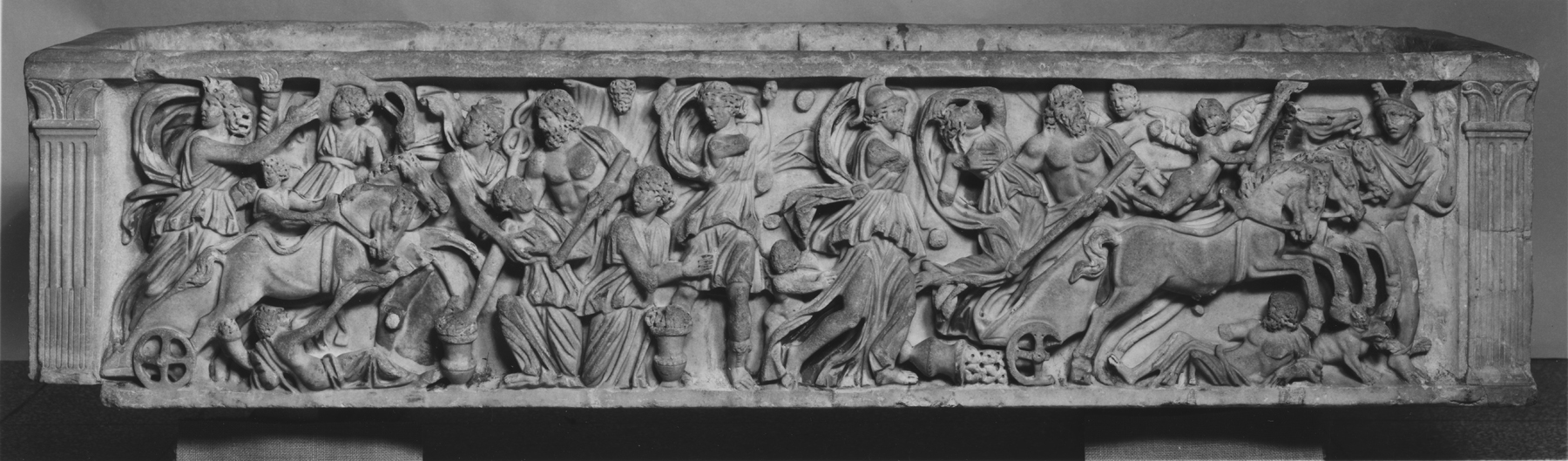
When Demeter discovered that her daughter had disappeared, she set out in search of her. She wandered across the earth by day and night, carrying burning torches in her hands. At last, she came to Hermione, a city in the Argolid, whose inhabitants revealed that Pluto had abducted Persephone.
Angry with the gods, Demeter resolved to leave heaven and withdraw from their company. She assumed the appearance of an ordinary woman and travelled to Eleusis, a city in Attica ruled by Celeus. There she sat upon a stone beside the Well of the Fair Dances. From then on, the stone would be known as the Mirthless Stone, in memory of the goddess's profound sorrow.
She then made her way to Celeus' house. Inside were several women who invited her to sit beside them. Demeter remained overwhelmed by grief, unable to find comfort after her daughter's disappearance. But an old woman named Iambe began making jokes and amusing remarks until she succeeded in making the goddess smile.
In memory of this episode, the women preserved the custom of exchanging jokes during the Thesmophoria, the festivals dedicated to Demeter.
Metaneira, wife of Celeus, had a young son named Demophon and entrusted him to the stranger's care. Demeter agreed to nurse him, but resolved to bestow upon him an extraordinary gift: immortality. Each night, she secretly placed the child in the fire, intending to burn away the mortal part of his nature so that he might live forever like the gods.
The boy began to grow at an astonishing rate. Each day, his extraordinary development became more apparent, until it aroused suspicion. A woman named Praxithea decided to keep watch during the night. When she discovered Demophon in the fire, she cried out in horror. The rite was interrupted, with terrible consequences: the child was consumed by the flames and died.
Demeter then revealed her true identity. The stranger who had arrived in Eleusis was the goddess herself.
But her stay there also changed the destiny of another young man: Triptolemus, the eldest of Metaneira's children, who received an extraordinary gift from her.
The goddess prepared a chariot drawn by winged dragons and gave him wheat. She then entrusted him with the task of spreading its cultivation among mortals. Triptolemus climbed into the chariot and set off through the skies. Flying over the inhabited lands, he scattered the wheat Demeter had given him. Thus, the cultivation of grain spread throughout the world.
Not all ancient authors agreed about Triptolemus' origins. Pseudo-Apollodorus records that the poet Panyassis regarded him as a son of Eleusis, while Pherecydes claimed that he was a son of Oceanus and Earth.
Meanwhile, Persephone remained in Pluto's kingdom. Zeus finally intervened and ordered the ruler of the underworld to send the young goddess back. Pluto received the command, but did not wish to lose his wife for long. Before allowing her to leave, he gave her a pomegranate seed to eat, hoping to prevent her from remaining with her mother. Persephone swallowed it without foreseeing the consequences.
Ascalaphus, son of Acheron and Gorgyra, had witnessed what happened and revealed that Persephone had eaten the seed. Furious at his testimony, Demeter punished the informer by placing a huge rock upon him in the realm of Hades.
Persephone was therefore compelled to spend one third of each year with Pluto and the remaining two thirds among the other gods.
She could return to the world above, but only for part of the year. The rest of her time belonged to the kingdom of the dead.
11. Pausanias — The Places Where Greece Remembered Demeter
Sección titulada «11. Pausanias — The Places Where Greece Remembered Demeter»11. Pausanias — The Places Where Greece Remembered Demeter
During his travels through Greece in the second century AD, Pausanias recorded numerous traditions concerning Persephone's abduction, Demeter's search and the mysteries celebrated in honour of the two goddesses.
In different regions, he encountered stories preserved by local communities and associated with their ancient sanctuaries. Some places remembered Demeter passing through during her search; others marked the spot where Hades had disappeared beneath the earth with Persephone. He also encountered ancient cults and ceremonies whose origins were linked to these events.
Many of these traditions were still alive when Pausanias visited their sanctuaries.
Argos: The Woman Who Revealed Persephone's Abduction
A different account of the search for Persephone survived in Argos.
The city's inhabitants said that Demeter, wandering the earth in search of her daughter, had reached Argos and been welcomed into the home of Pelasgus, son of Triopas. There she met a woman named Chrysanthis, who knew what had happened. It was Chrysanthis who revealed to Demeter that her daughter had been abducted.
Pausanias does not explain how Chrysanthis had learnt of the abduction or precisely what she told the goddess. But the Argives preserved her memory as part of their city's ancient religious traditions.
They also related that Trochilus, a priest of Demeter's mysteries at Argos, had been forced to flee the city because of his enmity with Agenor. He took refuge in Attica, married a woman from Eleusis and had two sons, Eubuleus and Triptolemus. This genealogy linked Argos with the traditions surrounding Demeter's rites and the spread of agriculture.
The Athenians, however, told a different story. According to their tradition, Triptolemus was the son of Celeus and the first person to sow grain for cultivation.
Pausanias knew still other versions. Verses attributed to Musaeus described Triptolemus as a son of Oceanus and Earth. Other verses, attributed to Orpheus, made Triptolemus and Eubuleus sons of Dysaules and claimed that Demeter had rewarded them with the knowledge of sowing grain because they had told her what had happened to her daughter. Pausanias himself doubted that these verses had really been composed by the poets to whom they were attributed.
In Argos itself, the memory of Persephone remained closely associated with religious worship.
Opposite an ancient tomb stood a sanctuary of Demeter, known there as Demeter Pelasgis because its foundation was attributed to Pelasgus. Nearby was a pit into which the Argives still threw burning torches in honour of Persephone, whom they also called Kore, 'the Maiden'.
In this way, the inhabitants of Argos continued to honour the young goddess and her mother, whose search had become part of their city's sacred traditions.
Eleusis: Where Pluto Descended Beneath the Earth
At Eleusis, near Athens, the landscape preserved other memories of the abduction.
The River Cephisus flowed through the region. Beside it lay a place called Erineos, where the inhabitants said Pluto had descended into the underworld after carrying off Persephone. According to this tradition, it was here that the ruler of the dead had vanished with the young goddess.
The region was rich in sacred places associated with Demeter and her daughter. The Eleusinians showed visitors a temple dedicated to Triptolemus, the hero entrusted by the goddess with spreading the knowledge of agriculture. There were also sanctuaries of Artemis Propylaia and Poseidon Father.
Another place associated with the goddess was a well called Callichoron, a name meaning 'Beautiful Dancing'. The inhabitants said that it was here that the women of Eleusis had first formed their choruses and sung in honour of Demeter.
Not far from the well stretched the Rharian Plain. The Eleusinians claimed that it was the first land ever sown and the first place where cultivated grain had grown. For this reason, they used barley harvested from its fields to prepare offerings and sacrificial cakes. They also showed visitors a threshing floor attributed to Triptolemus, beside which stood an altar.
Eleusis was also home to the great sanctuary of Demeter and Persephone, where the mysteries that made the city famous were celebrated. Pausanias knew their importance but chose not to describe what lay within the sanctuary walls. He explains that a dream had forbidden him to reveal those things, which the uninitiated were not permitted to see or learn about.
Thus, the traveller recorded the places where the Eleusinians located the abduction, Demeter's presence and the first cultivation of grain, while respecting the silence surrounding their most sacred rites.
Arcadia: Demeter Hides from Poseidon
In Arcadia, a mountainous region of the Peloponnese, the inhabitants preserved a much darker story.
They said that while Demeter was travelling the world in search of Persephone, Poseidon began pursuing her, determined to unite with her. But the goddess rejected his advances and, in an attempt to escape, transformed herself into a mare and mingled with the horses grazing on the lands of Oncius, near the town of Thelpusa.
Poseidon discovered her disguise and transformed himself into a stallion. In this form, he succeeded in forcing himself upon Demeter.
The goddess was furious at what had happened.
According to the inhabitants of Thelpusa, their union produced a daughter whose name they would not reveal to the uninitiated, and an extraordinary horse named Arion.
That horse, they said, would later become famous among the heroes. Heracles rode him during his war against Elis, after which he passed into the possession of Adrastus, king of Argos.
Demeter's anger was so intense that the Arcadians came to honour her under the title Erinys, 'the Furious One'. After a time, however, she set aside her wrath and bathed in the waters of the River Ladon. From then on, she was also called Lusia, 'She Who Bathes'.
The people of Thelpusa honoured both aspects of the goddess at a sanctuary beside the river.
But elsewhere in Arcadia, another tradition survived concerning the consequences of her anger.
Phigalia: The Goddess Dressed in Black
Near the town of Phigalia rose Mount Elaion. On one of its slopes was a cave sacred to Demeter, whom the inhabitants called Melaina, 'the Black One'.
The people of Phigalia also knew the story of Poseidon, although their version differed in certain respects from that told at Thelpusa. They said that Demeter had given birth to a daughter named Despoina, 'the Mistress', but rejected the tradition that she had also borne a horse.
After her encounter with Poseidon, and still tormented by Persephone's abduction, Demeter withdrew from the company of the gods. She dressed in black and shut herself away in the cave on Mount Elaion. There she remained for a long time, hidden from the world and consumed by sorrow. No one knew where she had gone.
Meanwhile, plants began to wither and the fields lost their fertility. The fruits of the earth disappeared, and people began to die of hunger.
Even the gods were unable to find Demeter. It was Pan who eventually discovered her hiding place. Accustomed to roaming the mountains of Arcadia while hunting, he came one day to Mount Elaion and saw Demeter inside the cave. He observed her appearance and the black garments she wore.
Pan went to Zeus and told him where the goddess was hiding. The ruler of the immortals sent the Fates, the goddesses who governed destiny, to speak to Demeter and calm her anger. She listened to their words and finally agreed to set aside her wrath and moderate her grief.
The people of Phigalia attributed the sacred character of the cave to these events and placed a wooden image of Demeter within it.
But the statue was very different from ordinary representations of the goddess. It sat upon a rock and had a woman's body, covered by a robe reaching down to her feet. Its head, however, was that of a horse, complete with a mane. Snakes and the figures of other animals emerged from it. In one hand, the goddess held a dolphin; upon the other rested a dove.
It was an extraordinary image, associated with the ancient encounter between Demeter and Poseidon and the appearance she had assumed during her withdrawal.
The people of Phigalia continued to worship her for generations. But eventually the wooden statue was destroyed by fire. No one remembered who had made it or how the fire had started.
The Phigalians did not replace the image, and in time they began to neglect the festivals and sacrifices owed to Demeter.
Then the land became barren once more. The harvests failed, and the people began to go hungry. In desperation, they consulted the oracle at Delphi to discover the cause of their misfortunes.
The answer was terrifying. The oracle reminded them that Demeter had given them cultivated crops and freed them from dependence on wild plants. Now, deprived of the honours she had once received, the goddess had withdrawn those gifts.
Unless they restored her worship and appeased her anger, the famine would become so dreadful that people might end up devouring one another and even feeding on their own children.
The Phigalians understood the warning, restored the honours due to Demeter and commissioned a new statue.
They turned to Onatas of Aegina, a renowned sculptor who made them a bronze image. He based it partly on a drawing or copy of the original wooden statue that he had discovered, although tradition held that a vision in a dream had provided him with most of the guidance for his work.
The new image was installed in the sanctuary, and Demeter once again received the honours due to her. But this statue, too, was eventually destroyed.
By the time Pausanias visited Phigalia, it had disappeared, and most of the inhabitants did not even know that it had ever existed.
The traveller spoke to some of the oldest inhabitants, who told him that three generations before their time, stones had fallen from the roof of the cave and crushed the statue. Pausanias himself could still see where the stones had broken away.
He was nevertheless able to visit the sanctuary. A grove of oak trees surrounded the cave, and a spring of cold water rose nearby. Pausanias had come to Phigalia especially to see this place.
There he made an offering according to the customs of the inhabitants. No animals were sacrificed. Instead, fruits from cultivated trees, including grapes, together with honeycombs and unworked wool still rich in its natural grease, were placed upon the altar in front of the cave. Oil was then poured over the offerings.
These rites were performed both by private worshippers and at the annual sacrifice held by the community, in honour of the goddess who, according to their traditions, had dressed in black and withdrawn into the mountains, leaving humanity without food.
Thus, many centuries after the legendary age of Demeter and Persephone, the people of Phigalia still honoured the goddess at the cave where their ancestors believed she had taken refuge in her sorrow.
12. Orphic Hymn to Persephone — A Prayer to the Queen of Life and Death
Sección titulada «12. Orphic Hymn to Persephone — A Prayer to the Queen of Life and Death»12. Orphic Hymn to Persephone — A Prayer to the Queen of Life and Death
The poet invokes Persephone and begs her to come and accept the offerings prepared in her honour. He calls her daughter of great Zeus, the only offspring of Demeter and the revered wife of Pluto, ruler of the underworld. But Persephone is more than the wife of that god. She also holds the gates of Hades, hidden deep beneath the earth, and reigns over the inhabitants of the realm of the dead.
The hymn calls her Praxidike, a name associated with the fulfilment of justice, and describes her as a goddess of beautiful hair. She is also the mother of the Eumenides, the fearsome divinities associated with the punishment of wrongdoing, and of Eubuleus, a powerful deity of many forms, associated with Dionysus in Orphic traditions. Yet her authority extends far beyond the underworld.
Persephone is a companion of the Horae, the goddesses of the seasons, and a bringer of light. The poet describes her as a radiant maiden, honoured and mighty, whose power extends over all things. He even calls her horned, an extraordinary attribute, and associates her with the fruits of the earth.
In spring, she delights in the breezes blowing across the meadows. Her sacred presence is revealed in the green shoots and the fruit beginning to grow upon the earth.
But the hymn also recalls her abduction and marriage, which it places in autumn. The maiden associated with spring meadows and growing plants is also the sovereign of the depths.
The poet attributes an even greater power to her: the life and death of mortals alike depend upon the goddess. Persephone nourishes all living things, but she also has the power to bring their existence to an end.
For this reason, the worshipper asks her to send forth the fruits of the earth and grant peace, health and prosperity. He hopes for a life free from great suffering, blessed with good fortune and lasting into a flourishing old age.
Only at the end of that long life does he envisage entering the realm of Persephone and mighty Pluto.
Thus, the prayer ends with the goddess who was invoked to bring forth the fruits of the earth. She nourishes life, yet also receives mortals when their lives come to an end.
13. Claudian — The Rebellion of the Lord of the Dead
Sección titulada «13. Claudian — The Rebellion of the Lord of the Dead»13. Claudian — The Rebellion of the Lord of the Dead
In the depths of the earth, Pluto, ruler of the dead, was consumed by anger. Of the three great gods who had divided the universe among themselves, he alone remained without a wife. Jupiter ruled the heavens beside Juno, and Neptune enjoyed the company of Amphitrite, while Pluto lived alone in the dark realm allotted to him.
He had grown weary of that existence. He had never known the joys of marriage or had children to brighten his home. He considered it unjust that Jupiter, surrounded by wives, lovers and descendants, enjoyed so many privileges while he himself was deprived even of sunlight.
His resentment grew into a threat against the order of the universe. Pluto threatened to open the gates of the underworld and unleash the monsters dwelling in its depths. He would break Saturn's chains and allow the Titans to rise against the gods once more.
The Furies prepared for war. Tisiphone, snakes writhing through her hair, raised a burning torch and summoned the armed shades. The world seemed on the brink of another war among the immortals, but the Fates, the three goddesses who spun and determined the destiny of every being, intervened before the conflict could begin.
They appeared before Pluto's throne and knelt at his feet. Their white hair fell over their shoulders, while the hands that governed the threads of existence reached out in supplication to the ruler of the dead.
Lachesis spoke first. She reminded Pluto that he, too, had an essential place in the order of the universe. His authority extended over birth and death, for all creatures eventually entered his kingdom when their allotted time came to an end. He must not destroy the agreement that preserved peace among the three brothers. If he desired a wife, he should ask Jupiter for one.
Pluto listened, and his anger began to subside. He ordered Mercury to be summoned, the messenger who could travel freely between heaven and the underworld.
When the winged god appeared, Pluto sat upon his throne, holding a sceptre covered with the dust of ages. His presence inspired such terror that, as he began to speak, even Cerberus ceased barking and the rivers of the underworld fell silent.
Pluto charged Mercury with carrying his protest to Jupiter. He reminded his brother that he, too, was a son of Saturn and had received his rightful share of the universe. He did not wield the thunderbolts of heaven or enjoy the light of day, but his authority was no less than that of his brothers. Why, then, should he remain alone?
Neptune had Amphitrite. Jupiter had Juno and had enjoyed numerous unions with other goddesses. His children populated Olympus. Pluto, by contrast, remained childless in an immense, silent kingdom.
If Jupiter refused to grant him a wife, he would unleash a war capable of plunging heaven and the depths of the earth into chaos once more.
Mercury carried the message to Olympus, and Jupiter immediately understood the seriousness of the threat. He spent a long time considering which goddess might accept such a marriage, for who would willingly abandon the sunlight to dwell beside the waters of Styx?
At last, he made his choice: Proserpina, daughter of Ceres.
Proserpina was Ceres' only daughter, and the goddess of grain loved her above all else. The young woman had reached marriageable age and was not without suitors. Mars and Apollo both sought her hand. Mars offered her the mountains of Rhodope, while Apollo promised Amyclae, Delos and his sanctuary at Claros. Juno and Latona interceded on behalf of their respective sons.
But Ceres rejected both proposals. She feared losing Proserpina and had resolved to keep her away from any danger that might threaten her. To protect her, she had secretly entrusted her to the island of Sicily.
There, near Enna, she had prepared an extraordinary residence. Its towering iron walls and great gates had been forged by the Cyclopes, and heavy steel bars secured its doors. Inside, the walls were covered with ivory, while the roof was strengthened with bronze beams and supported by lofty, gleaming columns.
Ceres trusted this refuge to keep Proserpina safe from harm.
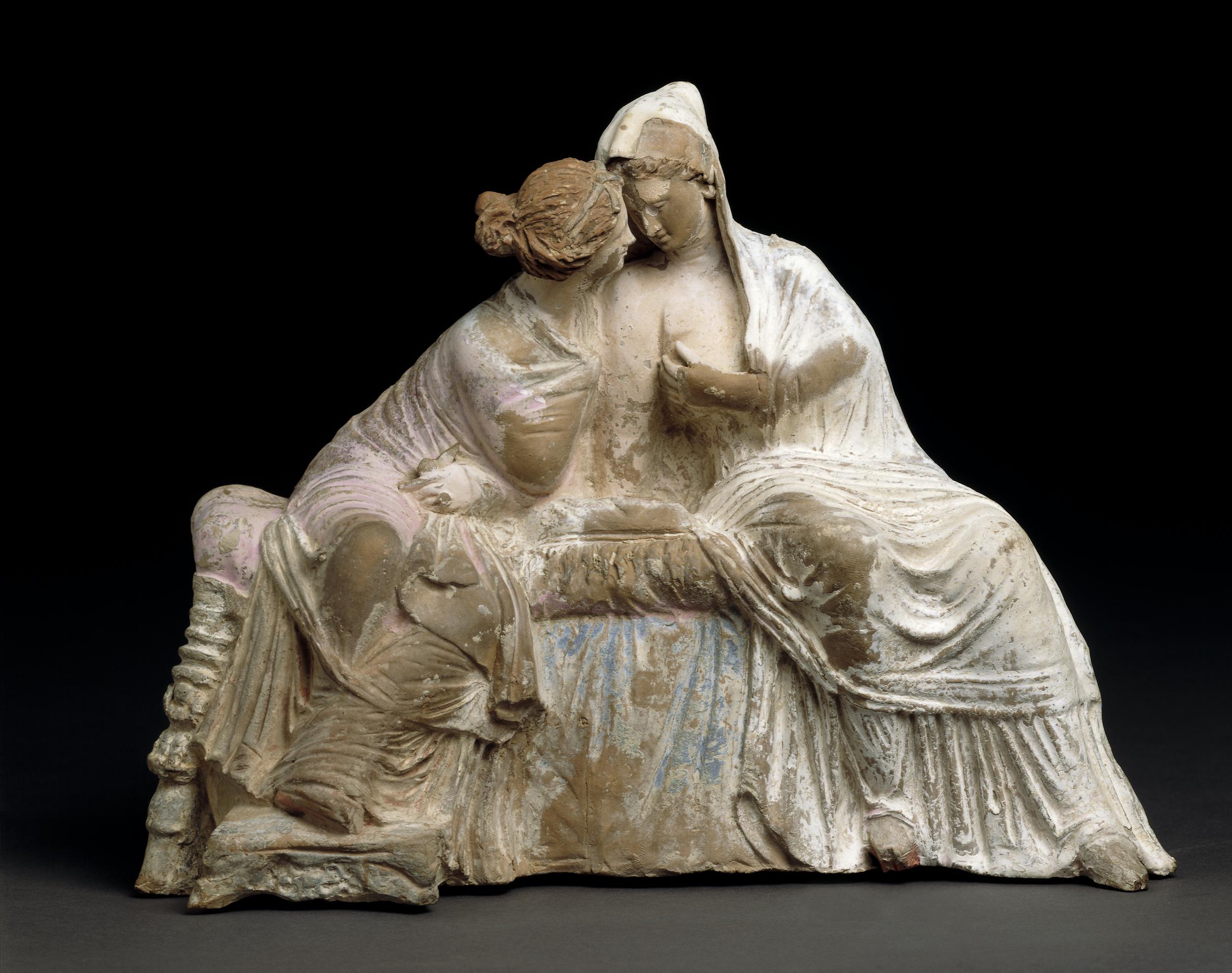
Ceres then set out for Phrygia to visit Cybele, the great goddess worshipped on Mount Ida. She travelled in a chariot drawn by winged serpents. As she passed, seeds sprouted spontaneously and the fields filled with ears of grain. Before Sicily disappeared from view, Ceres promised that its lands would always yield abundant harvests, even without being ploughed. Then she continued her journey.
When she reached Cybele's sanctuary, the drums fell silent, the priests ceased their dances and the lions accompanying the goddess lowered their heads. Cybele came out to welcome her affectionately.
While Ceres remained in Phrygia, Jupiter decided to put his plan into action. He summoned Venus and revealed that Proserpina was destined to become the wife of the ruler of the underworld. The marriage had also been ordained by the Fate Atropos and foretold long ago by Themis. Now that Ceres was far from Sicily, the moment had come to act.
Venus was to persuade Proserpina to leave her home and visit the meadows of Enna, where Pluto could find her. Jupiter wanted even the realm of the dead to experience the power of love. He also instructed Minerva and Diana to accompany Venus.
The three goddesses reached the fortress where Proserpina lived. Inside, the young goddess was singing softly as she embroidered a piece of cloth intended as a gift for her mother, Ceres, whose return she awaited.
It was an extraordinary work. With threads of many colours, she was depicting the birth of the universe and the separation of the elements from primordial chaos. Nature had brought order to that confusion: the lighter elements rose into the higher regions, while the heavier ones descended to their appointed places. Fire reached the heights of heaven, the sea began to flow and the earth hung suspended in space.
The young goddess embroidered the stars in golden thread and the waters in purple. Tiny gemstones adorned the shores, while the waves, represented in raised threads, seemed to swell and break against the rocks. The work was so lifelike that anyone looking at it might have imagined they could see seaweed tossed against the rocks and hear the waves murmuring as they spread across the sand.
She had also divided the earth into five great zones. In the centre, she depicted in red thread a region scorched by the sun's heat. On either side stretched two temperate zones, where the climate allowed human beings to live. At the extremes lay two frozen regions, held in the grip of perpetual winter.
Next, she began to embroider the dwelling of her uncle Dis and the Manes, the spirits of the dead, who would soon become part of her own destiny. She could not know that she would shortly share their world. Yet as she worked on that part of the cloth, sudden tears moistened her cheeks, as though she sensed the misfortune that awaited her.
She then began depicting the waters of Ocean, which were to surround the outer edge of the embroidery. But before she could finish, she heard the palace doors opening. Venus, Minerva and Diana had arrived.
Proserpina abandoned her unfinished work and turned towards her visitors. At the sight of them, her cheeks flushed with youthful colour.
Venus had come to lure her out into the meadows of Enna, where the flowers grew in extraordinary abundance. Unaware of the plan that had been made for her, Proserpina was drawn by the prospect of an outing with the goddesses.
At dawn, the four left the fortress, accompanied by numerous nymphs. But as the gates opened, their hinges sounded three ominous warnings, and Mount Etna rumbled three times in response. They were signs of the disaster that awaited the young goddess, but nothing could prevent her from leaving.
Venus walked ahead, delighted that her deception was succeeding. Behind her came Minerva and Diana, both renowned for their determination to remain virgins. Minerva carried her spear and wore her helmet; Diana had her bow and arrows. Proserpina walked between them.
She wore a magnificent dress decorated with another extraordinary embroidery, depicting the birth of the Sun and Moon. Both appeared as infants in the care of Tethys, who cradled them above the waters of the sea. The young Sun rested upon her right shoulder, while his sister, the Moon, lay against her left, suckling at her breast.
They were accompanied by the nymphs of Sicily, including those who inhabited the springs of Arethusa and the island's rivers. Tallest among them all was Cyane.
Soon they reached the meadows of Enna. Water flowed over the rocks and fed little streams. Trees offered shade even on the hottest days, while a lake of extraordinarily clear water, called Pergus, lay surrounded by wooded banks.
Enna herself, personified as the mother of flowers, called upon Zephyrus to adorn the fields and give the visitors a fitting welcome. The west wind blew gently, spreading fertile dew across the meadows. Roses glowed red, hyacinths displayed their colours and violets opened among the grass.
Venus then invited her companions to gather flowers, and they scattered across the meadows. Some wove lilies and violets together; others made garlands of roses. Even Minerva adorned her helmet with flowers, while Diana gathered blossoms for her hair.
Proserpina was especially delighted. She filled wicker baskets, made garlands and crowned herself with freshly gathered flowers, unaware of the fate that was approaching.
Far beneath the earth, Pluto was driving his chariot towards the surface. The Fury Alecto had harnessed the four horses that usually grazed beside the waters of Cocytus and Lethe. Their names were Orphnaeus, Aethon, Nycteus and Alastor.
Pluto drove them along the winding paths of the underworld, through regions of perpetual darkness, until he reached the depths beneath Sicily.
The chariot passed over the body of Enceladus, the giant who had once fought against the gods and now lay buried beneath Mount Etna. The weight of the horses disturbed him, and violent tremors shook the earth. Cities quaked, towers collapsed and the mountains thundered.
Pluto needed a way to reach the surface, but rocks blocked his path on every side. Enraged, he raised his enormous sceptre and struck the earth with all his strength. The blow shattered the rock and opened a vast fissure.
The disturbance seemed to shake the heavens themselves. The stars abandoned their accustomed courses, the sky darkened and the horses recoiled in terror as they encountered sunlight for the first time. They had always lived in the depths and were unaccustomed to such brightness.
For a moment, they struggled to turn the chariot back towards the darkness. But Pluto lashed them onwards, forcing them to endure the light.
Then they galloped forward with extraordinary speed, faster than a rushing torrent or an arrow in flight. Their breath contaminated the air, and the dust stirred by their hooves was poisoned by the foam from their mouths.
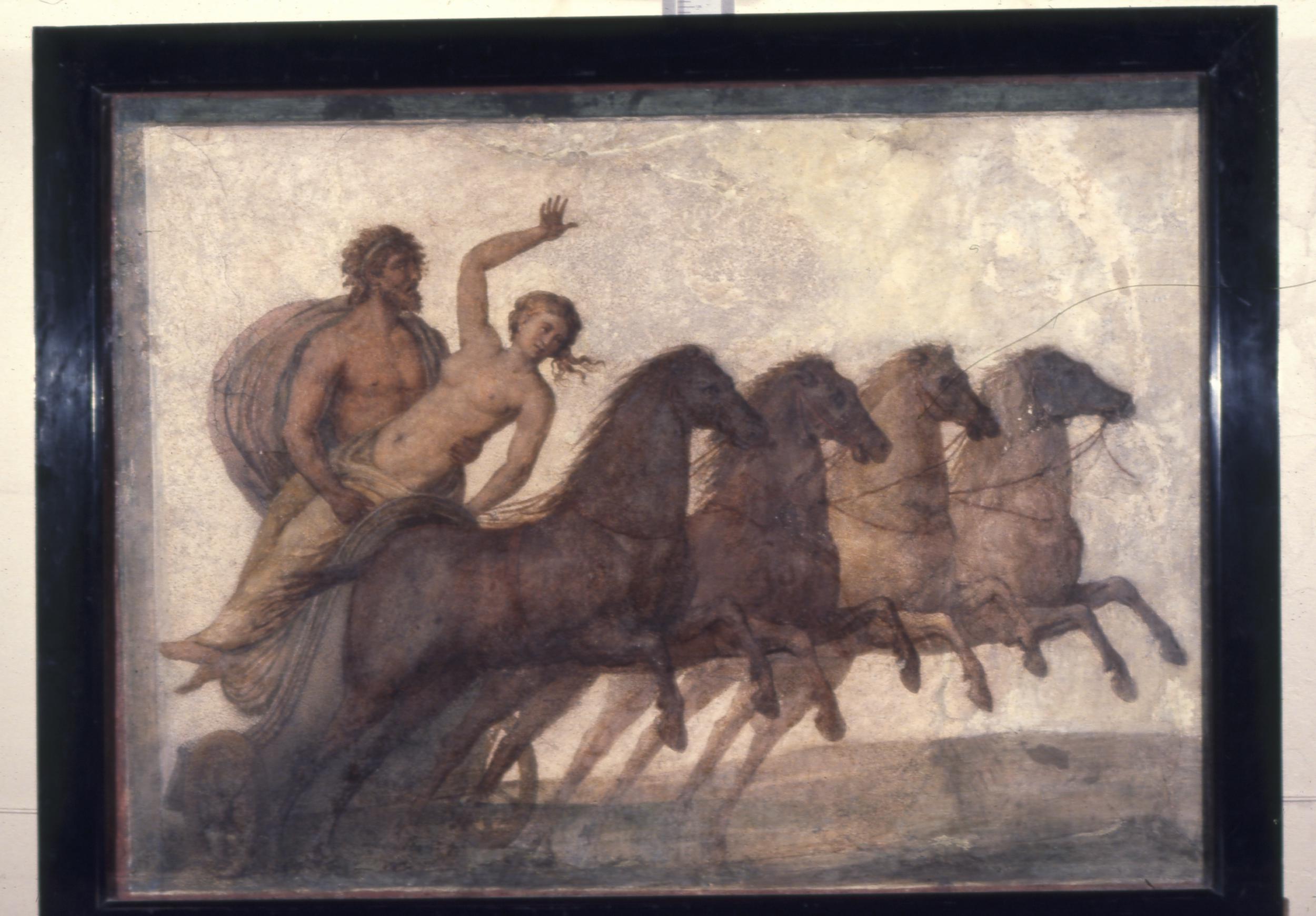
The nymphs fled in terror when they saw the ruler of the dead appear. Pluto seized Proserpina and lifted her into his chariot. The young goddess cried out, begging her companions to help her.
Minerva and Diana reacted immediately. Minerva uncovered the Gorgon's head upon her shield and moved to block the horses' path. Diana drew her bow and prepared to shoot the abductor.
Minerva rebuked Pluto for abandoning the realm allotted to him and invading the world of the living. She reminded him that the underworld was home to the Furies and other goddesses who might have become his wives. He had no right to carry off a young goddess from the world above.
She raised her shield against the advancing horses and prepared to hurl her spear. But before she could strike, Jupiter intervened from heaven. A red thunderbolt flashed through the clouds, announcing his approval of the marriage. The thunder itself seemed to proclaim the union.
Minerva and Diana understood that they could not oppose the will of the ruler of the gods. Reluctantly, they lowered their weapons.
Weeping, Diana bade Proserpina farewell and begged her not to forget them. She lamented that Jupiter's authority had prevented them from defending her and that the young goddess was being handed over to the silent kingdom of the dead.
The chariot sped onwards as Proserpina wept inconsolably. Her hair streamed in the wind as she beat her arms and raised her desperate pleas towards heaven.
She could not understand why her father had allowed such a disaster. She asked what crime she had committed to deserve this punishment. Why had Jupiter, her own father, permitted her to be driven from the world of light?
Other women carried off by abductors, she lamented, could at least continue to live beneath the sun. She, by contrast, was being taken into the kingdom of the dead. She was losing both her freedom and the world she had always known.
Remembering the flowers she had gathered, she bitterly regretted ignoring her mother's warnings. Too late, she understood the deception practised by Venus.
Then she cried out to Ceres, begging her to leave the celebrations in Phrygia and come to her aid. Wherever her mother might be, she implored her to stop Pluto's chariot and save her from the fate that awaited her.
Her pleas moved even Pluto. The god, unaccustomed to tenderness, began to experience the power of love. He wiped Proserpina's tears with his dark cloak and tried to calm her.
He assured her that she need not fear the marriage or believe herself destined for an unworthy husband. He was a son of Saturn, ruler of an immense kingdom whose authority was no less than that of his brothers.
She should not imagine that she had lost the light forever. The underworld had other stars, other heavenly courses and a radiance of its own. There she would discover the sun of Elysium and the blessed souls who inhabited its fields.
Pluto described a world where a golden race enjoyed a happier existence, possessing forever the blessings that mortals could scarcely obtain during their brief lives. There were gentle meadows, soft breezes and flowers that never ceased to bloom, more beautiful even than those of Enna.
He promised Proserpina extraordinary gardens and a precious tree whose branches gleamed with golden metal. That tree would be consecrated especially to her, and she would enjoy its golden fruits.
But these were only the beginning of his promises.
Proserpina would become queen of the underworld, and her authority would extend over every living creature beneath the Moon. All would eventually enter her kingdom.
Kings dressed in purple would appear before her stripped of their splendour, mingling with the poorest of mortals. Death made everyone equal.
She would judge the guilty and grant rest to the virtuous. Before her, those who had committed crimes would be compelled to confess their deeds. The waters of Lethe would obey her, and the Fates themselves would serve her will.
Such was the extraordinary power Pluto promised to the young goddess as he carried her towards his kingdom.
With these promises, Pluto tried to ease the young goddess's suffering. The chariot continued its descent into the depths, where an immense crowd awaited them. Shades from every age had gathered to behold their new queen.
Pluto entered his kingdom with an expression of joy quite unlike his former severity. Phlegethon, the fiery river of the underworld, rose to welcome the returning ruler and his bride. Servants unharnessed the horses, led them back to their familiar pastures and began preparing the bridal chambers, decorating the entrances with branches and embroidered hangings.
The women of the Elysian Fields surrounded Proserpina. They spoke gently to her, hoping to calm her fears, arranged her dishevelled hair and placed the bridal veil upon her head, concealing her troubled blushes.
Celebrations spread throughout the underworld. The shades set aside their customary sorrow and gathered for the wedding feast. The spirits of the dead wore garlands of flowers, and unfamiliar songs broke the silence of the gloomy realm.
Even the punishments of Tartarus were suspended. Minos ceased passing judgement, and the condemned were granted a respite from their suffering. Ixion was released from his wheel, Tantalus could at last drink the waters that usually withdrew from his lips, and the vulture was driven away from the breast of Tityos.
The Furies, forgetting their anger and the crimes they were accustomed to punish, joined the celebrations. They drank wine, sang gentle songs and lit festive torches, while the serpents in their hair stretched towards the cups.
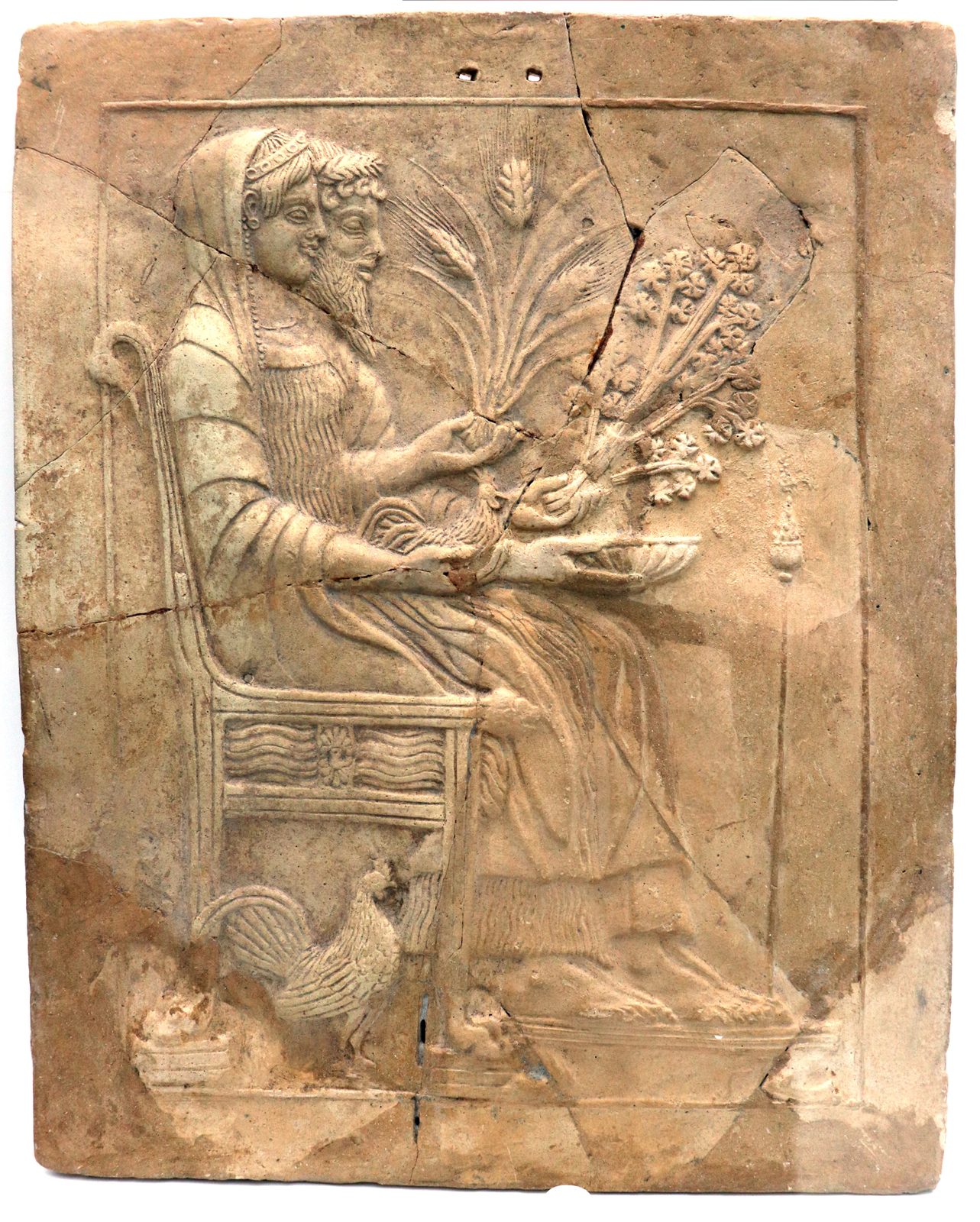
The rivers of the dead were also transformed. The springs of Acheron began to flow with milk, while Cocytus, its banks entwined with ivy, ran with sweet wine. Throughout the underworld, the dead celebrated Proserpina's arrival.
During the festivities, even death suspended its work. Lachesis ceased cutting the threads of life, and funeral lamentations fell silent. No one died in battle or perished at sea, and no parents had to mourn beside a funeral pyre. For a brief time, the world of the living was free from death.
At last, the moment came to lead the bride into the bridal chamber. Night herself, dressed in a mantle of stars, accompanied Proserpina and blessed the marriage. The blessed shades raised their voices in song, wishing the couple happiness and children. Pluto had secured the wife he had demanded for so long.
Proserpina, the young goddess carried away from the meadows of Enna, now stood at the centre of an extraordinary celebration as queen of the underworld. Meanwhile, Ceres knew nothing of what had happened.
On Olympus, Jupiter summoned an assembly of the gods. Iris travelled across sky and sea to gather them. The celestial gods, sea deities, rivers and nymphs came together. Once all were assembled, Jupiter announced that he had decided to change the destiny of mortals.
In the ancient age of Saturn, human beings had lived without needing to cultivate the land. Trees offered their fruits spontaneously, honey flowed from the woods and the fields produced food without being worked. But Jupiter believed that such abundance had allowed humanity to grow idle and had prevented people from developing their abilities.
He had therefore put an end to that effortless existence. He wanted necessity to drive mortals to work, discover new techniques and develop their intelligence. Through effort and invention, humanity would learn to transform the world.
Nature herself, however, had protested at the suffering that followed. She reproached Jupiter for leaving human beings to wander through the woods like animals, gathering acorns for food. Although they possessed intelligence, they were forced to live much as other creatures did.
Jupiter explained that he had finally listened to those complaints and devised a new plan. Ceres, still unaware of her daughter's disappearance, would soon wander across lands and seas in search of her. When she discovered traces of Proserpina, her joy would lead her to give mortals the gift of grain and spread its cultivation among the peoples of the world.
Thus, according to Jupiter, the suffering caused by the abduction would ultimately bring an extraordinary benefit to humankind.
But for his plan to succeed, Ceres must not yet learn the truth. Jupiter expressly forbade the immortals to reveal who had abducted Proserpina. He threatened anyone who disobeyed with the full force of his thunderbolts and punishment in Pluto's kingdom, regardless of their divine rank or family ties.
Meanwhile, far away in Phrygia, Ceres was still visiting Cybele. But disturbing dreams had begun to trouble her sleep.
Sometimes she dreamt that an enemy's spear was piercing her body. At other times, her clothes turned black, or a barren ash tree suddenly began to sprout within her home.
She also dreamt of a laurel tree that had once sheltered Proserpina's chamber. In her vision, it had been cut down to its roots, its branches lying in the dust. Weeping Dryads told her that the Furies had destroyed it with an axe from the underworld.
Then came the most terrifying vision of all.
Ceres saw Proserpina imprisoned in a dark dungeon, bound with heavy chains. Her once golden hair was dishevelled, her eyes had lost their brightness and the colour had drained from her face. Ceres could scarcely recognise her daughter.
In the dream, Proserpina reproached her mother for abandoning her. She asked how Ceres could continue enjoying the celebrations in Phrygia while her daughter suffered in captivity.
She begged her mother to come and rescue her and restore her to the upper world. If fate prevented her return, she asked at least that Ceres descend to visit her.
The young goddess tried to stretch her trembling hands towards her mother, but the chains held her back.
The clanking of iron awoke Ceres.
She lay motionless with terror. She was relieved that what she had seen was only a dream, yet deeply distressed that she could not embrace her daughter. The vision left her overwhelmed by fear.
She hurried to Cybele and announced that she could remain in Phrygia no longer. Proserpina was young and vulnerable, and even the fortress built by the Cyclopes might not be enough to protect her. Ceres feared that her daughter's hiding place had become too widely known.
She took leave of Cybele and mounted her serpent-drawn chariot, determined to return to Sicily as quickly as possible.
During the journey, every moment seemed too long. Ceres lashed her winged serpents and urged them to greater speed, as though she feared arriving too late. At last, she caught sight of the fortress where she had left her daughter.
The moment she saw it, she knew something was wrong. The guards had fled, the entrances were unprotected and the great halls lay silent. Ceres descended from her chariot and hurried inside. The palace had plainly been abandoned.
She wandered through the empty rooms and came upon the loom at which Proserpina had been working before Venus' visit.
The embroidery remained unfinished. Its threads hung in disorder, and a spider had begun weaving its web across the abandoned work. Ceres approached and kissed the loom. She gathered the spindles that had passed through her daughter's hands, the wool she had set aside and the little objects with which she had played. She pressed them against her breast as though she were embracing Proserpina herself.
Then she gazed upon the empty bed, the couch and the chair where her daughter used to sit. She searched the deserted rooms, but Proserpina was nowhere to be found.
At last, she discovered Electra, the elderly nurse who had cared for Proserpina since childhood. One of the ancient nymphs of Ocean, Electra had loved the young goddess almost as deeply as Ceres herself. She had carried her in her arms when she was small, placed her upon her father Jupiter's knees and watched over her as she grew.
Now Electra lay in one of the innermost rooms, her hair dishevelled and her body covered with dust. She was mourning the disappearance of the girl she had raised.
Ceres demanded to know what had happened. Had the Titans seized heaven again? Had one of the giants imprisoned beneath Italy broken free? Perhaps Enceladus had escaped from beneath Etna, or Briareus, the hundred-armed giant, had attacked her home.
She could not understand who had caused such devastation. Where was Proserpina? Where were her attendants, Cyane and the Sirens?
Electra trembled before her. Overwhelmed by grief and shame, she scarcely dared to speak. At last, she explained that the disaster had begun with the arrival of Venus, Diana and Minerva.
The three goddesses had appeared as Proserpina's friends. Venus had embraced the young goddess affectionately and criticised Ceres for keeping her daughter isolated from Olympus and the company of the immortals.
Proserpina had welcomed her visitors joyfully, unaware of the danger. She had amused herself trying Diana's bow and Minerva's helmet and shield, while Venus gradually drew her attention to the beautiful meadows of Enna.
Venus spoke of the extraordinary flowers that bloomed there, even during the winter months, and encouraged Proserpina to visit the fields. Electra had tried to prevent her from leaving, pleading with her to remain inside the fortress. But the young goddess, trusting in the protection of her companions, had gone out with them, followed by her attendant nymphs.
They reached the flower-covered hills at dawn and began gathering blossoms while the grass was still wet with dew.
But when the sun climbed higher in the sky, darkness suddenly spread across the fields. The earth trembled beneath the pounding of hooves and the thunder of chariot wheels. A terrifying figure appeared, driving horses whose breath brought destruction wherever it passed.
No one could recognise the charioteer. Electra herself could not say whether he was Death or one of his messengers.
The rivers seemed to stop flowing, and the meadows withered. Flowers lost their colour: roses faded, lilies drooped and the surrounding vegetation was blighted.
Then the chariot turned back towards the depths, carrying its darkness with it. When daylight returned, Proserpina had vanished.
The goddesses departed without remaining to explain what had happened, and the nymphs scattered in terror.
Cyane was found lying almost lifeless among the flowers, her garlands blackened and withered. She had been close to the disaster, and the others hurried to ask what she had witnessed. Who had driven the chariot? What had become of Proserpina?
But Cyane could give no answer. Some mysterious power had begun to transform her. Water spread through her hair, her arms and legs dissolved, and soon her whole body had turned into a clear stream that flowed across the ground.
The Sirens, daughters of Achelous, had also disappeared. They had flown to Cape Pelorus, on the coast of Sicily, where their songs would now bring destruction to sailors. Their beautiful voices held ships motionless upon the sea, preventing the oarsmen from continuing their voyage.
Electra had remained behind, alone in the deserted palace, condemned to spend the rest of her life mourning the young goddess she had loved and raised.
Ceres listened to Electra's account and realised that her daughter had been betrayed. Her sorrow turned to fury. She raised her eyes towards Olympus and began denouncing the gods.
She accused Venus of involvement in the abduction and reproached Diana and Minerva for abandoning Proserpina. How could they, who had chosen to remain virgins, have joined Venus and allowed another young goddess to be carried away? What had Proserpina ever done to deserve their hostility?
Then Ceres begged them at least to reveal the identity of the abductor. She was no longer demanding her daughter's immediate return. She wanted to know what had happened to her, where she was and who held her captive.
She even appealed to Latona, mother of Apollo and Diana, reminding her that she too understood a mother's love. Perhaps Diana had confided in her. But the gods obeyed Jupiter's prohibition and remained silent, or claimed to know nothing, while their tears betrayed their knowledge of the calamity.
At last, Ceres understood that she would have to search for Proserpina herself. She resolved to travel across lands and seas, leaving no region unexplored until she discovered her daughter's whereabouts.
She went to the slopes of Mount Etna, where a sacred wood preserved the weapons and trophies of the Giants defeated by Jupiter. Its trees bore enormous swords, shields and other spoils from the ancient wars among the gods. The monstrous remains of the fallen Giants hung among the branches, and no one dared disturb that hallowed place.
But Ceres, driven by grief and anger, took up an axe and began felling two towering cypresses. She struck first one and then the other, until both crashed to the ground. Then she lifted them and carried them towards the volcano's summit.
There, beside the mouth of Etna, she thrust the trees into the fiery depths. The volcano thundered as the burning trunks obstructed its opening, and the branches caught fire in the heat and sulphurous fumes.
Ceres made the flames inextinguishable, so that her torches would never fail during the long journey ahead.
When night fell, she set off once more. She remembered how she had hoped one day to accompany Proserpina to her wedding, carrying the festive torches expected of a mother at such a celebration. Now she carried those same lights in a desperate search for her missing daughter.
She reproached herself for leaving Sicily and abandoning Proserpina. She remembered the happiness they had shared and wondered whether she would ever embrace her daughter again. Would she still find her as beautiful and radiant as before, or would she discover her changed by suffering, as she had appeared in her dreams?
Then Ceres began searching the fields of Enna, cursing the flowers that had led to the abduction and the place where her daughter had been seized.
She examined the scattered tracks of the chariot and followed the ruts its wheels had left in the ground. Bending her torches towards the earth, she searched every path for signs of Proserpina.
Her tears fell upon the tracks as she continued across the fields.
The light from her torches spread far beyond the island. Its glow reached the surrounding seas and illuminated the distant coasts of Italy and North Africa. The Etruscan shore shone in the darkness, while the waters of the Syrtes reflected the flames.
Even the distant cave of Scylla was reached by that extraordinary light. Some of the monster's dogs drew back and fell silent in astonishment, while others, not yet overcome by fear, continued barking.
The Eleusinian Mysteries
Sección titulada «The Eleusinian Mysteries»The myth of Hades and Persephone tells of the separation of a mother and daughter and the consequences of that loss, not only for them but for the entire world, for the living and the dead.
Greek mythology contains many stories of abduction, often driven by the desire to possess someone or take them as a wife or companion. Zeus carries Europa away from her family to Crete; Boreas, god of the north wind, abducts Oreithyia, daughter of the Athenian king Erechtheus, and takes her to Thrace; Eos, goddess of the Dawn, falls in love with the mortal Tithonus and carries him away to become her companion; Castor and Polydeuces abduct Phoebe and Hilaeira, daughters of Leucippus, to marry them.
We could name many more. But unlike these examples, Persephone's abduction takes its victim into the kingdom of the dead. Hades forcibly carries her into his subterranean realm and makes her his wife and queen. What makes this myth distinctive is the way it intertwines life and death.
The ancient accounts do not explain how the young goddess gathering flowers came to be the formidable ruler of the dead. In the Homeric Hymn to Demeter, we still find her grieving in Hades' palace and longing to return to her mother. Yet in other accounts, such as the Odyssey, Persephone possesses an authority that inspires fear even in those who dare approach the realm of the dead.
Between these two images lies a contrast that the ancient stories do not attempt to resolve. The hymn tells us much about Demeter's anger at Zeus' betrayal, so great that she confronts the gods and threatens the survival of mortals. But how Persephone herself experienced that betrayal, beyond the grief and resistance described in the surviving accounts, remains largely unspoken.
Death and its mystery are ever-present in this story. But what is particularly striking is how closely death becomes intertwined with life. Demeter secures her daughter's periodic return to the world above, beneath the sunlight. And after attempting to free the little Demophon from old age and death, she reveals sacred rites to the people of Eleusis, rites associated with the hope of a different fate after death.
Demeter’s Promise
Sección titulada «Demeter’s Promise»Demeter's Promise
The Homeric Hymn to Demeter contains an episode that tends to be overshadowed by Persephone's abduction, yet deserves particular attention.
While searching for her daughter, the goddess reaches Eleusis and is welcomed into the home of Celeus and Metaneira. There she cares for their little son, Demophon. By day, she anoints him with ambrosia and breathes gently upon him; by night, she places him in the fire, intending to free him from old age and death.
His mother, terrified when she discovers him amid the flames, interrupts the rite. Demophon loses the immortality Demeter had intended to bestow upon him.
Later, after Persephone has returned and the earth is bearing fruit once more, Demeter reveals to the people of Eleusis sacred rites that they must keep secret. The poet calls those who have witnessed them blessed: after death, their fate will not be the same as that of those who have never been initiated.
The two episodes invite comparison.
When Metaneira interrupts the rite of fire, Demeter declares that she can no longer free the child from old age and death. Yet she adds that he will receive undying honour because he has rested upon her knees and slept in her arms.
The rites revealed at Eleusis do not promise initiates immortality. Instead, the hymn speaks of a different fate awaiting those who have witnessed them when their mortal lives come to an end.
The poem does not explicitly connect Demophon's lost immortality with the promise associated with the mysteries. Nevertheless, the contrast is striking. In one episode, the goddess attempts to overcome the limits of mortal life; in the other, she reveals sacred rites that distinguish the fate of the initiated after death.
What did that hope consist of?
The Road to Eleusis
Sección titulada «The Road to Eleusis»The Road to Eleusis
The Mysteries became one of the most celebrated religious occasions in the Greek world. Their cult was centred on Eleusis, in Attica, and the Greater Mysteries included ceremonies held in Athens and a procession along the Sacred Way to the sanctuary.
The celebrations involved purifications, sacrifices, songs and invocations. Iacchus, a youthful deity closely associated with the Mysteries, played a prominent role in the procession. His name rang out in the songs of those travelling along the Sacred Way. Associated with torches and the journey to Eleusis, Iacchus was identified with Dionysus by some ancient authors, although the two were not always regarded as the same deity.
Much of what took place along the route was public, rather than part of the rites reserved for initiates.
Certain ritual practices were also associated with episodes from the myth. Fasting and the drink known as kykeon recalled how Demeter, overcome by the loss of Persephone, had refused wine and accepted a mixture of barley meal, water and pennyroyal. Ritual joking could likewise recall the moment when Iambe succeeded in making her smile. Yet the surviving testimonies belong to different periods and do not always allow us to establish with certainty when these practices became part of the celebrations or how closely they followed the mythical accounts.
The secret rites took place at the sanctuary, where initiates participated in ceremonies they were forbidden to reveal. There stood the Telesterion, a great hall designed to accommodate gatherings of initiates. Its surviving remains tell us something about the architectural setting and the scale of the gatherings, but cannot by themselves reveal exactly what the participants saw, heard or did inside.
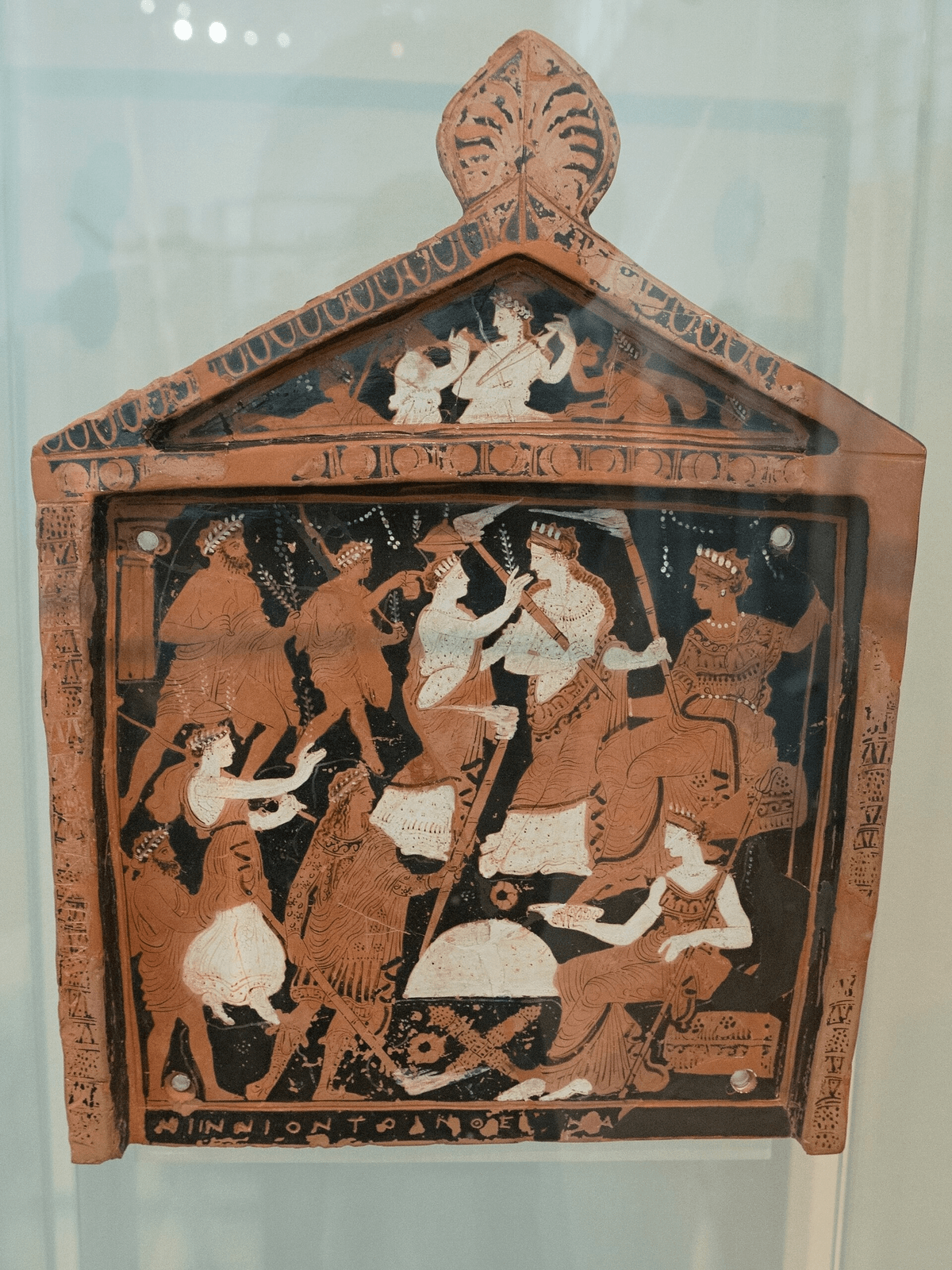
Those Who Had Seen
Sección titulada «Those Who Had Seen»Those Who Had Seen
Ancient authors repeatedly use an expression that deserves attention: the blessed are those who 'have seen'. In the closing lines of the Homeric Hymn to Demeter, a fortunate destiny is promised to mortals who have witnessed the sacred rites. Centuries later, Sophocles insists, in verses preserved only as a fragment, that those who have seen them are blessed when they descend to Hades. For them alone, he declares, there is life in that realm; for the others, only agony.
Pindar, too, considers blessed the person who has seen the Mysteries before dying. According to his verses, one who has witnessed those rites knows the end of life and its beginning, granted by the gods. The fragment does not explain what that knowledge consisted of, nor does it allow us to conclude that initiates were taught a complete doctrine of existence after death. Yet it once again underlines the extraordinary importance of the act of seeing.
Aristophanes offers a different perspective. In The Frogs, Dionysus descends into the realm of the dead and encounters a chorus of initiates singing and dancing in meadows filled with light. It is a comedy, not an account of the secret ceremonies at Eleusis. Yet its audience could recognise in that joyful existence beneath the earth a vision very different from the shadowy world of souls described by Homer. The realm of the dead did not necessarily hold the same fate for everyone.
Isocrates attributes two great gifts to Demeter: the fruits of the earth, which made a more civilised existence possible, and the sacred rites, which inspired sweeter hopes concerning the end of life and eternity. Cicero, writing centuries later, likewise praises the Mysteries for teaching people to live more happily and to face death with greater hope.
Neither author reveals what took place during the ceremonies. Both, however, testify to the hopes and benefits associated with them.
What Could Not Be Told
Sección titulada «What Could Not Be Told»What Could Not Be Told
The secrecy surrounding the Mysteries did not prevent some ancient writers from claiming to reveal details of their ceremonies. Authors of the Roman Imperial period, particularly Christian writers hostile to traditional cults, preserved accounts of practices they presented as secret.
Clement of Alexandria recorded a ritual formula mentioning fasting, the drinking of kykeon and the handling of objects transferred between a chest and a basket. Hippolytus, likewise writing from a polemical standpoint, described an ear of grain cut and displayed in silence, together with a proclamation announcing a divine birth. These testimonies are late, and the precise relationship of the practices they describe to the ceremonies at Eleusis remains disputed.
It would be tempting to bring these accounts together and imagine what took place inside the sanctuary. But the surviving sources do not allow us to reconstruct a complete ceremony. They come from different periods and contexts, and some bring together religious traditions whose relationship with Eleusis cannot be established with certainty. They offer glimpses of possible ritual elements, but we do not know how those elements fitted together or what they meant to the initiates.
In this context, a thought attributed to Aristotle and preserved by Synesius is particularly suggestive. According to this testimony, initiation was not a matter of learning a lesson but of undergoing an experience and entering a particular state of mind. We cannot be certain that Aristotle was speaking specifically of Eleusis, and his words have reached us indirectly. Even so, they suggest a possibility worth considering: that the significance of the Mysteries lay less in knowledge that could be explained or repeated than in an experience that had to be lived.
A fragment preserved by Stobaeus and traditionally attributed to Plutarch offers another striking comparison. It likens the experience of dying to an initiation: first come bewilderment, fear and uncertainty; then light, open spaces and blessed visions. The attribution to Plutarch is not entirely secure, and the passage cannot be treated as a description of an actual Eleusinian ceremony.
Nevertheless, the comparison helps us understand why ancient writers could associate initiation with the passage from life into death, and why an experience whose details remained unspoken might inspire such powerful hopes.
Persephone and the Boundary Between Two Worlds
Sección titulada «Persephone and the Boundary Between Two Worlds»Persephone and the Boundary Between Two Worlds
Let us return to Persephone. At the beginning of the Homeric Hymn to Demeter, we find her gathering flowers; elsewhere in the ancient accounts, she appears as the formidable sovereign of the realm of the dead. We see her grieving in Hades' palace and rejoicing at the news that she will be reunited with her mother. But her return is not permanent. She must spend part of each year in the underworld, while for the rest she can return to the light.
Mortals did not normally share that privilege. For them, descending into the kingdom of Hades meant leaving the world of the living behind, usually forever. Persephone, by contrast, united two apparently incompatible realities: authority over the dead and a periodic return to the world above. What connection might that extraordinary position have had with the hope Demeter offered to the initiates?
We cannot claim that the Mysteries promised mortals a return to life like Persephone's. Nor do we know whether participants witnessed a representation of the abduction, the reunion or both. What we can say is that the story of the two goddesses and the rites at Eleusis placed death at the heart of an extraordinary hope: according to the Homeric Hymn, those who had been initiated would not share the same fate as those who had not.
Perhaps the most important question is not which objects remained hidden behind the sanctuary doors, but why so many men and women wished to pass through them. They knew that they would die. Nothing in the surviving testimonies assures us that the rites promised to free them from that condition. Yet they could look to Demeter, who had lost and recovered her daughter, and to Persephone, who moved between the realms of the living and the dead, with the hope that death did not hold the same fate for everyone.
The precise nature of that hope remains beyond our knowledge. But its importance to those who sought initiation is unmistakable.
Ancient Sources and Cautions in Reading Them
Sección titulada «Ancient Sources and Cautions in Reading Them»Ancient Sources and Cautions in Reading Them
Homeric Hymn to Demeter, lines 231–274 (Demophon) and 470–482 (the sacred rites and the fate of initiates).
Pindar, fragment 137 Snell–Maehler (preserved by Clement of Alexandria, Stromata 3.3.17), concerning those who have witnessed the sacred rites; fragment 133 (preserved by Plato, Meno 81b–c), concerning Persephone's power over certain souls.
Sophocles, fragment 837 Radt (preserved by Plutarch, Moralia, How the Young Man Should Study Poetry 21e–f), on the blessed fate of those who have witnessed the mysteries.
Aristophanes, The Frogs 316–459 (the chorus of initiates in the underworld).
Isocrates, Panegyricus 28–29; Cicero, De legibus 2.14.36 (the benefits and hopes associated with initiation).
Pausanias, Description of Greece 1.38.7 (his refusal to describe the sanctuary's restricted rites).
Clement of Alexandria, Protrepticus 2.21; Hippolytus, Refutatio omnium haeresium 5.8 (late and polemical testimony concerning ritual practices).
Aristotle, fragment 15 Rose, transmitted by Synesius, Dion 10 (initiation as an experience rather than simply the acquisition of knowledge; its precise context and application to Eleusis remain uncertain).
Plutarch, fragment 178 Sandbach, preserved by Stobaeus (traditional attribution disputed; a comparison between death and initiation, not a direct description of an Eleusinian ceremony).
Andocides, On the Mysteries (historical evidence concerning accusations of profanation and the protection of the Mysteries' secrecy).